
A low win rate means you are winning a small share of the deals you chase, and it nearly always comes from one of two places: the wrong prospects entering your pipeline, or a sales conversation that fails to convert the right ones. Which of the two it is decides the fix. Most owners and sales leaders guess, change the pitch, and wonder why nothing moves. If you want to settle it with evidence, and have the gap closed with you rather than left as a report, our sales training and coaching packages are built for exactly that.
This guide is for UK business owners, sales leaders, SaaS founders and solo consultants who sell to other businesses. It covers sales win rate only, not win rates in trading or gaming.
TL;DR
- Win rate is deals won divided by deals closed (won plus lost) in a fixed period. Pick one definition and never switch.
- Many B2B teams sit somewhere between 15% and 30%, so “low” depends on your lead source, deal size and sales cycle, not on a magic number.
- A low figure is a diagnostic signal. Check lead fit first, then each pipeline stage, then your response speed and your conversations.
- Tightening qualification and answering enquiries faster are the two changes most often linked to better win rates.
- Fix one thing a month, measure it on a fixed cohort, and keep deal value protected while you do.
Table of Contents
- How to calculate your win rate properly
- What counts as a low win rate for a UK B2B business
- Why win rates are low: the two causes to separate first
- How to find where you are losing deals
- The fixes that move the number
- A worked example
- When the problem is bigger than a tweak
- Our perspective
- Getting help closing the gap
- FAQ
- Sources
How to calculate your win rate properly
The formula is simple. Take the deals you won, divide by the deals you won plus the deals you lost, and multiply by 100. Zendesk’s UK guide gives the example of 20 wins and 30 losses, which is 20 out of 50 closed deals, or 40%.
The trouble starts with what you count. Salesforce defines win rate as the share of qualified opportunities that become closed-won in a period, and its example of 50 wins from 200 qualified opportunities gives 25% for the quarter. Use all raw leads as your denominator and the number drops sharply, even though nothing about your selling has changed.
Three choices matter:
- The denominator. Won divided by closed is the usual, stable measure. Won divided by created (every opportunity opened in the period) runs lower and tells you more about lead quality. Metabase makes the point that what breaks reporting is switching between the two, or leaving it vague.
- How you treat “no decision”. Some teams count only deals where the buyer chose a supplier. Others count deals that simply went quiet as losses. In the UK, where buyers often prefer doing nothing to risking a mistake, this choice can move your number by several points.
- The period. Use a single month or quarter and keep it consistent, so a one-off event (a funding round closing for your buyers, a regulation change) does not get mistaken for a sales problem.
Write the definition down once and put it at the top of your dashboard. Every conversation about the number after that starts from the same place.
What counts as a low win rate for a UK B2B business
There is no single good number. The published benchmarks vary widely because they measure different things.
| Measure | Reported figure | Source |
|---|---|---|
| Win rate across all pipeline stages | 15% to 25% | Outreach |
| Win rate on qualified opportunities | Around 29% | Outreach |
| New business, UK and US tech companies | 18% average | Ebsta 2025 benchmarks, as reported by Proposal.biz |
| Expansion deals with existing customers | 45% average | Ebsta 2025 benchmarks, as reported by Proposal.biz |
| Proposal close rate, all industries | 20% average | Proposify, as reported by Proposal.biz |
Two things stand out. First, new business is far harder than selling more to existing customers: Ebsta’s data shows 18% against 45%, and expansion deals closed in 52 days against 91. If you blend the two, your headline number tells you very little. Second, sector shifts the picture. Outreach reports professional services at 28% with a 51-day cycle, while real estate and construction sit at 16% with a 147-day cycle.
As a rough reading, Revenue Grid treats 20% to 40% as average for most B2B organisations and anything under 20% as a sign of problems in lead qualification, sales training or how clearly the value is put across. Treat that as a prompt to look, not a grade. A company selling six-figure deals into large organisations over nine months can be healthy at 15%. A solo consultant selling a £3,000 engagement after a warm referral should expect much more.
The benchmark that matters most is your own, split by lead source and measured quarter on quarter.
Why win rates are low: the two causes to separate first
Zendesk’s guidance is that a low win rate points either to a sales team that is underperforming or to targeting prospects who were never a good fit. The number cannot tell you which. You have to look at the deals.
Here is how the two look in practice.
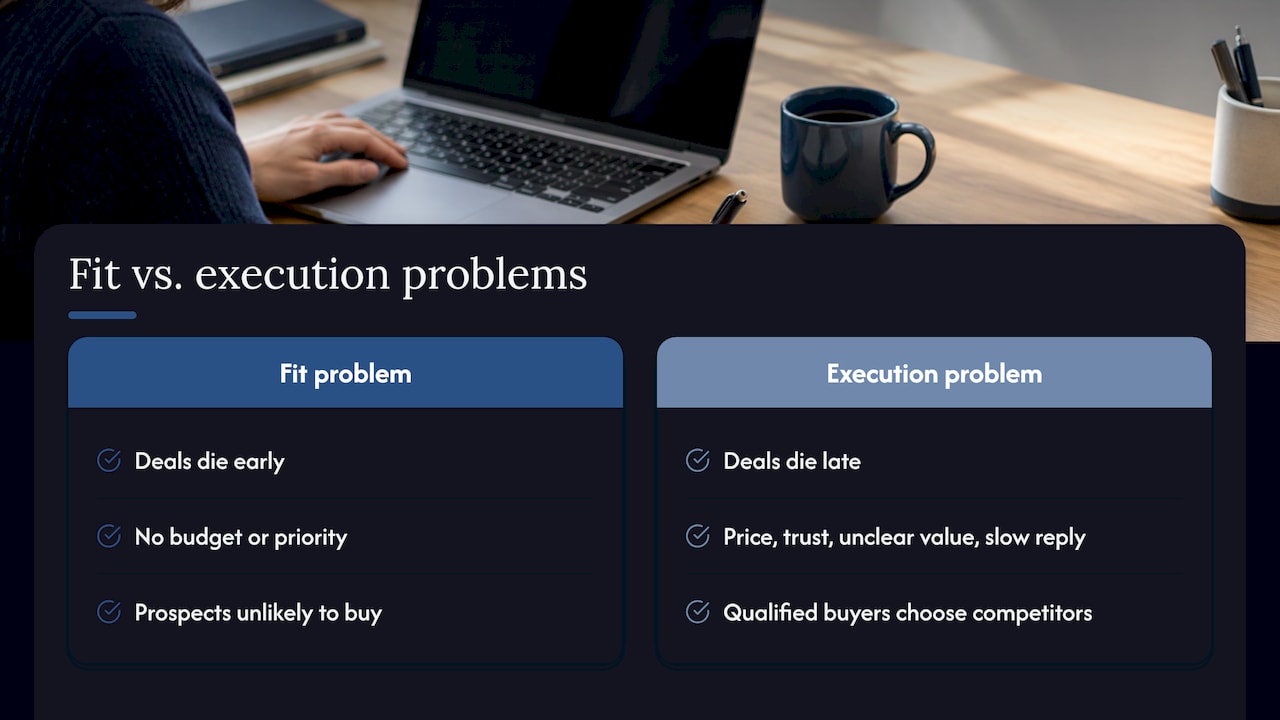
A fit problem shows up as deals dying early. Prospects take a first call, say it sounds interesting, then vanish. Or they ask for a proposal and never answer. The reasons for loss are “no budget”, “not a priority” or “we’re looking at other things”. The salespeople are not failing. They are talking to people who were never going to buy.
An execution problem shows up late. Qualified buyers with budget and a real problem get to the proposal stage, then choose a competitor or the status quo. The reasons for loss are about price, trust, unclear value or a slow reply.
Most businesses have some of each. A founder-led company often has a fit problem because the founder says yes to every enquiry. A growing team often has an execution problem because new reps were never taught a consistent way to run discovery.
How to find where you are losing deals
Here is the routine I would run on any pipeline with a weak win rate. It needs a spreadsheet and an afternoon, not new software.
Step 1: Pull the last 30 to 50 closed deals
Include wins and losses, and record lead source (inbound, outbound, referral), deal size, who the contact was, and the last stage reached. Fewer than 30 deals and you are reading noise.
Step 2: Split by lead source
Inbound enquiries and outbound prospecting behave differently. Mixing them hides whether outbound is working at all. If referrals win at 50% and cold outreach at 8%, your sales team is not uniformly poor. You have one channel to fix and one to protect.
Step 3: Find the stage where deals leave
Map the share of deals that move from each pipeline stage to the next. The stage with the steepest drop is where to focus. Our guide to sales pipeline stages explains how to define them so the data means something. Forecastio’s analysis reports that optimising conversion stage by stage lifts win rates by around 15% within 90 days, though your own results will depend on where your biggest leak sits.
Step 4: Read the reasons for loss, then check them
Loss reasons logged in a CRM are usually generic. “Price” often means “I did not see enough value”. The most reliable evidence comes from talking to the buyers who said no, and to the ones who said yes. A structured win-loss analysis lets you ship one change a month rather than rewriting your whole approach in a panic.
Step 5: Compare against your own history
Has it always been this low, or did it drop? A sudden drop after a new hire, a new product or a market shift is a different problem from a long-standing flat line.
The fixes that move the number
Once you know where the leak is, the changes are fairly consistent.
Tighten who you pursue
If the problem is fit, write down the profile of your last ten best customers: size, sector, trigger event, who signed. Then qualify against it before a proposal is written. Forecastio reports that deals meeting clear qualification criteria are two to three times more likely to close, and that companies tightening qualification typically see win rates rise 20% to 40%. Your win rate may fall on a per-lead basis for a week as you turn down poor fits, then rise because you are spending time where it counts. Fewer proposals, more wins, same or better revenue.
Reply faster
Speed is the cheapest improvement on this list. AireStream reports that UK professional services firms average 47 hours to first response, and cites an analysis finding 78% of B2B deals go to the first company to respond (AireStream). A UK manufacturing benchmark from Ell Advisory links a two-hour response to a 50% higher win rate than a 24-hour one. Whatever your sector, set a same-day reply as the rule and measure it.
Sell to the problem, not the product
When qualified buyers still choose a rival or do nothing, the conversation is usually at fault. They have not been shown the cost of leaving the problem alone, or they have heard a feature list rather than their own situation described back to them. Our guides on consultative selling techniques and consultative selling step by step show how to run discovery so the buyer states the problem, the stakes and the budget themselves.
Stop the proposal being the first real conversation
A request to “send me a proposal” is often a polite way of ending the call. If you send one cold, you will usually lose. Handling that request properly is one of the quickest ways to lift late-stage losses, and we cover it in handling the “send me a proposal” objection.
Shorten the cycle
Outreach reports that opportunities closing within 50 days win at 47%, against 20% or lower beyond 50 days. Part of that is simply that stalled deals are weak deals. Agree next steps with dates in every call, and put time limits on proposals that are genuinely sensible, not artificial.
A worked example
Imagine a UK software services company with 60 staff that closed 18 of 90 deals last quarter. That is 20%, which looks average. Split by source, the picture changes:
| Source | Closed deals | Won | Win rate |
|---|---|---|---|
| Referrals | 20 | 10 | 50% |
| Inbound enquiries | 30 | 7 | 23% |
| Outbound | 40 | 1 | 2.5% |
The average hid everything. Outbound is wasting a large share of the team’s time, and inbound is being answered slowly. The sensible fix is not new sales scripts across the board. It is a tighter outbound target list, a same-day reply rule for inbound, and a conversation review on the 16 lost inbound deals. Within a quarter you would expect the blended number to move because the mix and the quality moved.
When the problem is bigger than a tweak
Some win-rate problems are structural. A founder who is the only person who can close. A new team that has never had a consistent method. A solo consultant whose pipeline depends on two referral partners. A fast-growing SaaS business that has outgrown informal selling. In those cases, reading more benchmarks will not help. You need someone to tighten the process, coach the people doing the selling, and hold the numbers to account every week.
Our perspective
Whenever a business tells us its win rate is low, the first thing we do is stop it changing anything. The instinct is to rewrite the deck, cut the price or hire another rep. None of that works until you know whether the deals were wrong or the conversations were.
We built our approach around combining one-to-one coaching with traditional training and consultancy, because win rate is both a skills problem and a process problem. Training alone gives a team new language that fades in a month. Consultancy alone gives you a better pipeline that nobody knows how to work. Coaching the person on their own live deals, while fixing the qualification and stage definitions around them, is how a number like this actually shifts.
Our aim for the businesses we work with is at least 50% sales growth a year and quarterly targets met. We hold ourselves to that because a better win rate is only useful if it shows up as revenue.
Jerry
Getting help closing the gap
If you have run the diagnosis above and found a stubborn gap, we can work on it with you. Our team-based bespoke coaching and consultancy engagements run at £4,500 to £8,500 one-off, and our sales acceleration track for solo service businesses and consultants runs at £2,995 to £5,995 one-off. The Sage Collective is £990 per month.
If you need senior leadership more than training, we also provide a fractional sales director for B2B companies. For a full view of options and pricing, see our sales training cost page, or start from the Ahead of Sales home page.
FAQ
Is a 20% win rate bad?
Not necessarily. Several UK and US benchmarks put overall B2B win rates between 15% and 25%, and Revenue Grid treats 20% to 40% as average. A 20% rate on new business with long cycles can be healthy, while 20% on warm inbound leads would be weak. Compare like with like, by lead source and deal type.
What is the difference between win rate and close rate?
Win rate is usually measured against qualified opportunities or closed deals. Close rate, as Salesforce describes it, is measured against all initial leads or raw contacts, so it is always lower. Choose one, label it, and use it consistently.
How quickly can a win rate improve?
Quick fixes such as response speed and qualification can show up within a quarter. Forecastio reports about a 15% improvement from stage-by-stage optimisation within 90 days, though results vary by business. Skills changes take longer, because reps need to practise on live deals.
Should I lower my prices to win more deals?
Usually not as the first move. Check first whether buyers lost because of price or because they did not see the value. A tighter target market and a stronger discovery conversation protect your deal value, while discounting lowers it on every future sale.
Sources
- Zendesk UK: Sales win rate, how to calculate and improve it
- Salesforce: What is a win rate in sales?
- Metabase: Win rate definition, formula and tracking
- Outreach: How to calculate and improve sales win rates
- Proposal.biz: Sales win rate statistics and B2B benchmarks
- Revenue Grid: Win percentage calculator
- Forecastio: How to calculate win rate
- AireStream: Speed to lead for UK professional services
- Ell Advisory: UK manufacturing quoting benchmarks 2026