
You sell coaching packages by selling one named outcome to one type of buyer at a visible price, then using a short, structured conversation to find out whether the person in front of you is ready to buy it. Most coaches who struggle do not have a coaching problem. They have a package that sounds like “six sessions” and a sales call that feels like an apology.
This guide covers the whole chain: designing a package a buyer can picture, pricing it with UK figures, qualifying enquiries, closing without pressure, and what to do in the first weeks after someone says yes. It is written for coaches, consultants and service business owners who already deliver good work and want it to sell more reliably.
TL;DR
- A package sells when it names one buyer, one outcome, one timeframe and one price. “Six sessions” is a mechanism, not an offer.
- UK coaches publish prices from roughly £1,500 for three months of fortnightly 1:1 work to £5,400 for a year. Price against the cost of the problem you solve, not your hourly rate.
- Qualify before the call with three questions: what help, who is paying, and why now.
- Closing is a clear recommendation followed by a calm invitation. Say the price, then stop talking.
- If selling is the part you dislike, that is a skill you can be coached on, and our sales training for coaches is built around exactly that.
Table of Contents
- Why packages sell better than single sessions
- Design the package around one buyer and one costly problem
- Pricing: what UK coaches actually publish
- Get the right people in front of the package
- Qualify before you speak
- Run the sales conversation
- What to do once someone says yes
- Get help with the selling itself
- FAQ
- Sources
Why packages sell better than single sessions
A single session is a purchase of an hour. A package is a purchase of a result. The buyer of a package is deciding whether to commit to change, which is a bigger decision, but it is also the decision that gets you paid properly and lets you do your best work.
There is a second reason that matters to you as the seller. When you price by the hour, every conversation drifts towards “what does one session cost?” and the prospect compares you with the cheapest person they can find. When you price a defined programme, the conversation moves to “will this get me where I want to be?”, and that is a question you can answer.
A package is not four sessions with a nicer name. If the price is simply four times your hourly rate, you have changed the label and nothing else. The package has to include something the single session does not: a defined scope, a start and an end, support between sessions and a point at which you both review progress.
Design the package around one buyer and one costly problem
The most common mistake is a package for “professionals who want to grow”. Nobody feels that sentence is about them. A package that sells is aimed at someone with a specific, expensive problem, for example a newly promoted manager who needs a repeatable way to handle difficult one-to-one conversations.
Write the outcome in the words your buyer would use, and test it with three questions:
- Could the client tell whether it happened?
- Is it reachable within the timeframe of the programme?
- Does your work directly influence it?
“Business growth” fails all three. “A documented 90-day plan with a weekly review” passes. Do not frame the outcome as a guarantee. You can promise your process, your attention and your standards. You cannot promise what the client does with them.
The five things every package needs
When a package is hard to sell, one of these five is usually vague:
- Who it is for. One buyer, described precisely.
- The outcome. Observable, not emotional.
- The duration. Three months is the common starting point for new offers.
- The delivery structure. Number and length of sessions, format, what support sits between sessions.
- The price. One number, or a clear “from” price.
Name the package after the destination, not the delivery. “The First-Year Managers Programme” tells a buyer something. “12-session coaching bundle” does not.
What to include, and what to leave out
Beyond the sessions themselves, the extras that earn their place are the ones that support the outcome: a longer kick-off session to agree how success will be measured, a defined amount of support between calls, a mid-point review and a deliberate closing session. Add worksheets or a resource library only if the client will use them.
Resist the urge to stuff the package. Every extra is a promise you have to keep, and a crowded package creates delivery pressure that works against the quality of your coaching. Be especially careful with “unlimited” messaging. If you could not sustain it with ten clients at once, do not offer it. State what support looks like (for example, replies within one working day, Monday to Friday) and the offer becomes more credible, not less.
Pricing: what UK coaches actually publish
Price is not a number you find by looking at competitors, but real figures help you check you are in a sensible range. These are published prices from UK coaches, stated as they appear on their own pages.
One UK life and leadership coach sells three online programmes: three months at £1,500 (six fortnightly sessions), six months at £2,800 (twelve sessions) and a year at £5,400 (twenty-four sessions), with extra sessions at £250. Another UK coach prices single sessions at £85 for 45 minutes, £100 for 60 and £140 for 90, with packages starting at three sessions from £248 and running to eighteen sessions from £1,345.
At the executive end, a UK leadership coaching practice describes its engagements as typically six to twelve sessions over three to six months, at 60 to 90 minutes each with brief check-ins between sessions. Another UK executive coach sets out several structures: performance coaching of usually four to six sessions, line-management sessions over six weeks and transformational coaching agreed in blocks of six sessions with reviews along the way.
A 2026 rate table drawing on ICF and other market data puts UK executive coaching at £120 to £230 an hour for ICF ACC-level coaches, rising to £390 to £770 an hour for top-tier MCC and C-suite coaches. Treat these as a map of where your experience sits, not a ceiling.
Price against the cost of the problem
The range above is wide because the right price depends on what the problem costs the buyer. A vague result (“feel more confident”) supports a modest fee. A specific one (“win three speaking engagements and a promotion within six months”) supports a much higher one, because the buyer can see the return.
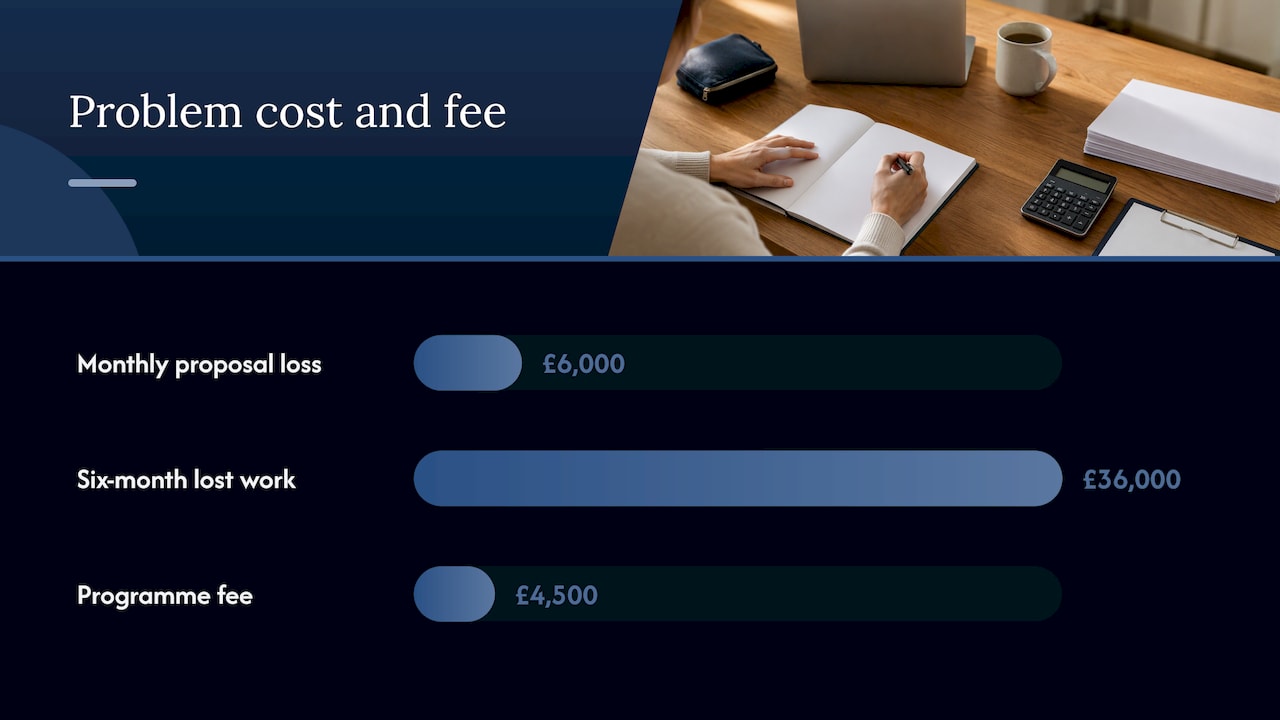
A worked example. You coach founders of service businesses on winning larger clients. Your buyer is losing roughly one proposal a month worth £6,000 because they discount too early. Over six months that is £36,000 of work that went elsewhere or was discounted away. A £4,500 programme that fixes the pricing conversation is a sensible purchase against that, and you can say so without hype, because you have done the arithmetic with them on the call.
If your work varies too much for a single figure, publish a “from” price or a range. A visible price also does some of your qualifying for you: the person who books after reading it has already accepted the fee, so the conversation is about fit.
Build a ladder, not a single offer
A simple three-rung ladder works for many UK coaches:
| Rung | What it is | Purpose |
|---|---|---|
| Entry | A paid, fixed-price diagnostic or single session | Shows how you work, filters out browsers |
| Core | A three- to six-month programme priced as one number | The offer you most want to sell |
| Premium | Longer engagement or closer access | For clients who want more depth |
Name each rung by the outcome it delivers. Someone who pays for an entry session usually arrives better prepared than someone who booked a free call, and some will move straight up to the core programme.
Get the right people in front of the package
A good package at the right price still fails if nobody who needs it knows you exist. Your prospects need to see that you understand their problem and hear you describe it in the language they use themselves. That comes before any price conversation.
For most solo coaches and consultants, the fastest early source is people who already know and trust you: past clients, former colleagues, referrers. The next is rooms where your buyers gather. In-person business owner networking events put you in front of founders and owners who can decide on the spot, which is the type of buyer a £3,000 to £6,000 package needs.
Whichever channel you use, send every enquiry down a path that fits what they want. One generic “book a call” button for three different services means you spend half your calls on people who needed something else.
Qualify before you speak
A discovery call is expensive for both sides. Three questions on the booking form save most of the wasted ones:
- What do you want help with? A short list of your services, so the enquiry routes itself.
- Who is this for, and who is paying? An individual paying personally and an employer sponsoring a manager are different sales, with different budgets and decision-makers.
- What made you get in touch now? This is the best predictor of readiness. Someone with a specific trigger, such as a lost client, a new role or a missed target, is a buyer. Someone browsing is not yet.
If you work with businesses, add one more: who else needs to agree? A founder will say yes alone. A head of department usually will not.
For the paid-for tiers, you also need a view on budget before you spend an hour on someone. It is not rude to say your programmes start at a stated figure. It is respectful of their time.
Run the sales conversation
The call has four parts, and the order matters.
1. Diagnose. Spend most of the time asking, not pitching. What is happening now, what have they tried, what is it costing them, and what would good look like in six months? Let them say the cost out loud. When the buyer states the price of the problem, your fee looks different.
2. Recommend. Name the package that fits and explain why in two or three sentences, using their words. “You told me the problem is discounting under pressure and you want to hold your price on the next five proposals. The three-month programme is built for that.” Recommend one option. Three options invite comparison and a decision to “think about it”.
3. State the price plainly. Say the figure, what it includes and how payment works. Then stop talking. The silence feels long to you and ordinary to them. Hesitation at this point is often caused by vague delivery, so be specific about sessions, support and timeline.
4. Invite, calmly. “Would you like to start in the first week of next month?” is an invitation. If the answer is no or not yet, ask what would need to be true for it to be a yes. Sometimes the answer is a payment plan. Sometimes it is a second conversation with a partner or finance director. Sometimes it is a genuine no, and a clean no is worth having.
Patience matters here. Many buyers of higher-priced coaching decide over days, not minutes. Agree a specific follow-up date before you end the call and keep it.
Where coaches lose sales
The usual failure points are the same ones I see repeatedly in solo practices:
- Discounting before anyone has objected.
- Explaining the method for twenty minutes instead of diagnosing the problem.
- Taking “I need to think about it” as the end rather than the start of a conversation.
- Offering free extra sessions to close, which teaches the buyer your price is negotiable.
- Not asking for the decision at all.
All of these are habits, and habits change with practice and feedback on real calls, not with another template.
What to do once someone says yes
Selling does not stop at payment. The package you deliver is the one your referrals are based on.
Send a short intake questionnaire with the booking: what they want from the work, what they have tried, what success looks like in six months. Session one then starts at depth. Put the terms in writing: number and length of sessions, booking window, rescheduling, what happens to unused sessions, how contact between sessions works and how either side can end early. The ICF Code of Ethics stresses clear agreements about roles, responsibilities and financial arrangements, and a written agreement is how you meet that.
Hold a review at the halfway point to check the goal still holds, and close with a deliberate final session that records what changed. Treat your first version of any package as a hypothesis. The package you sell in year two should be better than the one you sold in month one, because you will have learned which parts clients valued and which they ignored.
What we have learned about selling a coaching offer
We work with business owners, sales leaders and solo consultants, and the pattern is consistent: the coaches who sell well are not the most persuasive, they are the most specific. They can say who they help, what changes and what it costs, without flinching.
That is why we combine 1:1 coaching with consultancy rather than one or the other. Coaching builds the confidence and the habits on a real call. Consultancy fixes the offer, the pricing and the process around it. Do only the first and you have a more confident person selling a vague package. Do only the second and you have a clear package nobody is comfortable pitching.
If you take one thing from this guide, make it this: write your outcome sentence, put a price against the cost of the problem, and then rehearse the price conversation out loud until it is dull. Dull is good. Calm is what buyers read as competence.
Jerry
Get help with the selling itself
If you are a solo coach, consultant or service business owner and your delivery is stronger than your sales, our sales acceleration track for solo service businesses and consultants is a one-off package priced from £2,995 to £5,995. It combines 1:1 coaching with practical consultancy on your offer and your sales conversations, and you can see how it is structured on our sales training cost page.
If you would rather work with a monthly option, The Sage Collective is £990 per month and sits on our main site. For a coach-specific view of how we approach this, start with our guide to sales training for coaches. If you are weighing up different formats, our comparison of pricing coaching packages by cost per outcome shows how to judge what you are buying.
FAQ
How much should I charge for a coaching package in the UK?
Published UK prices run from around £1,500 for three months of fortnightly 1:1 sessions to £5,400 for a year, with executive work priced higher. Work out what the problem costs your buyer and price well below that. Your experience and the specificity of your outcome move the number more than the session count.
How do I qualify coaching clients before a call?
Add three questions to your booking form: what they want help with, who is paying, and what made them get in touch now. The last one tells you most about readiness. If you serve businesses, ask who else must agree to the decision.
How do I close coaching clients without sounding pushy?
Diagnose first, recommend one package, state the price clearly and then ask whether they would like to start on a specific date. A clear recommendation is service, not pressure. If they say not yet, agree a follow-up date before you finish.
Should I sell single sessions as well as packages?
A paid, fixed-price introductory session can work as the entry rung of a ladder, because it shows how you work and filters out browsers. Keep your main focus on the core programme, and name it by outcome so buyers compare results rather than hours.
Sources
- UK life and leadership coach: three-month, six-month and annual programme prices
- UK coach: single session and package prices
- UK leadership coaching practice: package structures
- UK executive coach: coaching package formats
- 2026 UK executive coaching rate table