
You stop discounting by treating every price request as a signal about the deal, not a request for money off. Work out why the request came, decide in advance what you will trade for any concession, and only then talk about the number. Done properly, you protect margin and keep the deal. Most businesses that discount routinely have a process, proof and incentive problem, not a price problem, and that is fixable.
If you run a £2m+ company, lead a sales team, or sell your own services as a consultant or coach, this is written for you. I’ll keep it practical and use real arithmetic, because the numbers are what usually convince people.
TL;DR
- A discount comes straight off profit. On a 30% margin, a 10% discount needs about 50% more volume just to stand still, according to Oliver Wyman’s analysis.
- Routine discounting is usually a symptom: weak value conversations, fear of losing the deal, or commission that rewards volume over margin.
- Diagnose before you fix. Look at when, who, which segment and what you got back for every concession.
- Set a floor, build a list of non-price value, and trade every concession for something: a bigger scope, a faster decision, earlier payment.
- Raising list prices does not work on its own if the discounting habit stays.
Table of Contents
- What discounting really costs you
- Why good salespeople discount anyway
- Find the real cause before you change anything
- How to answer a price objection without reaching for the discount
- Build your margin line before the next live deal
- What sales leaders and owners can change
- Where we can help
- Our perspective
- FAQ
- Sources
What discounting really costs you
A discount is not a small gesture. It is a cut in profit, and it is felt much harder than the percentage suggests. AlixPartners makes the point that a discount should be seen as a markdown on profit, not a knock-down on the list price. In the same January 2024 piece, they report that a 5% discount off the full sales price can reduce profits by 50%, and that in software, regular, promotional and discretionary discounts can swallow 20 to 30% of gross revenue.
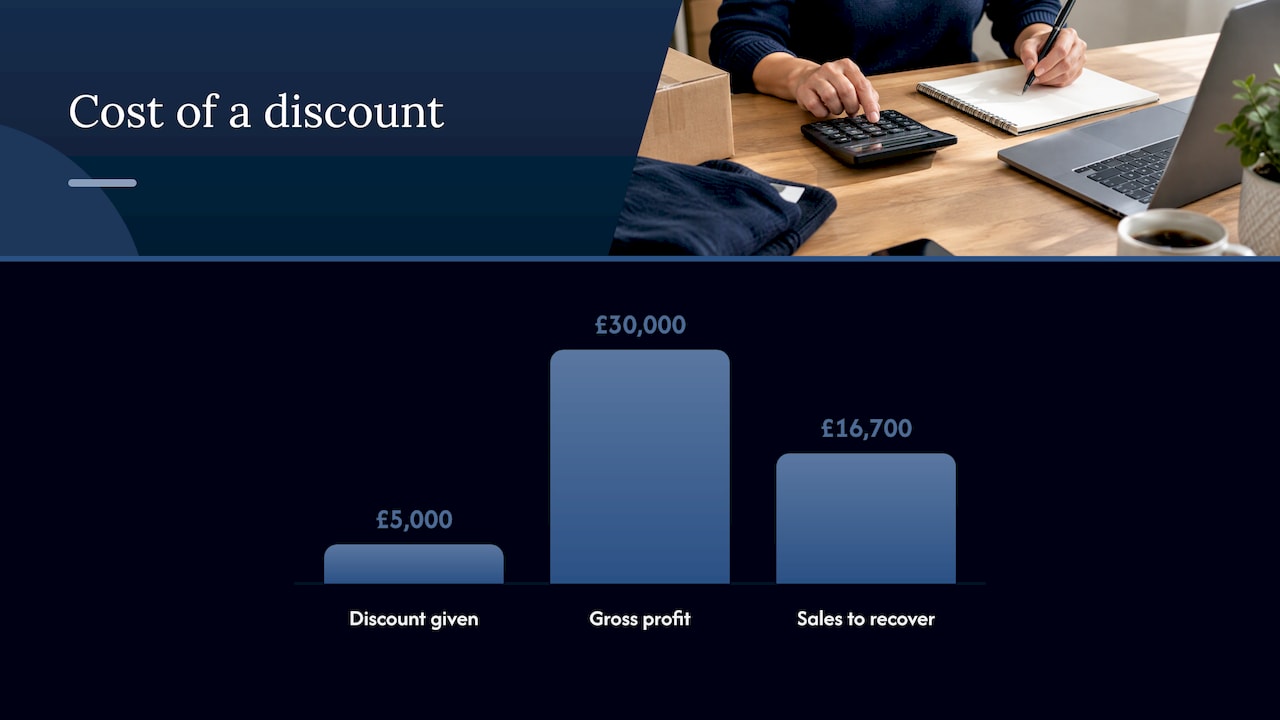
Here is a worked example you can rerun with your own numbers. Say you sell a £100,000 package at a 30% gross margin. That is £30,000 of gross profit. A 5% discount gives away £5,000, which is one sixth of the profit. To earn that £5,000 back at the same margin, you need to sell about £16,700 of additional work. For a service business with a fixed number of delivery hours, that extra volume often simply doesn’t exist.
The asymmetry runs the other way too. Oliver Wyman shows that on a product with a 30% margin, a 10% discount needs a 50% rise in demand to break even, whereas a 10% price increase can lose a quarter of demand before it hurts. In other words, defending your price is far cheaper than recovering from a discount.
The damage to future deals
The cost is not only on the deal in front of you. When customers see reduced prices regularly, lower prices become the expected price, and you end up offering deeper discounts to get the same effect. NetSuite also lists the signs that you are already there: margins falling below your own history, buyers delaying purchases to wait for a deal, conversations that centre on price rather than benefits, and a brand that starts to feel cheap rather than good.
If two or three of those sound familiar, the habit has already started to shape how your market sees you.
Why good salespeople discount anyway
I have sat on both sides of this, as the salesperson with a quarter to close and as the person coaching someone through it. Discounting rarely comes from laziness. It comes from a few predictable pressures.
Fear of losing the deal. The rep hears “it’s a bit expensive” and assumes the deal is slipping. A concession feels like the safe move.
No value story. If the buyer has never put a number on the cost of the problem, price is the only thing left to compare.
Commission logic. SaaStr’s Jason Lemkin describes the pattern clearly: reps quote at list for maximum commission, then discount heavily at month or quarter end to hit quota, and use discounts to shorten sales cycles. It is rational for the individual and expensive for the business.
No guardrails. When nobody has decided where the floor is, every negotiation is improvised. Baringa’s 2025 survey of private equity-backed B2B SaaS firms found that a lack of pricing governance produces net price variation of 30 to 50%, with sales teams given freedom that favours volume over profit.
If you are a solo consultant or coach, the same pressures apply in a personal form. There is no commission plan, but there is a monthly income target, and a quiet month makes a 15% “friends’ rate” look very attractive.
Find the real cause before you change anything
The most common mistake I see is jumping straight to a policy: a cap, an approval chain, a lower list price. Those treat the symptom. First find out what is driving the discounts.
Rework’s analysis of discounting says three different root causes all show up in the CRM as “average discount too high” and need telling apart:
- Pricing or packaging misfit. Discounts cluster on one package or one customer segment.
- Value-selling failure. Discounts vary widely between reps selling the same package, and appear late after a stalled negotiation.
- Process or incentive problems. Discounts rise in the last weeks of a quarter, or when a bonus accelerator is within reach.
The fix is different for each. Repackaging will not help a team that lacks a value conversation, and coaching will not help a team whose bonus plan pays for volume.
A simple discount log
For every discount request, granted or not, for the next 60 to 90 days, record:
- When it came up in the deal. A cluster at one stage points to a step being skipped earlier.
- Who it came up with. If the same reps keep appearing, that is a coaching conversation.
- Which segment. If one type of customer always asks, question the fit or the pricing.
- What was really being asked. Often it is budget approval, a need for ammunition for a boss, or reassurance on risk.
- What you got back. If the answer is nothing, it was a concession, not a trade.
This log follows the approach Revenue Journal sets out for treating a discount request as diagnostic information. A month of honest entries usually tells you more than a year of gut feel.
How to answer a price objection without reaching for the discount
When a buyer says “that’s more than we expected”, the number is rarely the whole message. Here is the routine I teach, step by step, with where it tends to go wrong.
1. Pause and ask what sits behind it
Don’t answer the number. Ask: “More than you expected, or more than you’d budgeted?” or “Compared with what?” The first step goes wrong when the salesperson fills the silence with a concession. Waiting three seconds feels like a minute. Do it anyway.
2. Reconnect the price to the problem
Go back to what the problem costs the buyer, in their own numbers. If you never got a figure earlier in the process, this is where the weakness shows. A buyer who has said “we lose roughly £8,000 a month to this” hears a £24,000 fee very differently from one who has only said “it’s a pain”.
3. Check who you are really talking to
A vague “is there anything you can do on price?” with no number and no reason often comes from a sponsor who needs something to take to an internal approver. Ask what the approver cares about, and give your sponsor a business case, not a lower price.
4. Offer options, not a cut
Teamwork.com suggests three strategic options instead of one fixed price: the lowest matches the stated budget, the highest reflects a more strategic path, and the middle becomes the natural choice. The conversation moves from “how much does this cost?” to “how much value do we want to create?”. The common failure is making the low option so thin that it looks like an insult. Make it a real, smaller scope.
5. If you move, trade
Never give a concession for free. Ask for something in return: a longer term, a bigger package, a faster signature, upfront payment, a case study. If the buyer will not trade anything, you have learned the request was about budget, not value, and you can go back to step 3.
We go through each of these scenarios in more depth in our guide to price objection responses that diagnose the root cause, and our piece on sales negotiation tips that protect margin covers the closing conversation.
Build your margin line before the next live deal
The worst time to decide your limits is in the middle of a negotiation. Write them down beforehand on a single sheet with three columns.
The floor. A real number worked out from your real margin, below which you do not go. For a team, this is the figure finance and sales agree together. For a solo consultant, it is the day rate or project fee below which the work costs you more than it earns once your time and overheads are counted.
The ladder. Everything of genuine value you can add that is not a price cut. For a service business that might be an extra review session, faster turnaround, a named point of contact, a short training session for the buyer’s team, or a follow-up check at 90 days. The longer this list, the less often you will reach for the discount. An empty ladder is the biggest reason people cut price: they have nothing else to offer.
The trades. What you ask for in return for any step down the ladder or toward the floor: bigger scope, a second project, quicker decision, earlier payment terms, a referral.
The rule is simple: nothing leaves your side of the table for free. This framework follows the “Margin Line” idea from UK writer Scott Leeder’s Sales Win Report, which I have found works as well for a three-person consultancy as for a larger team.
When a discount is still fine
I am not saying never discount. A concession is justified when it is a trade, a give for a get: a two-year commitment for a lower monthly fee, or a 10% reduction for paying annually upfront. Every other discount should be treated as a defect report: something to measure and understand, not just approve.
What sales leaders and owners can change
If you manage a team, the individual rep’s skills are only half of it. Three changes make the biggest difference.
Pay for margin, not just volume. If commission is calculated on revenue alone, discounting is the rational choice at quarter end. Consider tying part of the payout to realised price against list.
Set tiered authority. A common structure is that small concessions need only a manager’s agreement, larger ones need a director, and anything below the floor is blocked until finance and sales leadership review it. Make exceptions time-limited so that a one-off concession does not quietly become the permanent price.
Fix the habit before the list price. Rework’s analysis argues that raising list into a leaky process mostly raises the starting point for the next negotiation. A price increase only holds once reps can defend it.
This is also where coaching earns its keep. A team that has rehearsed the objection, with their own real deals and their own buyers, defends price differently from one that has only been given a policy document.
A note for solo consultants and coaches
If you sell your own time, the same principles apply with less machinery. Write your floor and your ladder, quote with three options, and keep a simple log of every price conversation. If you find yourself discounting the same type of client repeatedly, the issue is probably who you are selling to, not what you charge. Our guide on how to sell consulting services without feeling pushy is a good next read.
Where we can help
At Aheadofsales we combine bespoke 1:1 coaching with team training and consultancy, so the conversation your people have with buyers, and the rules around it, get fixed together. Our team engagements run from £4,500 to £8,500 as a one-off, and our sales acceleration track for solo service businesses and consultants runs from £2,995 to £5,995 as a one-off. The Sage Collective is £990 per month. You can see how the packages work on our sales training cost page.
If you are a solo founder or consultant, the sales coaching programme is built around exactly this kind of work: pricing with confidence and holding it.
Our perspective
When a business tells us it has a discounting problem, it almost never has a price problem. It has a conversation problem. Somewhere before the proposal, the buyer was never helped to put a number on what the issue costs them, so by the time price arrives it is the only thing left to talk about.
That is why we pair 1:1 coaching with consultancy. Coaching changes how a salesperson behaves in the room: what they ask, how they handle silence, whether they can say a price and stay quiet. Consultancy changes what surrounds them: the packaging, the approval rules, the incentives. You need both, because a well-coached rep in a plan that pays for volume will still discount at quarter end.
Our own aim for clients is at least 50% sales growth a year and teams that hit target every quarter. Holding price is a large part of how that happens, because every pound you do not give away is a pound that does not have to be won back with extra volume.
Start with the log, write the floor, and practise the pause. It is not complicated, but it does take patience, and it is much easier with someone alongside you.
Jerry
FAQ
What does it mean to stop discounting?
It means no longer cutting your price by default when a buyer pushes back. You still negotiate, but any change in price is traded for something, such as scope, term or payment timing, and sits above a floor you set in advance.
Won’t I lose deals if I stop discounting?
You may lose some deals you should not have won, those with buyers who only ever wanted the lowest price. The arithmetic helps here: at a 30% margin, a 10% discount needs about 50% more volume to break even, so you can lose a fair number of marginal deals and still come out ahead.
How do I sell on value rather than price?
Get the buyer to put a number on the problem before you quote. Then link your fee to that number, and offer two or three options of different scope so the buyer chooses a level of outcome rather than haggling over a single figure.
Is raising my prices the answer?
Not on its own. If the team keeps discounting from the new list, you simply move the starting point. Fix the value conversation and the approval and incentive rules first, then raise prices with a team able to defend them.
Sources
- AlixPartners: The discount effect
- Oliver Wyman: How to recession-proof your pricing
- NetSuite: 6 signs of overdiscounting
- SaaStr: The confounding logic of discounting
- Baringa: B2B SaaS pricing and value
- Rework: Is discounting a sales problem or a pricing problem?
- Revenue Journal: Diagnosing B2B discounts
- Teamwork.com: How to protect margins without cutting prices
- Scott Leeder: Competing on value, not price