
Use BANT when your deals are small, quick and decided by one person. Use MEDDIC when the deal is large, slow and involves a buying committee. Most growing UK sales teams end up using both: BANT as a fast first filter, MEDDIC once an opportunity has earned real attention. The rest of this article shows you how to decide, with the deal-size and cycle-length markers that matter, and how to avoid the common ways each framework goes wrong.
I have coached sales teams through both, and the framework is rarely the problem. The problem is a team using a heavyweight tool on a lightweight deal, or the reverse.
TL;DR
- BANT (Budget, Authority, Need, Timing) is a short checklist for transactional deals with one buyer and a cycle of days or weeks.
- MEDDIC (Metrics, Economic Buyer, Decision criteria, Decision process, Identify pain, Champion) suits complex deals with several stakeholders and long cycles.
- Every BANT element has a MEDDIC equivalent, but MEDDIC is more specific and adds Decision criteria and a Champion.
- The two are complementary: qualify with BANT early, then run the deal with MEDDIC.
- Whichever you pick, it only works if reps use it live in conversations, not as a form filled in afterwards.
Table of Contents
- What BANT and MEDDIC actually stand for
- How the questions differ
- BANT in practice: more than four questions
- MEDDIC in practice: a living tool
- Which framework fits your deals
- Using both: a two-stage approach
- Is BANT still relevant, and is MEDDIC outdated?
- Our perspective
- Getting your team to apply it
- How we can help
- FAQ
- Sources
What BANT and MEDDIC actually stand for
BANT stands for Budget, Authority, Need and Timing. Some teams say Timeframe, and the meaning is the same. It originated at IBM, and IBM’s own template asks sellers to describe the customer’s Budget, Authority, Need and Timeframe.
MEDDIC stands for Metrics, Economic Buyer, Decision criteria, Decision process, Identify pain, and Champion. It was devised in the 1990s by Jack Napoli and Dick Dunkel while they worked at the software company PTC. A longer version, MEDDICC, adds Competition.
If you are asking who invented MEDDIC: those two sales professionals. If you are asking whether the name is MEDIC or MEDDIC: it is MEDDIC, with two Ds, one for Decision criteria and one for Decision process.
How the questions differ
The easiest way to see the gap is to look at what a rep asks in the room.
With BANT, you ask whether the prospect has a budget, whether your contact has decision-making power, whether they have identified a specific need, and whether they are ready to buy now. With MEDDIC, you ask about the quantifiable result they want, the final decision-maker, their evaluation criteria, their purchasing process, the problem and the consequences of not solving it, and who is advocating for you internally.
| Question | BANT | MEDDIC |
|---|---|---|
| Money | Is there a budget? | What measurable outcome justifies spend (Metrics)? Who controls the money (Economic Buyer)? |
| People | Does my contact have authority? | Who signs, who influences, who is on my side (Champion)? |
| Problem | Is there a need? | What is the pain, and what happens if it is not fixed (Identify pain)? |
| Timing | When will they buy? | What steps and approvals lie between here and a signature (Decision process)? |
| How they choose | Not covered | What criteria will they use to compare options (Decision criteria)? |
The Dialpad UK glossary describes MEDDIC’s elements in similar terms: Metrics are the measurable business outcome, the Economic Buyer holds financial authority, Decision criteria are the factors used to evaluate options, and a Champion is an influential internal advocate.
Notice what BANT leaves out. It never asks how the buyer will compare you with alternatives, and it treats Authority as a single name. Every BANT element has a MEDDIC equivalent, but MEDDIC makes them more specific and adds Decision criteria and Champion. Those two additions are where complex deals tend to be lost.
BANT in practice: more than four questions
Many people treat BANT as a conversational script. IBM’s template shows something stricter. The seller is expected to describe how budget has been or will be identified and approved, include a customer C-level or line-of-business executive as a contact (procurement and purchasing contacts are not accepted as executive decision makers), describe the business problem and list key decision milestones.
That is useful discipline. If your reps can write down the problem in the buyer’s words and name the next two decision milestones, they are using BANT well. If they only tick four boxes, they are not.
BANT’s strengths are speed and simplicity. It works well for transactional deals with a single decision-maker and a cycle measured in days or weeks, is fast to teach and gives a new SDR a workable script on day one.
Where BANT goes wrong
The same source notes that BANT assumes one buyer holds all four answers. In a deal with a buying committee, reps may disqualify prospects who simply have not brought finance into the conversation yet.
There is a second problem. Many modern purchases have no pre-existing budget, because the money is found if the case is good enough. A rigid reading of BANT can reject a good deal because nobody has allocated a budget line for a problem they have not yet named. Related to this, by the time a project is fully BANT qualified, the customer is often already far into their decision-making, which is a poor position for a seller who arrives late.
The practical fix: treat a missing budget as a question to explore, not a verdict. Ask what it would be worth to solve the problem, and who would need to be persuaded to release funds.
MEDDIC in practice: a living tool
MEDDIC asks a rep to understand the buyer’s world. Focusing on specific metrics and pain points helps reps learn about a prospect’s motivations beyond surface-level product interest. Understanding the decision process shows the steps, people and hurdles ahead, especially in longer cycles.
A short example. Say you sell a sales-productivity platform to a 300-person UK services firm. The sales director says they want to improve conversion. BANT would note a need and ask about budget. MEDDIC pushes further:
- Metrics: conversion from proposal to signed has sat at 18% and they want 25%, worth a stated amount in annual revenue.
- Economic Buyer: the managing director, who has not yet been in a call.
- Decision criteria: it must integrate with their CRM, and legal wants UK data hosting.
- Decision process: a pilot, then finance review, then a board sign-off.
- Identify pain: two missed quarters and a board asking questions.
- Champion: the sales director, who needs help building the internal case.
None of those answers appear in a four-letter checklist, and each one changes what you do next.
Keep it live, not a one-off
MEDDIC is not a checklist completed once; it is a living tool to revisit throughout the sales cycle. For deals lasting three months or more, qualification has to continue as stakeholders, budgets and competitors change. BANT’s snapshot approach cannot keep pace with that.
Where MEDDIC goes wrong
Its typical failure is enormous CRM fields that nobody fills in honestly. Experienced sellers may adapt to it quickly, while inexperienced teams may struggle. And on small, fast deals it costs more than it returns: if your average deal is £4,000 and closes in three weeks, documenting six fields plus decision criteria on every opportunity is poor value.
If your team is already stretched, keep the early stages light. Targeted prospecting support, such as targeted wholesale buyer identification and pipeline building, can take the first-pass screening burden off reps so the heavier fields are only completed for deals that deserve them.
Which framework fits your deals
The honest answer depends on four things: deal value, sales cycle, number of stakeholders and how formal the purchase is. Published guidance varies by author, so treat the figures below as markers rather than laws.
- One source puts BANT’s ideal deal size under £20,000 and MEDDIC’s at £20,000 and above. It also rates BANT as higher risk for false positives, and MEDDIC as lower risk because its rigour filters out weak deals.
- A US decision matrix suggests BANT for deals under $10K, closing in under 30 days with one stakeholder, and MEDDIC from around $50K with four or more stakeholders. Between those, it points to lighter alternatives such as GPCT or SPICED.
- Another guide says MEDDIC becomes necessary when a deal shows at least three signals: a ticket above 100k euros, a cycle above 90 days, five or more stakeholders, a formal purchase process, a validation committee or strong legal constraints. It adds that enterprise deals without an identified Champion have little chance of closing.
- On stakeholders, if deals involve five or more people, BANT’s single Authority criterion is inadequate: you need to understand the Economic Buyer, Champion, technical evaluators, end users and procurement gatekeepers.
A simple rule of thumb I give clients: count the people who can say no. If it is one, start with BANT. If it is three or more, or the purchase needs a formal process, use MEDDIC. If your deals sit awkwardly between the two, which is common in UK mid-market selling, use the hybrid below.
Using both: a two-stage approach
The frameworks are complementary rather than mutually exclusive. BANT can provide an initial go/no-go filter, while MEDDIC inspects and manages the opportunity in greater depth once it merits continued investment.
In practice, SDRs use BANT to qualify leads, then account executives apply MEDDIC across the full sales cycle. Here is how I would set that up:
- Stage one, first conversation: the SDR confirms a genuine problem, a plausible budget route (not necessarily an existing line), a person with influence and a rough timeframe. Ten minutes, no form-filling marathon.
- The handover: the AE receives the written problem in the buyer’s words and the names involved.
- Stage two, discovery onwards: the AE builds the MEDDIC picture. Metrics and the Economic Buyer come first, because they decide whether the deal is worth the time.
- Every pipeline review: the manager asks which MEDDIC element is weakest and what the next action is to fix it. This is where the framework earns its place.
If you want to map these checkpoints against your own pipeline, our guide to B2B sales pipeline stages shows where each question naturally sits, and the B2B sales cycle stages guide covers how the cycle itself unfolds.
Is BANT still relevant, and is MEDDIC outdated?
Neither is outdated, but both need a modern reading.
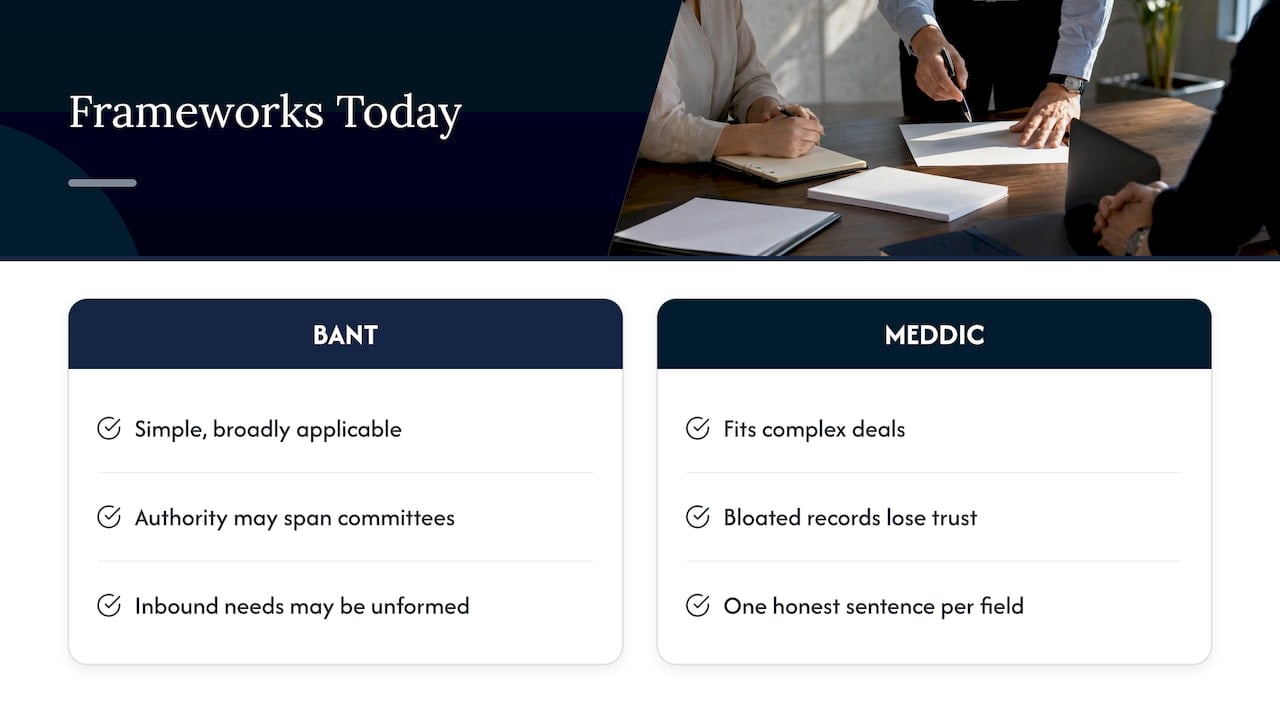
BANT’s staying power comes from simplicity. Using predetermined criteria to assess prospects was revolutionary when it began, and more prescriptive successors have made BANT seem almost fresh in how broadly it applies. Its weakness is that buying committees have grown, so Authority is rarely one person, and inbound prospects may not have formalised their need, so reps must help shape it.
MEDDIC is not outdated because complex deals have not become simpler. What ages it is the way teams run it: a bloated record that nobody believes. Keep each field to one honest sentence and it stays useful.
One caution about framework debates in general. Choosing between letters matters less than whether reps execute well live. A team that listens, asks the second question and follows the buyer’s logic will outperform a team with a perfect framework and a script. If you are comparing wider methodologies, our piece on Challenger, SPIN or a hybrid covers the selling approach that sits on top of qualification.
Our perspective
I have sat in a lot of pipeline reviews, and the pattern is consistent: teams do not fail because they picked the wrong acronym. They fail because the framework lives in the CRM and not in the conversation.
At Ahead of Sales, we combine bespoke 1:1 coaching with traditional training and consultancy for exactly this reason. Teaching a rep what MEDDIC stands for takes an afternoon. Helping them ask about the Economic Buyer without sounding like an interrogator, or to keep a deal alive when the budget is not yet allocated, takes practice with their own live deals.
That is why we work on your actual pipeline. We look at which deals are small enough for a light BANT-style screen, which need the full MEDDIC treatment, and where your team is confusing the two. Our aim is to help teams hit target every quarter, and clean qualification is the first place that shows up.
My advice: pick one framework per deal type, write down the rule, coach to it weekly, and review a handful of real calls each month.
Jerry
Getting your team to apply it
If you lead a team of 50 to 1,000 people, or run a growing service business, here is where I would start.
First, segment your deals. Pull the last 20 won and 20 lost opportunities and note value, cycle length and number of people involved. The pattern usually shows you where BANT is enough and where it missed something.
Second, decide the handover. Define exactly what an SDR must record before passing a lead on, and what an AE adds afterwards. Our overview of sales consultancy explains how we help teams build that process.
Third, coach on conversations. Role-play the awkward questions: who else needs to be involved, what happens if you do nothing, how will you compare options. Then listen to real calls and give feedback within the week.
Finally, inspect the deals that matter. For each large opportunity, the manager should be able to name the Champion and the Economic Buyer without opening the CRM.
How we can help
We design sales training and coaching around how your team actually sells, including qualification. Our team-based bespoke coaching and consultancy engagements run from £4,500 to £8,500 one-off, and our sales acceleration track for solo service businesses and consultants runs from £2,995 to £5,995 one-off. If you would like an experienced sales director without a full-time hire, our sales director retainer is £990 a month.
See how the packages fit your size and goals on our sales training cost page, or if you are a solo consultant, look at the solo sales accelerator.
FAQ
Who invented MEDDIC?
MEDDIC was devised in the 1990s by sales professionals Jack Napoli and Dick Dunkel while working at the software company PTC. It grew out of a period of rapid growth there. It has since been extended by others into MEDDICC and MEDDPICC.
What is BANT in lead qualification?
BANT is a four-part test: Budget, Authority, Need and Timing. A rep uses it to judge whether a lead can afford the product, has decision power, has a real problem and is ready to move. It originated at IBM and remains popular for fast, simple deals.
Is BANT still relevant?
Yes, for short-cycle deals with a single buyer. For committee purchases it needs a flexible reading, because Authority is shared and budget is often created during the sale. Many teams keep it as an early filter and add MEDDIC later.
Is MEDDIC outdated?
No. Complex, multi-stakeholder deals still need clarity on the measurable outcome, the decision process and an internal champion. It works best as a living tool revisited through the cycle, not a form completed once.
Sources
- BANT vs. MEDDIC: Comparing Sales Methodologies, Salesforce
- Budget Authority Need Timeframe (BANT) Criteria Template, IBM
- BANT vs. MEDDIC, Qwilr
- The MEDDIC Sales Process, Dialpad UK
- BANT vs MEDDIC: Which One Your Sales Team Actually Needs, Connectloop
- Sales Qualification Framework: BANT vs MEDDIC vs CHAMP, GTM Only
- Sales Qualification Frameworks Compared, Sales Blog UK
- A brief history of sales opportunity qualification, CustomerThink
- BANT Framework: Is It Still Relevant for B2B Sales, Uplift Sales
- Sales Process Qualification Frameworks, Rework
- GPCT vs BANT vs MEDDIC, Pitchbase
- BANT vs. MEDDIC: Which Should Your Team Use, Rattle
- BANT vs MEDDIC: Which Sales Qualification Wins, Prolifiq