
Introverts can sell very well, and the best introvert sales strategies don’t try to turn you into a backslapping extrovert. They give your natural strengths (listening, preparation, careful thinking) a repeatable structure: prepare properly, set a clear agenda, ask better questions, tell short customer stories, follow up with substance and practise in low-stakes ways. That is what I walk through below, with the call anxiety side covered in its own section.
I wrote this for business owners, solo consultants and sales leaders who sell for a living but recharge in quiet. If you’ve ever dreaded a cold call or come away from a networking event drained, you’re in good company.
TL;DR
- Selling effectiveness comes down to learned skills, not personality type, so you can build a process around how you naturally work.
- Prepare the opening and closing of every call, set an agenda, and let thoughtful questions do the heavy lifting instead of small talk.
- Manage call anxiety with a short pre-call routine, rehearsal and gradual exposure to harder calls.
- Follow up with something useful tied to the prospect’s problem, never a vague “just checking in”.
- Record yourself, drill objections and get feedback: deliberate practice beats willpower.
Table of Contents
- Why introverts have more to offer in sales than they think
- Strategy 1: Prepare like it’s your unfair advantage
- Strategy 2: Open with an agenda, not a performance
- Strategy 3: Let questions and listening do the selling
- Strategy 4: Tell short customer stories and handle objections gently
- Managing sales call anxiety
- Follow up and build relationships without small talk
- Networking events without the drain
- Practise in ways that suit you
- Perspective: why introverts often make our best clients
- Getting support to build your own sales process
- FAQ
- Sources
Why introverts have more to offer in sales than they think
The old stereotype says the best seller is the loudest person in the room. The evidence points elsewhere. Psychology Today argues that an outgoing personality isn’t required for effective selling, and that empathy, active listening, preparation and analytical thinking work well when they sit inside a clear, repeatable system. HubSpot makes the same point: effectiveness is a matter of learned skills, and active listening helps prospects feel heard.
It shows up in small, concrete ways. In HubSpot’s example of an introverted seller, prospects remarked on how well she remembered details of their software setup and business structure, and said the experience felt more personalised. That isn’t charisma. It’s attention, noted down and used.
Buyers also tend to arrive better informed than they used to, which suits a seller who prefers insight to performance. If your instinct is to understand the problem before you talk about the solution, you’re already close to what good consultative selling looks like. (If you want the full method, our step-by-step guide to consultative selling covers it.)
The catch is that strengths without structure stay private. Plenty of quiet sellers listen brilliantly, then fail to ask for the next step. The strategies below fix that.
Strategy 1: Prepare like it’s your unfair advantage
Preparation is where introverts usually beat their louder colleagues, because we’d rather think than improvise. Turn that into a routine.
Before every call, I’d suggest a one-page prep note covering:
- Who you’re speaking to, their role and whether they actually make or influence the decision.
- One specific thing about their business (a recent hire, a product launch, a problem visible on their website).
- Three questions you want answered by the end of the call.
- The single next step you will propose.
The decision-maker point matters. Psychology Today’s playbook specifically recommends making sure you’re speaking to the decision maker, which saves you from pouring energy into a conversation that can’t end in a yes.
If you want a deeper template, our sales call preparation guide sets out what to gather and how long to spend on it.
Warm up the cold call
If you dread unsolicited calls, ask first whether you need to make them. The Guardian’s small business network suggests considering whether cold calling is necessary at all. If it can’t be avoided, send a warm-up email or engage on social media first, then refer to that interaction in your opening line. The person is no longer a stranger, and neither are you.
Protect your energy
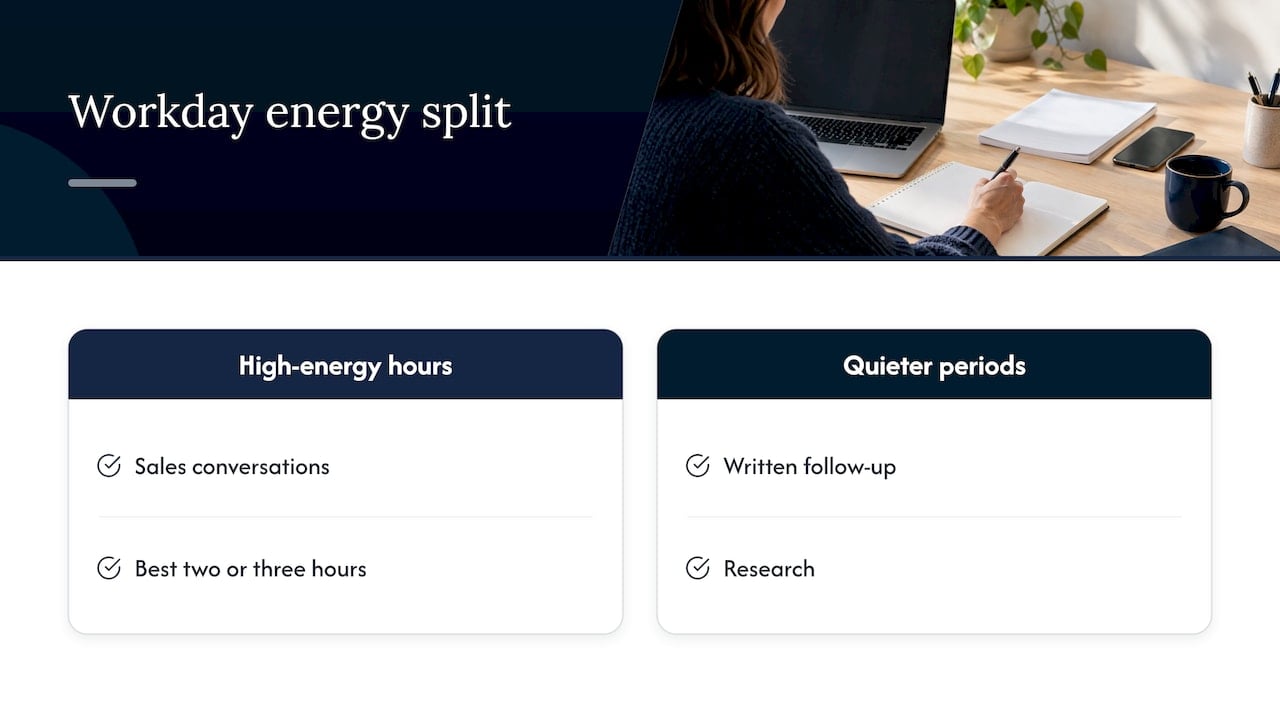
Progressive Recruitment’s UK guidance for introverted sellers recommends scheduling calls when your energy is highest and keeping quieter periods for written follow-up and research. It sounds obvious, but most diaries are built around other people’s preferences. Block your best two or three hours for conversations and put admin elsewhere.
Strategy 2: Open with an agenda, not a performance
Small talk is the part of a call many introverts like least, and you don’t need much of it. Psychology Today’s playbook says the first steps are to establish trust and set a clear agenda so the prospect knows where the conversation is going.
In practice, it sounds like this:
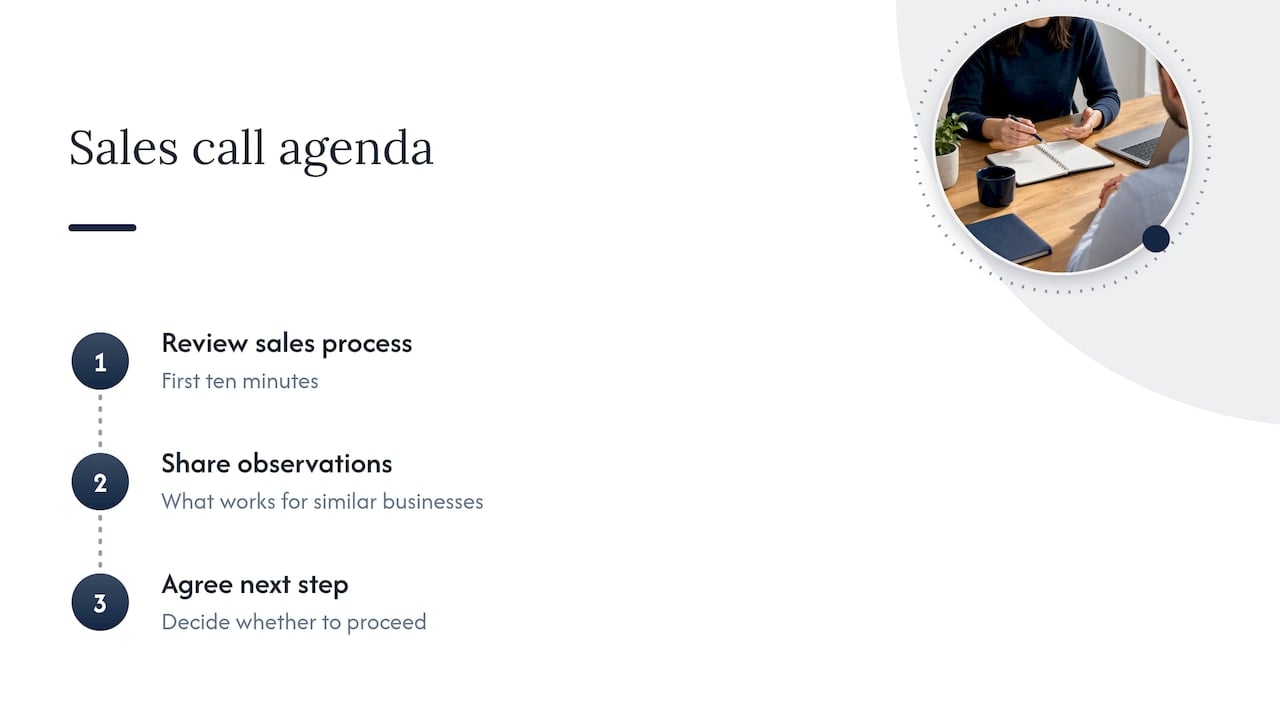
“Thanks for making time. I’d suggest we spend the first ten minutes on where you are with your sales process, then I’ll share what I’m seeing work for similar businesses, and we’ll agree whether a next step makes sense. Does that work for you?”
That’s confident, warm and brief. It also removes the uncertainty that fuels nerves, because you both know the shape of the next 30 minutes.
The Guardian’s advice on scripting is useful here: write down what you want to say and rehearse the opening and closing sentences, trusting the middle to take care of itself. You don’t need to memorise a whole call. You need a strong first minute and a clear last one.
For a fuller structure, see our sales call process guide and the 30-minute discovery call framework.
Strategy 3: Let questions and listening do the selling
This is the centre of introvert sales strategy. You’re not trying to out-talk anyone. You’re trying to find the problem worth solving.
Psychology Today recommends asking questions to uncover pain points. A good question sequence moves from situation to problem to consequence to outcome:
- “How are you currently handling new enquiries?”
- “What’s not working about that?”
- “What has that cost you in the last quarter?”
- “If this were fixed, what would be different?”
One personal-blog account describes a doctor-like model: ask genuine questions, listen carefully and reflect back, diagnose the core problem, then prescribe tailored help. I like the image because nobody trusts a doctor who prescribes before examining you.
Reflecting back is the quiet superpower. A sentence such as “So the real issue is that referrals have dried up and you have no outbound routine, is that right?” makes the prospect feel understood, and it gives you time to think. Progressive Recruitment notes that listening in this way helps you reflect the customer’s viewpoint and build a stronger value proposition.
Here is a scenario. A solo HR consultant tells you she’s “busy but not growing”. A loud pitch about packages would miss the point. A few considered questions reveal that 80% of her income comes from two clients, and that she’s afraid to quote higher day rates. Now you’re discussing her pricing confidence, which is the real sale.
Be honest about fit
Trust grows when you’re willing to say what the client doesn’t need. NI Business Info advises building trust through honest advice, including recommending a cheaper product when it genuinely meets the client’s needs rather than pushing the most expensive option. Introverts tend to be naturally good at this, because we dislike pressure tactics. Use that.
Strategy 4: Tell short customer stories and handle objections gently
When prospects are reluctant to open up or raise objections, Psychology Today’s playbook recommends using customer stories. It says to tell a customer story rather than pitching the solution, so buyers can compare you with the competition quickly, and that story-based answers to objections work because people don’t want to be told they’re wrong.
A simple three-part story:
- Who: a business similar to theirs, described without breaking confidence.
- What was going on: the problem, in the customer’s own words.
- What changed: the specific steps taken and what happened.
Try it on a common objection. When a prospect says “we’ve tried training before and it didn’t stick”, you can answer: “That’s what the sales director at one business I worked with said. What they’d really had was a one-day workshop with nothing afterwards. We changed it to short sessions and regular coaching, and the team started using the new questions within weeks.” Only tell stories you can truthfully stand behind, and keep the detail accurate.
Psychology Today also suggests a trial close rather than a direct ask for the sale. “Based on what we’ve covered, does this feel like the right direction?” is a far easier sentence for most introverts to say than “Shall we sign?”, and it surfaces objections early while they’re still cheap to handle.
Our article on consultative selling techniques goes further on how this fits into the whole buying conversation.
Managing sales call anxiety
Nerves before a call are normal and don’t mean you’re in the wrong job. What helps is having a routine, so you’re not relying on mood.
A five-minute routine before you dial
Sybill’s guide to sales call anxiety suggests a five-minute pre-call routine with three parts:
- Paced breathing: inhale for four seconds, exhale for six.
- Reframing: tell yourself that arousal is performance fuel and that you’re curious, not judged.
- A structured opener: know your first two sentences so there’s no uncertainty at the start.
The Guardian adds a simple physical tip: stand up and smile while you’re on the phone, which can add confidence and friendliness to your voice.
Over-prepare the lines, not the whole call
The Guardian also includes a practitioner, Sandra Lewis, who says over-preparing her lines and rehearsing until she knew them by heart helped her relax and overcome her shyness over time. Notice that the point is the lines you’ll definitely say: the opening, the transition into questions, the close. Everything in between should be driven by what the prospect says.
Build up gradually
Sybill also suggests combining quick regulation with progressive exposure over two weeks. Start with easier calls (existing contacts, warm replies), log how anxious you felt afterwards, and gradually add harder ones. Then do a short post-call review to spot triggers and improvements. Anxiety usually falls when the unknown shrinks, and a log makes your progress visible when your feelings tell you otherwise.
A sample week might look like this:
| Day | Call type | Aim |
|---|---|---|
| Monday | Check-in with a happy client | Get your voice warmed up |
| Tuesday | Reply to an inbound enquiry | Practise your agenda opener |
| Wednesday | Follow-up with a warm lead | Use two prepared questions |
| Thursday | Warm-up email, then a call | Refer to the earlier interaction |
| Friday | Review the week’s log | Note what got easier |
This is a confidence-building pattern, not a medical approach. If anxiety is affecting your health or daily life well beyond work, speak to your GP.
Follow up and build relationships without small talk
Many introverts do their best work after the call, in writing. That’s a real advantage, because most deals are won in the follow-up.
Make every follow-up carry value
SalesAssessmentTesting’s prospecting guidance recommends making each follow-up value-led rather than sending a generic “just checking in”: share something tied to the prospect’s issue, such as a short checklist, a relevant case study, a brief explainer video, a template, a pilot or an audit. For post-event contact, it suggests sending a personalised message within 24 to 48 hours that mentions a specific detail, delivers whatever you promised and proposes one small next step, such as a 20-minute call.
Articuler makes a similar point: thoughtful follow-ups that reference something specific from the conversation build longer-lasting relationships than generic “great to meet you” notes.
A message that works might read:
“You mentioned that your reps skip discovery when they’re under pressure. I’ve attached the one-page question checklist we discussed. If it’s useful, I’m happy to spend 20 minutes next week showing how other teams use it.”
After the yes
Don’t let the relationship go quiet after signature. NI Business Info says to confirm agreed details, including delivery dates and times and payment procedures where appropriate, record next steps, confirm details in writing, make progress calls and check delivery. Written confirmation plays to introvert strengths, and it makes clients feel safe.
An alternative to small talk
Whitehat describes a context, curiosity, contribution approach for B2B conversations: open with concrete business context, ask one considered question about the person’s challenge, then offer a relevant insight or resource. It’s a real conversation without pretending to be fascinated by the weather.
Networking events without the drain
Events are hard for many introverts, but a few changes make them manageable. One UK podcast on introvert networking recommends treating events like business development calls, researching attendees beforehand so you can warm up on LinkedIn, arriving early when rooms are quieter and using openers like “What brings you here?” instead of “What do you do?”. The first invites a story. The second invites a rehearsed line.
Set a small goal: two good conversations and two follow-ups sent within 48 hours. Leave when you’ve met it. Quality beats the number of business cards collected.
Practise in ways that suit you
Sales is a skill, and skills improve with repetition. The Dock’s founder guide says sales is a skill rather than a personality type and that repetition is how you find your own “sales recipe”. It also advises documenting demo flows and talking points so you can improve them.
Solo practice is ideal for introverts. GradeMyClose suggests recording your pitch and reviewing it for filler words, pacing, clarity and energy, then answering common objections aloud against a timer, say 30 seconds each. Progressive Recruitment recommends asking a colleague or manager for desk-side coaching and feedback on your questioning and conversation skills.
A weekly rhythm that takes under an hour:
- Record your opening and listen back once.
- Drill your three most common objections aloud.
- Review one real call and note one thing to keep and one to change.
- Update your call notes and story bank.
Our sales skill checklist is a good way to see which of these skills to work on first.
Perspective: why introverts often make our best clients
We’ve coached a lot of quiet, thoughtful sellers, and the pattern is consistent. They rarely lack ability. What they lack is a system that lets that ability show up on a call when the pressure is on.
That’s why we combine 1:1 coaching with practical training and consultancy. Coaching deals with the mindset side: the hesitation to ask for money, the dread of the call. Training and consultancy build the structure, from discovery questions to follow-up sequences. Our approach is designed to help businesses reach at least 50% sales growth a year and hit target each quarter, and we’ve seen that when a seller stops trying to imitate someone louder, the results follow.
If you are an introvert, don’t copy the extrovert playbook. Build a process around listening, preparation and honest advice, then rehearse it until it feels like yours.
Jerry
Getting support to build your own sales process
If you’d rather not work this out alone, we can help. For teams, our team-based bespoke coaching and consultancy engagements run from £4,500 to £8,500 as a one-off investment. For solo service businesses and consultants, our sales acceleration track runs from £2,995 to £5,995 one-off. Both combine personalised 1:1 coaching with practical training, so each person learns to sell in a way that fits them. You can see how the packages work on our sales training cost page.
If you’re a solo founder or consultant, take a look at our sales coaching programme. If you’d like ongoing support, The Sage Collective is £990 per month, and you can find it on our home page.
FAQ
Can introverts be good salespeople?
Yes. Both Psychology Today and HubSpot say effective selling doesn’t depend on an outgoing personality. Listening, preparation and analytical thinking are real assets when you pair them with a repeatable process.
How do I stop feeling anxious before sales calls?
Use a short routine: paced breathing, a reframing sentence and a rehearsed opener. Then build up gradually from easy calls to harder ones and log how each felt. If the anxiety goes beyond work and affects your daily life, speak to your GP.
Do I have to do cold calling as an introvert?
Not necessarily. Ask whether a cold call is needed at all, and if it is, warm the prospect up first with an email or social media interaction, then mention it at the start of the call. Many introverts do better with this written-first approach.
How can I follow up without sounding pushy?
Send something genuinely useful tied to the prospect’s problem, such as a checklist or case study, and propose one small next step. Mention a specific detail from your conversation so the message is clearly personal, and aim to send it within a day or two.
Sources
- Build Your Sales Skills: A Playbook for Introverts, Psychology Today
- How to Be in Sales as an Introvert, HubSpot
- Sales Success Tips for Introverts, Progressive Recruitment
- Terrified of cold calling? How to succeed at sales, The Guardian
- Sales follow-up and relationship building, NI Business Info
- Learning to Sell When You’re an Introvert, Felix Lenhard
- Sales Call Anxiety: Quick Fixes + 2-Week Plan, Sybill
- Prospecting Strategies for Introverted Salespeople, SalesAssessmentTesting
- Networking for Introverts: No Small Talk, Articuler
- B2B Networking for Introverts, Whitehat
- Practice Sales Calls Alone, GradeMyClose
- The founder’s guide to sales, The Dock