
ADHD and sales can work well together, but only when the role, the routines and the support fit the person. The same traits that make a conversation lively (energy, quick thinking, curiosity) can sit alongside missed follow-ups, scattered pipelines and a painful reaction to a “no”. In my experience the answer is rarely “try harder”. It is building a sales process that does the remembering for you, and knowing what support you are entitled to in the UK.
This guide is for three readers: people with ADHD (diagnosed or suspected) working in sales, founders and solo consultants who have to sell their own services, and sales leaders who manage neurodivergent reps and want to get the best from them.
TL;DR
- ADHD is best understood as an executive functioning difference, not a lack of motivation. The gap is usually between planning and doing, which is exactly where pipeline admin and follow-up live.
- Strengths such as enthusiasm, rapport and fast thinking vary from person to person, so build the role around the individual rather than a stereotype.
- Systems beat willpower: short work blocks, visible task lists, scripted follow-up and a pause before you reply when you feel stung.
- In the UK, people with ADHD can ask for reasonable adjustments under the Equality Act 2010, and Access to Work can fund practical support. Telling your employer is your choice.
- If you sell your own services, a simple weekly rhythm and a structured coaching relationship take the pressure off memory and mood.
Table of Contents
- How ADHD can show up in a sales role
- Where the friction usually sits
- Rejection, sensitivity and the “no”
- Strengths worth building a sales career around
- Practical strategies that work in a sales week
- Your rights and support in a UK sales job
- If you manage a salesperson with ADHD
- Selling your own services with ADHD
- Where we can help
- Our perspective
- FAQ
- Sources
How ADHD can show up in a sales role
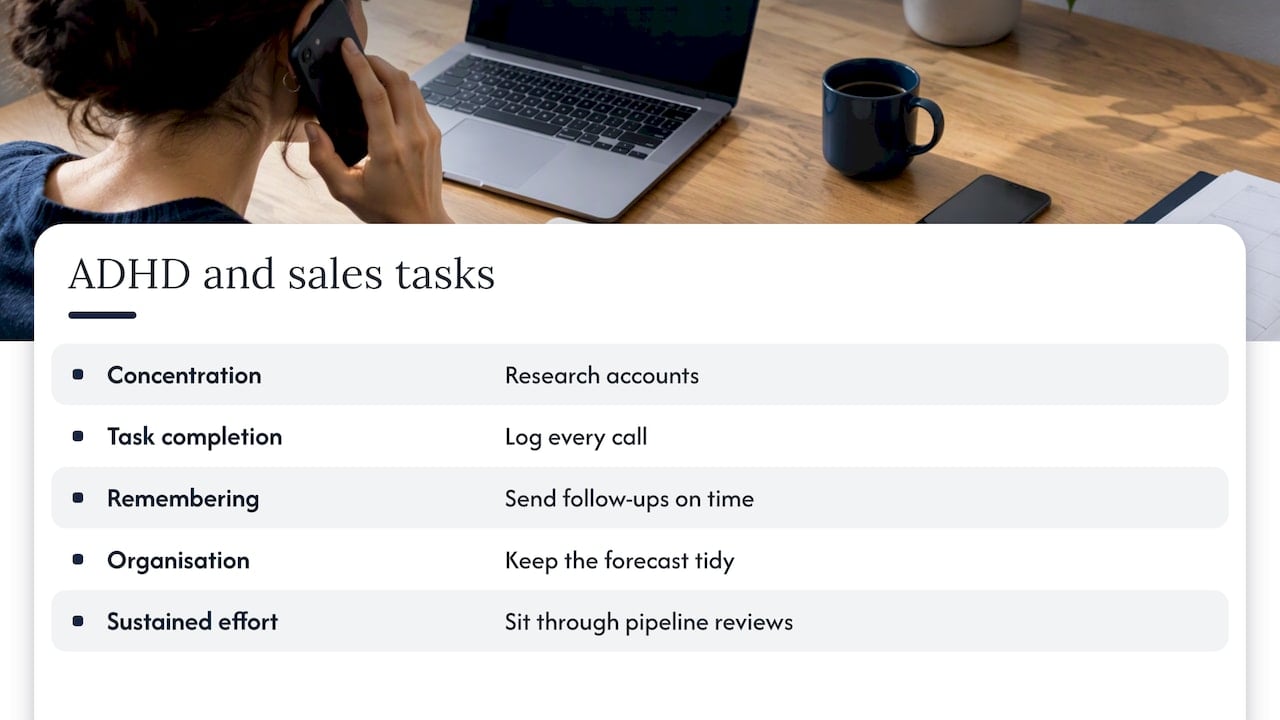
NHS guidance describes ADHD symptoms as potentially severe, persistent and pervasive, affecting work, finances and day-to-day tasks. The same source notes difficulty concentrating for long periods, finishing tasks, staying organised and remembering things, plus a reluctance to take on tasks that need sustained mental effort.
Now put that next to a typical sales week. You are asked to research accounts, log every call, send follow-ups at the right moment, keep a forecast tidy and sit through pipeline reviews. None of that is glamorous, and all of it leans on working memory and sustained effort.
One useful reframe comes from a workplace article on ADHD: it describes the issue as an executive functioning difference rather than a motivation problem, where people intend to finish tasks but struggle to bridge the gap between planning and execution. If you have ever been told you “just need to care more”, that is the gap being misread as laziness.
I see this pattern often when I coach people. The rep who lights up on a discovery call but whose CRM notes are three weeks behind is not uninterested. The process is asking them to do the least stimulating part of the job with no support.
Where the friction usually sits
Every person with ADHD is different, so treat the list below as common sticking points, not a diagnosis of anyone.
Prospecting and organisation
Prospecting is repetitive, and the reward is delayed. Lists, sequences and research can feel flat until you are in a live conversation. Disorganisation shows up as lost notes, half-built lists and tabs left open.
Follow-up
Most deals are lost in the quiet middle: the proposal is sent and then nothing happens. Forgetfulness makes this worse, because the follow-up you meant to send on Thursday slides past without a trigger. If this is you, a fixed process matters more than good intentions. Our sales follow-up workflow guide sets out a structure you can adapt.
Impulsivity in conversations
NHS material lists impulsivity as including interrupting conversations, acting quickly without thinking and finding it hard to wait your turn. In a sales call that can mean finishing the buyer’s sentence, jumping to your pitch before you have heard the problem, or discounting in the moment because the silence felt too long.
Targets and the long game
Quarterly targets can feel distant until the last fortnight, then everything becomes urgent. Breaking a target into weekly activity numbers gives the brain something nearer to aim at.
Rejection, sensitivity and the “no”
Sales means hearing “no” often. Many adults with ADHD describe a strong emotional reaction to real or perceived criticism. Psychologist Russell Ramsay, writing for Psychology Today, notes that many adults with ADHD report strong reactions to criticism and rebuffs.
You will often see this called rejection sensitive dysphoria, or RSD. It helps to be precise about the term. NHS guidance from Just One Norfolk explains that RSD is not a UK diagnosis or an ADHD symptom, though people with ADHD may well recognise intense rejection-related feelings after criticism. So use it as a description of an experience, not a label that explains everything.
Ramsay’s approach is practical, and it translates neatly to a lost deal:
- Identify the trigger (for example, a prospect going silent after a proposal).
- Check whether your thoughts are accurate and proportionate (“they hate me” versus “they may be waiting on budget sign-off”).
- Label the feeling.
- Decide what action, if any, is needed.
- Make a plan for that action, and communicate without defensiveness.
A small habit helps here: never reply to a hard email or message in the first ten minutes. Write the reply, leave it, then send. That one rule has saved more relationships than any script I know.
Strengths worth building a sales career around
I would not romanticise ADHD, but I would not ignore the upside either. A 2024 article on neurodivergent team members lists high energy and enthusiasm as something many people with ADHD bring.
The CIPD’s guidance on neurodiversity takes a balanced view: employers should celebrate and make use of neurodiverse strengths while accommodating individual challenges. The word that matters is individual. Some people with ADHD are brilliant at rapport and thinking on their feet. Others are meticulous and deeply focused when something interests them. Others find calls draining and prefer written selling.
The practical point for managers and for you: work out which parts of the sales cycle give you energy and put your best hours there. A rep who excels at discovery calls but dreads admin may do better with a tight handover to a coordinator, or with automation that handles the logging.
Practical strategies that work in a sales week
The NHS and professional bodies are consistent on the basics. The pack from NHS Cheshire and Merseyside suggests reminders, checklists, planners, 25 to 30 minute work periods with short breaks, body doubling and an end-of-day shutdown checklist. Here is how I would apply them to selling.
Structure the day
The UK Council for Psychotherapy recommends time-blocking with 10 to 15 minute transition buffers, visible timers, a daily list limited to three main tasks and very small starting steps. For a salesperson, a workable version looks like this:
| Block | Purpose | Tip |
|---|---|---|
| Morning, 25 minutes | Outbound or follow-up messages | Use a visible timer and start with the easiest contact |
| Mid-morning | Live calls and meetings | Keep a one-line agenda in front of you |
| After lunch, 25 minutes | CRM updates and notes | Log straight after each call where possible |
| End of day, 10 minutes | Shutdown checklist | Write tomorrow’s three priorities |
Body doubling means working alongside another person, in person or on a call, while each of you does your own task. It is surprisingly effective for CRM updates and proposal writing.
Make follow-up automatic
Do not rely on remembering. Set the next step before you end every call, put it in the calendar, and use templates for the common follow-up emails. If you run your own business, the same applies to the money side of selling: chasing late payments is a follow-up task like any other, and a guide to tools for chasing invoices shows how to take the remembering out of it.
For a wider view of workflow design, our piece on sales productivity hacks for UK sales leaders covers routines that suit most teams, and a sales skill checklist helps you see which parts of the job you want to strengthen first.
Slow down the live conversation
Berkshire Healthcare NHS Foundation Trust suggests a ‘Stop and Think’ sequence: pause, use self-talk, write the main points before speaking, consider the consequences, choose an alternative response, act and then reflect. In a sales call, that becomes:
- Keep a notepad open and jot a keyword when you want to interrupt, rather than speaking over the buyer.
- Ask an open question, then wait.
- Reflect back what you heard before you offer anything.
Psychologist Sharon Saline makes similar points about writing keywords instead of interrupting, reflective listening and open-ended questions. Buyers experience this as being listened to, which is the opposite of the pushy salesperson stereotype.
Protect your attention
If you are easily distracted on calls, move somewhere quiet, close unrelated tabs and silence notifications. These are small changes, and they matter more than people expect.
Your rights and support in a UK sales job
If you are employed, the legal position is clearer than many people think. NHS guidance states that people diagnosed with ADHD or autism are entitled to reasonable adjustments under the Equality Act 2010. Adjustments mentioned in NHS resources include flexible working hours, task-management support, quiet environments, flexible deadlines, assistive technology and neurodiversity training. The Cheshire and Merseyside pack adds regular feedback conversations, breaking tasks into chunks and standing desks, and points to Acas and Access to Work.
In a sales role, sensible adjustments might include:
- Written follow-up of verbal targets and instructions after one-to-ones.
- A quieter desk or permission to take calls in a quiet room.
- Weekly activity targets alongside the quarterly number.
- Automation or templates for call logging.
- Flexible deadlines for non-urgent admin such as reports.
The same NHS resource describes Access to Work as a government programme that funds practical support such as job coaches, workplace adaptations and assistive equipment to help people start or keep working. Check the current rules and how to apply on the official GOV.UK page, because the details change.
Should you tell your employer?
That is your decision. Acas is clear that disclosure is a personal choice and workers do not have to tell their employer, although talking about it can make it easier to get support. It also recognises people worry about negative reactions and stereotyping. Acas also notes that employers can offer support to everyone, such as noise-cancelling headphones and a quiet space anyone can use, so people can get help without sharing anything.
A useful middle route is to ask for the adjustment, framed around the outcome: “I do my best work when targets are confirmed in writing. Could we do that after our weekly one-to-one?” You decide how much context to give.
If you manage a salesperson with ADHD
Acas advises employers who suspect someone is neurodivergent to focus on observed performance difficulties and discuss supportive adjustments rather than asking direct questions about a suspected diagnosis. That is sound advice for any sales manager.
The leadership shift worth making is moving from judgement to curiosity. The workplace article quoted earlier frames it as stopping yourself from reading executive function difficulties as not caring. When a rep misses CRM updates, ask what is getting in the way before you assume a will problem.
A few manager habits that help every rep, not just those with ADHD:
- Keep one-to-ones regular and the feedback specific.
- Track a small number of leading indicators weekly. Our sales performance tracking guide for managers explains how.
- Build accountability into the rhythm of the week. Here are six ways to boost sales accountability that do not rely on pressure.
- Coach to the individual, not to a template. A 30-60-90 plan for coaching underperforming reps is a good starting structure.
Selling your own services with ADHD
If you are a solo consultant, coach or service business owner, nobody sets your pipeline rhythm for you, and that is where ADHD can bite hardest. You are the prospector, the closer, the account manager and the bookkeeper.
The founders I work with get the best results from a few simple rules:
- Fix your selling hours. Put two or three blocks in the diary every week and treat them as client meetings.
- Keep a single pipeline view. One list, with a next action and a date against every name.
- Script the awkward parts. Pricing conversations and objections are far easier with prepared wording. Most people with ADHD I coach find that having a script frees them to be spontaneous around it.
- Sell in the format you like. Some people thrive on calls, others on workshops or written proposals. Choose the route that suits your energy.
- Get an outside rhythm. A coach or accountability partner supplies the structure that willpower does not.
Where we can help
We are a UK sales training and coaching company, and our approach combines bespoke one-to-one coaching with training and consultancy. We design every engagement around the person or team in front of us, which matters when the people in your team think and work differently.
For teams, our team-based bespoke coaching and consultancy engagements run at £4,500 to £8,500 one-off. For solo service businesses and consultants, our sales acceleration track runs at £2,995 to £5,995 one-off. We also offer The Sage Collective at £990 per month, and fractional sales director support for businesses that need senior sales leadership without a full-time hire.

You can see how the options fit on our sales training cost page, or explore our one-to-one sales coaching programme for solo businesses.
Our perspective
We have coached salespeople and founders for years, and the pattern is consistent: the people who struggle with the admin side of selling are very often excellent in the room with a buyer.
Our view is that sales is a system before it is a talent. When a process supplies the reminders, the next steps and the weekly rhythm, the individual can put their energy where it counts: listening, asking better questions and building trust.
That is why we pair one-to-one coaching with consultancy. Coaching works on mindset, objection handling and how you respond to a “no”. Consultancy builds the follow-up workflow, pipeline structure and targets that keep the quarter on track. Together they give a person with a busy, creative mind a structure that fits how they actually work, and a leader a team that hits target.
If selling feels harder than it should, start with the process, not with self-criticism.
Jerry
FAQ
Is ADHD a disadvantage in sales?
Not inherently. ADHD can make admin, follow-up and long-term planning harder, and it can also come with energy, enthusiasm and strong rapport. Outcomes depend on the individual, the role and the support around them.
What is rejection sensitive dysphoria?
It is a term many people use for intense emotional reactions to criticism or rejection. NHS guidance notes it is not a UK diagnosis or an ADHD symptom, but people with ADHD may recognise the experience. If these feelings affect your work or wellbeing, speak to your GP.
Do I have to tell my employer about my ADHD?
No. Acas says disclosure is a personal choice. Telling your employer can help you get reasonable adjustments, so weigh the support against any worries about reactions, and consider asking for adjustments in terms of outcomes.
What adjustments might help in a sales job?
Common examples are written confirmation of targets, a quiet space for calls, flexible deadlines for admin, regular feedback sessions and assistive technology. You can also ask about Access to Work for practical support.
Sources
- How to screen for neurodiversity, Nottinghamshire Healthcare NHS Foundation Trust
- ADHD in the Workplace: Looking Beyond the Behaviour, Career Life Transitions
- Understanding ADHD in Adults booklet, Leicestershire Partnership NHS Trust
- Adult ADHD and Coping With Rejection Sensitivity, Psychology Today UK
- ADHD, Just One Norfolk
- Neurodiversity at work, CIPD
- Adult ADHD Information Pack, NHS Cheshire and Merseyside
- ADHD tips for the workplace, UK Council for Psychotherapy
- Strategies to support hyperactivity and impulsivity, Berkshire Healthcare NHS Foundation Trust
- Navigating Conversations with ADHD, Psychology Today UK
- C&H Adult ADHD Support Resource Pack, East London NHS Foundation Trust
- Neurodiversity at work guidance, Acas