
Before you hire anyone to sell in the UK, confirm with a tax adviser whether that one salesperson creates a permanent establishment, because it can bring UK corporation tax and employer duties with it. Then do three things: complete a right-to-work check, register as an employer with HMRC, and issue a written statement of employment particulars. Keep HMRC and ACAS bookmarked throughout.
TL;DR:
- A UK based salesperson can create permanent establishment exposure by habitually negotiating or closing contracts, even when final signatures remain with overseas directors.
- An employer of record can test the market quickly, while a UK subsidiary suits several planned hires; neither arrangement automatically removes permanent establishment risk.
- For 2026 to 2027, budget 15% employer National Insurance above the secondary threshold; register with HMRC, run PAYE, and issue particulars by day one.
- Write commission terms into the contract, covering eligible revenue, payment timing, cancellations, termination, and a worked deal example; clear wording can make discretionary schemes enforceable.
- Use the same scoring rubric for every candidate, test a realistic sales role play, and include at least two interviewers to limit individual bias.
Table of Contents
- When does a UK sales hire create a permanent establishment?
- How does HMRC tell marketing from trading?
- Contractor, employer of record or UK entity: which route fits?
- What payroll, PAYE and VAT steps does your first UK hire need?
- How should you draft contracts and commission to avoid tribunal disputes?
- How do you recruit, assess and onboard sales staff fairly?
- What does a practical sales hiring plan look like, from pre-hire to first quarter?
- How should you structure the team around a new sales hire?
- What legal compliance sits beyond payroll and contracts?
- What cultural and market factors shape selling in the UK?
- How do you keep your best salespeople in the UK?
- Hire design protects both your tax position and your sales results
- FAQ
- Sources
When does a UK sales hire create a permanent establishment?
A permanent establishment, or PE, is a fixed place or a dependent agent through which an overseas company carries on business in the UK. For a sales hire, the question is rarely about an office. It is about what the person does. A salesperson who works from a spare room in Leeds and regularly closes deals for a foreign employer can expose that employer to UK corporation tax, even if nobody ever rents a desk.
These are the practical indicators we ask you to map before you advertise the role:
- The person has authority to conclude contracts, or habitually negotiates terms that the head office simply rubber-stamps.
- The person controls pricing, discounts or delivery commitments without sign-off from overseas.
- Deals are regularly closed with UK customers by someone physically based in the UK.
- The person holds stock, demonstrates products or operates from premises the company pays for.
Remote working makes this easier to trigger, not harder. A home-based seller is still a person in the UK acting for your business, and tax authorities look at behaviour, not job titles.
Our advice is to act before the offer letter goes out. Speak to a tax adviser who knows UK and your home-country rules. Map each planned sales activity against the indicators above. Then write down the boundaries of the role, for example that final pricing and signature stay with a director outside the UK, and make sure the person’s day-to-day reality matches that document. A boundary on paper that nobody follows protects nothing.
How does HMRC tell marketing from trading?
HMRC’s practical focus is whether an activity forms part of your trading operations or merely prepares the ground for them. Preparing the ground is generally lower risk. Doing the trading is where exposure sits. The distinction matters because many founders describe a “business development” hire who in practice negotiates and closes, and the job title does not change the analysis.
Think of it as two columns:
- Marketing-type activity: generating and qualifying leads, attending trade events, running introductory calls, sharing brochures, and booking meetings for people based elsewhere.
- Trading-type activity: negotiating prices and terms, agreeing contract variations, signing or accepting orders, and binding the company to a customer.
Most real roles sit across both columns, which is why design matters. If you want the hire to qualify leads and hand over to a closer abroad, build the process so that handover genuinely happens. Record in the contract and the role profile what the person can and cannot agree. Our Sales account manager job description guide gives you a UK hiring template you can adapt, with the authority limits stated plainly.
Pro Tip: Run one test deal on paper before the hire starts. Walk through who quotes, who agrees the discount, who signs and where each of them sits. If the UK employee appears at every step, your role boundaries are too thin.
Contractor, employer of record or UK entity: which route fits?
There are three ways to put a salesperson on the ground, and the right one depends on how certain you are about the UK market and how fast you need to move.
- Contractor. The cheapest to start, with no payroll to run. The risk is employment status: if the person works under your direction, uses your tools and works largely for you alone, they may in reality be an employee, with tax and employment rights following. Treat this route with care for a role as embedded as sales, and take advice on status before you sign.
- Employer of record (EOR). A third party becomes the legal employer, runs payroll and handles contracts and compliance, while you direct the daily work. It is fast and removes the setup burden, at the price of a monthly fee per head. If you are weighing the model, a provider’s onboarding material such as this EOR onboarding checklist shows what a structured onboarding process involves, though the example is written for hires in India rather than the UK. An EOR does not automatically remove PE risk, because that depends on what the person does for you, so keep the tax adviser in the loop.
- UK entity. A subsidiary gives you a proper legal home, clear separation and the ability to hire several people. It also brings incorporation, accounts, a registered address, payroll and filing duties. It tends to make sense once you plan more than a couple of hires or a lasting commercial presence.
A sensible pattern is to start with an EOR to test the market, then move to a subsidiary when volume justifies the fixed costs.
What payroll, PAYE and VAT steps does your first UK hire need?
The employer duties are the same whichever size of business you are, and the order matters. GOV.UK sets out the sequence for taking on an employee: check employment status, make sure you can afford the hire, make the workplace safe and accessible, register as an employer and set up PAYE, choose how to run payroll, and check pension responsibilities and Employers’ Liability insurance.
- Register as an employer with HMRC and report the new employee in line with official guidance.
- Decide how to run payroll: payroll software in-house, or a bureau if you would rather not own the process.
- Submit a Full Payment Submission (FPS) to HMRC each time you pay, and run PAYE for income tax and National Insurance.
- Budget for employer National Insurance, workplace pension contributions and Employers’ Liability insurance.
- Give the employee a written statement of employment particulars by their first day.
Most of this is set out in HMRC’s employer guide to PAYE and National Insurance for the current tax year, which is worth a finance colleague reading in full.
The employer Class 1 National Insurance rate from 6 April 2026 to 5 April 2027 is 15% on earnings above the secondary threshold. Build that into the cost of every salary and every commission payment, since commission is earnings too.
VAT is a separate question. It becomes relevant if you sell taxable goods or services from the UK, so check the registration thresholds on GOV.UK once you know where invoices will be raised.
How should you draft contracts and commission to avoid tribunal disputes?
Sales pay is where employment disputes tend to start, because the base salary is simple and the variable part is not. A written statement of employment particulars is the legal minimum, and for a sales role it should go further.
- Pay, hours, place of work, notice period and probation length, all in writing.
- Exactly which earnings are commissionable: new business only, renewals, upsells, or all revenue.
- When commission is earned and when it is paid, including how it treats refunds or cancelled deals.
- What happens to commission on termination or resignation, including deals in the pipeline.
- Any multipliers, accelerators or targets, with the calculation shown.
- Whether the scheme is contractual or discretionary, stated in clear words.
Tribunals have shown what unclear drafting costs. In one 2017 case, the Angus v Forfront judgment, shifting spreadsheets and vague definitions fed a dispute over what the employee was owed. In Sharma v Lily Communications, verbal promises and a broad salary range led to an argument about whether commission was contractual at all, as recorded in the tribunal findings. ACAS makes the practical point that a discretionary commission scheme can still be enforceable if it is in the contract, and that reserving discretion works only when the wording is clear and precise.
Add a worked example to the scheme itself. One page showing how a real deal turns into a payment prevents most arguments.
How do you recruit, assess and onboard sales staff fairly?
Good sales hiring is a system, not a rescue operation. Harvard Business School research frames hiring as something to repeat and refine rather than treat as a one-off crisis, and notes that sales is hard precisely because you are predicting future performance in a volatile market.
Practitioners warn that AI-generated CVs and ghost applicants make paper screening less reliable, and Robert Half recommends a documented process with role-play evaluations and scoring rubrics, so you do not settle for the first likeable candidate, a common cause of early turnover.
- Score every candidate against the same rubric: discovery questions, objection handling, closing and follow-up.
- Use a short role-play based on your real product and a realistic buyer.
- Put at least two interviewers on the panel to reduce individual bias.
- Follow ACAS rules: employers must not discriminate in recruitment, should avoid asking about health or disability except to arrange reasonable adjustments, and should complete right-to-work checks properly.
- Plan the onboarding period with goals, a named mentor, CRM access from the start and a clear view of how commission will be tracked.
Pro Tip: Ask the finalist to run the role-play a second time after feedback. How quickly they adjust tells you more about their ramp-up than their first attempt does.
What does a practical sales hiring plan look like, from pre-hire to first quarter?
Here is the plan on one page, in the order we would work through it.
- Before you advertise: define the role and its authority limits, confirm PE risk with a tax adviser, choose contractor, EOR or entity, and set the budget.
- Weeks 0 to 4: advertise, shortlist by rubric, hold role-play interviews, complete right-to-work checks, then issue the offer and signed contract.
- After hiring: register as an employer, run payroll and submit the FPS.
- Months 2 and 3: hold the probation review, check that commission calculations match the scheme and adjust if needed, and set retention checkpoints.
Cost headings to carry in your budget:
- Base salary and expected commission
- Employer National Insurance at 15% where it applies
- Pension contributions
- Recruitment fees, if you use an agency
- Employers’ Liability and other insurance
- EOR fees, if you take that route
Track a short set of KPIs from the start: time to first qualified meeting, pipeline created, win rate, average deal size and time to first closed deal. Our guide to sales performance management covers how to set useful measures without drowning a new starter in dashboards.
How should you structure the team around a new sales hire?
A first salesperson fails more often from isolation than from lack of talent. Before they start, decide who they report to, who supports them with proposals, marketing material and contracts, and who covers the weeks when they are away.
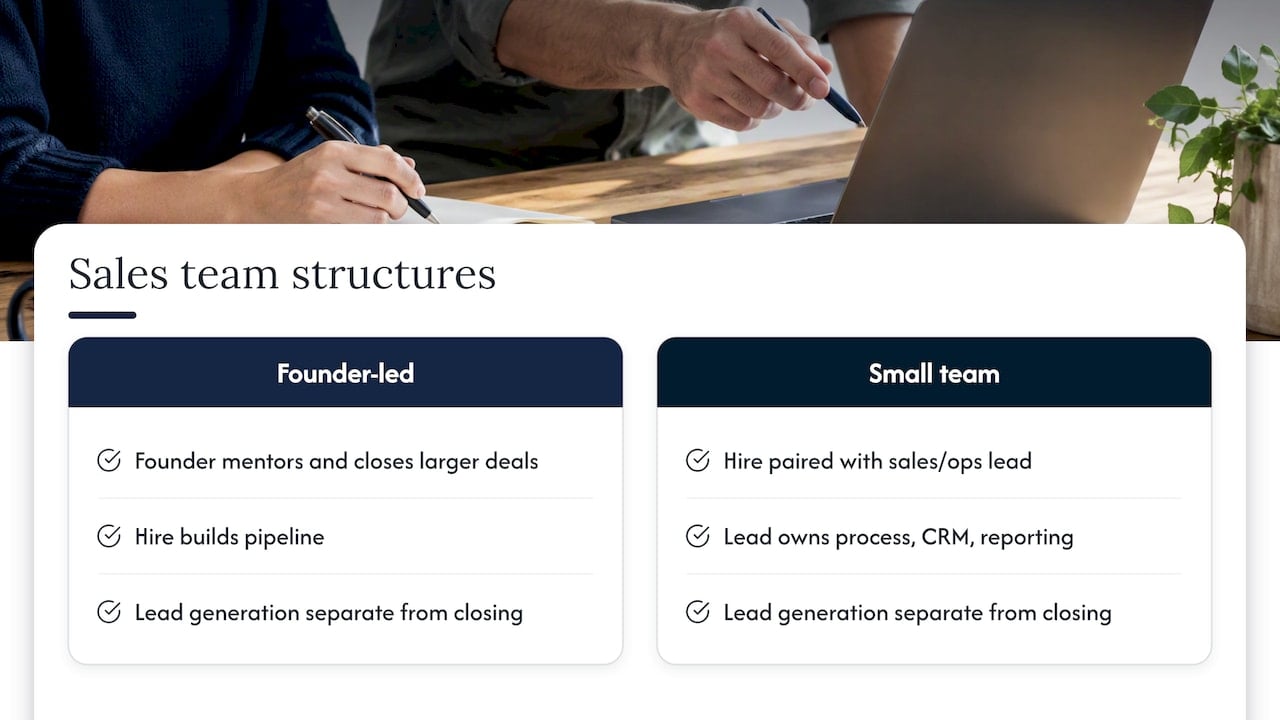
For a first UK hire, the usual shapes are simple. A founder-led setup has the founder as mentor and closer on larger deals, with the hire building pipeline. A small-team setup pairs the hire with a sales or operations lead who owns the process, the CRM and reporting. Either way, keep lead generation and closing as clearly separate responsibilities if you are managing PE risk, as covered earlier.
Think ahead to the second and third hires too. If the first person must write their own playbook, price list and onboarding, you are asking one individual to do a team’s work. Write a basic playbook before day one: ideal customer, qualification questions, standard objections and the approval route for discounts. When you are ready to grow, our guide on how to scale a sales team for UK growth picks up where this plan stops.
What legal compliance sits beyond payroll and contracts?
Several duties sit outside the payroll run, and sales roles touch most of them. Because the role involves handling prospects’ personal data, UK GDPR and the Data Protection Act apply from day one. Your new hire will be collecting names, work emails and phone numbers, and sometimes buying lists, so decide before they start which lawful basis you rely on for outreach and how you record it.
Practical points to settle early:
- Keep sales data in a company-controlled CRM, not in personal spreadsheets or messaging apps.
- Decide who can export or share contact lists, and put that in writing.
- Know the rules on direct marketing by email and telephone, including opt-outs and the register that screens numbers for cold calls.
- Make sure your privacy notice covers what you do with prospect data.
- Check the employee’s right to work before they start, and keep a copy of the evidence.
- Confirm health and safety basics, including a safe workspace if they work from home.
None of this needs to slow the hire. It does need an owner. Name one person responsible for data protection and compliance, even in a small business, and take specialist legal advice on the points that are specific to your sector.
What cultural and market factors shape selling in the UK?
UK buyers tend to reward understatement. A salesperson who arrives with high-pressure American-style closing lines often meets polite scepticism, then silence. Buyers expect credibility to be earned through relevant references, clear answers and a reasonable pace. Plain speaking works better than hype, and saying what a product does not do builds more trust than claiming it does everything.
Regional and sector differences matter. A pitch that suits a London financial services buyer may not suit a manufacturer in the Midlands or a public-sector buyer, where procurement frameworks, committees and longer cycles are normal. Allow longer for decisions than you might in other markets, and plan follow-up around the working calendar: school holidays, bank holidays and year-end budgets all affect when people commit.
Local knowledge is part of what you are hiring. Someone who already knows how your buyers talk, which trade bodies and events matter and how procurement works will ramp faster than a strong seller who is new to the market. If your best candidate lacks that, build it into onboarding with customer introductions and shadowing early on. For firms that want a quicker route to building this capability, we offer sales training for UK teams tailored to how UK buyers actually behave.
How do you keep your best salespeople in the UK?
Retention begins in the hiring plan, not at the first resignation. The main reasons good sellers leave are unclear or changing commission, weak support, unrealistic targets and a lack of progression. You can address all four.
- Keep commission stable and transparent. Changing the scheme mid-year is a fast route to distrust and, as the tribunal cases show, to disputes.
- Set targets that match the pipeline. A target no one can reach teaches your best people to look elsewhere.
- Offer a visible path. Senior account roles, team lead positions or specialist tracks give ambitious people a reason to stay.
- Coach regularly. One-to-one coaching on live deals does more for retention than an annual bonus. Our own approach to sales team coaching is built around exactly this.
- Check in early. Regular retention checkpoints catch problems while they are still conversations rather than resignations.
Pay competitively, but do not rely on pay alone. People stay where they feel they are winning, learning and trusted.
Hire design protects both your tax position and your sales results
In my view, most hiring problems in this area come from the same cause: the role was never properly designed. The founder hires a likeable person, promises commission in conversation, leaves the boundaries vague and hopes it works out. Then the hire struggles, the commission is disputed and, if the person is closing deals in the UK, the tax position is unclear too.
Role clarity, commission transparency and structured assessment fix all three at once. A role with written limits protects you against PE exposure. A written commission example protects you at tribunal. A scored role-play protects you against hiring on charm. These are not three separate projects. They are one piece of design work done before the advert goes live, and it costs far less than putting right a bad first hire.
— Jerry
This article is general information, not a substitute for advice from a qualified financial advisor. Consult a qualified financial professional about your own circumstances before acting on anything here.
FAQ
Can one UK sales rep create a permanent establishment?
Yes, it can happen with a single person. What matters is what they do, not how many there are. A UK-based salesperson who regularly negotiates and closes contracts for an overseas employer is the classic risk, so take tax advice before the hire starts.
How long before the first pay day must I register for PAYE?
Register as an employer with HMRC and report the new employee in line with official guidance. GOV.UK sets out the sequence for setting up payroll. Leave enough time for registration to come through before you pay anyone.
When do I need to complete a right-to-work check?
Check the official guidance for when to complete it, and keep a copy of the evidence. ACAS lists right-to-work checks among the safe recruitment steps in its recruitment guidance. Apply the same check to every candidate, so your process stays fair.
Is commission legally enforceable if it is discretionary?
It can be, if it is written into the contract and the wording is clear. ACAS notes that employers can reserve discretion only where the language is clear and precise, as explained in its commission guidance. Vague or verbal promises are where disputes start.