
If you have around four or more sellers who all need the same skills, in-house training usually costs less per head and gets new behaviours into live calls faster. If your group is small or mixed in experience, a public course or cohort programme often makes more sense; understanding the benefits of customer testimonials for UK businesses can be vital when advising leaders how to measure and present training impact internally. The real deciding factors are scale, how much tailoring you need, and whether your managers can coach what gets taught.
TL;DR:
- In house training typically reaches break even at about four delegates; public courses usually cost less for one or two people or mixed groups.
- Include manager preparation and follow up, lost selling hours, and administration in the budget, and schedule sessions during the team’s quietest selling week.
- Build coaching skill before increasing manager coaching frequency; frequent input from an unskilled manager can reduce goal attainment instead of improving it.
- Track technique use, practice completion, and role clarity in the first weeks, then review quota attainment, win rates, and average deal size over time.
- Growing teams can pair private core skills training with periodic public courses, adding external perspective and networking after shared fundamentals are established.
Table of Contents
- Pros, cons and trade-offs of in-house versus public scheduled courses
- Cost, scale and logistics: rules of thumb for when in-house pays off
- Making training stick through managerial coaching and organisational support
- Measuring impact: KPIs and quick evaluation methods for training effectiveness
- Decision checklist: a quick flow to choose between in-house, public or blended solutions
- A pragmatic next step for sales leaders
- How our bespoke programmes fit as a direct solution
- FAQ
- Sources
Pros, cons and trade-offs of in-house versus public scheduled courses
We find that most sales leaders frame this as a simple cost question, but it is really a question of fit. In-house training brings the content to your team, on your schedule, built around your actual deals and objections. Public courses bring your people to a room full of strangers from other companies, which has its own value when used at the right moment.
In-house training tends to win on:
- Lower cost per delegate once you have a small group, because the trainer fee is fixed regardless of headcount
- Tailored examples, using your products, your competitors and your real objections rather than generic scenarios
- Schedule control, so you can run sessions around quota deadlines rather than fitting your team into someone else’s calendar
Public, scheduled courses tend to win on:
- An external perspective, which can land differently with experienced sellers who tune out internal trainers
- Peer exposure, letting your team compare notes with sellers from other industries and sectors
- Suitability for very small groups, where paying for a bespoke day for one or two people rarely makes financial sense
Neither option is flawed so much as mismatched to the wrong situation. A common objection to in-house training, that it lacks outside perspective, is really a trade-off: you gain relevance at the cost of external benchmarking. A common objection to public courses, that content feels generic, is the flip side of the same coin: you gain variety at the cost of specificity. Knowing which trade-off you can live with is more useful than hunting for a format with no downsides at all.
Cost, scale and logistics: rules of thumb for when in-house pays off
The clearest rule of thumb from practitioner guidance is that in-house training usually breaks even at around four delegates. For a smaller group, a public course is typically the more economical route, since you are not paying for an entire trainer day to reach a small number of people.
Direct trainer fees are only part of the real cost. Three things often get missed:
- Manager time spent preparing briefs, sitting in on sessions and following up afterwards
- Lost selling hours, which matter more in a short sales cycle than a long one
- Administration, including booking rooms, chasing diaries and producing materials
For in-house delivery, build in a room with working AV, printed or digital materials ready in advance, a schedule that avoids your busiest selling days, and a contingency plan if a key trainer or facilitator falls ill.
Pro Tip: Book your in-house session around your quietest selling week rather than the first open date in the diary. Lost pipeline time is often the biggest hidden cost.
Making training stick through managerial coaching and organisational support
Here is the part most sales leaders underweight: the format you choose matters less than what happens after the session ends. Research on factors influencing training transfer found that organisational support, a positive training climate and manager reinforcement all increase the chance that sellers actually apply what they learned on the job. Without that reinforcement, even excellent content fades within weeks.
A separate multilevel study adds a sharper warning: coaching frequency without coaching skill can actually reduce goal attainment. In other words, a manager who checks in constantly but coaches badly can do more harm than one who coaches rarely but well.
Practical steps that make the difference:
- Train managers in coaching skills first, before asking them to coach more often
- Schedule on-the-job practice immediately after training, while the content is still fresh
- Set role-clarity checkpoints, so each seller knows exactly what good looks like in their next three calls
Skill before frequency is the principle worth remembering here. A manager who observes calls and gives sharp, specific feedback will usually outperform one who sits in on many calls with vague encouragement.
Measuring impact: KPIs and quick evaluation methods for training effectiveness
You do not need an elaborate measurement framework to know whether training worked. A short set of leading and lagging indicators, checked on a simple cadence, tells you most of what you need.
Leading indicators worth tracking in the first few weeks:
- Manager-observed technique use during live or recorded calls
- Rehearsal completion, meaning sellers have actually practised the new approach before using it live
- Role-clarity improvements, measured through short manager check-ins
Lagging indicators to connect back to the training over a longer window include quota attainment, win rates and average deal size.
Sales managers who coach with skill, not just frequency, have a direct link to sales goal attainment, which means the coaching conversation after training may matter as much as the training itself.
A regular cadence works well: check technique adoption first, then role clarity and manager observations, and later review the lagging numbers. A short manager checklist for each stage keeps the process consistent without becoming another admin burden.
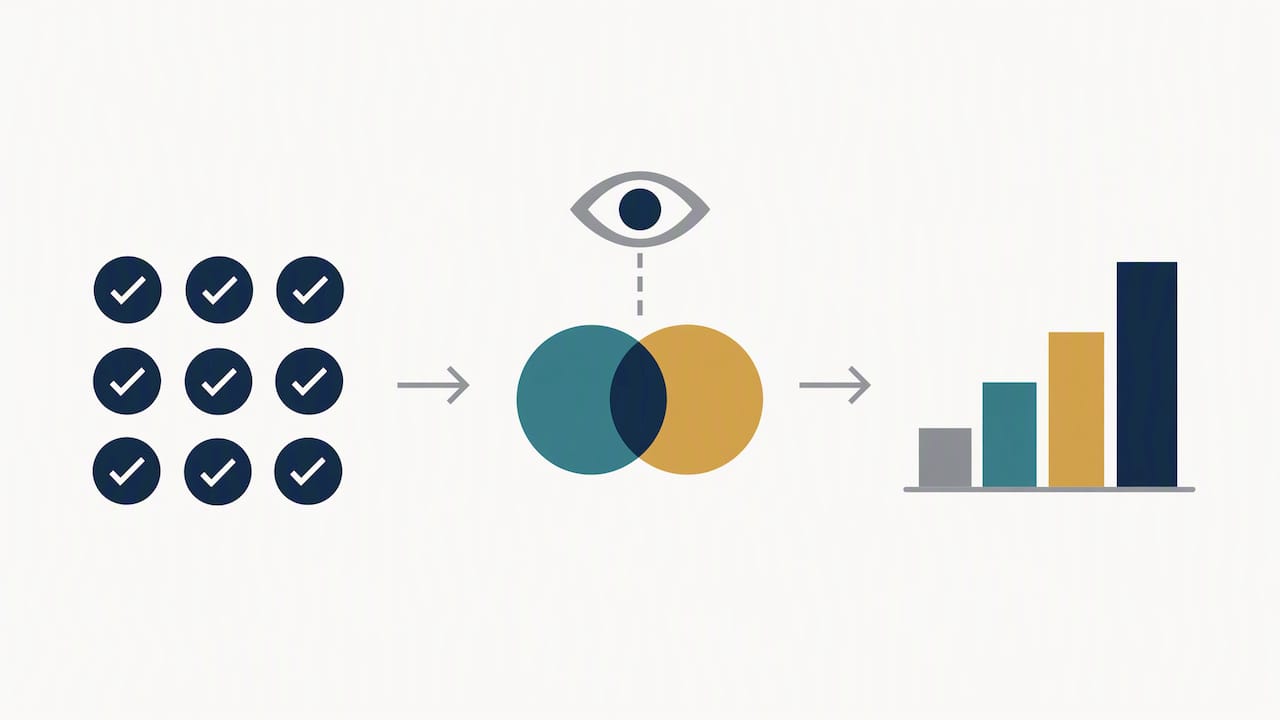
Decision checklist: a quick flow to choose between in-house, public or blended solutions
Use this sequence to reach a decision quickly rather than deliberating for weeks:
- Count your delegates. Four or more with a shared need points towards in-house; fewer, or a mixed group, points towards a public or cohort course.
- Check your managerial capacity. If your managers lack coaching skill or bandwidth, look for a provider that builds in post-course coaching rather than a one-off session.
- Ask providers about customisation. Can they build sessions around your actual product, market and objections, or is the content fixed?
- Ask about measurement support. Will they help you track leading and lagging indicators, or does accountability stop at the end of the session?
- Ask about trainer track record. Request specifics on the trainer’s background in your sector rather than generic claims of experience.
- Consider blending both. Many teams run an in-house programme for core skills, then send individual sellers to public courses periodically for fresh perspective and networking.
A blended approach often suits growing teams best: in-house for the shared foundation, public exposure for ongoing development once the basics are embedded.
A pragmatic next step for sales leaders
Our honest view is that the venue matters far less than what happens in the weeks after it. Run a small, manager-supported pilot: pick a team, build in immediate practice, and review it at regular intervals. If your managers do not yet have the coaching skill to support that, say so early and look for a provider that builds coaching into the programme rather than treating it as an afterthought. If internal capacity is the gap, a short conversation with a provider about a tailored needs assessment usually clarifies the path faster than another round of internal debate.
— Jerry
How our bespoke programmes fit as a direct solution
We built our approach around the gap this article keeps circling back to: training that does not get coached afterwards rarely sticks. Our team-based bespoke coaching and consultancy engagements combine customised in-house training with 1:1 coaching and structured follow-up, so new skills get reinforced in live selling situations rather than left in a workshop.
- Packages for teams typically run as fully customised engagements built around your sales cycle and objections
- Solo consultants and service business owners can access a dedicated sales coaching programme built for smaller operations
- Growing teams exploring flexible formats can start with The Sage Collective at £990 per month
If your team fits the four-or-more profile and you want training that includes the coaching layer this article recommends, our sales training services page is a good place to start a conversation about a tailored needs assessment.
FAQ
How much does it cost to train a salesperson?
Cost depends heavily on format and group size. In-house training tends to be more economical once you have roughly four or more delegates, since the trainer fee is spread across the group, while public courses can be more cost-effective for one or two people.
What are the key differences between personal selling and direct marketing?
Personal selling involves a direct, individual conversation between a seller and a prospective buyer, allowing for tailored objection handling and relationship building. Direct marketing reaches many prospects at once through channels like email or mail, trading personalisation for scale.
What is the 2 2 2 rule in sales?
Definitions of this rule vary across sales teams and trainers, with no single agreed standard. A common version uses it as a follow-up rhythm, such as contacting a prospect at set intervals, but it is best treated as a flexible guideline rather than a fixed formula.
What does “in-house training” mean?
In-house training means a programme delivered directly to your team, usually on your premises or through a private session, built around your company’s products, processes and real selling scenarios. It contrasts with public training, where your sellers join a scheduled course alongside people from other companies.
Sources
- ojs0925Alan Dubinsky-Factors influencing the impact-check-e
- Does Coaching Matter? A Multilevel Model Linking Managerial Coaching Skill and Frequency to Sales Goal Attainment
- The Advantages and Disadvantages of In-House Training