
Don’t automatically send a full proposal when a prospect says “send me a proposal.” Instead, convert the request into one of two things: a quick scoped range with a confirmed next step, or a scheduled walkthrough where you present a tailored proposal in person. A simple line does the job: “Happy to, let’s just lock down scope and timeline on a quick call first, so the number I send you is right the first time.”
TL;DR:
- Most “send me a proposal” requests are stall signals, especially if the scope, decision process, budget, timeline, or stakeholders are unclear or missing.
- Responding with a range or scheduling a short discovery call helps ensure the proposal is based on enough information and increases the chances of closing.
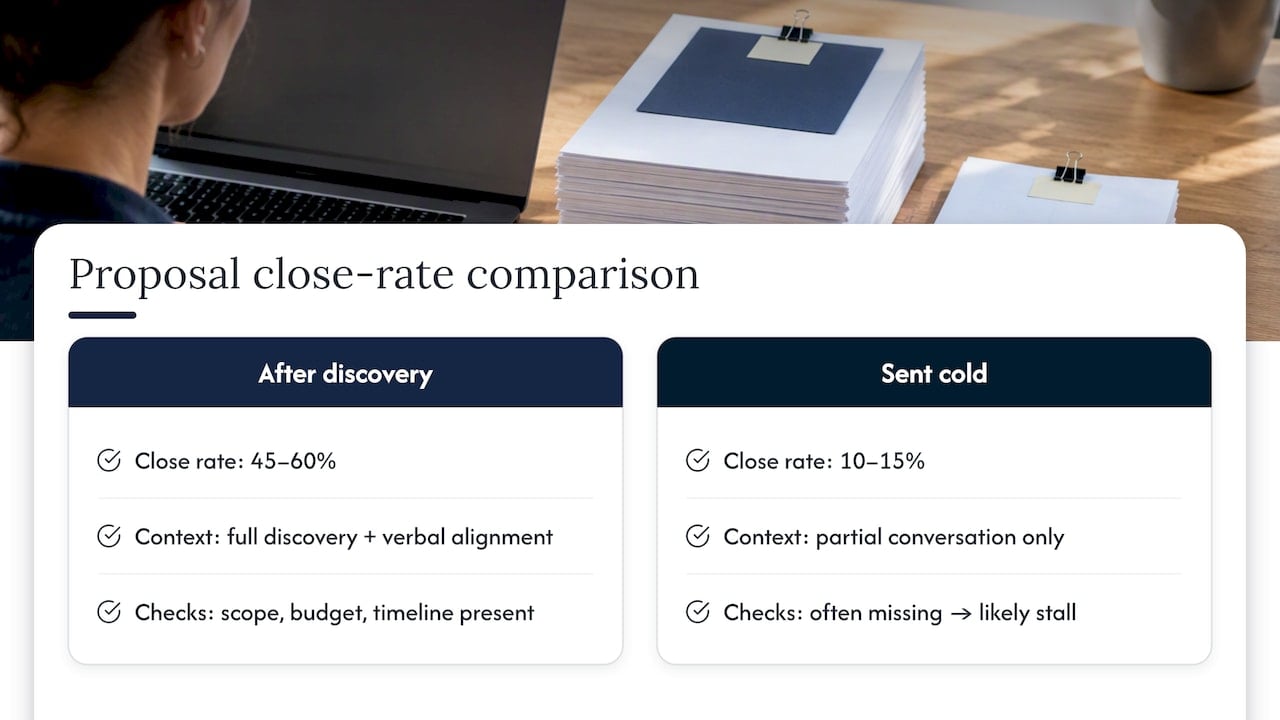
- Sending a full proposal prematurely often leads to low close rates, with full discovery proposals closing 45% to 60% of the time versus 10% to 15% for cold submissions.
- A clear, concise proposal should include an objective, approach, scope, timeline, responsibilities, investment, assumptions, and a specific next step.
- Running a follow-up cadence with scheduled calls and revealing the proposal logically helps move the deal forward and prevents early pricing objections.
Table of Contents
- Three short call replies and micro-scripts you can use verbatim
- Why a proposal request often signals a stall, and the red flags to watch for
- Decision checklist: when to send a full proposal, give a range, or insist on a walkthrough
- Exactly what to include in the proposal email or covering note
- Follow-up cadence and how to run the proposal walkthrough
- Where to practise and get help with these conversations
- Author Jerry’s perspective: balancing buyer autonomy and seller validation
- If you want help embedding these skills: Ahead of Sales training and coaching
- FAQ
- Sources
Three short call replies and micro-scripts you can use verbatim
When a prospect asks for a proposal mid-call, the words you choose in the next ten seconds decide whether you end up negotiating on your terms or theirs. Three situations come up again and again, and each needs a different reply.
- The price-check: they want a number before they’ll keep talking.
- The discovery-stall: they’re using “send me a proposal” to end the call politely.
- The genuine-procurement request: they actually have a defined process and need your document to move through it.
For the price-check, acknowledge the ask and widen it before you answer. Something like: “Projects like this typically run between two figures depending on scope, so let me ask two quick questions before I give you a number that actually fits.” This mirrors the approach Waco3 recommends when a buyer wants a ballpark: give a realistic range rather than a single figure, then ask clarifying questions before committing to anything written.
For the discovery-stall, the goal is to buy a few more minutes without sounding like you’re resisting the request. Try: “Of course, I can get that to you today. Before I do, can I ask what’s driving the timing on this, so the proposal actually matches what you need?” That single question often surfaces whether there’s a real decision process behind the ask or whether the prospect is simply deflecting.
For genuine procurement, comply, but confirm the mechanics first. Ask who else reviews the document, what format they need, and when the decision gets made. A short version: “Happy to send that over. Who else will be reviewing it, and when’s the decision likely to land?”
What each script communicates matters as much as the words themselves:
- The price-check script signals confidence without pinning you to a number you’ll regret.
- The discovery-stall script keeps the conversation open without sounding evasive.
- The procurement script shows respect for their process while protecting your own time.
None of these scripts are designed to dodge the request. They’re designed to make sure that whatever you send next actually has a chance of landing. A proposal built on five minutes of conversation is a guess dressed up as a document, and prospects can tell the difference even if they can’t articulate why.
The common thread across all three is pace. You’re not stalling the buyer, you’re matching your output to the information you actually have. Send too early and you’re negotiating against your own best interests before the prospect has even seen the full picture.
Why a proposal request often signals a stall, and the red flags to watch for
Buyers today do a huge amount of research before they ever speak to a sales rep, and Gartner’s research on the B2B buying journey found that 75% of B2B buyers prefer a rep-free experience, and that statistic explains a lot of what feels like avoidance in early sales calls. Many prospects genuinely would rather read a document on their own time than sit through another call.
But the same research notes that buyers still turn to sales reps to validate decisions at key points, which is often the context where “send me a proposal” is requested. The request isn’t necessarily a brush-off; it’s often a test of whether you’ll do the validating work (asking the right questions, scoping properly) or just hand over a document that mirrors whatever is already on their desk.
One practical way to tell the difference: Gartner and practitioner guidance point to five checks, scope defined, decision process known, budget range indicated, timeline present, and stakeholders identified. If three or more of those are missing, you’re looking at a stall, not a procurement step. Gartner’s buying-journey data backs this distinction, and it’s a useful filter to run silently while the prospect is still talking.
The cost of getting this wrong is measurable. Waco3’s analysis of the “send me a proposal” objection found that proposals delivered after full discovery and verbal alignment close at roughly 45% to 60%, compared with just 10% to 15% for proposals sent cold after a partial conversation. That’s not a marginal difference, it’s the gap between a proposal that works and one that quietly dies in an inbox.
Red flags worth noticing in real time: the prospect can’t describe what “done” looks like, there’s no decision date on the table, or they’re vague about who else needs to sign off. Any one of these on its own isn’t disqualifying. All three together usually mean you’re being asked to write a document nobody has committed to reading properly.
This is where the consultative selling approach earns its keep: a few well-placed questions do more to move a deal forward than any amount of polish on the proposal itself.
Decision checklist: when to send a full proposal, give a range, or insist on a walkthrough
Running a quick mental checklist on the call stops you sending the wrong document to the wrong person at the wrong time. It takes seconds once it’s familiar, and it protects you from the trap of looking responsive while actually wasting your own week.
Before you agree to send a full proposal, you need five things confirmed:
- A clear scope: what’s included, what isn’t.
- Agreed success criteria: what the buyer will measure against.
- A known decision process: who signs off, and how.
- A real deadline: not “soon,” an actual date.
- Named stakeholders: the people who’ll read it and the people who’ll decide.
If you’ve got four or five of those, send the proposal, ideally alongside a walkthrough rather than as a cold attachment. If you’ve got two or fewer, you’re not ready, and sending anyway just produces a document that answers questions nobody asked.
When you don’t have enough to write a proper proposal but the prospect is pushing for a number, offer a range instead of a fixed quote. The language matters here: say “projects like this typically run between £X and £Y depending on scope” rather than naming a single figure. Waco3 suggests a range spanning two to three times the low figure, wide enough to be honest, narrow enough to be useful.
When the gaps are too big for a range to help, ask for more time rather than more patience. This is the Discovery Bridge: request 10 to 30 minutes to finish scoping before you commit to a document. A workable line: “I can absolutely get you something, but I’d rather spend twenty minutes making sure it’s the right number than send you a guess. Can we grab a short call this week?”
If the prospect resists even that, offer a walkthrough instead of a document drop: “Let me put together something tailored and talk you through it rather than just emailing it over, that way you get the context along with the numbers.” This single offer does more to protect deal quality than any amount of proposal polish, because it keeps you in the room when the price appears for the first time.
The pattern across all three options, full proposal, range, or walkthrough, is that you’re always trading on information. The more you have, the more precise you can be. The less you have, the more you should be asking rather than writing.
Exactly what to include in the proposal email or covering note
Once you’ve earned the right to send something, the document itself needs to do specific work. D-Tools’ review of why project proposals get rejected lists fourteen recurring causes, and most of them are fixable editorial problems rather than strategic failures: unclear benefits, excessive text, a missing implementation plan, and risks that are never addressed.
A tight proposal email covers seven things, in this order:
- Subject line: specific enough that the recipient knows exactly what’s attached before opening it.
- Agreed objective: restated in the buyer’s own words from the discovery call.
- Recommended approach: the logic behind your solution, not just the solution itself.
- Scope and deliverables: precisely what’s included, with enough detail to rule out assumptions.
- Timeline and responsibilities: who does what, and by when, on both sides.
- Investment and assumptions: the number, along with what it depends on.
- Single next-step CTA: one action, not three.
That last point matters more than it sounds. A proposal that ends with “let me know your thoughts” invites silence. A proposal that ends with “let’s confirm this on a 20-minute call Thursday” invites a decision.
| Proposal section | Common rejection cause it prevents |
|---|---|
| Agreed objective | Buyer feels the document wasn’t written for their actual problem |
| Recommended approach | Reader can’t see why this solution over another |
| Scope and deliverables | Ambiguous offer, the top cause D-Tools identifies |
| Timeline and responsibilities | No implementation plan, a frequent rejection trigger |
| Investment and assumptions | Pricing feels arbitrary without context |
| Single CTA | Document ends in silence instead of a next step |
Two short examples show how this plays out depending on which path you took.
Example A, range plus confirmation (sent after a price-check call where discovery wasn’t complete):
Subject: Quick follow-up and ballpark, as discussed
“Thanks for the call earlier. As mentioned, projects like yours typically run £8,000 to £18,000 depending on final scope, I’ll have a precise number once we’ve confirmed the two points we discussed. Can we grab 20 minutes Thursday to finish that and get you something exact?”
Example B, tailored proposal with walkthrough invite (sent after full discovery):
Subject: Your proposal: [objective], ready to walk through
“Attached is the proposal we discussed, covering scope, timeline and investment based on everything you shared. Rather than leave you to read it cold, I’d like to walk you through it on a short call so you’ve got context for the numbers. Does Wednesday at 2pm work?”
A CRM that generates and tracks these documents properly, such as the proposal and contract tools in SmartFlowCRM, can make the follow-up cadence easier to manage once the proposal is out the door. The same discipline applies whether you’re selling a service or scoping a project brief, and the same logic shows up in how agencies prepare a client brief before quoting: scope first, number second.
Follow-up cadence and how to run the proposal walkthrough
Sending the proposal is not the end of the work, it’s the start of the follow-up. A sensible cadence runs: the proposal goes out, a first follow-up lands within 48 hours, a second follow-up with a voicemail or short call attempt follows three to four days after that, and a final check-in happens around the stated decision date.
- Day of send: confirm receipt with a one-line message, no pressure, just “landed safely, happy to answer anything before Thursday.”
- 48 hours later: a short, specific follow-up referencing one detail from the proposal, not a generic “just checking in.”
- Day 5 or 6: a call attempt, with a voicemail script ready: “Wanted to check you’d had a chance to look at the numbers, give me a call back or I’ll try again Friday.”
- Decision date: a direct ask for a yes, no, or a reason for delay.
The walkthrough itself works best as a Three-Step Reveal: restate the problem first, map the solution second, and only then present the investment. This sequencing matters because a number shown without context invites comparison shopping, while a number shown after the logic has been laid out invites a decision. Practitioner guidance on demand-side selling backs this problem-first approach as a way to avoid price-first rejection.
Pro Tip: Never open a walkthrough call by sharing your screen on the pricing page, start with the problem statement and let the number arrive last.
When the reaction is hesitation rather than a clear objection, resist the urge to discount on the spot. Ask what specifically feels uncertain, then address that point directly rather than lowering the number to make the discomfort go away.
Where to practise and get help with these conversations
Scripts help in the moment, but the judgement behind them, knowing when to push for discovery and when to send, tends to come from repetition and feedback rather than reading alone. Some readers will get there through self-study and call reviews. Others, particularly teams handling proposal objections daily, benefit from structured practice.
For sales teams wanting to build this into a repeatable process, Sales Training Cohorts cover objection handling and proposal review as part of a wider programme. For individuals or smaller teams, consultative selling techniques offer a practical starting point for the discovery questions that underpin everything in this article. And for a broader view of how structured coaching fits into a sales process, the effective sales consultancy guide is worth a read.
Author Jerry’s perspective: balancing buyer autonomy and seller validation
I’ve sat through calls where a prospect asked for a proposal in the first ninety seconds, before either of us had said anything useful. Sending one anyway always felt like handing over a guess with a decimal point on it.
Buyers genuinely want to self-serve more of the process now, and that’s fair. But a proposal written without proper discovery isn’t respecting their time, it’s just moving the guesswork downstream to a document that looks finished but isn’t. Treating the proposal as a conversation rather than a verdict protects your time and, more importantly, gives the buyer something they can actually act on with confidence. Measure what closes and what stalls, then adjust the next call accordingly.
— Jerry
If you want help embedding these skills: Ahead of Sales training and coaching
Reading the scripts is one thing, running them under pressure on a live call is another. That gap is exactly what structured coaching closes, and it’s the difference between knowing a line and actually using it when a prospect pushes back.
This kind of practice is built into coaching and training work combining 1:1 coaching with consultancy for businesses seeking quarter-on-quarter improvement in handling objections like this one.
- Teams looking for structured, cohort-based practice can start with Sales Training Cohorts.
- Businesses wanting a fully bespoke engagement can view customised coaching and consultancy packages.
- Solo consultants and service business owners can look at the sales coaching programme built for that exact situation.
If you’re not sure which fits, the Aheadofsales homepage lays out the full range, including The Sage, Titans, and The Sage Collective, so you can see which level of support matches where your team is right now.
FAQ
How do I write an email when sending a proposal?
Structure the email with a specific subject line, the agreed objective in the buyer’s own words, your recommended approach, clear scope and deliverables, a timeline with named responsibilities, the investment with its assumptions, and a single clear next step. Keep it concise: D-Tools identifies excessive text as one of the most common reasons proposals get rejected.
What are the three golden rules for objection handling?
Listen fully before responding, so you address the real concern rather than an assumed one. Ask a clarifying question before offering a solution, since most objections hide a more specific worry underneath. Confirm understanding before moving forward, so the prospect feels heard rather than managed.
What are the five steps of objection handling?
A common version runs: listen to the full objection, acknowledge it without agreeing or arguing, ask a clarifying question to find the real concern, respond directly to that concern, and confirm the prospect is satisfied before continuing. Definitions vary slightly between sales methodologies, but these five steps appear in most practical frameworks.
How do I reply to a proposal objection without losing the deal?
Reply by converting the request into either a scoped price range with clarifying questions, or a short discovery call before you commit to a document. Waco3’s research found proposals sent after full discovery close at roughly 45% to 60%, against 10% to 15% for proposals sent cold, which is the practical reason to slow down rather than send immediately.
Sources
- Objection: Send Me a Proposal and I Will Review It
- 14 reasons why project proposals are rejected
- The B2B buying journey: key stages and how to optimize them