
The player-coach model works as a short-term bridge, never as a permanent structure. Kept in place too long, it starves your team of coaching, skews your forecast and stalls hiring. The fix has two parts: document your sales process so it doesn’t live only in your head, and ring-fence coaching time so it survives contact with a full pipeline. Practitioner guidance from SaaStr and academic research on managerial coaching both back this up.
TL;DR:
- The player-coach role should be temporary, with clear exit criteria such as documented processes, team growth, and revenue milestones, to prevent long-term inefficiencies.
- Prioritizing coaching over selling is crucial, requiring scheduled, scored sessions and deliberate sequencing of hires to ensure knowledge transfer without losing coaching time.
- Transition timelines vary from several months, with milestones including a written playbook, a fully ramped account executive, and maintained or improved conversion rates.
- Relying on a founder’s instinct without formal documentation and coaching risks deal stalls, pipeline issues, and team performance decline during the handoff.
- External support, such as fractional sales leaders or coaching services, can help build a repeatable sales process and coaching structure, especially for solo or resource-constrained teams.
Table of Contents
- What the player-coach role is and why businesses create it
- Core traps and failure modes: how the role breaks teams
- When the player-coach can work: a short set of conditions
- Practical steps to avoid the trap
- Transition checklist and realistic timeline for handing off selling
- Ahead of Sales: how bespoke coaching and playbooks prevent the player-coach trap
- Lessons from coaching leaders through the transition
- Consider professional help: what Ahead of Sales offers and when to pick it
- Primary sources and further reading
- Sources
- FAQ
What the player-coach role is and why businesses create it
A player-coach is someone who carries a personal sales quota while also managing, coaching or mentoring the people selling around them. In practice, that usually means one of two people: the founder who is still closing deals while trying to build a team underneath themselves, or a senior sales rep promoted into a management title without ever fully putting down their own patch.
Businesses don’t stumble into this by accident. It tends to happen for three fairly predictable reasons.
- Early traction: the founder is the best (sometimes only) person who can sell the product, so nobody wants to take deals away from them.
- Budget limits: hiring a dedicated sales manager before the revenue justifies it feels wasteful, so one person is asked to do both jobs.
- Skillset gaps: the person who can sell is not necessarily the person who should be designing a repeatable process, but they’re often the only one in the room.
There isn’t just one flavour of player-coach. You’ll see the founder-seller, still running their own top accounts while onboarding the first few hires. You’ll see the promoted rep, given a management title as a reward for good numbers rather than an aptitude for coaching. And you’ll see the interim leader, deliberately holding the role while the business searches for a permanent head of sales.
Each version creates the same underlying mechanism: two jobs competing for the same hours, with selling almost always winning because it has a number attached to it and coaching does not.
Core traps and failure modes: how the role breaks teams
The player-coach role rarely fails all at once. It erodes in a fairly consistent sequence, and recognising the pattern early is the only way to interrupt it.
- Coaching gets deprioritised first, because it has no immediate deadline and selling does.
- The manager becomes the bottleneck for every deal above a certain size, since reps route anything complicated straight to them.
- Forecast accuracy drifts, because a manager carrying their own number tends to protect their pipeline view rather than challenge it.
- Hiring stalls, because there’s no spare capacity to onboard or ramp anyone new.
- Team performance flattens or drops, as the gap between the player-coach’s personal skill and the rest of the team’s skill widens rather than closes.
The time conflict sits at the root of all of it. A 167-response academic study found that managerial coaching has a positive effect on sales-force performance, working through customer orientation and results orientation rather than through pipeline inspection alone. That matters because it tells you coaching isn’t a nice-to-have layered on top of management: it’s the mechanism that actually changes how reps sell. When a manager’s own quota eats the hours that coaching needs, the team loses the one lever proven to move performance, not just a supportive gesture.
The forecast problem is subtler but just as damaging. A manager who is also a seller has a personal stake in how rosy the pipeline looks, which makes them a poor judge of their own deals and, by extension, a poor judge of everyone else’s. Deals get generously stage-weighted, slippage gets explained away, and the board or the founder ends up planning against numbers that were never independently checked.
Then there’s the administrative load that quietly competes with both selling and coaching. Frontline managers can lose a substantial share of their week to reporting, CRM upkeep and internal meetings, which leaves even less room for the 1:1 coaching that the research says actually works. When that time gets squeezed, coaching is usually the first thing to disappear, precisely because it’s the easiest thing to skip without anyone immediately noticing.
When the player-coach can work: a short set of conditions
The role isn’t wrong in every case. It’s wrong as a permanent fixture. Used deliberately, for a defined period, with clear exit criteria, it can be the right way to bridge a business from founder-led sales to a proper team.
SaaStr’s guidance on founder-led sales transitions treats the player-coach stage as transitional by design, with conditions for moving on documented and reviewed regularly rather than left to drift. A handful of signals suggest the model is being used correctly rather than as an excuse to avoid change:
- Team size and revenue have reached a point where a full-time management hire is financially sensible, not just theoretically nice.
- The sales process is written down somewhere other than the founder’s head, even in a rough form.
- The founder or manager is stepping back from routine deals but staying selectively involved in strategic or high-value accounts, by design rather than habit.
- There’s a named threshold, whether that’s deal size, account type or revenue milestone, for when founder involvement is expected to end.
Even when those boxes are ticked, residual risk doesn’t disappear entirely. A founder who says they’re “stepping back” but still takes every call from a nervous prospect is still the bottleneck, just a quieter one. Practitioner accounts and case evidence both suggest that the real danger isn’t the transitional player-coach stage itself, it’s a transition that never actually completes.
Practical steps to avoid the trap
Fixing this isn’t about willpower. It’s about calendar rules, sequencing decisions, and a small number of measurements that tell you whether the handoff is safe.
- Block coaching time before it competes with selling. Put a weekly, non-negotiable slot in the diary for call reviews or 1:1s, and treat it the same way you’d treat a client meeting, not as something that moves when the pipeline gets busy.
- Score every coaching session, don’t just hold it. A simple scorecard covering opening, discovery, objection handling and close gives you something to track over time instead of a vague sense that “the call went alright”.
- Bring in a process-oriented sales assistant before you hire a VP of Sales. David Cummings’ guidance on founder-led sales recommends this specifically because the assistant’s job is to shadow the founder, document the playbook and build repeatable stages, reducing the chance that an early sales leader inherits a process that only exists in someone’s memory.
- Sequence your hires deliberately. Bring in account executives once the playbook is written and repeatable, and only bring in a process-oriented head of sales once there’s a team big enough to justify full-time management. Hiring the manager first, before there’s anything documented to manage against, is one of the more common ways this goes wrong.
- Track a small number of leading indicators, not vanity metrics. Conversion rate by stage, ramp time for new hires, and actual coaching minutes delivered per week tell you far more about whether the handoff is working than total revenue does in the short term.
Turning founder knowledge into something transferable is really what building a sales playbook is for: it’s the document that lets someone else run the process you’ve been running by instinct. Pair that with structured manager-first coaching and you’ve addressed both halves of the trap at once, the missing process and the missing coaching time.
Pro Tip: Score coaching calls out of ten across four categories (opening, discovery, objections, close) and track the average weekly. A flat or falling average is a faster warning sign than a missed quota.
Transition checklist and realistic timeline for handing off selling
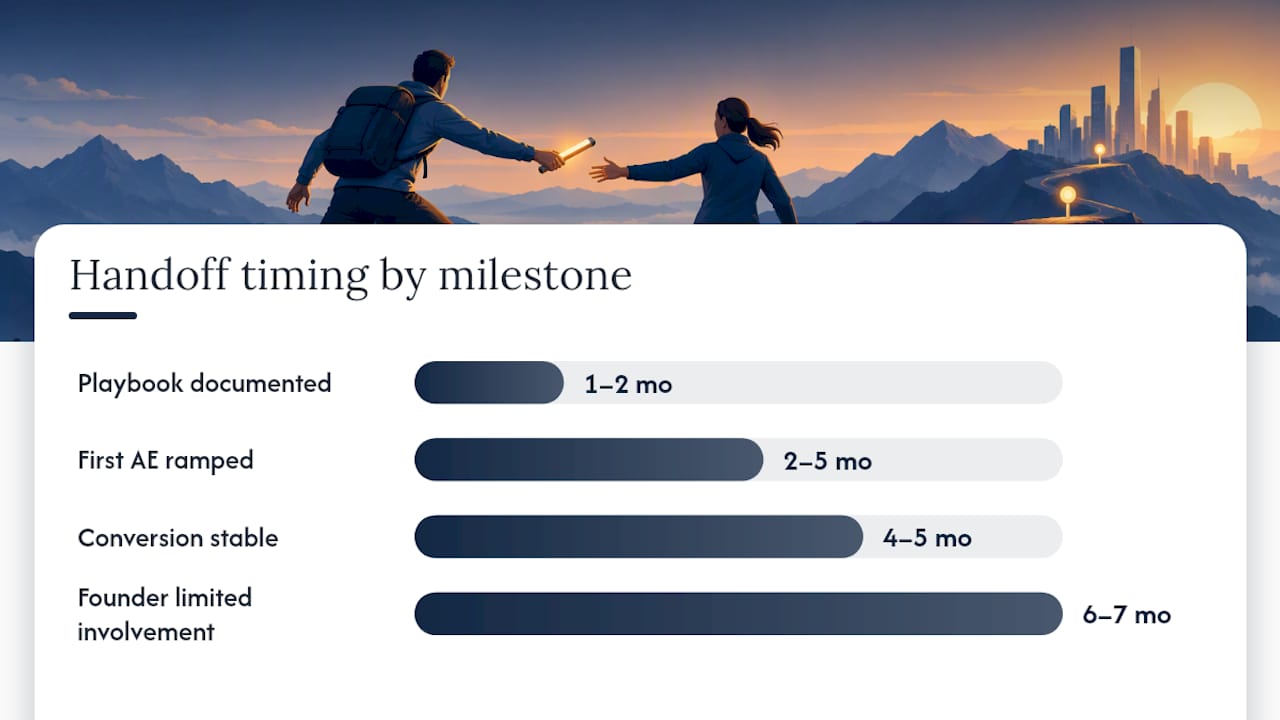
There’s no single date on which a founder should stop selling. There’s a set of milestones, and a rough window shaped by how long your sales cycle actually takes.
As a general guide, expect the transition to take several months, depending on deal complexity and how quickly the first hires ramp. A short, transactional sales cycle can move faster; a long, multi-stakeholder enterprise cycle will sit at the longer end.
- A written playbook exists and a new hire can follow it without the founder in the room.
- Conversion rates have stayed stable, or improved, across at least one full sales cycle after a new rep starts selling from that playbook.
- The first account executive has been hired and has closed deals independently.
- A hiring brief exists for the next role, whether that’s a second AE or a process-oriented head of sales.
- Quota staging is in place, so new hires aren’t expected to hit full targets from day one.
- Rules exist for when founder involvement is still expected, such as deals above a certain size or in a specific vertical.
| Milestone | What it signals | Typical timing |
|---|---|---|
| Playbook documented | Process no longer lives only with the founder | Month 1 to 2 |
| First AE hired and ramped | Team can sell without founder on every call | Month 2 to 5 |
| Conversion stable post-handoff | Process transfers without a performance dip | Month 4 to 5 |
| Founder involvement limited to strategic deals | Transition largely complete | Month 6 to 7 |
If conversion rates drop sharply after a new hire takes over, or if deals start stalling at a stage the founder used to personally push through, that’s a trigger to pause and reinforce coaching rather than push ahead with a full handoff.
Ahead of Sales: how bespoke coaching and playbooks prevent the player-coach trap
Bespoke 1:1 coaching paired with a written playbook is a practical way to convert founder knowledge into something a team can run without them. Coaching that targets the specific gaps in a rep’s call handling, alongside consultancy work that turns a founder’s instinct into a documented, repeatable process. That combination addresses the two failure points covered above directly, the disappearing coaching time and the undocumented process, rather than treating them as separate problems.
A short weekly coaching model, built around scored call reviews of around 30 minutes, is one practical way this gets applied without demanding hours a growing leader doesn’t have. It’s the same principle behind protecting coaching time on a calendar: small, regular, measured, rather than occasional and informal.
Lessons from coaching leaders through the transition
I’ve watched a founder hand off selling in a single week, cold, with no documented process behind it. Deals stalled almost immediately because the new hire had no script for the objections the founder used to handle by instinct. I’ve also watched the opposite: a staged handoff over several months, playbook first, then one hire, then a second, with the founder only stepping in on the largest accounts. That one held.
The trade-off is patience. Founders who protect coaching time and document the process before they step back nearly always keep more of their conversion rate than those who simply stop selling and hope the team catches up.
— Jerry
Consider professional help: what Ahead of Sales offers and when to pick it

If you don’t have the time to build a playbook yourself, or nobody on your team is set up to run structured coaching, that’s exactly the gap a fractional sales leader or a coaching partner is built to close. Ahead of Sales offers a Fractional Sales Director service for businesses that need experienced leadership without a full-time hire, alongside fully customised coaching and consultancy packages that combine 1:1 coaching with playbook development for teams and solo operators alike. For solo service businesses managing this transition alone, the sales acceleration track is built specifically for that situation, and The Sage Collective runs at £990 per month for ongoing structured support. Explore the full range at Ahead of Sales.
Primary sources and further reading
- David Cummings on Startups: From Founder-Led Sales to a Sales Team, practitioner guidance on hiring a process-oriented assistant before a VP of Sales.
- SaaStr: How To Transition from Founder-Led Sales, a staged playbook for moving off founder-led selling.
- Managerial coaching and sales performance, a 167-response academic study on how coaching affects sales-force performance.
- For lead handoff between marketing and sales during a transition, see this practical piece on lead nurturing and conversion.
Sources
- How To Transition from Founder‑Led Sales: Why Most Get It Wrong and How to Get It Right | SaaStrAI
- Managerial coaching and sales performance: the influence of salesforce approaches and organisational demands
- From Founder‑led Sales to a Sales Team – David Cummings on Startups
FAQ
What is the 70/30 rule in coaching?
It’s used as a rough guide for weighting coaching sessions toward practice rather than lecture.
What is the 70/30 rule in sales?
It’s a heuristic rather than a fixed standard, useful mainly as a reminder that discovery should dominate a sales call.
What is the 30-60-90 rule in sales?
The 30-60-90 framework breaks a new hire’s ramp into three phases: the first 30 days for learning the product and process, the next 30 for supervised selling, and the final 30 for independent quota-carrying work. It’s commonly used to define onboarding tasks, early coaching checkpoints and initial performance metrics during a handoff.
What is the 80/20 rule in coaching?
The Pareto principle in coaching suggests that a large share of a team’s results comes from a small share of behaviours or reps. In practice, it’s used to argue that coaching effort should concentrate on the specific skills or people most likely to move overall performance, rather than being spread evenly across everyone.