
Field sales training only works when it does two things at once: get reps genuinely ready to sell face to face within weeks, not months, and back that up with coaching that continues long after the induction slides are forgotten. The single highest-leverage move you can make right now is building a 30/60/90 onboarding plan with hard activity numbers attached (visits, demos, opportunities logged) and a ride-along schedule that starts in week one, not month three.
TL;DR:
- Building a 30/60/90 onboarding plan with activity targets and ride-alongs starting in week one significantly reduces ramp-up time for new reps.
- Effective field sales training should focus on skills directly applicable in face-to-face situations, such as discovery, objection handling, product positioning, and CRM habits.
- Ongoing coaching through ride-alongs, role-plays, and micro-coaching sessions proves more impactful than theoretical classroom content for changing rep behavior.
- Training must be tailored to specific industry nuances, deal cycles, compliance rules, and the need for translating technical value into commercial language.
- Frequent, short refresher sessions delivered via mobile keep skills fresh and prevent decay, while CRM discipline should emphasize immediate, detailed logging after visits.
Table of Contents
- What should field sales training actually cover?
- How long does it take to ramp a new field rep?
- Which coaching methods change field rep behaviour?
- How do you train reps to manage a territory well?
- What technology should field sales training include?
- How do you measure field sales training ROI?
- Who should attend field sales training?
- How do you adapt training for different industries?
- How does field training fit with inside sales and marketing?
- How often should field sales teams refresh their training?
- What CRM habits are unique to field sales reps?
- Ahead of Sales’ perspective: what actually moves the needle
- Ready to build your team’s 30/60/90 plan?
- Sources
- FAQ
What should field sales training actually cover?
Field sales training only earns its budget when every module maps to something a rep does on the doorstep, not a slide they nodded through in a classroom. If you’re auditing an existing programme or building one from nothing, use this as your checklist against outside sales training content, not a wish list.
- Discovery and consultative questioning: taught as a repeatable technique, not a personality trait. Reps need scripted question banks they can adapt live, and consultative selling skills that stick come from drilling real scenarios, not memorising theory.
- Objection handling and closing: frameworks built specifically for in-person meetings, where body language and timing matter more than they do on a call.
- Product positioning and competitor framing: reps need a tight, current answer to “why you and not them” before they ever knock on a door.
- CRM workflows and data hygiene: logging habits taught as muscle memory, ideally via mobile, immediately after each visit rather than at day’s end.
- Virtual and hybrid selling: most field reps now also run video calls with procurement or head office contacts, so the training has to cover both modes.
How long does it take to ramp a new field rep?
Roughly three months or more, according to SPOTIO’s 2026 State of Field Sales survey, which found that 44% of field teams take three months or longer to get new hires to full productivity. That’s a long runway for a manager watching quota, and it’s exactly the gap a written 30/60/90 plan closes.
Pro Tip: Print the 30/60/90 plan and hand it to the rep on day one. Reps who can see the whole runway ahead of them hit early milestones more consistently than those working off verbal expectations alone.
- Days 1 to 30, field-ready minimum: CRM fully set up, product knowledge score above your set threshold, and at least two completed ride-alongs with a manager or senior rep.
- Days 31 to 60, activity benchmarks: a practical field sales playbook suggests targets such as 30 or more customer visits by day 60, plus a defined number of qualified opportunities logged in the CRM.
- Days 61 to 90, ownership metrics: pipeline built to a set multiple of quota, a first closed deal, and forecast accuracy tracked against actual outcomes.
Benchmarks need to flex by role and deal size. A rep selling a £500 monthly service and one closing six-figure annual contracts cannot share the same visit-to-close ratio, so calibrate each phase’s numbers against your own historic conversion data before you print them on a template.
Which coaching methods change field rep behaviour?
Classroom content rarely survives contact with a real prospect. What sticks is coached repetition: watching a rep sell, correcting one thing at a time, and doing it again the next week. Field sales coaching frameworks consistently point to front-loaded minimum viable training followed by coached field experience, not the reverse.
- Ride-alongs: pick one objective per visit (opening, questioning, close), observe without interrupting, then debrief within the hour while the detail is fresh.
- Role-play drills: use real objections pulled from lost deals in the pipeline, run weekly, not as an annual training day exercise.
- Micro-coaching: short daily activity checks plus a focused 15 to 30 minute coaching session each week beats one long monthly review.
- Recorded self-review: reps who record and watch their own pitches catch habits a manager’s notes never quite convey.
Pro Tip: Role-playing objections drawn from the team’s own lost deals, run as a weekly 30 minute drill, tends to outperform an occasional webinar because reps rehearse the exact wording they’ll hear next week, not a generic script.
How do you train reps to manage a territory well?
Territory discipline is what separates a rep who feels busy from one who’s actually productive. The habit worth drilling hardest is batching: grouping visits by geography first, then prioritising within that cluster by opportunity stage and deal value, so nobody drives forty minutes for a low-value courtesy call.
- 80:20 segmentation: classify accounts A, B, C by value and potential, then build a distinct visit cadence and playbook for each tier.
- Pre-call data verification: checking contact details and recent account activity before leaving the office prevents wasted trips to a closed site or the wrong decision-maker.
- Route templates: even a shared spreadsheet with postcodes and priority flags beats ad hoc planning for smaller teams without dedicated routing software.
- Time blocking: protect selling hours from admin by batching CRM updates and call planning into fixed windows rather than letting them bleed into drive time.
Territory segmentation and CRM analytics are named among the core skills that lift sales productivity, and they’re teachable in an afternoon workshop if you use real territory maps rather than hypothetical ones.
What technology should field sales training include?
Tool training should follow the workflow, not the feature list. A rep doesn’t need a tour of every CRM function on day one, just the three or four they’ll use every single visit.
- CRM: train on one-tap logging immediately after a visit, not end-of-day batch entry, which is where most data quality dies.
- Route planning: even a basic mapping tool saves hours weekly once reps trust the sequencing.
- Data verification and enrichment: a quick pre-call check habit prevents wasted drive time to outdated addresses or contacts who’ve moved on.
- Microlearning: short refresher modules delivered to a phone between visits, rather than a full learning management system few field reps will log into voluntarily.
For teams under roughly twenty reps, a heavyweight enterprise LMS is often overkill. Favour lightweight, mobile-first microlearning that reps can finish between appointments rather than a platform that demands a desk and thirty spare minutes they don’t have.
How do you measure field sales training ROI?
Leading indicators tell you within the first month whether training is landing; lagging indicators confirm it weeks later. Track both, because waiting for quota results alone means you find out too late to adjust.
Run short trials on coaching cadence or content format, comparing one team’s weekly role-play against another’s fortnightly session, before rolling either out company-wide. Reporting these numbers on a simple weekly dashboard keeps coaching conversations grounded in evidence rather than gut feel, and analytics-driven reporting has been linked to considerably stronger marketing ROI, a principle that holds just as well when you’re measuring sales coaching impact.
Who should attend field sales training?
Three groups need this training, and each needs a different slice of it. New field reps need the full curriculum: discovery, objection handling, CRM habits, territory basics, all delivered before they’re trusted with a full patch alone. Experienced territory holders need less foundational content and more targeted refreshers, particularly around new product lines or shifting competitor positioning, since their gaps tend to be narrow rather than structural.
Sales managers themselves are the third, often overlooked, audience. A manager who’s never been trained to run a ride-along properly will default to either silence (learning nothing gets fixed) or taking over the meeting (the rep learns nothing either). Coaching the coaches, teaching managers how to observe, when to intervene, and how to debrief without demoralising, is frequently the highest-return investment in the whole programme, because one well-trained manager improves the ramp speed of every rep on their team, not just one.
There’s a fourth group worth naming separately: solo operators and founder-led sales teams, where the same person prospecting is also the one who has to self-coach. Structured training for this group looks different again, less ride-along, more scripted self-review and accountability check-ins, because there’s no manager in the passenger seat to observe.
Whatever the mix on your team, the training needs sequencing. Reps get the full course. Managers get coaching-the-coach sessions layered on top. Skip that second layer and even excellent curriculum content will decay the moment reps leave the classroom, because nobody in the field is reinforcing it.
How do you adapt training for different industries?
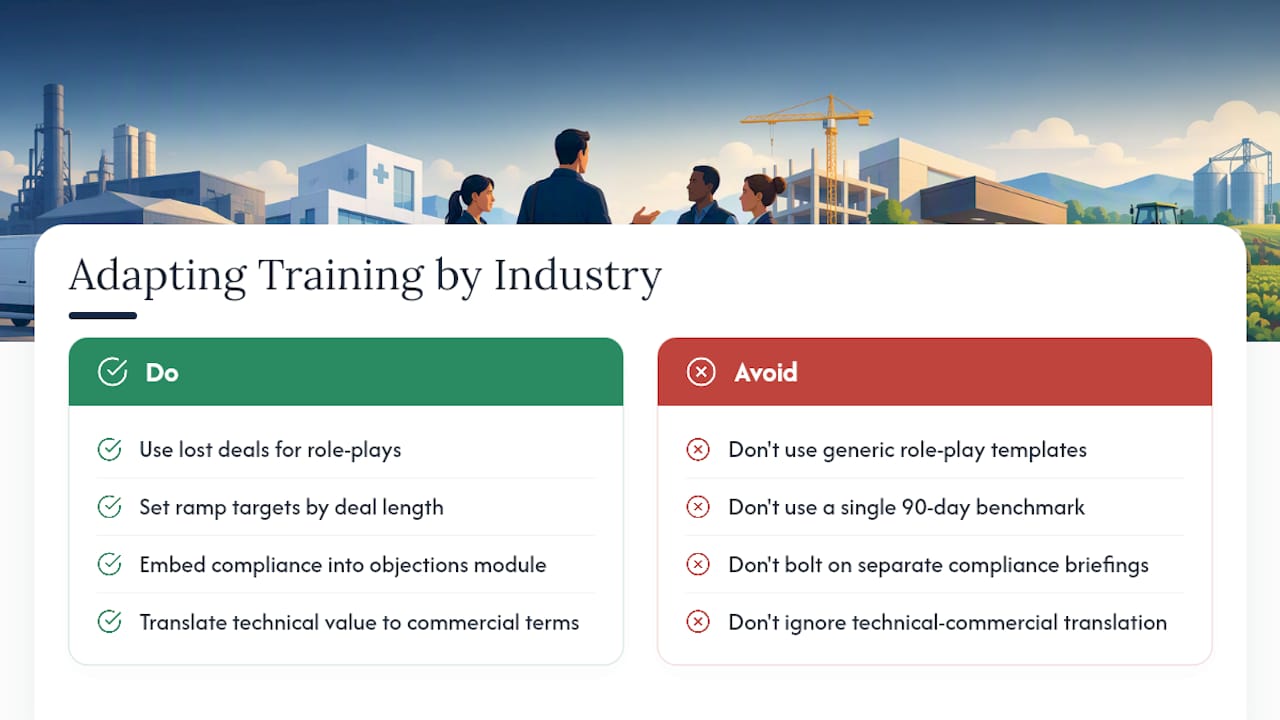
A generic field sales course rarely survives contact with a specific sector’s buying process, and pretending otherwise wastes the first month of a rep’s ramp. The objection a field rep hears selling FMCG into independent retailers (“I don’t have shelf space”) bears no resemblance to the one heard selling capital equipment into manufacturing (“who else needs to sign off on this”), so the role-play library has to be built from your own lost deals, not a generic template.
Deal length changes what “ramp” even means. A rep selling short-cycle consumables might close their first deal in week three; a rep selling long-cycle industrial contracts might not close anything until month four, and judging both against the same 90-day benchmark is a mistake that quietly demoralises the slower-cycle rep for no good reason.
Regulated sectors add a layer most generic courses skip entirely: compliance framing. A field rep selling into healthcare, financial services, or construction needs to know exactly what they can and cannot claim in a live conversation, and that content has to be built into the objection handling module itself, not bolted on as a separate compliance briefing nobody remembers by the second week.
SaaS and technology sales carry their own wrinkle: the field rep often has to bridge a technical buyer and a commercial one in the same meeting. Training built specifically for SaaS sales teams tends to spend far more time on translating technical value into commercial language than a generic outside sales training course would, because that translation skill is the actual job.
The practical fix, whatever the industry, is the same: take the generic curriculum framework (discovery, objections, closing, CRM) and rebuild the content inside each module using your own product, your own lost deals, and your own regulatory constraints. The skeleton is universal. The muscle has to be sector specific.
How does field training fit with inside sales and marketing?
Field reps rarely operate in isolation any more, and training that ignores the handoffs either side of them creates gaps a competitor will happily exploit. Marketing generates the lead, inside sales often qualifies it, and the field rep closes it face to face, so training has to cover the handover points explicitly, not just the field rep’s own patch.
The most common failure point is CRM discipline at the handoff itself. If inside sales logs a lead with incomplete context, the field rep walks into a meeting blind, and the visit that should have taken twenty minutes stretches to an hour of re-discovery. Training field reps to demand (and check) specific handoff fields before booking a visit closes that gap without needing a single new tool.
Marketing alignment matters just as much, particularly around messaging consistency. A rep who’s fielding objections that contradict the campaign the prospect just saw on LinkedIn looks unprepared even when they’re not, so field training should include a standing update on live campaigns and the language they use, refreshed at least monthly.
The reps who perform best in hybrid pipelines tend to be the ones trained to see themselves as the final stage of a relay, not a standalone hunter. That framing changes how seriously they take CRM notes, because they understand someone else, whether that’s account management or a renewal specialist, will read them later.
How often should field sales teams refresh their training?
Field sales training decays faster than most managers expect. Product knowledge goes stale within a quarter as competitors reposition and your own roadmap shifts, and objection handling skills erode the moment a rep goes a few weeks without hearing a genuinely tough one.
Weekly coaching cadence is the backbone that prevents that decay, and it pays off measurably: teams running consistent weekly coaching see notably higher quota attainment than those relying on sporadic training days. Layer short microlearning modules, ideally under fifteen minutes and delivered to a phone, on top of that weekly rhythm rather than scheduling occasional half-day refreshers that pull reps off the road and rarely stick regardless.
Quarterly deep refreshers still have a place, particularly around major product launches or when the competitive landscape shifts enough to need a full repositioning conversation. But the default cadence should be small and frequent: a fifteen minute Monday morning huddle on one objection, a short video review of a recent lost deal, a five-minute product update pushed to mobile. Reps retain far more from four short touches a month than from one long session, and the cost to a manager’s calendar is a fraction of the time.
Treat refresher training as ongoing maintenance, not a one-off event triggered only when performance dips. By the time attainment numbers slip, the skill gap has usually existed for weeks already.
What CRM habits are unique to field sales reps?
Field CRM discipline breaks in a specific, predictable way: the rep is away from a desk, often standing in a car park after a meeting, and the natural instinct is to log details later. Later rarely comes, or comes hours later with half the detail already forgotten.
The fix is training reps to log immediately, ideally from a phone, in the minutes right after leaving a visit rather than batching entries at the end of the day. This single habit shift does more for data quality than any CRM feature training ever will.

Pre-call verification deserves its own line in the curriculum too. Checking a contact’s current role, recent account activity, and confirming the address before setting off avoids the specific field sales problem of a wasted drive to a closed site or a contact who’s since moved on, a form of wasted time that inside sales teams simply never encounter. Practitioner guidance on this point is consistent: mandating a quick verification check before every visit meaningfully cuts wasted travel.
Field CRM entries also need more context than an inside sales note, because there’s no recorded call to fall back on later. A field rep should log not just what was discussed but the physical setting, who else was in the room, and any non-verbal signal worth remembering, detail that feels excessive until the next rep picks up the account and has nothing else to go on.
Ahead of Sales’ perspective: what actually moves the needle
Programmes that treat field readiness and coaching as separate phases consistently underperform ones that run them in parallel from day one. Training programs can be built around the principle of combining a written 30/60/90 plan with real activity numbers, paired with scheduled ride-alongs from week one rather than month three.
— Jerry
Ready to build your team’s 30/60/90 plan?
Most field sales training either stops at a one-off workshop or hands managers a generic template with no coaching built in. Some sales training providers offer engagements that pair one-to-one coaching with structured consultancy, aimed at measurable ramp and quota performance, rather than issuing a certificate after a single training day.

Solo consultants and service founders fit the sales acceleration track, priced between £2,995 and £5,995 one-off. Growing teams typically sit within the bespoke coaching and consultancy engagements, priced between £4,500 and £8,500 one-off, while businesses wanting ongoing support can join The Sage Collective at £990 per month. Larger organisations running full cohorts should look at the Sales Training Cohorts format, where pricing is available on request.
A short engagement typically starts with an assessment of current ramp speed and activity gaps, then builds a 30/60/90 plan specific to your product and territory structure, with coaching cadence set from week one. If you’re ready to see how your team’s current ramp compares, get in touch to discuss an assessment and start building a plan that fits your reps, not a generic template.
Sources
- Field Sales Training That Ramps Reps Faster – SPOTIO
- Field Sales Training Playbook for 2026 Teams – Prospeo
- Field sales training frameworks and coaching methods – eCanvasser
FAQ
What are the seven golden rules of sales?
There’s no single universal list, but versions commonly used in field sales training centre on: know your customer, listen more than you talk, qualify before pitching, handle objections with evidence not pressure, always confirm next steps, follow up promptly, and keep CRM records current. The exact wording varies by trainer, but the underlying discipline stays consistent across field sales skills training.
What are the seven stages of sales?
Most field sales training frameworks teach prospecting, preparation, approach, presentation, handling objections, closing, and follow-up as the core stages. Field reps typically compress preparation and approach into a single pre-visit routine, including the data verification checks covered above.
What is the 10-3-1 rule in sales?
It’s a rough guide for setting activity benchmarks, similar in spirit to the 30-visits-by-day-60 target used in a structured onboarding plan, though the exact ratio should be calibrated against your own historic conversion data.
What are the six basic selling skills?
Most field sales training programmes teach discovery and questioning, active listening, objection handling, closing, relationship building, and CRM or data discipline as the six foundational skills. Aheadofsales structures its own sales training programmes around exactly this set, paired with coached practice rather than classroom theory alone.