
A discovery call framework is a staged, evidence-led meeting plan that turns a vague chat into a structured decision. It maps purpose, current state, desired state, impact, decision authority and next steps, with clear evidence required at each stage. Use it instead of a scripted question list, and you’ll reliably qualify or disqualify prospects, and leave every call with a concrete next step.
TL;DR:
- The discovery call framework emphasizes identifying clear evidence at each stage before progressing, improving qualification accuracy and reducing wasted meetings.
- Different deal types require tailored emphasis: enterprise deals need extended stages with multiple stakeholders, SaaS focuses on critical events, and solos concentrate on impact and desired outcomes.
- Using open-ended questions and specific follow-ups helps gather concrete evidence, while avoiding vague answers or rushing into demos prevents flawed qualification.
- Recording, replaying calls, and structured coaching are crucial for embedding consistent evidence-led discovery habits across sales teams.
- A fixed 30-minute structure with time-boxed stages ensures efficient, disciplined conversations that consistently produce actionable insights.
Table of Contents
- The discovery call framework: six evidence-driven stages
- A time-boxed 30-minute structure you can run today
- Which questions actually belong in a discovery call?
- How to qualify and disqualify without wasting anyone’s time
- What to capture and how to hand it to the next person
- Adapting the framework by deal type
- Mistakes that quietly wreck discovery calls
- Trainer perspective: what to coach first
- Turning this framework into a habit across your team
- Sources
- FAQ
The discovery call framework: six evidence-driven stages
Most reps treat discovery as a list of questions to fire through in order. That’s the wrong mental model. A proper discovery call framework works like a decision tree: each stage exists to produce a specific piece of evidence, and you only move forward once you have it. If you don’t, you branch, probe again, or park the deal.
Here’s the six-stage map, with the decision question, the exit evidence you need, and a sample question for each:
- Purpose. Decision question: why are we talking today? Exit evidence: a stated reason for taking the call that isn’t just curiosity. Sample question: “What prompted you to look into this now, rather than three months ago?”
- Current state. Decision question: what does the prospect’s world look like today? Exit evidence: a factual, checkable description of the existing process or tool. Sample question: “Walk me through how your team handles this right now, step by step.”
- Desired state. Decision question: what does “fixed” actually look like to them? Exit evidence: a specific, measurable outcome, not a vague aspiration. Sample question: “If this were solved in six months, what would be different on your dashboard?”
- Impact. Decision question: what does the gap between current and desired state actually cost? Exit evidence: a number, a named consequence, or a business risk they can quantify. Sample question: “What has this cost you so far this year, in time or money?”
- Decision. Decision question: who decides, and how? Exit evidence: a named decision maker, a process, and a rough timeline. Sample question: “Besides yourself, who else needs to sign off on something like this?”
- Next step. Decision question: what happens immediately after this call? Exit evidence: a scheduled action with a date and an owner. Sample question: “Would it make sense to bring your finance lead into the next conversation?”
The branching logic is where most training programmes fall short. A specific answer lets you move on. A vague answer (“things are a bit messy”) needs a follow-up that asks for an example or an artifact, not a repeated question. A conflicting answer, where the stated pain doesn’t match the urgency they claim, needs a direct, polite challenge: “You’ve described this as a big problem, but it sounds like it’s been this way for two years. What’s changed?” An out-of-scope answer, where they raise something your product can’t touch, needs an honest redirect rather than a forced fit. Treating the discovery call framework as an evidence map rather than a script is what separates a diagnostic conversation from an interrogation.
A time-boxed 30-minute structure you can run today
A fixed, minute-by-minute agenda removes the guesswork that makes discovery calls drag or skip stages entirely. The 30-minute structure below is a template you can adapt, not a rigid script:
- Minutes 0 to 2, opening and consent. State the purpose and agree the agenda out loud: “I’d like to spend the next half hour understanding where you are today, what you’re hoping changes, and whether this is worth pursuing further. Sound fair?” Capture nothing here except confirmation they agree to the format.
- Minutes 2 to 5, rapport and context. Light, genuine conversation. Note their tone and any casual mentions of team size, recent changes, or pressure they’re under. This often surfaces impact clues later stages miss.
- Minutes 5 to 12, current state. Ask about their existing process, tools and workarounds. Capture specifics into the CRM opportunity notes immediately, not after the call, while the detail is fresh.
- Minutes 12 to 17, problem and pain. Dig into what’s actually broken and why it matters now. Update the “pain statement” field with their own words, quoted where possible.
- Minutes 17 to 23, impact and desired state. Quantify cost and define what success looks like. This is where budget and priority signals usually surface, so log any numbers straight into a “quantified impact” field.
- Minutes 23 to 27, decision process. Map who else is involved and how the decision gets made. Update the “decision maker” and “buying process” fields before you forget the names.
- Minutes 27 to 30, next steps. Agree a specific date, attendee list, and action. Set the CRM task there and then, on the call, so it doesn’t slip once you hang up.
Compress to 20 minutes for a warm inbound lead by merging rapport into the opening and trimming the decision-process block to one question. Expand to 45 minutes for enterprise conversations where multiple stakeholders are present, splitting current state and impact into separate blocks per function (technical, operational, financial), so each voice gets heard properly.
Which questions actually belong in a discovery call?
Choosing between BANT, MEDDIC and SPICED isn’t about picking a favourite. It’s about matching the framework to the deal. BANT (Budget, Authority, Need, Timeline) works well for transactional or mid-market sales where the buying process is short and the stakeholder count is low. MEDDIC (Metrics, Economic buyer, Decision criteria, Decision process, Identify pain, Champion) earns its complexity in enterprise deals with multiple approvers and a formal procurement process. SPICED (Situation, Pain, Impact, Critical event, Decision) suits SaaS sales well because it forces you to find the critical event, the specific trigger that makes now the moment to buy, rather than a general problem that’s always been there.
Most experienced reps blend elements rather than running one framework rigidly. You might open with SPICED’s situation and pain questions, then borrow MEDDIC’s decision-criteria probe once you sense a multi-stakeholder deal forming.
Here is a stage-aligned question bank you can lift directly into your own call notes:
- Situation: “What does your current setup look like, and who built it?”
- Problem: “What’s the most frustrating part of how you handle this today?”
- Impact: “If nothing changes in the next twelve months, what happens?”
- Critical event: “Is there a deadline, audit, or event forcing this decision?”
- Decision: “How has your team made similar decisions in the past?”
- Next step: “What would need to be true for you to move forward with confidence?”
Open-ended phrasing matters more than the framework you pick. Questions that start with “what”, “how” or “walk me through” invite detail, while closed questions invite a one-word answer and stall momentum. Open-ended questioning is a recognised interviewing technique for exactly this reason: it surfaces information the prospect wouldn’t have volunteered unprompted.
Pro Tip: When an answer sounds rehearsed or vague, ask for a specific example: “Can you give me a recent instance of that happening?” A real example is evidence. A general statement is just a claim.
Salesforce’s own discovery scripts reinforce this by mixing tactical, fact-finding questions with open discovery prompts designed to uncover motivating pain, not just confirm what you already suspect.
How to qualify and disqualify without wasting anyone’s time
A discovery call should end in one of two outcomes: a qualified next step, or a respectful disqualification. Sliding into a demo without either is how teams end up running demos for prospects who were never going to buy.
Use this checklist to qualify:
- Budget evidence. They’ve named a rough figure, a comparable spend, or confirmed budget exists this financial year.
- Authority map. You know who decides, who influences, and who can block the deal.
- Urgency or critical event. There’s a deadline, contract expiry, or business event forcing a decision timeline.
- Measurable impact. The cost of inaction has a number attached, even a rough one.
If two or more of these are missing, the deal isn’t dead, it’s just not ready. Disqualification signals include a prospect who can’t name a decision process, repeatedly reschedules without reason, or describes a “nice to have” rather than a business problem. Close it respectfully: “It sounds like this isn’t a priority right now, which is completely fine. Would it be useful if I checked back in six months?” That line preserves the relationship and often reopens the door later, which HubSpot’s discovery playbook backs as better practice than pushing a dead deal into a wasted demo slot.
For scoring, keep it simple: log budget confidence, authority confidence, and urgency confidence as high, medium or low fields in the CRM, with a one-line note such as “Disqualified: no budget confirmed until next fiscal year, revisit Q1.”
What to capture and how to hand it to the next person
The call is worthless to anyone else on the team if the only record is your memory. An evidence packet turns a 30-minute conversation into something a colleague, or your future self, can act on without replaying it.
Build the packet around these fields:
- Statement. The exact claim the buyer made, in their own words where possible.
- Source. Who said it, on which call, on what date.
- Speaker. Their name and role, so authority weight is clear.
- Observed date. When the statement was captured, not when the deal was created.
- Confidence level. Whether it’s a verified fact (they showed you a document or number) or an unverified claim (they simply said it).
- Owner. Who’s responsible for following up on that specific piece of evidence.
The distinction between a buyer statement and a verified fact matters more than most CRM setups allow for. “They told us they spend £40,000 a year on this” is a statement. “They shared a screenshot showing £40,000 in the current contract” is verified. Store call recordings, screenshots and shared documents in a linked artefact folder rather than burying them in a notes field nobody reopens.
A sample post-call CRM update might read: “Discovery complete. Pain confirmed: manual reporting costing ~15 hours/week (stated, unverified). Decision maker: Head of Ops, confirmed budget owner. Next step: demo booked for 14 March with finance lead invited.” Structured discovery and coaching platforms are widely used across sales organisations precisely because ad hoc note-taking fails at exactly this handoff point. Keep raw artefacts for at least the length of the sales cycle plus one renewal period, since disputes over what was promised tend to surface late.
Adapting the framework by deal type
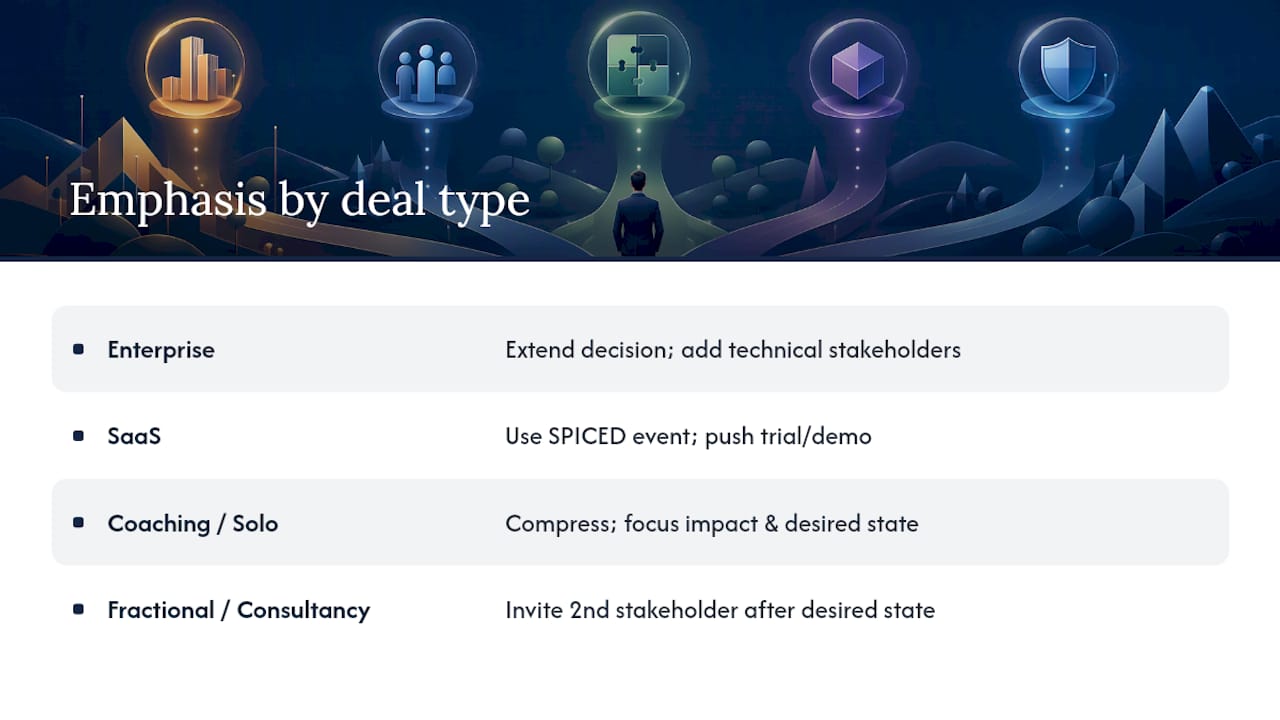
The six-stage map stays constant, but the emphasis shifts depending on who you’re selling to. For enterprise deals, lean on MEDDIC and extend the decision stage significantly, since procurement, legal and technical stakeholders each need their own mini-discovery. Invite a technical evaluator early with language like: “Would it help to bring your systems lead into our next call, so we can answer any integration questions directly?”
For SaaS deals, SPICED’s critical-event question does the heaviest lifting, because subscription buyers often need a trigger, not just a problem, to justify switching now. Keep the call tight and push toward a trial or technical demo fast.
For coaching and solo-service buyers, the framework compresses naturally. Budget and authority usually sit with one person, so spend more time on impact and desired state, since the emotional and financial stakes of the decision rest entirely on them.
For fractional or consultancy-style engagements, invite a second stakeholder only once desired state is confirmed, to avoid overwhelming an early conversation with too many voices.
Mistakes that quietly wreck discovery calls
Five mistakes come up again and again in call reviews. Accepting vague answers without a follow-up is second, since “it’s not great” isn’t evidence of anything. Skipping the decision-process question because it feels awkward is third, and it’s exactly why deals stall in “verbal yes” purgatory. Jumping to a demo before impact is quantified is fourth. Failing to agree a dated next step before hanging up is fifth, and it’s the single easiest fix on this list.
Two drills fix most of this fast. Record and replay one call a week, listening only for the moment you should have branched but didn’t. Then run a question-branching exercise with a colleague: they answer vaguely on purpose, and you practise the follow-up that turns it into evidence.
Pro Tip: Set a visible timer for each call block. Reps who can see the clock control the agenda far better than those relying on instinct, and it stops rapport-building from eating the impact conversation.
Trainer perspective: what to coach first
Score evidence quality before you score anything else. A rep who talks less but leaves every call with a quantified impact and a dated next step is outperforming a “confident” talker every time, and scoring behaviour over personality makes coaching fair and specific rather than vague. Call quality maps directly to pipeline accuracy: weak evidence produces inflated forecasts that collapse at quarter end. Run weekly fifteen-minute call reviews using a simple three-column feedback sheet: evidence captured, evidence missing, next action, and you’ll see qualification consistency improve within a month.
— Jerry
Turning this framework into a habit across your team
Reading a framework is easy. Getting twenty reps to run it the same way, every call, under pressure, is the actual job, and it’s where most teams stall out on their own. Structured coaching can embed this kind of evidence-led discovery process effectively, in contrast to one-off training days that fade quickly.
The Sales Training Cohorts programme is built for teams who want repeated, coached practice on call structure, question phrasing and CRM handoff discipline rather than a single workshop that everyone forgets by Friday. For solo consultants and service business owners running discovery calls alone, the sales acceleration track (priced between £2,995 and £5,995 as a one-off engagement) focuses coaching directly on qualification and evidence capture. Larger teams typically work through a bespoke coaching and consultancy engagement, priced between £4,500 and £8,500. If you’d rather discuss what fits your team’s size and buying motion, get in touch through Aheadofsales and start with a conversation about where your discovery calls are currently losing evidence.
Sources
- Discovery Call Framework: Evidence, Branches, and Decisions
- Discovery Call Framework: Questions, Scripts & the 30-Minute Structure
- What is a discovery call? Questions & sample script — Salesforce
FAQ
How should you structure a discovery call?
Structure it around six evidence stages: purpose, current state, desired state, impact, decision and next step, each with its own exit evidence before you move on. A time-boxed 30-minute agenda with fixed minute allocations keeps the conversation on track and stops any single stage eating the whole call.
What are the four phases of customer discovery?
Definitions vary across sales methodologies, but a common practical version covers understanding the current situation, defining the desired outcome, quantifying the impact of the gap, and confirming the decision process and next step. Aheadofsales’s own framework extends this into six explicit stages to make each phase’s exit evidence unmistakable.
What are the five stages of cold calling?
Cold calling and discovery calls are related but distinct: cold calling typically covers opening, permission, hook, qualifying question and booking a next step, while a full discovery call goes deeper into current state, impact and decision authority once that next step is booked. The six-stage discovery map above picks up where a successful cold call leaves off.
How long should a discovery call be?
Thirty minutes is the most common and practical length, though many teams compress to 20 minutes for warm inbound leads or extend to 45 minutes for enterprise deals involving multiple stakeholders. The right length depends on how many people need to weigh in on the decision, not a fixed rule.
Does Aheadofsales offer discovery call training?
Yes, discovery call structure and evidence capture are core parts of Aheadofsales’s coaching work, delivered through Sales Training Cohorts for teams and a dedicated acceleration track for solo consultants. Current pricing and package details are listed on the Aheadofsales website.