
Closing skills training teaches sellers to read a buyer’s readiness and apply the right technique at the right moment, rather than defaulting to a single closing line. The single most impactful habit to install straight away is securing a calendar-bookable next step on every call, since Convo’s analysis of nearly 43,000 sales calls found missing next steps cut close rates by 71%. Combine that discipline with structured techniques like the Summary and Question closes catalogued by HubSpot, and role-play coaching to make the behaviour stick.
TL;DR:
- Securing a specific, calendar-bookable next step on every sales call reduces close loss caused by missing follow-up actions by 71%.
- Using closing techniques that map to buyer psychology, such as the summary close and question close, improves accuracy and relevance over habitual moves.
- Tailoring the close to the buyer’s state—ready, indecisive, stalling, or guarded—significantly increases the chances of closing successfully.
- Overcoming late-stage objections involves directly addressing real blockers, clarifying approval processes early, and removing operational payment or onboarding friction.
- Blended training that couples workshops, realistic role-playing, and ongoing coaching yields better long-term closing performance compared to workshops alone.
Table of Contents
- Core closing techniques every seller should master
- Match technique to buyer state and deal stage
- Overcoming common objections and removing payment friction
- How closing skills training is delivered: courses, workshops and coaching
- How to practise and sustain better closing rates
- Why blended coaching and training wins on closing skills
- How Aheadofsales can help you close more, faster
- Sources
- FAQ
Core closing techniques every seller should master
Most sellers know two or three closing moves and reach for whichever one is habitual, not whichever fits the buyer in front of them. That’s the gap closing skills training exists to close. HubSpot’s research into why certain sales closing techniques work shows the effective ones map cleanly to buyer psychology, not to seller preference.
Here are the seven you need in your kit, with a decision cue and a script stem for each:
- Summary close. Recap the agreed value points before asking for commitment. Use when the buyer has gone quiet through a long evaluation and needs the case restated in one breath. “So to confirm, you need X by Q3, this solves Y, and the budget works at Z. Shall we move forward?”
- Question close. Ask a question whose honest answer is a yes to buying. Use with analytical buyers who want to reach the conclusion themselves. “If we could guarantee delivery by that date, is there anything else stopping us signing this week?”
- Assumptive close. Speak as though the decision is made and move to logistics. Use with buyers who’ve shown strong verbal buy-in but haven’t formally said yes. “I’ll get the contract over today. Does Thursday or Friday work better for kickoff?”
- Next-step/calendar close. Lock a specific date and named attendee before ending the call. Use on every single call, regardless of deal stage. “Let’s grab 20 minutes next Tuesday with your finance lead to walk through the numbers.”
- Soft close. Offer a low-pressure option that tests appetite without forcing a decision. Use with relationship-focused buyers who resist anything that feels pushy. “Would it help to see a short pilot before you decide?”
- Now-or-never close. Attach a genuine, time-bound reason to act now. Use sparingly, and only when the deadline is real (end-of-quarter pricing, limited onboarding slots).
- Objection close. Surface the real blocker directly, then answer it. Use whenever a buyer hesitates without stating why. “What would need to be true for this to be a clear yes for you?”
Practise these until the phrasing feels like your own voice, not a script you’re reading off a card.
Match technique to buyer state and deal stage
Picking the wrong close for the wrong buyer is where deals stall, not where they die. A useful sales closing techniques breakdown groups buyers into four states, and each one calls for a different move.
- Ready buyers (verbal agreement, active questions about timing) respond well to the Assumptive close or the Next-step close. Don’t overtalk it. Ask for the calendar date.
- Indecisive buyers (repeated “let me think about it”) need the Soft close or Question close, giving them a low-risk way to say yes.
- Stalling buyers (delayed replies, vague timelines) need the Objection close to surface what’s genuinely holding them back, and sometimes the Now-or-never close if a real deadline exists.
- Guarded buyers (short answers, minimal information shared) need more discovery before any close attempt, not a harder push.
That last point matters more than the techniques themselves. Wise’s guide to closing a sale makes the case that closing is a continuation of discovery, and when qualification has been done properly, the close becomes a formality rather than a negotiation.
Before attempting any close, check the deal against this readiness list:
- Has the buyer named a specific problem you’ve confirmed you solve?
- Do you know who signs off, and have they been part of the conversation?
- Has budget been discussed in real numbers, not vague ranges?
- Is there a genuine timeline driving urgency, rather than one you’ve invented?
If two or more of those are unclear, go back to discovery. Closing harder won’t fix a qualification gap.
Overcoming common objections and removing payment friction
Verbal agreement isn’t the finish line. Wise’s research into closing found that late-stage stalls usually come down to uncertainty about approvals, payment steps, or “what happens next,” not a change of heart about the product.
When an objection surfaces, try this sequence:
- Name the real blocker. Ask “what would need to be true for this to work?” rather than accepting a vague “not right now.”
- Reframe on ROI. Reconnect the cost to the specific number or outcome the buyer cared about earlier in the conversation.
- Offer phased delivery. A smaller first phase lowers perceived risk without losing the deal.
- Bring in the right stakeholder. A short call with a finance lead or technical approver often resolves what a proposal document can’t.
Build a frictionless close checklist for every deal nearing signature: confirmed payment method, vendor onboarding steps, invoice or PO requirements, and a named approver with a date attached. Businesses handling multi-stage approvals often find automating operational finance steps removes exactly this kind of late-stage drag.
Pro Tip: Ask “what does your approval process actually look like?” in the first call, not the last one. Buyers rarely volunteer this until you ask directly.
How closing skills training is delivered: courses, workshops and coaching
Format matters more than most sales leaders assume. A short workshop builds awareness of the techniques above in an afternoon, but awareness rarely changes behaviour on a live call. Research on sales closing strategies points to blended delivery, workshop plus cohort practice plus ongoing 1:1 coaching, as what actually shifts conversion numbers over months, not days.
- Workshops introduce the framework and vocabulary the whole team can share.
- Cohorts and role-play let reps rehearse the techniques against realistic pushback before trying them on a real buyer.
- 1:1 coaching embeds the behaviour change, correcting the small timing and phrasing habits that group training can’t catch.
- E-learning works for refreshers and onboarding but rarely shifts an experienced rep’s habits alone.
When evaluating a training programme for consultants or any provider, ask three questions: does it include manager coaching after the workshop, does it build in on-the-job practice against real pipeline deals, and does it measure behaviour change rather than just attendance?
How to practise and sustain better closing rates
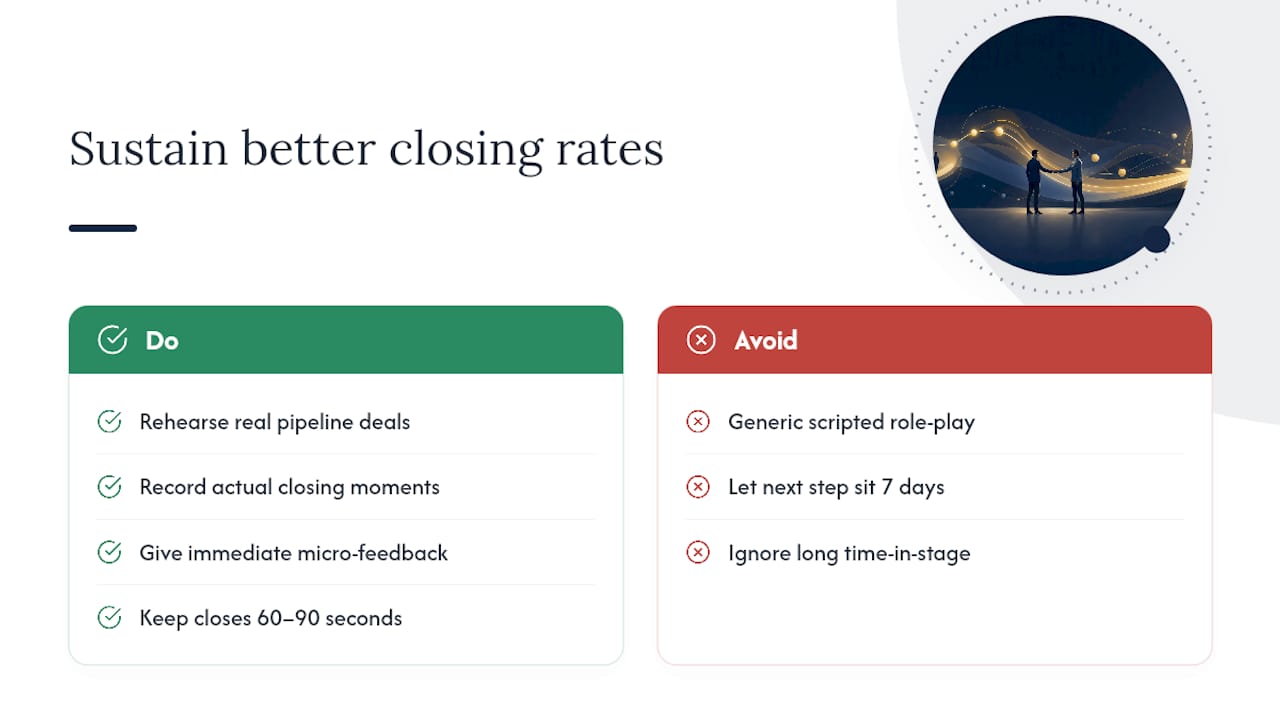
The fastest improvement comes from rehearsing real pipeline deals, not generic scenarios. SPOTIO’s research into closing techniques that win more deals found recording actual closing moments and giving immediate micro-feedback speeds up behaviour change far more than scripted role-play, and that well-prepared closes typically run just 60 to 90 seconds.
Build manager coaching triggers directly from pipeline data: flag any deal where time in stage has doubled the average, or where no next step has been logged in seven days. Track three numbers weekly: next-step coverage rate, average time in stage, and close conversion by stage.
Why blended coaching and training wins on closing skills
Workshops teach the techniques; coaching makes them instinctive under pressure. Sustained closing improvement comes from pairing structured technique training with ongoing 1:1 coaching against live deals, not from a one-off session.
— Jerry
How Aheadofsales can help you close more, faster
Most closing skills training stops at the workshop. Aheadofsales pairs that structured technique training with bespoke 1:1 coaching against your own live pipeline, so the skills get embedded on real deals rather than left in a slide deck.
For teams of 50 to 1,000 people, Sales Training Cohorts combine group workshops with follow-up coaching, and fully bespoke team coaching and consultancy engagements are offered as one-off packages. Solo consultants and service business founders can access a sales acceleration track. If you’d rather test the waters first, The Sage Collective is available as a monthly subscription. Visit the Aheadofsales homepage to talk through which format fits your team.
Sources
- How to close a sale: 18 techniques & why they work — HubSpot
- The Best Sales Closing Techniques in 2026: 12 for B2B SaaS — Convo
- How to close a sale: Proven techniques and expert strategies — Wise
FAQ
What are the top closing techniques in sales?
The most reliable techniques are the Summary, Question, Assumptive, Next-step, Soft, Now-or-never, and Objection closes, each suited to a different buyer state, as HubSpot’s closing research sets out. Most experienced sellers rotate between three or four of these depending on the deal.
What are the most common sales closing techniques used by teams?
Teams most often rely on the Summary close, Question close, Assumptive close, and Objection close because they work across most B2B deal types without needing a hard deadline. The Next-step close belongs in every call regardless of which of these you also use, since Convo’s data links it directly to higher conversion.
What are five effective closing techniques to start with?
Start with the Summary, Question, Assumptive, Soft, and Next-step closes, since together they cover ready, indecisive, and relationship-focused buyers without requiring an artificial deadline. Layer in the Objection and Now-or-never closes once you’re comfortable reading buyer signals.
What are the golden rules of successful closing?
The core rules are: qualify thoroughly before you attempt to close, match the technique to the buyer’s state rather than your habit, always secure a calendar-bookable next step, surface objections directly instead of avoiding them, and remove operational friction (payment, approvals, onboarding) before it stalls a signed deal. Structured closing skills training builds these into habit through coaching, not just a one-off session.
How is closing skills training usually delivered?
It’s typically delivered through a mix of workshops for framework knowledge, cohort-based role-play for applied practice, and ongoing 1:1 coaching to embed the behaviour on real deals. Aheadofsales structures its programmes this way, with team engagements from £4,500 to £8,500 and solo operator packages from £2,995 to £5,995.