
AI for sales training gives reps on demand, realistic rehearsal with objective feedback so they ramp faster and coach more consistently. The tools work best for practice repetitions, roleplay against simulated buyers, and pulling patterns out of real call data. They fall short on strategic judgement, negotiation nuance, and the accountability that only a human coach provides. Use AI to multiply practice volume, then use people to turn that practice into performance.
TL;DR:
- AI sales training tools excel at increasing practice volume and providing real-time, simulated scenarios, but they lack the strategic judgment and negotiation nuance of human coaches.
- Combining AI-driven practice with ongoing human coaching yields the best results, particularly in converting repetitions into measurable pipeline growth within 90 days.
- Evaluation before pilot programs should focus on realism, transparency of scoring, integration with existing systems, and clear data security policies.
- The most effective deployment involves small, time-boxed pilots with at least two practice sessions per week and close manager review, rather than broad or unstructured rollouts.
- The right AI tool depends on your main sales challenge, whether it’s practice repetition, call analytics, or structured learning, and should be paired with leadership development for maximum impact.
Table of Contents
- What is AI for sales training and how do reps use it?
- What outcomes do sales teams actually report?
- Which AI training format fits which sales problem?
- How should you evaluate and pilot an AI training tool?
- What does a realistic 90-day rollout look like?
- Where should reps and managers go next?
- Where AI genuinely helps and where it still falls short
- A managed route to faster, measurable sales growth
- Sources
- FAQ
What is AI for sales training and how do reps use it?
Ask a room of sales managers what “AI for sales training” means and you’ll get four different answers, because it covers four genuinely different tools. Understanding which one you need matters more than picking a vendor.
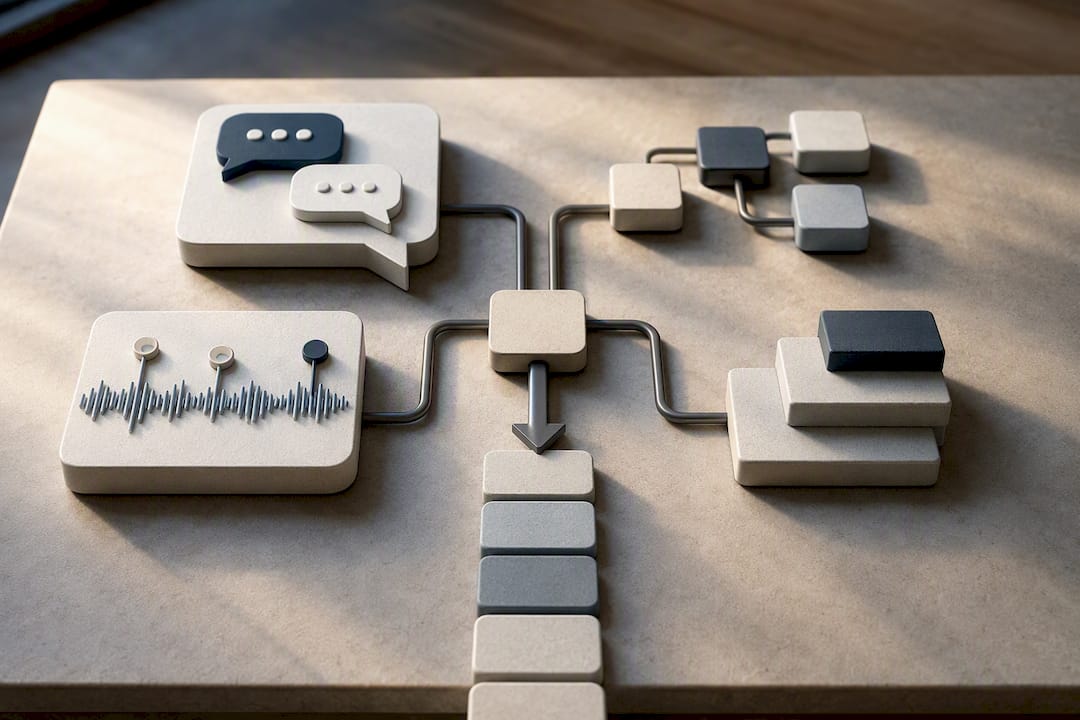
Roleplay simulations let reps practise against an AI buyer that pushes back, raises objections, and reacts to tone and phrasing, either by voice or text. These sit closest to what most people picture when they hear the term.
Persistent coaching agents, sometimes called personified application layers or PALs, go a step further. Rather than resetting after every session, they carry memory across conversations, so a rep working through a multi-stage negotiation can pick up where they left off. Tavus has described this shift as a move away from scripted branching scenarios towards something closer to a real, evolving relationship with a buyer persona.
Call analytics and scorecards analyse recorded live calls against a defined rubric, surfacing where a rep talked too much, missed a buying signal, or skipped a qualifying question. Some platforms then feed those gaps straight back into targeted practice sessions.
Personalised learning paths use performance data to sequence microlearning: a rep weak on discovery questions gets short modules and drills on exactly that skill, rather than a generic course everyone sits through regardless of need.
Most serious sales enablement technology stacks now blend at least two of these approaches, pairing roleplay for repetition with analytics for direction.
What outcomes do sales teams actually report?
Vendor demos promise a lot. The honest answer is that measurable gains are real but concentrated, and they depend heavily on how well a programme is rolled out, not just which tool you buy.
Statistic Callout: Microsoft’s internal case study on its Agent J.ai rollout reported substantial boosts in customer planning efficiency and agile workflow performance. Those figures come from a large enterprise with dedicated change management resource behind the deployment, not a plug-and-play result any team gets automatically.
The metrics worth tracking on your own team are more modest but easier to verify: ramp time to first quota-hitting month, conversion uplift on specific call types, and objection-handling success rate measured before and after a training cycle.
Be sceptical of any claim that isn’t tied to a specific metric and a specific baseline. “Improved performance” means nothing; “cut average ramp time by three weeks across a cohort of 12 reps” means something. Watch for vendors quoting improvement percentages without stating the starting point, and for case studies drawn from a single enterprise rollout presented as if it were typical of any team, any size. The Microsoft numbers are impressive precisely because they sat inside a wider organisational change effort, not because the software did the work alone.
Which AI training format fits which sales problem?
Not every AI tool solves the same problem, and matching the right format to the right moment in a rep’s week saves you from buying capability you’ll never use.
- Pre-call rehearsal. A rep with a tricky call in twenty minutes runs a quick simulated version of that exact conversation, testing phrasing and anticipating pushback before it happens live.
- On-demand objection practice. When a new objection starts appearing across the pipeline (a competitor’s price cut, a new compliance concern), reps drill against it repeatedly until the response becomes automatic. UMU’s roleplay chatbot is built around this kind of instant competency scoring, giving managers a “field-ready” bar reps have to clear before taking the scenario live.
- Ongoing coaching from call analytics. Rather than one-off practice, this runs continuously in the background, flagging drift in talk time, discovery quality, or next-step clarity across every real call a rep makes. Gong’s AI Trainer applies the same scorecard used to judge live calls to the practice sessions themselves, so reps aren’t training against one standard and being judged against another.
- Formal learning paths and certifications. These suit reps building foundational AI literacy or moving into a new product line, where structured modules matter more than rehearsal reps.
Buying all four at once rarely works. Start with whichever gap costs you the most deals right now.
How should you evaluate and pilot an AI training tool?
Most evaluation mistakes happen before the pilot even starts, when a manager gets seduced by a slick demo instead of asking the boring questions that determine whether reps will actually use the thing.
Run through this before signing anything:
- Realism. Does the simulated buyer sound like your actual buyers, or a generic customer persona built for nobody in particular?
- Playbook alignment. Can you load your own objection scripts and qualification criteria, or are reps training against someone else’s methodology?
- Scoring transparency. Can you see exactly why a session scored 6 out of 10, or is the rubric a black box?
- Integration. Does it connect cleanly to your CRM and call recording system, or does it demand a separate login nobody remembers to use?
Security deserves its own line of questioning. Ask where recorded calls are stored, whether they’re used to training the vendor’s broader model beyond your account, how long data is retained, and who at your company can access transcripts. Sales calls often contain pricing, competitor intelligence, and personal client details, so treat this like any other data processing agreement, not a formality.
For the pilot itself, keep it small and time-boxed: one team of six to ten reps, four to six weeks, two or three metrics agreed upfront (ramp time, one conversion metric, one objection-handling metric). Anything broader gets messy to measure.
Pro Tip: Assign a manager to review AI-generated session scores weekly, not just at the end of the pilot. Reps disengage fast when practice feedback sits unreviewed, and the tool’s value drops to zero the moment they stop trusting the scoring.
Techniques for coaching sales reps around this kind of feedback loop matter as much as the software itself.
What does a realistic 90-day rollout look like?
A 90-day pilot works better than an open-ended rollout because it forces a decision point. Structure it in three phases: weeks 1 to 2 for setup and playbook loading, weeks 3 to 10 for practice and live coaching cycles, weeks 11 to 13 for measurement and a go/no-go call on wider adoption.
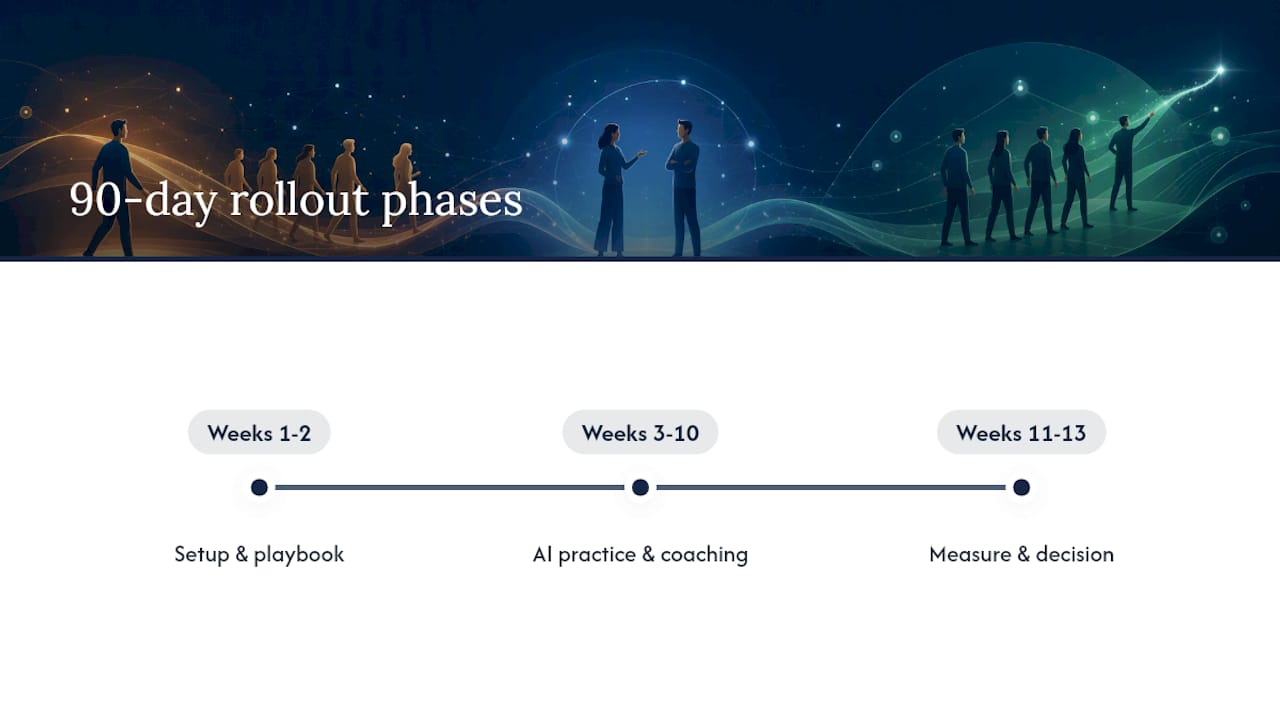
Set the cohort at 8 to 15 reps. Smaller and you can’t trust the numbers; larger and managers lose the ability to review sessions properly. Cadence matters more than volume: two AI practice sessions a week paired with one human coaching conversation reviewing the results tends to outperform daily AI drills with no human follow-up.
The reason blending works comes down to what each side does well. AI practice multiplies repetitions cheaply, exposing reps to more objection variations in a month than they’d hit in a quarter of live calls. Human coaching interprets those repetitions, spots the pattern behind a rep’s recurring mistake, and pushes on mindset and confidence in ways a scoring rubric can’t. Structured coaching engagements built around this combination, like those run through bespoke sales team coaching, tend to convert practice volume into actual pipeline movement rather than letting it stay a training exercise.
Set KPI targets before you start, not after. A realistic 90-day target for a mid-sized B2B team is a measurable shift in one leading indicator, ramp time or a specific objection success rate, not a full quarter’s revenue swing.
Where should reps and managers go next?
Building AI literacy across a sales team doesn’t require a huge budget, and several credible learning paths exist for exactly this purpose.
- Coursera’s AI for Sales specialisation bundles progressive courses covering AI literacy alongside hands-on tool skills, useful for reps starting from scratch.
- Salesforce’s free AI sales training courses focus on applying AI directly within selling workflows.
- LinkedIn Learning’s AI Essentials for Sales Professionals offers a shorter, more curated path for managers wanting a quick grounding before rolling anything out to a team.
Internally, three steps matter before any tool goes live: get explicit consent for recording and using call data, write down the objection scripts and qualification criteria you want the AI to reflect, and agree the scorecard categories with your team before scores start appearing. Skip that last step and reps will argue with the rubric instead of learning from it. Structure coaching sessions around specific flagged moments from AI sessions rather than general performance chat. It’s the difference between a rep hearing “get better at discovery” and hearing “here’s the exact question you skipped on three of your last five calls.”
Where AI genuinely helps and where it still falls short
AI is an efficiency multiplier, not a replacement coach. It gives reps volume: more reps against more objections than any manager could realistically run live. What it can’t do is read a complex, multi-stakeholder deal or coach a rep through the confidence problem sitting underneath a skill gap. For that, and for developing leadership capability in future sales managers, bespoke 1:1 coaching still wins outright. Blend both and the measurable gains compound.
— Jerry
A managed route to faster, measurable sales growth
Reading a pilot plan is one thing. Running one properly, with a coach who actually reviews the scores and turns them into behaviour change, is another. This provider combines bespoke 1:1 coaching with structured, traditional training and consultancy, suited for growth-minded businesses and solo consultants seeking more than a subscription and a login.
A discovery call is the natural starting point: you talk through where reps are getting stuck, and Aheadofsales scopes a pilot around that gap rather than a generic curriculum. Team engagements run from £4,500 to £8,500 as one-off packages, while solo consultants and service business owners can access the sales acceleration track from £2,995 to £5,995. If you’re weighing up AI tools against a managed alternative, book a discovery call through the Sales Training Cohorts page and see what a properly coached pilot actually looks like.
Sources
- How Microsoft built an AI coach to scale personalized sales training – Inside Track Blog
- AI Sales Training: Free Online Courses
- AI for Sales Specialization
FAQ
What is the best AI tool for sales training?
There isn’t a single best tool, because roleplay simulators, persistent coaching agents, and call analytics platforms solve different problems. The right choice depends on whether your priority is practice volume, live-call feedback, or structured learning paths, so match the format to your biggest current gap rather than picking by reputation.
How can I use AI to help me in sales?
Reps typically start with pre-call rehearsal against a simulated buyer and on-demand objection drills before moving to ongoing call analytics for continuous feedback. Pairing that practice with a human coach who reviews the results tends to convert rehearsal into real pipeline movement faster than AI practice alone.
What are the best AI certifications for sales?
Coursera’s AI for Sales specialisation and Salesforce’s free AI sales training courses are two credible, widely used starting points for building practical AI literacy in a sales role. LinkedIn Learning’s AI Essentials path offers a shorter option for managers wanting a quick grounding first.
Is bespoke coaching still worth it if my team already uses AI training tools?
Yes. AI tools multiply practice repetitions and flag patterns in call data, but they can’t coach judgement on complex deals or develop a rep’s confidence and leadership potential. Aheadofsales’ team coaching and consultancy packages are built specifically to layer human coaching on top of whatever practice tools a team already runs.
How much does AI sales training cost compared with managed coaching?
AI tool pricing varies widely by vendor and seat count, so check current terms directly with each provider. Aheadofsales publishes its own packages: bespoke team engagements run £4,500 to £8,500 as a one-off, and solo consultants can access the acceleration track from £2,995 to £5,995.