
When procurement enters a deal, the seller’s job is simple: engage early, re-anchor the economic buyer, and defend price by trading pre-priced variables rather than cutting the number. The moment you spot a procurement negotiation tactic forming, send a one-paragraph value recap to your economic buyer and hand procurement a ready-made kit. That’s the credibility built around negotiation coaching focused on speed.
TL;DR:
- Building a procurement kit and pre-pricing tradeables before negotiation helps maintain margin and reduces the need for reactive improvisation under pressure.
- Re-engaging the economic buyer early with a value recap and involving them in a three-way call prevents procurement from controlling the decision process.
- Asking targeted questions about late discount requests reveals whether they are genuine budget issues or leverage tactics, allowing for appropriate trade-based responses.
- Defending clauses such as liability caps and intellectual property rights is crucial, as conceding these early weakens the overall negotiating position.
- Training reps through simulation and personalized coaching embeds trade-first habits, making negotiation discipline consistent rather than dependent on knowledge alone.
Table of Contents
- What should you do in the first 48 hours when procurement shows up?
- Building a procurement kit and price-defence playbook before you need one
- How do you diagnose the real reason behind a late price objection?
- Redline triage: when to defend, negotiate, or escalate a clause
- Protecting margin after signature: what stops the next renewal fight
- Why negotiation discipline has to be trained, not just briefed
- Turn these tactics into a repeatable team habit with Aheadofsales
- Sources
- FAQ
What should you do in the first 48 hours when procurement shows up?
The seller who stalls here loses margin before the negotiation even begins. Procurement teams are trained to reframe a deal around price alone, so your job in the first two to three days is to reassert value and control the pace.
- Re-engage the economic buyer. Send a short recap of the agreed value and propose a three-way call including procurement. This stops procurement from becoming the sole channel for decisions.
- Send the procurement kit immediately. Bundle your MSA/SOW approach, security evidence, implementation plan, and reference list into one pack. Teams that send this early hold more margin than those who wait to be asked.
- Pre-price four to six tradeables and confirm who has authority to approve each one internally. Set a decision deadline and ask procurement, directly, who signs off on their end.
- Read the signal before you respond. A demand for 15% off with no timeline attached is usually leverage, not a value gap. A comment like “we can’t justify this against Vendor B’s proposal” is a genuine budget or competitor signal worth a real diagnostic question.
Pro Tip: If procurement opens with a round number discount request and no stated reason, ask “what’s driving that figure?” before you say anything about price. Silence after the question does more work than a counter-offer.
Building a procurement kit and price-defence playbook before you need one
Most margin is lost in the scramble, not the negotiation itself. Sales teams that build a procurement kit and triage process before procurement ever appears hold measurably more margin than reactive teams, because they aren’t improvising terms under time pressure.
Your kit should contain:
- A standard MSA and SOW structure, with fallback clauses pre-approved by legal.
- Security and compliance evidence (SOC 2 reports, data handling summaries) ready to send without a request.
- A one-page implementation plan showing time-to-value.
- A short reference list of comparable customers, ideally in the buyer’s sector.
- A redline triage log tracking which clauses you’ve conceded before and why.
Pre-pricing tradeables means deciding, before the call, what a longer term is worth, what a faster payment cycle is worth, and what a scope reduction saves you — a process that benefits greatly from expert process improvement and change-management consulting to map procurement workflows effectively. Map each one to its margin impact in advance so you’re not doing mental arithmetic while procurement watches. Then agree internally who has walk-away authority and who can approve which concessions. Every conditional trade needs to hit the order form fast: delays in documenting agreed conditions can erode negotiated value, often because the verbal agreement drifts once procurement’s own notes diverge from yours.
How do you diagnose the real reason behind a late price objection?
A discount request that arrives after verbal agreement almost never means what it says on the surface. Diagnostic questioning separates five distinct drivers, and each one needs a different response.
- Value gap — “Which part of the ROI case doesn’t hold up for your finance team?” If they can’t answer specifically, the objection is tactical, not real.
- Budget or timing — “Is this a budget ceiling for this quarter, or a total contract value issue?” This tells you whether to restructure payment terms rather than price.
- Authority — “Who else needs to sign off on this figure?” If procurement can’t name a person, they may be testing you without a mandate to actually block the deal.
- Competitor price — “Can you share the structure they’re comparing against?” Rarely apples to apples once you ask.
- Leverage play — “What would need to be true for this to move forward at the current number?” This flushes out whether there’s a real blocker at all.
Once you know the driver, trade instead of discount. A workable script: “We can move on payment terms if you commit to a 24-month term and a signed reference call.” That phrasing ties every concession to something you get back, which is the entire logic of a conditional trade.
Delivery matters as much as content. State the anchor number, explain the value once, then stop talking. Reps who fill silence after stating a position tend to negotiate against themselves. Timing helps too: pushing final rounds about a week before the buyer’s quarter-end compresses procurement’s internal pressure and reduces last-minute leverage plays, since they’re then working against their own deadline rather than yours.
Pro Tip: Never answer a discount demand with a discount. Answer it with a question. The question buys you the information you need to trade rather than concede.
Multi-sourcing is procurement’s other standard play: inviting two or three vendors to a “final round” purely to manufacture price tension. Treat it as a signal to reinforce differentiation and total cost of ownership, not to match a lower number blind. If you don’t know what you’re actually being compared against, you can’t respond to it credibly. Aheadofsales’ negotiation tips for protecting margin cover scripts for exactly this scenario.
Redline triage: when to defend, negotiate, or escalate a clause
Not every redline deserves the same response, and treating them all as “must negotiate” burns time and goodwill on points that don’t matter. Running legal and security review in parallel with commercial talks, and triaging each clause by category, keeps the deal moving.
- Defend — liability caps, IP ownership, standard indemnity language. Hold the line; these rarely move without executive sign-off, and conceding early signals weakness on everything else.
- Negotiate — payment terms, renewal notice periods, service level specifics. These are genuinely tradeable and should map to your pre-priced list.
- Escalate — anything touching data residency, security certifications, or unlimited liability. These need legal-to-legal conversation, not AE improvisation.
Recommended service levels: AE rebuttal within 24 hours of receiving redlines, sales ops counter within 48 hours, and a legal-to-legal call scheduled within five business days if the clause sits in the escalate category. Where reasonable, accepting the customer’s own contract paper speeds review considerably because their legal team already knows their own template. Bring in an executive sponsor only once, framed as a decision point rather than a rescue mission, so it reads as momentum rather than panic.
Protecting margin after signature: what stops the next renewal fight
The negotiation doesn’t end at signature. What you build into the contract and the account plan now determines how hard procurement pushes at renewal.
- Include a most-favoured-nation clause carefully, a defined renewal notice period, and a clear change-order process for scope shifts.
- Run quarterly business reviews with a visible KPI dashboard so the account’s value is never in question when renewal talks start.
- Hit early implementation milestones publicly; a client win six months in gives procurement far less room to reopen price than a quiet, undocumented rollout.
Early proof points and a citable case study do more to blunt future leverage than any clause. A buyer who can already see the return has a weaker argument for a discount next time.
Why negotiation discipline has to be trained, not just briefed
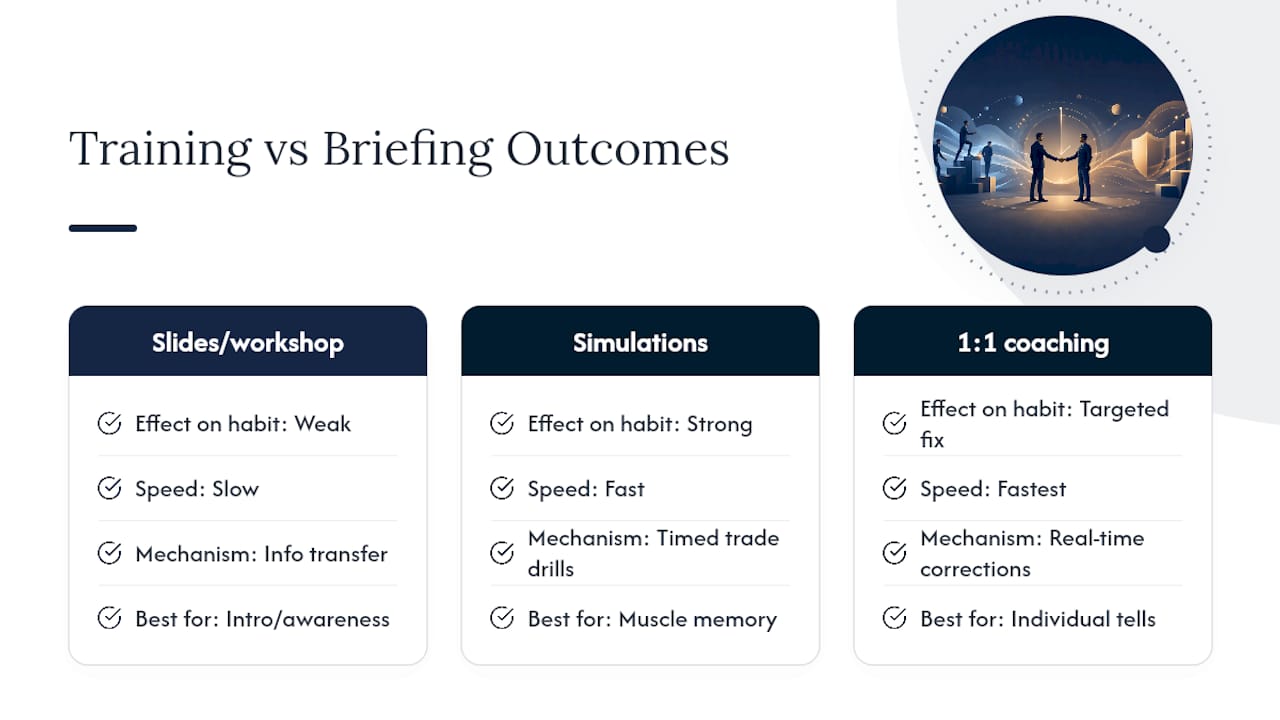
Most of what breaks in procurement negotiations isn’t a knowledge gap. Reps know they shouldn’t discount first. They do it anyway, under pressure, because the habit hasn’t been drilled into muscle memory. Repeated simulation against a pre-approved trade library changes that faster than a slide deck or a one-off workshop ever will, because it forces the same decision under time pressure until the trade-first response becomes automatic rather than aspirational.
Bespoke 1:1 coaching does the rest: it catches the specific tell in someone’s posture, the pause that signals they’re about to cave, and corrects it in real time. That’s the shift from discount-first to trade-first, and it tends to land fastest with growth-focused teams and solo operators scaling fast enough that one bad negotiation habit compounds across every future deal.
— Jerry
Turn these tactics into a repeatable team habit with Aheadofsales
Reading a playbook and running it under pressure from a procurement lead who negotiates for a living are two different skills. This gap is closed through bespoke 1:1 coaching and negotiation-simulation training that puts your team through realistic procurement scenarios, live objections, redline pressure, multi-sourcing bluffs, until trading instead of discounting becomes the default response, not the aspiration.

Training and consultancy packages are designed for B2B teams aiming for consistent quarterly growth, alongside sales acceleration packages for solo service businesses that need the same discipline without a full team around them. Outcomes typically show up fastest in negotiation-heavy pipelines, where one recovered concession pays for the coaching several times over. If procurement pressure is already eating into your margin, the sales training services page is the right place to see how a programme would be structured for your team, and to book a discovery call to talk through your current negotiation gaps.
Sources
- Navigating Procurement and Legal in Enterprise Sales
- Price negotiation: how to hold margins under pressure
- How do you handle a price objection late in a deal in 2027?
FAQ
What’s the first thing to do when procurement enters a deal?
Re-engage your economic buyer immediately with a short value recap and propose a three-way call, then send your procurement kit within 48 hours to keep control of the narrative.
How many tradeables should I pre-price before negotiating with procurement?
Four to six tradeables covering term length, payment timing, scope, and reference commitments give you enough range to trade without discounting on price directly.
How do I tell if a discount request is a real budget issue or a leverage play?
Ask what specifically is driving the number; a vague answer with no named approver usually signals leverage, while a specific budget ceiling or named competitor points to a real constraint.
Which contract clauses should I always defend rather than negotiate?
Liability caps, IP ownership, and standard indemnity language should be defended by default, since conceding on these early tends to weaken your position on every clause that follows.
Can training actually change how a rep handles procurement pressure?
Yes. Negotiation-simulation coaching repeatedly drills trade-first responses under realistic pressure, which shifts habitual discounting far more reliably than a one-off briefing.