
This article gives you 12 copy-ready sales role play scenarios plus a five-step runbook, so you can run a focused practice drill in your next team meeting with no prep beyond picking the scenario. Each session should run as a 5 to 10 minute drill followed by a structured debrief, scored against a short rubric rather than left as a vague “how did that feel?” chat. Highspot’s research on role-play exercises backs this format, and Sales training providers often build the same short, scored drills into every coaching cycle with clients.
TL;DR:
- Focus on 3 to 5 scenarios directly tied to recent deal losses, such as price objections or stakeholder resistance, to ensure relevant skill practice.
- Run each scenario for five to ten minutes with a structured debrief, score against four fixed criteria, and track progress over four to six weeks.
- Build scenarios around specific buyer personas, stakeholder dynamics, and real data, introducing variability and real-world obstacles for authentic practice.
- Use a simple rubric scoring questions asked, control, value articulated, and next step clarity to measure improvement consistently each session.
- Emphasize short, targeted drills over long mock calls, integrating role-play into coaching cycles to improve skills that directly impact pipeline outcomes.
Table of Contents
- TL;DR: what to run first and what to measure
- What a sales role-play scenario actually is
- Why sales role-play works: the evidence behind the drill
- How to run a role-play session: the five-step runbook
- Scenario families and when to use each one
- 12 ready-to-use sales role play scenarios and scripts
- Matching scenarios to your sales cycle and roles
- How to use a script without sounding scripted
- Customising scenarios by role, tenure and methodology
- Ahead of Sales coaching notes on turning drills into results
- What to score in every debrief
- Giving and receiving feedback without it turning defensive
- Building customer personas and real variability into scenarios
- Why most role-play sessions fail before they start
- How Ahead of Sales turns practice into pipeline
- Sources
- FAQ
TL;DR: what to run first and what to measure
Start narrow. Pull the last quarter of lost deals, find the pattern (usually price objections, a stalled multi-stakeholder deal, or a weak discovery call), and pick 3 to 5 scenarios that match it directly. Running a scenario that has nothing to do with where your team actually bleeds revenue wastes a session.
- Choose 3 to 5 scenarios tied to current deal losses, not a random assortment.
- Timebox every drill to 5 to 10 minutes and the debrief to roughly the same length.
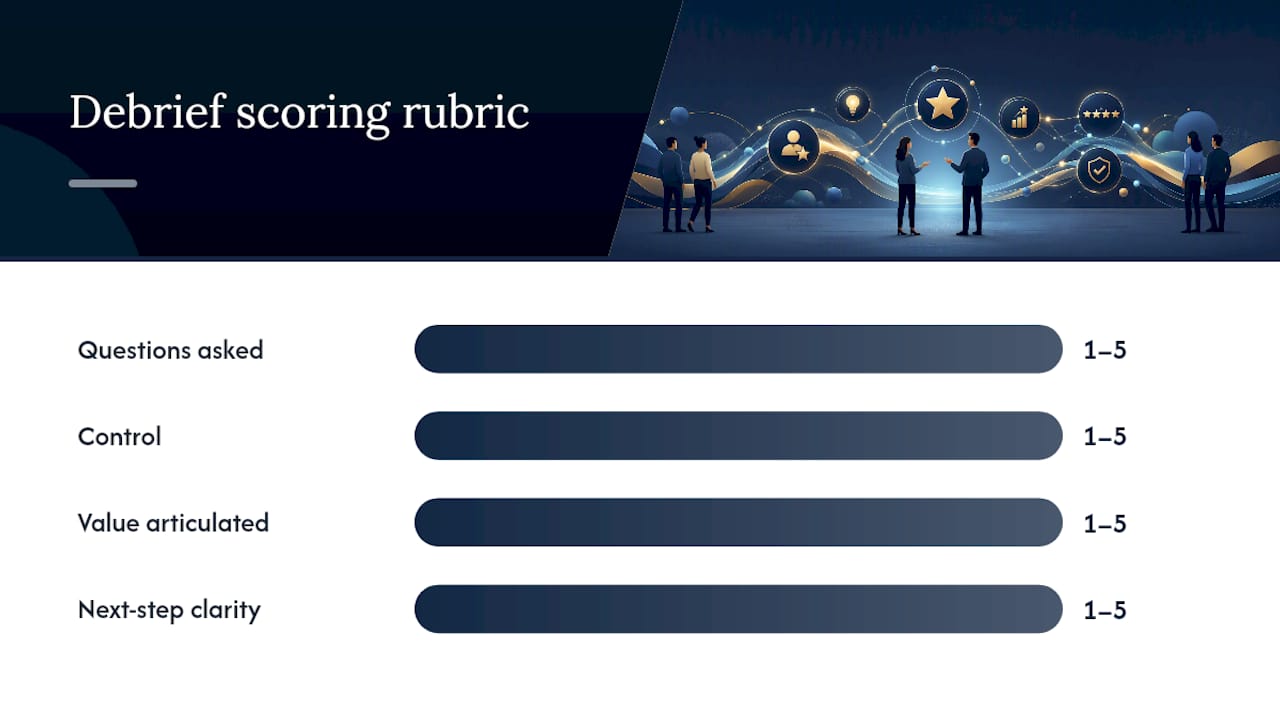
- Score against four fixed criteria: questions asked, control of the conversation, value articulated, and clarity of next step.
- Rotate who plays the buyer each week so reps hear different objection styles.
- Log scores so you can see whether the same rep improves against the same scenario over four to six weeks.
What a sales role-play scenario actually is
A scenario is the situation you build: a buyer persona, a specific business context, and stated stakes (“this is the third vendor call, budget is under review, the champion is nervous about internal pushback”). The exercise is separate. It is the repeatable drill structure, the rubric, and the debrief format wrapped around that scenario, and you reuse the same exercise structure across dozens of different scenarios.
Conflating the two is the most common set up mistake trainers make. Without a clear situation, buyer, and stakes, reps improvise generically instead of practising a specific skill. Every scenario should isolate one skill, whether that’s opening a cold call, handling a price objection, or navigating a second stakeholder who’s just been added to the deal. Trying to practise discovery, objection handling, and closing in one 15 minute role-play teaches nothing well. Set one clear win condition before you start, such as “get the buyer to commit to a next meeting date” or “uncover the real budget owner”, so both players know what success looks like.
Why sales role-play works: the evidence behind the drill
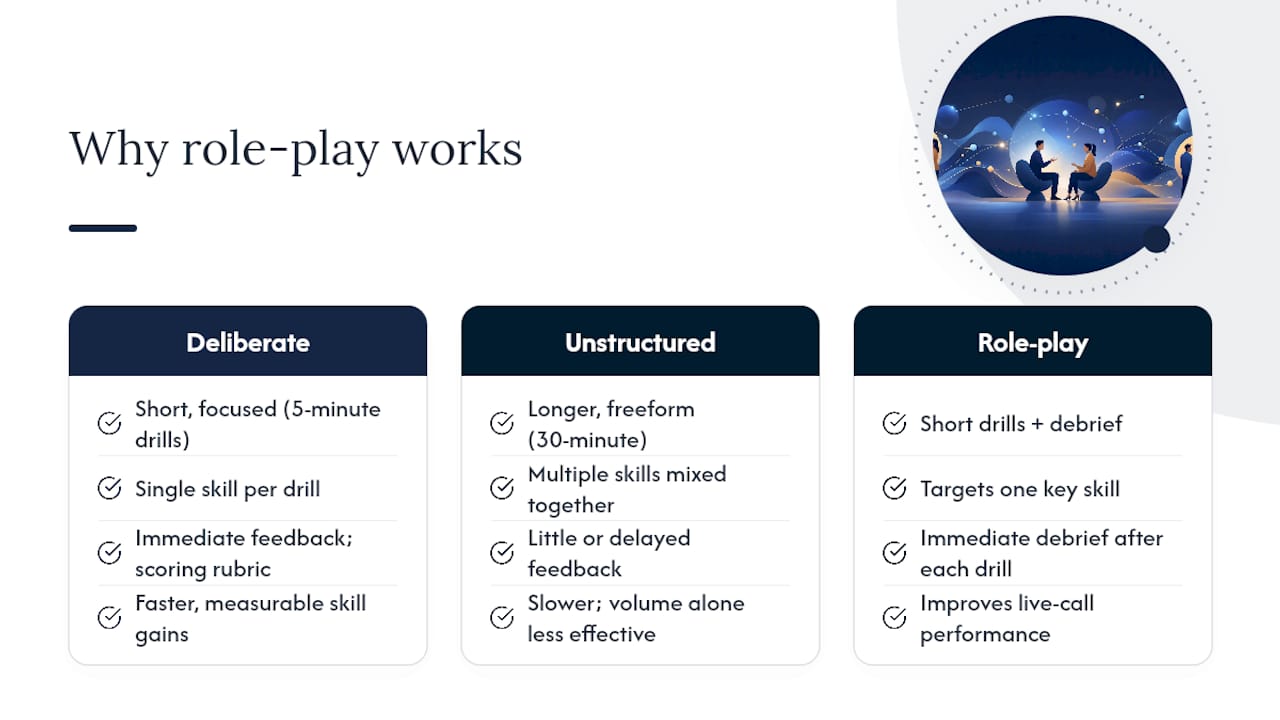
Role-play as a sales training method isn’t new. Harvard Business Review documented its use for recreating buyer conversations back in 1987, and the mechanism hasn’t changed since: reps improve fastest when practice is short, focused on one skill, and followed immediately by feedback.
Deliberate practice with fast feedback loops builds expertise faster than unstructured repetition. Research on the making of an expert found that structured drills with a consistent scoring rubric, rather than volume alone, produce measurable skill change. A PLOS ONE study on practice and skill transfer reinforces this: controlled practice followed by feedback shows measurable improvement in complex skill tasks, which is exactly the model a good role-play session follows.
The practical upshot for a sales floor: five focused minutes on “handle the price objection” beaten by a proper debrief will move a rep’s live-call performance further than a 30-minute freeform mock call ever will. Deliberate practice research published in Science makes the same point outside sales entirely, which tells you this isn’t a sales training fad. It’s how skill acquisition works, full stop.
How to run a role-play session: the five-step runbook
Run every scenario through the same five steps. Consistency here is what makes results comparable across reps and across weeks.
- Pick a scenario and one skill. Choose from your rotation based on what’s actually going wrong in the pipeline right now. State the skill out loud before anyone speaks: “today we’re only judging discovery questions.”
- Brief the buyer persona. Whoever plays the buyer needs two minutes alone with the scenario card to build a consistent character. Give them a name, a role, a mood, and one hidden objection they shouldn’t reveal unless asked the right question.
- Set the win condition. State it aloud before the clock starts. “Win” might mean securing a follow-up meeting, uncovering the real decision maker, or getting the buyer to state a number.
- Run the drill for 5 to 10 minutes. No pausing to coach mid-scene. Let it play out, including the awkward silences, because that’s where real skill gaps show up.
- Debrief with structure, not vibes. Score against your rubric immediately, while the exchange is still fresh.
Rotate roles deliberately. The strongest format uses three people: one rep as seller, one peer or manager as buyer, and a third as silent observer scoring the rubric. Over a month, every rep should play buyer at least once. Playing the difficult customer teaches reps more about resistance patterns than being on the receiving end ever does.
A compact rubric beats an elaborate one. Score each run on:
- Questions asked — did they dig past the first answer?
- Control — did the rep or the buyer drive the conversation’s direction?
- Value articulated — was the pitch tied to a stated buyer problem?
- Next step clarity — did the call end with a concrete, dated action?
Four criteria, scored one to five each, gives you a number you can track week on week without turning the debrief into a seminar.
Scenario families and when to use each one
Not every scenario suits every role or every stage of the pipeline. Grouping scenarios into families helps you pick the right difficulty and the right rep quickly, instead of guessing.
- Gatekeeper scenarios suit SDRs early in tenure, practising getting past a receptionist or EA without sounding evasive.
- Cold-call and opening scenarios train the first 30 seconds of a call, where most calls are won or lost on tone alone.
- Discovery scenarios suit AEs and reps moving from SDR to closer roles, focused on question quality rather than pitching.
- Demo scenarios test whether a rep can tie product features to the specific pain surfaced in discovery, not a generic script.
- Objection handling scenarios work for any tenure but should get harder as reps mature, moving from price objections to competitive comparisons.
- Negotiation scenarios suit senior AEs handling procurement pushback or contract term disputes.
- Multi-stakeholder scenarios suit AEs and CSMs managing accounts where a new voice enters mid-deal and changes the dynamic.
Calibrate difficulty within a family using a simple 1 to 5 scale: level 1 gives the buyer one predictable objection, level 5 gives the buyer contradictory motivations and a hidden decision maker the rep has to uncover. Running SDRs against level 5 negotiation scenarios wastes everyone’s time; save that for reps who’ve already mastered levels 1 to 3 in an easier family.
12 ready-to-use sales role play scenarios and scripts
Each scenario below includes the setup, what to practise, a short starter script, and prompts for raising difficulty. Treat the scripted lines as a scaffold, not a transcript. Edit the numbers, product names, and buyer name to match your own patch before running it.
-
The price haggle. Situation: buyer likes the product but wants 20% off before signing. Practice focus: holding value without discounting reflexively. Seller: “Talk me through what a 20% gap would mean for you internally, budget approval or a competing quote?” Buyer: “Honestly, I’ve got a quote at that price already.” Raise difficulty by having the buyer produce a specific competitor name and feature list. Score on value articulated.
-
The deadline pusher. Situation: buyer claims they need to sign by Friday or lose internal budget. Practice focus: testing urgency without capitulating to it. Seller: “What happens to the budget if we sign Monday instead?” Buyer: “It just disappears, use it or lose it.” Escalate by making the deadline claim false and rewarding reps who probe it. Score on control.
-
The feature fanatic. Situation: buyer fixates on one minor feature and ignores the core value proposition. Practice focus: redirecting to the buyer’s actual stated problem. Seller: “Before we get into that, remind me what’s driving this project right now?” Buyer: “But does it integrate with our old system, that’s my main worry.” Difficulty tweak: have the buyer interrupt every redirect attempt twice. Score on questions asked.
-
The reluctant revealer. Situation: buyer won’t disclose budget, timeline, or who else is involved. Practice focus: earning information through trust, not direct interrogation. Seller: “No pressure on numbers, but roughly, is this a five figure or six figure decision for you?” Buyer: “I’d rather not say yet.” Raise difficulty by giving the buyer a scripted deflection for every question type. Score on questions asked.
-
The last-minute objection. Situation: deal appears closed, then the buyer raises a new concern days before signature. Practice focus: staying calm and diagnosing whether it’s a real objection or cold feet. Seller: “That’s new, what changed since we last spoke?” Buyer: “My boss asked why we’re not looking at anyone else.” Escalate by making the objection vague and testing whether the rep asks enough follow-ups before responding.
-
The power balance shift. Situation: a senior buyer who was previously silent suddenly takes control of the call. Practice focus: reading the room and adjusting who you’re selling to mid-conversation. Seller: “Glad you’re here, what matters most to you specifically in this decision?” Buyer: “Frankly I want to know why this costs so much more than what we currently pay.” Difficulty tweak: have the new stakeholder contradict something the original champion said earlier. Score on control.
-
The sudden change in decision-maker. Situation: the champion announces someone else now owns the final call. Practice focus: rebuilding rapport and value with a fresh audience fast. Seller: “Happy to run through this again, what’s top of mind for you coming in?” Buyer: “I’ve only seen the deck, not heard the pitch.” Escalate by giving the new decision-maker a completely different priority to the original buyer.
-
The cultural or communication barrier. Situation: buyer’s direct or indirect communication style doesn’t match the rep’s usual approach. Practice focus: adjusting pace and directness without losing clarity. Seller: “I want to make sure I’m being clear, does that make sense so far?” Buyer: gives an ambiguous, non-committal response. Raise difficulty by having the buyer never state a clear yes or no. Score on next step clarity.
-
The skeptical prospect. Situation: buyer has been burned by a similar vendor before and assumes every claim is exaggerated. Practice focus: building credibility through specificity, not reassurance. Seller: “What went wrong with the last provider, specifically?” Buyer: “They promised the world and delivered nothing.” Escalate by making the buyer challenge every claim with “prove it.” Score on value articulated.
-
The multi-stakeholder deal. Situation: three people join the call, each with a different priority (cost, ease of use, security). Practice focus: managing competing agendas in one conversation. Seller: “Let’s go round, what’s the one thing that would make this a clear yes for each of you?” Buyer group: each gives a conflicting priority. Raise difficulty by having two stakeholders disagree openly mid-call. Score on control and next step clarity together.
-
The indecisive prospect. Situation: buyer agrees with everything but never commits to a next step. Practice focus: converting vague enthusiasm into a dated action. Seller: “Given everything we’ve covered, what would need to be true for you to move forward this month?” Buyer: “It all sounds good, let me think about it.” Escalate by having the buyer repeat the same soft deflection three times. Score on next step clarity.
-
The unexpected curveball. Situation: buyer asks something entirely off-script, a legal question, a competitor rumour, or an unrelated personal comment. Practice focus: staying composed and steering back without dismissing the buyer. Seller: “Good question, let me come back to that, and first tell me…” Buyer: throws in an unscripted, unpredictable line. This one works best run by a peer who improvises freely rather than following a card.
Matching scenarios to your sales cycle and roles
New starters need gatekeeper and opening scenarios in their first fortnight, before anything harder. Weekly team training should rotate through discovery, objection handling, and one multi-stakeholder scenario, keeping the total rotation at 3 to 5 scenarios so reps build real repetition rather than novelty fatigue.
Quarterly business reviews are the right moment for negotiation and power-shift scenarios, since senior stakeholders and renewal conversations tend to surface exactly then. One-to-ones are best for the scenario a specific rep is struggling with personally, run privately rather than in front of the team.
PitchMonster’s guidance on scenario rotation recommends keeping the active rotation small and tied to where deals are actually being lost, rather than cycling through every scenario type for variety’s sake. Pull your last quarter’s lost-deal reasons before choosing what goes into rotation this month; the scenarios should mirror your pipeline, not a generic list.
How to use a script without sounding scripted
The starter lines above are scaffolding, not dialogue to memorise. Give reps two or three replaceable phrases per scenario (“talk me through…”, “what would need to be true…”) and let them fill in the specifics from their own patch. A rep reciting a script word for word sounds exactly like what it is, and buyers notice instantly.
Coaches should prompt adaptation mid-debrief rather than fidelity: “what would you say differently if this were your actual account, Northgate?” Encourage improvisation once a rep has run a scenario twice successfully; before that, some structure keeps nervous reps from freezing entirely.
Pro Tip: Ban the phrase “does that make sense?” from every script. It invites a reflexive yes and tells you nothing about whether the buyer actually understood the value.
Customising scenarios by role, tenure and methodology
Adjust three levers for tenure: how much resistance the buyer offers, how ambiguous their signals are, and how strict the win condition is. A junior SDR gets one clear objection; a senior AE gets contradictory stakeholders and a hidden budget constraint.
Tie scenarios to whatever methodology your team already runs. A discovery scenario built for SPIN selling should score situation, problem, implication, and need-payoff questions separately. A Challenger-style scenario should reward reps who teach the buyer something uncomfortable rather than simply agreeing with them. A MEDDIC scenario should score whether the rep uncovered the economic buyer and the decision criteria explicitly. For remote teams, run the same drills over video call rather than in person, since reading tone without body language is its own skill worth practising.
Ahead of Sales coaching notes on turning drills into results
Some coaching engagements build short, scored role-play drills directly into the coaching cycle rather than treating them as a one-off training day event. A typical cadence runs a 10-minute scenario at the start of a coaching session, scored against the same four-point rubric used above, followed by a review of how that skill showed up on the rep’s actual calls that week.
The pattern we see most often: reps who repeat the same scenario every two to three weeks, with scores tracked against the same rubric, show visible improvement in live call recordings well before their manager notices it in pipeline numbers. Consistent scoring, not novelty, is what makes coaching stick.
What to score in every debrief
A debrief without a fixed checklist collapses into opinion. Run through the same four questions every time, in the same order, so reps know what’s coming and managers stay consistent across sessions.
Start with questions asked: did the rep ask open questions that uncovered new information, or did they lead with statements dressed up as questions? Score this before anything else, because weak discovery undermines every stage that follows.
Move to control: who directed where the conversation went? A rep can talk the least and still control the call, if their questions set the agenda. Watch for reps who let the buyer’s tangents derail the win condition entirely.
Third, check value articulated: did the rep tie anything they said back to a problem the buyer had actually stated, or did they recite generic benefits? Generic pitching is the single most common failure across every scenario family.
Finally, score next step clarity: did the role-play end with a dated, specific action, or a vague “I’ll follow up”? A call that ends fuzzy in practice will end fuzzy live.
Keep the scale simple: one to five per criterion, twenty points total. Write the score down immediately, before discussing it, so the conversation doesn’t drift into softening the number before it’s even recorded. Our sales skill checklist gives a fuller version of this rubric if you want to extend it beyond four criteria.
Giving and receiving feedback without it turning defensive
Feedback should follow the run immediately, while both players remember specific lines, not general impressions. Ask the rep to self-score first: “what would you give yourself on control, and why?” Self-assessment before manager input reduces defensiveness because the rep sets the frame before anyone else does.
Be specific about moments, not traits. “You interrupted the buyer at the price objection” is useful; “you weren’t listening” is not, and invites an argument rather than a correction. Managers should aim for one thing done well and one thing to change per debrief, never a long list. Reps retain the first correction they hear far better than the fifth.
Receiving feedback well is a skill worth coaching too. Encourage reps to ask a clarifying question back (“what would you have asked instead, right there?”) rather than defending the choice they made. That single habit turns a debrief from a verdict into a rehearsal for the next attempt.
Rotate who gives feedback. A peer catches different things than a manager does, and a rep who’s just played the buyer often has the sharpest insight of all, because they felt exactly where the pitch lost them.
Building customer personas and real variability into scenarios
Generic buyer personas produce generic practice. Build each persona from a real account: their industry, their stated objection history, their actual decision-making structure, pulled from CRM notes rather than invented from scratch. A buyer persona named after a real segment, “the risk-averse ops director,” trains reps for the buyer they’ll actually meet next week.
Introduce variability deliberately rather than running the same scenario the same way every time. Change the buyer’s mood, give them a hidden constraint the rep must uncover, or have the observer inject a surprise mid-scene, a new stakeholder joining, a budget cut announcement. Real sales conversations rarely follow the script, and a role-play that always resolves cleanly teaches false confidence.
Refresh personas quarterly against your actual lost-deal data. If your last quarter’s losses were mostly procurement pushback from mid-market buyers, that persona belongs in rotation now, replacing whatever’s gone stale. Our consultative selling guide covers how to build discovery questions around a specific buyer’s real context, which pairs well with persona design here.
Why most role-play sessions fail before they start
The mistake I see most often is trainers running long, unfocused role-plays that try to cover an entire sales call in one go. Nobody learns anything from that except that role-play is tedious. A 20-minute freeform mock call with no scoring produces an opinion, not a measurable skill change.
Short, scored drills beat marathon sessions every time. Pick one skill, run it for five minutes, score it against the same four criteria you used last week, and you’ll see improvement in weeks rather than quarters.
— Jerry
How Ahead of Sales turns practice into pipeline
Running scenarios is only half the work. The harder part is knowing which skill gap is actually costing you deals, and building a coaching plan that closes it faster than your team can drift back into old habits. This gap can be addressed by bespoke 1:1 coaching and team training built around your own pipeline data, not a generic scenario pack.

If you manage a team of reps, our sales training services combine structured role-play with ongoing coaching cycles built around where your deals are actually stalling. Running a SaaS sales team specifically, our SaaS sales training packages address product-led buying cycles and technical stakeholder objections directly. Solo consultants and service business founders may book a sales acceleration package built around scenarios related to deals they are losing. Get in touch to talk through a training plan tailored to your team’s current pipeline.
Sources
- 9 Sales role play exercises that boost skills — Highspot
- Role-playing as a sales training tool — Harvard Business Review (1987)
FAQ
What are some good examples of role-play scenarios?
The strongest examples isolate one skill and one buyer situation, such as a price haggle, a reluctant revealer who won’t disclose budget, or a multi-stakeholder call where priorities clash. The 12 scenarios above cover the situations that come up most often in B2B sales cycles.
What are good scenarios for customer service role plays?
Customer service role-plays typically mirror sales objection scenarios but shift the win condition from closing to resolution, such as a frustrated customer demanding a refund or an unclear complaint that needs clarifying questions before any fix can be offered. The same five-step runbook and scoring rubric used for sales drills apply directly.
What is the 30-60-90 rule in sales?
The 30-60-90 rule refers to a structured onboarding plan for new sales hires, typically covering ramp-up learning in the first 30 days, followed by applied practice including role-play, and then independent quota-carrying performance. It’s a planning framework rather than a role-play technique itself.
What are good workplace scenarios for role-play?
Beyond sales calls, useful workplace role-play scenarios include difficult feedback conversations, cross-team negotiation over resources, and handling an escalated internal conflict, all of which use the same brief, run, and debrief structure as a sales drill.
How long should a sales role-play session last?
Keep the drill itself to 5 to 10 minutes, followed by a debrief of similar length, since research on role-play exercises shows shorter, focused practice with immediate feedback beats longer freeform sessions.
How many scenarios should a team rotate through?
Rotate 3 to 5 scenarios at a time, chosen to match where your team is actually losing deals, rather than cycling through every possible scenario for variety’s sake.