
Pick a simple coaching model, GROW or a four-pillar scorecard, and run it every week in 30-minute 1:1s with rehearsal built in. The model you choose matters far less than whether you run it consistently and score the calls. Consistency plus rehearsal changes behaviour; swapping acronyms does not. If you want the practical template, jump to the weekly session structure below.
TL;DR:
- Consistent weekly coaching with scored calls and rehearsal leads to behavior change, while switching frameworks or skipping practice undermines progress.
- The most effective models, like GROW or OSKAR, are interchangeable; the key is regular application and focus on one behavior at a time.
- Short, structured 30-minute sessions, divided into review, diagnosis, and rehearsal, reliably improve forecast accuracy and quota attainment for middle performers.
- Technology tools increase practice frequency but do not replace managerial judgment or the importance of embedding coaching routines.
- Teams that measure actual follow-through and keep coaching simple with shared scorecards see better retention, faster ramp-up, and measurable sales improvements.
Table of Contents
- What is sales coaching, and how is it different from sales training?
- Why do sales coaching frameworks matter more than ad-hoc feedback?
- Which sales coaching model should you use, and when?
- How do you choose a model and make it stick?
- What does a 30-minute weekly coaching session look like?
- Can technology help you scale sales coaching without losing quality?
- How does a structured coaching programme actually get delivered?
- Why discipline beats framework choice in sales coaching
- Get help building a coaching model that actually runs every week
- Sources
- FAQ
What is sales coaching, and how is it different from sales training?
Sales training teaches a skill once, usually to a room. Sales coaching repeats and reinforces that skill, one rep at a time, until it shows up on live calls. Training gives someone a new objection-handling technique in a workshop. Coaching is the manager sitting with that same rep three weeks later, listening to a recorded call, and asking why they didn’t use it.
The distinction matters because most sales leaders default to training when what their team actually needs is coaching. A new methodology launched in January and never revisited by March isn’t a coaching failure. It’s an absence of coaching altogether.
Coaching pays off most with your middle performers, not your stars or your strugglers. Your top rep doesn’t need a framework, and your bottom performer often needs a different role or a different manager conversation entirely. The middle 60% of most teams, the reps hitting 70 to 95% of quota, respond best to structured coaching because they already have the fundamentals; they just need someone forcing consistency.
The evidence for this isn’t anecdotal. Organisations running formal coaching programmes report stronger revenue growth, sharper selling skills, and better rep retention than those relying on ad-hoc feedback. Retention is the underrated part of that finding: reps who get coached tend to stay longer, which matters enormously when replacing a mid-level salesperson can take months of ramp time.
What coaching actually builds, when it’s done properly:
- Consistent use of a discovery framework, rather than reverting to feature-dumping under pressure
- Faster recovery from objections, because the rep has rehearsed the response rather than improvising it
- Better forecast accuracy, because reps learn to qualify honestly instead of inflating pipeline to please a manager
- Higher quota attainment among mid-tier performers specifically, the group most responsive to structured practice
None of this happens from a single training day. It happens from repetition.
Why do sales coaching frameworks matter more than ad-hoc feedback?
Frameworks matter because unstructured feedback almost always collapses into one of three failure modes. The first is advice-dumping: a manager listens to five minutes of a call and delivers eight suggestions, none of which the rep can realistically absorb or apply before the next call. The second is unscored reviews, where “that went well” or “you need to tighten that up” replaces any measurable standard. The third is irregular cadence, coaching that happens when there’s a crisis and disappears the moment pipeline looks healthy.
A framework fixes all three by forcing structure onto the conversation. It makes the manager ask questions instead of issue instructions, which shifts ownership of the fix back to the rep. It gives the session a fixed shape, so feedback becomes comparable week to week rather than a fresh improvisation each time. And it creates a natural rhythm, because a model with defined stages is far easier to schedule and defend on a calendar than a vague “coaching chat.”
The underlying research backs this directly: structured frameworks with weekly cadence and scored reviews are what prevent coaching sessions from becoming theatre, a term worth sitting with, because a lot of what passes for sales coaching genuinely is theatre. It looks like coaching. It feels supportive. It changes nothing.
Typical failure modes to watch for in your own team:
- Sessions that run long on chat and short on specific, rehearsed commitments
- No written record of what the rep agreed to try differently
- The same three coaching topics recurring month after month with no resolution
- Managers coaching on gut feel rather than a recording or CRM data
Pro Tip: Track the gap between a rep’s score in a rehearsed practice scenario and their score on the equivalent moment in a real call. If practice scores are consistently higher than live-call scores, your coaching isn’t transferring, no matter how good the sessions feel.
That practice-to-real-call gap is arguably the single most useful diagnostic a sales manager can build, and it’s one most teams never measure.
Which sales coaching model should you use, and when?
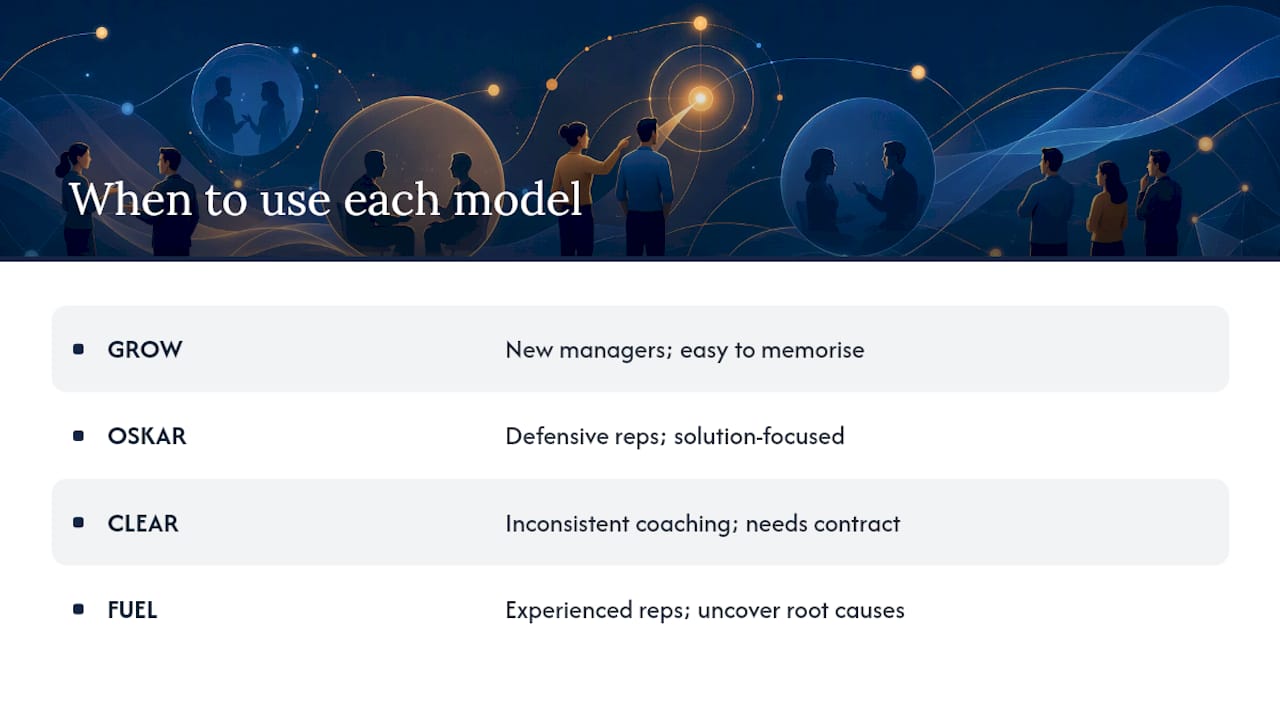
Most established coaching models share the same underlying arc: define the goal, assess the current reality, generate options, and commit to action. The differences between GROW, OSKAR, CLEAR and FUEL are mostly cosmetic, which is genuinely liberating once you accept it. You are not searching for the one true framework. You are picking a vocabulary your managers can remember under pressure and using it every single week.
Here’s how the main models break down, and where each earns its place.
1. GROW (Goal, Reality, Options, Will)
GROW is the oldest and most widely taught coaching model, originally developed in executive coaching before sales teams adopted it. The manager asks the rep to state a goal for the specific deal or skill, describes the current reality honestly (often surfaced through call recordings), explores options for closing the gap, and locks in a “will,” a concrete commitment with a deadline. Best for: managers new to structured coaching, because the four steps are intuitive and easy to memorise mid-conversation.
2. OSKAR (Outcome, Scaling, Know-how, Affirm, Review)
OSKAR is solution-focused rather than problem-focused. Instead of dwelling on what went wrong, it asks the rep to describe the outcome they want, rate their current position on a scale of one to ten, identify what know-how or resources would move them up that scale, affirms what’s already working, and reviews progress against the previous session. Best for: coaching reps who tend to get defensive or discouraged, since it spends far less time on the negative reality and more on forward motion.
3. CLEAR (Contract, Listen, Explore, Action, Review)
CLEAR opens with an explicit contract, an agreement on what this session will cover and how success will be judged, which makes it useful when coaching feels aimless or when reps disengage because they don’t know the point of the conversation. Listening and exploring follow a similar arc to GROW, but the contract step and the closing review add accountability bookends. Best for: managers coaching reps who’ve had inconsistent coaching in the past and need the structure made explicit rather than assumed.
4. FUEL (Frame, Understand, Explore, Lay Out)
FUEL leans on framing the conversation upfront, understanding the current situation deeply before jumping to solutions, exploring possibilities collaboratively, and laying out a specific plan. It resembles GROW closely but places more weight on the “understand” phase, useful when a manager suspects the presenting problem (say, weak closing) is actually a symptom of something earlier in the funnel, like poor qualification. Best for: coaching more experienced reps where the real issue is often buried a few layers beneath the obvious complaint.
5. Solution-focused variants and hybrid scorecards
Beyond the named acronyms, many effective sales organisations run a simplified, rubric-based approach: a fixed scorecard covering discovery, objection handling, competitive positioning, and closing, scored on every reviewed call regardless of which conversational model the manager uses to reach that score. A four-pillar rubric like this covers most B2B call types while staying focused enough to be memorable. Best for: sales leaders managing multiple managers, where consistency of measurement across the team matters more than the conversational style each manager prefers.
The comparative takeaway is simple. Every model above moves through roughly the same four beats: understand the goal, confront the reality, generate a path, commit to action. Pick one that matches your own coaching fluency and your team’s culture, then stop shopping for a better acronym. The model is the container. The scorecard and the weekly cadence are what actually do the work.
How do you choose a model and make it stick?
Choosing the right model is less about theoretical fit and more about what your managers will actually use under time pressure. Run it through a short checklist before committing.
- Simplicity first. If a manager can’t recall the model’s steps without opening a document mid-session, it’s too complicated for weekly use.
- Manager fluency. A model your senior manager already half-knows will get used properly. A model nobody’s seen before will get abandoned by week three.
- Language match. If your team culture already talks about “wins” and “blockers,” CLEAR’s contract-and-review structure will feel native. If it talks about scaling and momentum, OSKAR fits more naturally.
- Problem fit. Defensive, easily discouraged reps respond better to solution-focused models like OSKAR. Reps with buried root causes benefit from FUEL’s deeper “understand” phase.
Choosing well is only half the job. Most coaching programmes fail not because the model was wrong, but because it was never properly embedded. Four rules make the difference.
First, coach one behaviour at a time. A session that tries to fix discovery, objection handling, and closing simultaneously fixes none of them. Second, tie every coaching commitment to a real, named deal in the pipeline, not an abstract skill. “Improve your discovery questions” is unmeasurable. “Ask three open discovery questions on the call with Acme on Thursday” is not. Third, inspect the following week, specifically. Don’t ask “how did it go?” Pull the recording and check whether the committed behaviour actually appeared. Fourth, score every reviewed call against the same rubric every time, even when the call went well. Consistency of measurement is what turns coaching from a mood into a system.
Watch for these red flags, because they predict a coaching programme’s collapse months before it visibly fails:
- Sessions get cancelled first whenever pipeline pressure rises
- The same coaching topic appears three sessions running with no measurable change
- Managers can’t produce a scorecard or written note from the last session
- Reps describe coaching as “a check-in” rather than a working session with commitments
Pro Tip: If a rep can’t tell you, unprompted, what they committed to changing in their last coaching session, the framework isn’t the problem. The follow-through is.
What does a 30-minute weekly coaching session look like?
A weekly, scored, 30-minute session beats a monthly hour every time, because behaviour change comes from frequency and repetition, not from the length of any one conversation. Practitioner guides consistently recommend 30 to 45 minute weekly 1:1s paired with structured call review and role-play as the baseline for high-performing teams.
Structure the 30 minutes as three roughly equal blocks:
- Review (0 to 10 minutes). Pull a real call recording or CRM note chosen in advance, not on the spot. Preparing beforehand with recordings and CRM data keeps feedback objective rather than a vague impression from memory. Score the call against your rubric together.
- Diagnose and choose (10 to 20 minutes). Pick one behaviour to work on this week, using your chosen model’s questioning structure (Goal/Reality/Options/Will, or your scorecard’s weakest row). Resist the urge to fix everything you noticed.
- Rehearse (20 to 30 minutes). Role-play the specific moment, an objection, an opening, a closing ask, live in the room. Score the rehearsal against the same rubric used for the real call, so you can compare the two scores directly.
A simple scorecard, scored one to five on each row, keeps this consistent across every rep and every manager:
Compare the real-call column against the practice column weekly. If a rep scores four on discovery in rehearsal but two on the equivalent real call, that gap is your operational metric, not the model, not the mood of the session. Rehearsal that doesn’t close that gap over three or four weeks means the practice scenario itself needs revising, not abandoning.
Can technology help you scale sales coaching without losing quality?
Technology helps mainly by increasing how often reps practise, not by replacing the manager’s judgement. Asynchronous AI role-play tools let a rep rehearse an objection ten times in a week instead of once in a scheduled session, compressing the feedback loop and increasing practice frequency measurably compared with manager-only rehearsal. The manager still decides what’s worth coaching; the tool just handles the repetition that used to eat calendar time.
This shift lets managers spend their limited 1:1 minutes on the moments that need human judgement, the borderline calls, the deals with unusual politics, rather than on basic drilling a tool can run at scale. Similar practice-loop logic shows up outside sales entirely; AI-driven content tools that scale repetitive creative work free humans for the judgement calls a machine can’t make, which is the same principle applied to a different craft.
Build your measurement around two tiers rather than one:
- Leading indicators: practice sessions completed per rep per week, participation rate in scheduled 1:1s, scorecard completion rate
- Lagging indicators: win rate, ramp time for new starters, quota attainment, rep retention over two quarters
Pairing leading and lagging metrics tells you two separate things: whether coaching is actually happening, and whether it’s moving revenue. A team can look busy on leading indicators and still show flat lagging numbers, which usually means the practice isn’t tied to real deal behaviour.
One governance point matters as much as the mechanics. Frame scorecards as a development record tied to progression criteria, not a surveillance log, because reps who see scoring as career-relevant engage with it; reps who see it as a manager building a case against them shut down and stop being honest in the room.
How does a structured coaching programme actually get delivered?
A structured programme in practice combines bespoke 1:1 coaching with team workshops and a shared scorecard, so every manager and rep is measured against the same rubric rather than a personal style. Aheadofsales builds this exact shape for B2B teams: weekly scored sessions, role-play rehearsal, and a one-page rubric that a whole sales team can run consistently across managers.
Engagements scale by business size and need. Team coaching and consultancy packages for growing B2B companies typically have a pricing range structured around the size and complexity of the sales team. Solo service businesses and consultants get lighter sales acceleration packages, generally priced within a mid-range, built around the same principle of weekly cadence and rehearsal rather than a one-off training day.
The mechanics stay consistent regardless of package size: a shared scorecard, a weekly review rhythm, and a rehearsal step that closes the gap between practice performance and what shows up on real calls.
Why discipline beats framework choice in sales coaching
The framework debate is mostly a distraction. I’ve watched sales leaders lose weeks comparing GROW against OSKAR against CLEAR as though the acronym itself carried some hidden performance edge. It doesn’t. What separates teams that improve from teams that stall is whether the manager shows up every week, scores honestly, and makes the rep rehearse the exact behaviour that’s failing on live calls.
Two things to try this week: pick one scorecard row your weakest rep consistently fails, and rehearse only that moment in your next session, nothing else. Then check next week whether it shows up on a real call. That single loop, chosen behaviour, rehearsed, verified, is worth more than a year of framework shopping.
— Jerry
Get help building a coaching model that actually runs every week
Choosing a model is the easy part. Running it consistently, with scored calls and rehearsal built into every session, is where most internal coaching programmes quietly fall apart within a quarter.
Packages for growing B2B teams run in a price range reflective of team size and current coaching needs. Solo service businesses and consultants can expect lighter packages built around the same weekly cadence and rehearsal principle covered above. If you’d rather have a structured coaching model designed and run for you than build one internally, start by reviewing Aheadofsales’s sales training services and get a quote based on your team’s current setup.
Sources
- Sales Coaching Framework: The 2026 Manager Playbook | Battlecard
- Sales coaching 101 (Pipedrive)
- The Ultimate Sales Coaching Guide: Strategies, Tools & Best Practices | SalesHood
- Sales Coaching Guide: Build a Program That Delivers — QUOTA Training
FAQ
What are the 5 C’s of coaching?
Definitions vary across coaching disciplines, but in a sales context the most commonly cited version covers clarity, communication, commitment, confidence and collaboration, each addressed through structured questioning rather than direct instruction.
What are the 10 main coaching styles?
There’s no single agreed list of exactly ten styles, but sales organisations typically draw from a mix including directive, non-directive, solution-focused (OSKAR), goal-based (GROW), peer coaching, and scorecard-driven approaches, often blending two or three depending on the rep and situation.
What is the 70/30 rule in coaching?
The 70/30 rule generally means the rep should be talking and problem-solving roughly 70% of the session, with the manager asking questions and guiding rather than dominating the conversation with advice, a ratio that mirrors the framework principle of asking over telling.
What are the 7 P’s of coaching?
There’s no single standardised “7 P’s” model consistently used across the sales coaching field, so treat any specific list you encounter with caution rather than as an established industry standard.
How often should sales coaching sessions happen?
Weekly, for 30 to 45 minutes, is the cadence practitioner guides consistently recommend, paired with scored call review and role-play rehearsal rather than a longer, less frequent session.