
When a buyer tells you the price is too high, pause for two seconds, then ask, “Compared to what?” That single question forces them to reveal what they’re actually measuring your offer against. From there, reanchor on the outcome you deliver rather than the number they’re objecting to, and offer structured options instead of a discount. Price objections are rarely about price. They usually mask a value gap, an authority problem, or a timing issue, and your first job is to work out which one you’re facing before you say another word.
TL;DR:
- Most price objections reveal a value gap, authority issue, or timing problem rather than an actual cost concern.
- Asking “Compared to what?” and “How are you coming to that conclusion?” uncovers the true basis of the objection before responding.
- Diagnosing the root cause allows for targeted responses like ROI calculations, scope comparisons, or stakeholder insights, which preserve margins.
- Applying a six-step sequence—pause, diagnose, validate, reframe, offer options, ask for commitment—reduces reflexive discounting and closes deals more effectively.
- Regular role-play practice and tracking discount habits help reinforce diagnose-first behavior and stop automatic, margin-eroding negotiations.
Table of Contents
- What are the best price objection responses to use right now?
- A framework to stop reflexive discounting and find the real blocker
- Which tactics fix which root cause?
- How do you protect margin without hard-line discounting?
- Common mistakes that quietly cost margin
- Ready-to-use scripts, email lines and a role-play checklist
- What evidence supports a diagnose-first approach to price objections?
- How should you personalise price objection responses by buyer type?
- What do price objections look like across different industries?
- Why do stories and social proof beat arguing on price?
- What psychological principles drive price objections?
- How can sales teams practise handling price objections regularly?
- What actually changes when you diagnose before you respond?
- How Aheadofsales helps teams stop discounting on autopilot
- Where this article’s evidence comes from
- Sources
What are the best price objection responses to use right now?
You don’t need forty scripts memorised. You need four or five that cover the situations you’ll actually meet, deployed with the right diagnostic question attached. Here’s the shortlist worth practising until it’s second nature.
Diagnostic openers get the buyer talking before you defend anything:
- “Compared to what?” This forces them to name the alternative in their head, whether it’s a competitor, doing nothing, or an internal budget line. You can’t respond usefully until you know what you’re being measured against.
- “How are you coming to that conclusion?” This is less confrontational than it sounds. Most buyers haven’t actually benchmarked your price against anything specific. Asking this surfaces the (often flimsy) reasoning behind the objection.
Value anchors shift the conversation from cost to consequence:
- “What’s the cost of doing nothing about this for another six months?” This works because most buyers have never priced out inaction. Once they do, your fee looks smaller.
- A simple per-unit ROI line: “If this saves your team four hours a week, that’s roughly £X a month in recovered time, against a one-off cost of £Y.” Numbers beat adjectives every time.
Authority and timing probes stop you from negotiating with the wrong person or at the wrong moment:
- “Is this a budget issue or a cashflow timing issue?” Those two problems need completely different responses, and conflating them is how reps end up discounting for no reason.
- “Who else needs to sign off on this before we can move forward?” If the answer reveals a hidden decision-maker, you’ve just avoided negotiating twice.
Margin-preserving negotiation stems let you move without cutting the number:
- “If you can commit to a 12-month term, I can add the onboarding package rather than reduce the price.” Trading scope for commitment protects your pricing power far better than trading price for nothing, a point SalesArmor’s collection of defence tactics makes repeatedly across its response families.
Each of these lines does one job: it buys you information before it costs you margin. That order matters more than the wording.
A framework to stop reflexive discounting and find the real blocker
Most reps discount because they haven’t been trained to do anything else when they hear “too expensive.” The fix is a repeatable sequence, not a better excuse. Here’s the six-step version worth drilling until it’s automatic.
- Pause. Two seconds of silence after “your price is too high” does more work than most rehearsed comebacks. It signals confidence rather than panic, and it stops you blurting out a concession before you understand the objection.
- Diagnose. Ask one of the openers above. You’re isolating which of four root causes you’re dealing with: anchor (they’re comparing you to the wrong thing), value gap (they don’t see enough return), authority (they can’t say yes alone), or timing (the money isn’t available yet, or won’t be until later).
- Validate. Reflect back what you heard without agreeing that the price is wrong: “So it sounds like the budget was set before you saw the full scope, is that right?” This confirms you’ve understood without conceding ground.
- Reframe. Move the conversation from sticker price to outcome. Instead of defending the fee, quantify what happens if the problem stays unsolved. This is where the cost-of-inaction question earns its place.
- Offer structured options. Present two or three configurations, e.g. full scope now, phased delivery, or a reduced scope at a lower entry price, rather than a straight discount on the same deliverable. This preserves the value of what you sell while giving the buyer a way to say yes.
- Ask for commitment. Close with a direct question: “Which of those works better for your timeline?” Ambiguity is where deals stall. A structured, stepwise version of this sequence is what Nimitai’s framework for handling price objections sets out in detail, and it’s worth reading in full if you want the longer script library behind each step.
Pro Tip: Write your diagnostic question on a sticky note on your monitor for two weeks. Reps who force themselves to ask before they answer report the habit sticks after about twenty calls, because the silence stops feeling awkward once you’ve survived it a few times.
Roughly 80% of objections framed as “too expensive” are actually value objections in disguise, according to the synthesis behind Nimitai’s 7-step model. That’s the reason step two matters more than any script in step five. Guess wrong about the root cause and even your best reframe lands on deaf ears.

Which tactics fix which root cause?
Once you know whether you’re facing an anchor problem, a value gap, an authority gap, or a timing issue, the right move becomes obvious. Mixing these up is the single most common reason good reps still discount unnecessarily.
Anchor problems happen when the buyer is comparing your price to something that isn’t equivalent, a cheaper competitor with less scope, an internal estimate that predates inflation, or a vague number someone mentioned in a hallway.
- Ask directly: “What are you comparing this to, and does that include [the specific thing you deliver that they don’t]?”
- Run an apples-to-apples scope comparison on paper, not from memory, so the gap is visible rather than argued.
- If they name a competitor, ask a neutral question rather than attacking them: “What’s included in that quote?”
Value gaps mean the buyer hasn’t connected your fee to a number that matters to them.
- Build the ROI math live on the call using their own figures, not a generic case study.
- Use a cost-of-inaction example: what does the current problem cost per month if nothing changes?
- Offer to send a short case reference from a similar buyer rather than promising generic results.
Authority gaps show up when the person you’re negotiating with can’t actually approve the spend.
- Ask who else signs off, and offer to prepare a one-page executive brief they can forward.
- Surface stakeholders early rather than late. Gartner’s research into B2B buying journeys consistently shows that late-stage discovery of a hidden decision-maker is one of the most common causes of stalled or lost deals.
Timing gaps are about cashflow or calendar, not value or authority.
- Offer a phased start, a calendar hold for next quarter, or a pilot at reduced initial scope.
- If the timing genuinely won’t improve, a polite exit beats a dead deal sitting in your pipeline for months.
| Root cause | Tell-tale sign | Best first move |
|---|---|---|
| Anchor | Compares you to something cheaper or vaguer | Scope comparison, not price defence |
| Value gap | Can’t articulate the return | ROI math and cost-of-inaction |
| Authority | Hesitant on final commitment | Surface stakeholders, send exec brief |
| Timing | Interested but budget cycle is wrong | Phased start or calendar hold |
The AmpUp framework for mapping four root causes to twelve responses is worth bookmarking. It removes the guesswork of picking a generic script and replaces it with a decision you can make in the first ten seconds of the objection.
How do you protect margin without hard-line discounting?
Every discount you give without a trade attached teaches the buyer, and eventually your whole account base, that your price is negotiable on request. That’s a governance problem as much as a sales skill problem, and it needs rules, not good intentions.
Set discount approval tiers so no single rep can concede margin without a counter-trade attached. A common structure looks like this:
- Discounts under a small threshold require a documented reason (term length, volume, referral).
- Anything larger needs sign-off and a specific trade: longer contract, upfront payment, or reduced scope.
- No discount is approved without the buyer giving something back, even something small.
Concessions tied to a specific counter-trade preserve pricing power in a way that unconditional discounts never do, a point Rework’s guidance on price objection handling makes clearly when it links reflexive discounting to weaker retention over time.
When you do need to move, move on levers other than the headline number:
- Phased delivery so cashflow, not total cost, is the thing you’re adjusting.
- Payment schedules stretched across months rather than a lump sum.
- Added services (training, priority support, an extra review cycle) instead of a lower fee.
Odd, precise numbers signal you’ve actually calculated something. A concession of £340 reads as considered. A round £500 off reads as arbitrary, and arbitrary numbers invite further negotiation because the buyer assumes there’s more room.
A price concession is only justified when it’s conditioned on something concrete: a longer term, a case study permission, a faster decision date, or a referral. Concede without a condition, and you haven’t negotiated. You’ve just given money away.
Common mistakes that quietly cost margin
Most margin leakage doesn’t come from one bad negotiation. It comes from small, repeated habits that feel harmless in the moment.
- Reflexive discounting. Offering a lower number within seconds of hearing “too expensive” trains buyers to object as a matter of course, because it works.
- Arguing the price instead of diagnosing it. Defending your number before you understand the objection puts you on the back foot for the rest of the call.
- Defensive language. Phrases like “I understand it’s a lot of money, but…” concede the frame before you’ve made your case.
- No definitive next step. Ending a call on “let me think about it” without a date or a follow-up action is how live deals quietly die in a pipeline.
Fixing these four habits alone, according to HubSpot’s collection of price objection responses, does more for close rates than any new script.
Ready-to-use scripts, email lines and a role-play checklist
Practice beats memorisation. Reading a script once won’t help you on a live call, but running the same fifteen lines through role-play until they sound natural will.
Call lines for common moments:
- “Before we talk numbers, can I ask what’s driving the timing on this?”
- “Compared to what, specifically?”
- “If cost weren’t a factor at all, would this solve the problem you described?”
- “What would need to be true for this to feel like an easy yes?”
- “Is the concern the total number, or how it’s spread across the year?”
- “Who else is involved in this decision besides you?”
- “What happens if this problem is still unsolved in six months?”
- “If I could show you the return on this within 90 days, would the price still feel high?”
- “Would a phased start make the initial number easier to work with?”
- “What’s the budget you had in mind, and what does that number need to include?”
Email snippets for follow-up without cutting price:
- “Following our call, I’ve put together two structured options rather than one fixed quote, so you can pick what fits your timeline.”
- “I wanted to check whether the concern was the total investment or the payment schedule. Happy to restructure either.”
- “Attaching a short brief you can forward internally if budget approval needs to go further up.”
A role-play checklist for coaches:
- Does the rep pause before responding, or jump straight to justifying the price?
- Does the rep ask a diagnostic question before offering any reframe?
- Does the rep quantify value using the buyer’s own numbers, not a generic example?
- Does every proposed concession carry a named counter-trade?
- Does the call end with a specific next step and a date?
Run this checklist live after every practice call. Reps improve faster from immediate feedback on a real conversation than from another slide deck.
What evidence supports a diagnose-first approach to price objections?
Coaching that trains reps to pause and diagnose before responding produces a measurable shift in behaviour, not just a mood improvement. The change is small on paper (a two-second pause, one extra question) but consistent in its effect on margin retention, because it stops the automatic slide into discounting that most reps default to under pressure.
This diagnose-first sequence can be integrated into bespoke 1:1 coaching and team training programmes, designed to support businesses with growth ambitions and their sales teams. Training packages may vary in cost, with options available for solo service businesses as well. Clients who tend to benefit include B2B companies and service business founders aiming to prevent deals from shrinking at the finish line due to poorly diagnosed objections.
How should you personalise price objection responses by buyer type?
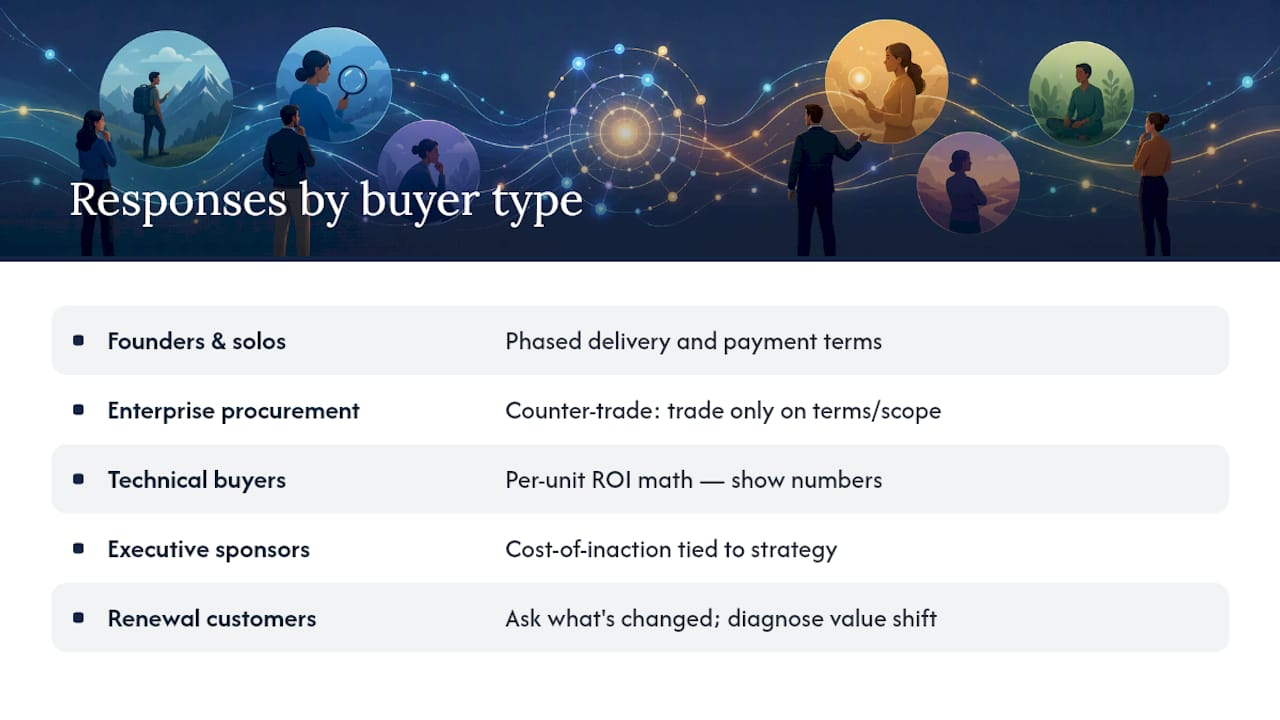
A stretched startup founder and a risk-averse procurement lead at a large enterprise will both say “the price is too high,” but they mean different things, and treating them identically wastes the conversation.
Founders and solo operators tend to be genuinely budget-constrained. Their objection is often real, not tactical. Lead with phased delivery and payment terms rather than value math they’ve probably already worked out for themselves.
Enterprise procurement contacts are frequently negotiating on principle, not personal budget. They’re measured on the discount they extract, so expect the objection regardless of your price. Here, the counter-trade approach matters most: give ground only against term length or scope, never against nothing.
Technical buyers (an engineering lead, an operations manager) usually respond better to per-unit ROI math than to emotional framing. Show the number, not the story.
Executive sponsors care about strategic outcomes and risk more than line-item cost. A cost-of-inaction frame, tied to a business-level consequence rather than a departmental one, lands harder with this group than any per-hour saving would.
Repeat or renewal customers objecting on price usually mean something has shifted, either their own budget cycle or their perception of value delivered since the last renewal. Ask directly what’s changed rather than assuming it’s a pure pricing conversation. In every case, the diagnostic question stays the same. Only the reframe you follow it with should change to match who’s actually across the table.
What do price objections look like across different industries?
The underlying causes repeat everywhere. Only the surface language changes.
In B2B software sales, the objection often sounds like, “Your competitor is £200 a month cheaper.” The right move is a scope comparison: what’s genuinely included in that cheaper plan, and what breaks if the buyer scales past its limits?
In professional services (consultancy, agency work, fractional leadership), the objection is frequently a proxy for uncertainty about outcomes rather than the fee itself. “I’m not sure this will work for us” hides behind “that’s a lot for advice.” The fix is evidence, not a lower rate.
In field sales and equipment, timing objections dominate. “We don’t have budget until next quarter” is often genuine. A calendar hold with a locked-in price beats chasing the same lead again in twelve weeks.
In retail and high-ticket consumer sales, anchor problems are the norm. Buyers have seen a cheaper alternative online minutes before walking in. Apples-to-apples comparison on materials, warranty, or service beats arguing the number directly.
In subscription and recurring-revenue businesses, price objections at renewal usually signal a value gap that opened up gradually. The buyer stopped noticing the return somewhere in month four. Reintroducing usage data at renewal time, rather than defending the fee, tends to resolve this faster than any discount would.
Why do stories and social proof beat arguing on price?
Numbers persuade the analytical part of a buyer’s brain. Stories persuade the part that actually decides. A well-placed case example does more to overcome a price objection than a spreadsheet of ROI figures, because it answers the question the buyer hasn’t said out loud: “Will this actually work for someone like me?”
The mechanism is straightforward. When you quote a fee in isolation, the buyer has nothing to weigh it against except their own fear of wasting money. A short, specific story, “a business your size implemented this and recovered the cost within four months because of X,” gives them a comparable outcome instead of an abstract promise.
Specificity matters more than polish. A vague testimonial (“great service, highly recommend”) does almost nothing for a price objection. A story with a number, a timeframe, and a named problem does real work, because it lets the buyer picture themselves in the outcome rather than just reading a claim about it.
Social proof also does something subtler: it removes the buyer’s sense that they’re the one taking the risk. If others in a similar position have already made the same decision and it worked out, the objection shifts from “is this worth the money” to “am I the outlier if I say no.” That’s a much easier frame to move a buyer out of.
Use this deliberately, not decoratively. Save your strongest case example for the exact moment you’ve diagnosed a value gap, not as a generic slide at the start of every pitch. Timing the story to the objection is what makes it land.
What psychological principles drive price objections?
Buyers rarely calculate price rationally in the moment they raise it. Several well-documented biases are doing the work underneath the objection, and knowing which one is active changes how you respond.
Anchoring is the most common. The first number a buyer hears, whether it’s a competitor’s quote, a budget set months ago, or a figure a colleague mentioned casually, becomes the reference point everything else gets judged against. This is why asking “compared to what?” is so effective: it exposes the anchor so you can address it directly instead of fighting an invisible number.
Loss aversion explains why cost-of-inaction framing works better than benefit framing for many buyers. People feel the pain of a potential loss more sharply than the pleasure of an equivalent gain, so “here’s what continuing to lose £X a month costs you” often moves a buyer further than “here’s what you’ll gain.”
Social proof and consensus bias mean buyers feel safer making a decision that others like them have already made. This is the psychological engine behind the storytelling point above: reducing perceived risk by demonstrating that the choice is already validated elsewhere.
Commitment and consistency explain why asking small yes questions earlier in a conversation (“Would solving this problem be a priority if the cost weren’t an issue?”) makes the final commitment question easier to answer. Buyers who’ve already agreed with the logic find it harder to reject the conclusion.
Understanding which bias is active doesn’t mean manipulating the buyer. It means matching your language to how they’re actually processing the decision, rather than repeating a generic value pitch that ignores the specific fear or comparison driving the objection.
How can sales teams practise handling price objections regularly?
Skill built once in a workshop decays within weeks without repetition. Price objection handling needs to be drilled the same way any other high-pressure skill is, through short, frequent, feedback-rich practice rather than an annual training day.
Run weekly role-play sprints of fifteen minutes, not full-length mock calls. Rotate who plays the buyer so reps experience different objection styles, from the blunt “too expensive” to the more evasive “let me think about it.”
Record real calls (with appropriate consent) and review them for the specific behaviours in the role-play checklist above: did the rep pause, diagnose, and quantify before reframing? Call-analytics research from firms like Gong has linked objection-handling quality directly to win rates, which makes this kind of review worth the time it costs.
Build a shared script library that reps can add to after every win, so the team’s language improves collectively rather than staying locked in one person’s head. Pair newer reps with experienced ones specifically for objection-handling shadowing, not general onboarding.
Finally, track a simple metric: discount frequency and size per closed deal, month over month. If that number falls after training without a drop in close rate, the diagnose-first habit is genuinely sticking, not just sounding good in a workshop.
What actually changes when you diagnose before you respond?
Here’s what surprises most reps when they finally try this properly: the hardest part isn’t learning the scripts. It’s tolerating the silence after you ask the diagnostic question. Most people fill that gap with a justification nobody asked for, and that’s the exact moment margin disappears.
I’ve watched the same pattern play out across very different sales teams. The rep who wins isn’t the one with the cleverest reframe. It’s the one who resists the urge to talk in the three seconds after “your price is too high” and lets the buyer’s own answer do the diagnostic work instead. Conventional advice treats price objections as something to be overcome with a better argument. The stronger read is that they’re information you haven’t collected yet.
Pro Tip: In coaching sessions, I ask reps to write down what they think the objection means before they respond to it live. Nine times out of ten, their guess is wrong, and that gap is exactly why the diagnostic question earns its place ahead of the reframe.
— Jerry
How Aheadofsales helps teams stop discounting on autopilot
Reflexive discounting is a trained behaviour, and it gets untrained the same way it was learned: through repetition, feedback, and a coach watching real calls rather than a slide deck. Aheadofsales builds the diagnose-first sequence into bespoke 1:1 coaching and team training programmes for B2B businesses that want their sales teams hitting quota without eroding margin every quarter to do it.
If your team’s default move under pressure is still a discount, that’s a coaching gap, not a pricing problem, and it’s fixable faster than most leaders expect once the right diagnostic habits are drilled in. Whether you run a growing B2B company with a full sales team or operate as a solo service business, Aheadofsales structures its sales training and coaching packages around exactly this kind of behavioural change. For teams navigating high-stakes negotiations specifically, the sales negotiation techniques that protect margin go deeper into the levers covered above. Book a discovery call to talk through where your team’s price conversations are currently leaking margin, and what a bespoke coaching programme could look like for your specific deals.
Where this article’s evidence comes from
The frameworks and scripts above draw on practitioner sources that specialise in objection handling and sales negotiation, cross-checked against buyer behaviour research.
- HubSpot’s response collection supplies practical, tested scripts for the “too expensive” objection specifically.
- AmpUp’s root-cause framework maps anchor, value, authority, and timing to distinct response families.
- Nimitai’s stepwise model provides the pause, diagnose, validate, reframe sequence used throughout this piece.
- Rework’s guidance evidences why unconditional discounting damages retention over time.
- Gartner’s B2B buying research supports the authority and stakeholder-mapping points.
- SalesArmor’s tactic collection informed the margin-protection and mistake-avoidance sections.
Sources
- 14 responses to the sales objection, ‘Your price is too high’ | HubSpot
- Price Objection Handling: 12 Responses That Work | AmpUp
- How to Handle Price Objections in Sales: 7-Step Framework + 15 Scripts (2026) | Nimitai
- Price objections framework and guidance | Rework (2025)