
Land and expand means winning a small, focused initial contract, proving measurable value fast, then growing that account once real expansion signals appear. The capability that makes it work is fast time-to-value paired with outcome-focused customer success, not clever upselling scripts. Get it right and you buy more capital-efficient growth and materially higher net revenue retention. Get it wrong and you’ve simply sold a bigger contract with a slower death.
TL;DR:
- The initial deal should focus on an urgent, measurable use case delivered within 30 to 90 days, not on securing the largest spend possible.
- Accurate documentation of baseline metrics and success outcomes is crucial for proving impact and supporting future expansion discussions.
- Expansion signals include increased product usage and leadership budget changes, and expansion should be treated as a separate, value-based negotiation.
- Consistent routines like regular value reports, quarterly reviews focused on outcomes, and shared ownership between sales and customer success drive expansion success.
- Tools like CRM for documented success metrics, usage analytics, and health scoring are vital, while legal clauses should be aligned with future growth considerations.
Table of Contents
- What is a land and expand strategy, and why does it work?
- Scoping the land deal: pricing and setting up the first win
- When is an account ready to expand?
- The operational playbook: sequence, rituals, and handoffs
- Which metrics prove the motion is actually working?
- What kills land and expand before it starts?
- What does success and failure actually look like?
- A 90 to 120 day checklist you can start using this week
- Getting sales and customer success working from the same playbook
- How should the approach change by segment or industry?
- Why feedback and relationship management decide the expand phase
- Which tools actually support a land and expand motion?
- What legal and contract details matter as accounts grow?
- How does competitive positioning shift once you’re expanding?
- How Aheadofsales approaches land and expand coaching
- Ready to build a land and expand programme that actually expands?
- Sources
What is a land and expand strategy, and why does it work?
A land and expand strategy is not upselling with better timing. Upselling pushes more product at an existing buyer, often on the sales team’s calendar rather than the customer’s. Land and expand starts smaller on purpose, then earns the right to grow by delivering an outcome the customer can point to. The difference sounds subtle. In practice, it changes almost every decision you make about scoping, pricing, and who owns the relationship after the ink dries.
This motion fits products and services where value compounds with adoption and where a single department, team, or use case can prove the concept before the whole organisation commits. It suits complex B2B sales with long buying cycles, multiple stakeholders, and budget gatekeepers who need evidence before they’ll expand a commitment. It fits less well where the product only delivers value at scale from day one, because there’s no meaningful “small” version to land.
The commercial case is straightforward once you’ve run it a few times. Net revenue retention rises because expansion revenue from existing accounts costs a fraction of new logo acquisition. Customer acquisition cost per pound of lifetime revenue falls, because the second and third deals inside an account are cheaper to close than the first ever was. The trade-off, and it’s real, is that land deals often carry thinner initial margins and demand more patience from your board or your investors before the payoff shows up in the numbers. Business growth strategy frameworks like the value stick help clarify exactly where you should land first and how you intend to capture value as the account grows, rather than leaving that decision to whichever rep closes the loudest prospect.
Scoping the land deal: pricing and setting up the first win
The initial contract is the single highest-leverage decision in the entire land and expand model, and most sales teams get it wrong by defaulting to the biggest deal they can close rather than the smallest deal that proves value fastest.
Pick the most urgent single use case the buyer has, not the largest theoretical spend across their organisation. A finance director who wants to fix one broken reporting process is a better land opportunity than a vague mandate to “improve visibility across the business,” even if the second sounds bigger on paper. Urgency, not size, predicts whether the buyer will actually implement what they’ve bought.
Here’s the sequence worth following on every land deal:
- Define one measurable outcome. Agree what success looks like in numbers, not adjectives, before the contract is signed.
- Set a 30 to 90 day window. Practitioner data on land and expand programmes shows that deals scoped to deliver measurable value inside this window preserve far more expansion momentum than open-ended engagements.
- Resist the urge to overbundle. Every module or feature the customer isn’t actively using becomes what practitioners call implementation debt, and it sits between you and the next conversation.
- Price for expansion economics, not maximum land revenue. If the first deal is priced so tightly that expansion looks expensive by comparison, you’ve made your own job harder.
- Document everything from day one. Onboarding notes, baseline metrics, and named stakeholders become the raw material for every future business case you build inside that account.
The operational checklist matters more than most sales leaders admit. A land deal without a documented baseline is a land deal you can’t prove you improved. That single gap kills more expansion conversations than any competitor ever will.
When is an account ready to expand?
Expansion readiness shows up in two distinct signal types, and conflating them is a common way sales teams either push too early or leave money on the table for months longer than necessary.
Look for behavioural signals such as increased usage or requests from new departments, alongside commercial signals like budget renewals or leadership changes. Both types inform the right timing for expansion discussions.
Treat the expansion conversation as a separate sale, not a follow-on chat. Land and expand practitioners recommend running fresh discovery with the new stakeholders involved, because the success criteria for department two are rarely identical to department one’s.
Practical rules for running expansion well:
- Bring a documented outcome from the land phase into the room, not a vague promise of “more value.”
- Identify who actually holds budget for the new scope; it’s often not your original champion.
- Price the expansion on its own merits rather than simply multiplying the original contract.
- Avoid discounting the expansion to “reward loyalty,” because it signals your pricing was never disciplined in the first place.
- Ask your champion for a warm introduction to the new stakeholder rather than going in cold.
Champion-led introductions convert at meaningfully higher rates than cold outreach into the same account, according to practitioner benchmarks on expansion conversion.
Pro Tip: Build your expansion pitch around the metric your champion already reports upward. If they’ve been telling their own boss the land deal cut processing time by a third, that’s the number your expansion proposal should open with, not a new one you’ve invented for the occasion.
The operational playbook: sequence, rituals, and handoffs
A land and expand motion collapses without a repeatable sequence. Ad hoc heroics from one strong account manager might work once. They don’t scale across a sales team, and they definitely don’t survive that account manager leaving.
Start with qualification. Use a jobs-to-be-done lens to pick landing opportunities: what specific job is the buyer trying to get done, and can you deliver a visible result against it inside your target window? HBS Online’s growth strategy framework treats this as choosing where to compete before deciding how to win, and it applies just as well to picking which department to land in first as it does to picking which market to enter.
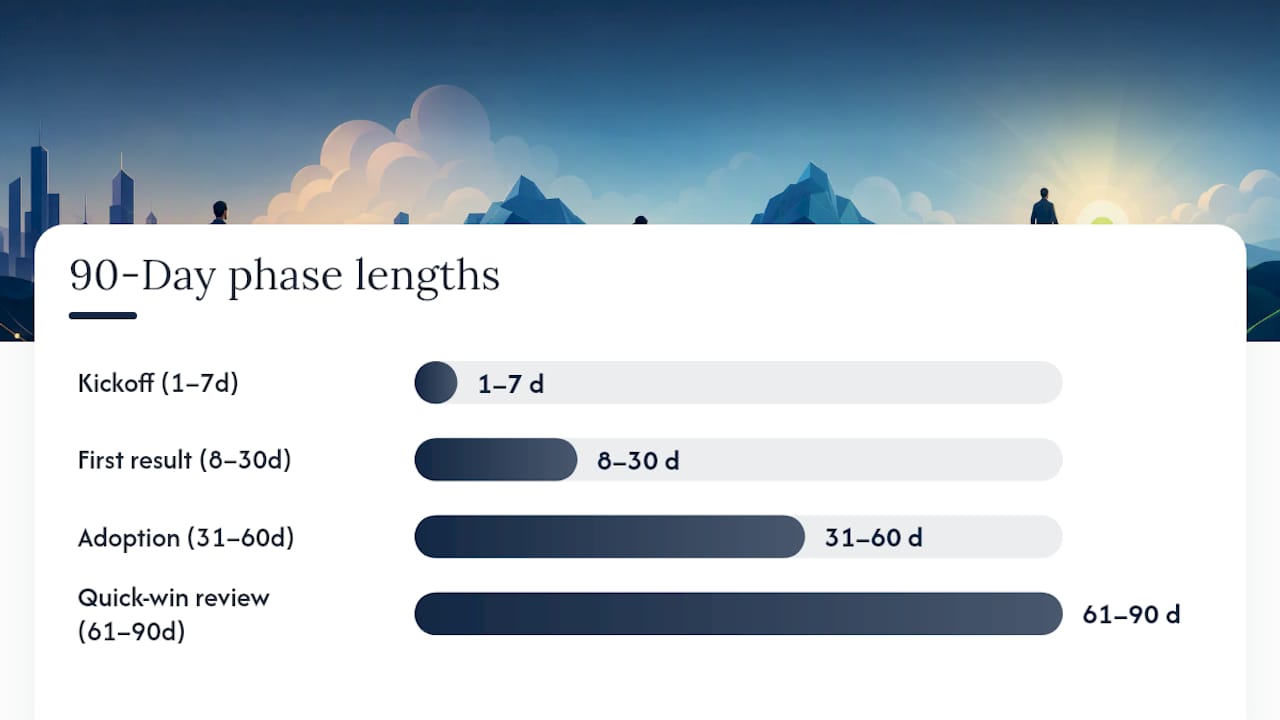
The first 90 days set the tone for everything that follows:
- Days 1 to 7: Kickoff call, confirm the success metric, assign a named owner on both sides.
- Days 8 to 30: Deliver the first visible result, however small, and document it against the baseline.
- Days 31 to 60: Widen adoption within the landed team, surface early usage data, and flag any friction before it becomes churn risk.
- Days 61 to 90: Deliver the quick-win report and formally review it with the buyer, framing it as proof rather than a routine check-in.
Daily visibility routines matter more than most sales leaders expect. Retention research from Forbes Coaches Council frames retention as a daily discipline rather than a rescue operation, and the same logic applies directly to expansion: accounts that get reviewed weekly rarely surprise you with a churn risk, because the CRM signals (usage dips, ticket volume spikes, a champion going quiet) show up long before the renewal conversation does.
Beyond the daily cadence, build these rituals into the account’s rhythm:
- A monthly one-page value report that states the outcome delivered in the customer’s own numbers.
- A quarterly business review that opens with results, not a feature roadmap.
- An expansion scoring model that flags accounts crossing usage or seat thresholds automatically.
- A documented handoff between the account manager and whoever owns the expansion conversation, so context never gets lost mid-account.
Quarterly business reviews built around a clear value narrative do double duty: they satisfy the customer’s need for proof and they give your account team the exact material they’ll need when an expansion signal finally appears.
Which metrics prove the motion is actually working?
Net revenue retention (NRR) measures revenue from your existing customer base over a period, including expansion, contraction, and churn, expressed as a percentage of where you started. Values above 100% indicate expansion revenue is outpacing losses; lower values suggest leaking land deals.
Four metrics deserve a permanent place on your dashboard:
- Net revenue retention (NRR): the headline health check for the entire motion.
- Time-to-value (TTV): how long from contract signature to the customer experiencing a measurable outcome.
- Expansion rate: the share of accounts that grow within a defined period after landing.
- Logo and revenue churn: tracked separately, because losing a small account and losing a large one tell you different things.
Benchmark to watch: practitioner data on documented land and expand programmes points to first expansion conversations commonly happening around the 90 to 120 day mark when the land deal was scoped correctly. If your accounts routinely drift past that window with no expansion conversation started, the land phase probably wasn’t scoped tightly enough.
Review these numbers monthly at the account level and quarterly at the portfolio level. A single bad quarter tells you little; a TTV that’s crept upward for three consecutive quarters tells you your onboarding process has quietly degraded somewhere.
What kills land and expand before it starts?
Most failed expansion motions die from the same handful of causes, and nearly all of them are avoidable with discipline rather than talent.
Overscoping the initial deal is the biggest one. Sales reps chase the largest number they can get signed, bundle in every feature the buyer might theoretically want, and hand customer success a contract nobody can fully implement inside a reasonable window. Practitioner analysis of failed land deals calls this implementation debt, and it’s the single clearest predictor of a stalled account.
The second failure is pushing expansion before value is proven. A rep under quota pressure pitches module two before the customer has finished rolling out module one, and the buyer reasonably concludes you care more about your number than their outcome.
Organisational silos compound both problems. When sales, onboarding, and customer success don’t share documentation, nobody expanding the account actually knows what was promised at land, what’s been delivered, or what the customer’s own success metric was supposed to be.
Guardrails that work in practice:
- Cap the land deal’s scope to a single use case with a named success metric.
- Trigger expansion conversations from behaviour data, never from quota pressure alone.
- Require a documented baseline and outcome before any expansion pitch goes to the customer.
- Force a handoff document between land and expand owners, reviewed by both parties, not just filed and forgotten.
What does success and failure actually look like?
The positive pattern is consistent across accounts that expand well. For example, a mid-size logistics firm lands with a single-department deployment, agrees a 60-day success metric tied to processing time, hits it inside the window, and documents the result in the customer’s own reporting format. The champion, now armed with a number their own leadership recognises, makes the warm introduction to a second department without being asked twice. Expansion closes faster than the original deal did, because the discovery work and the trust were already in place.
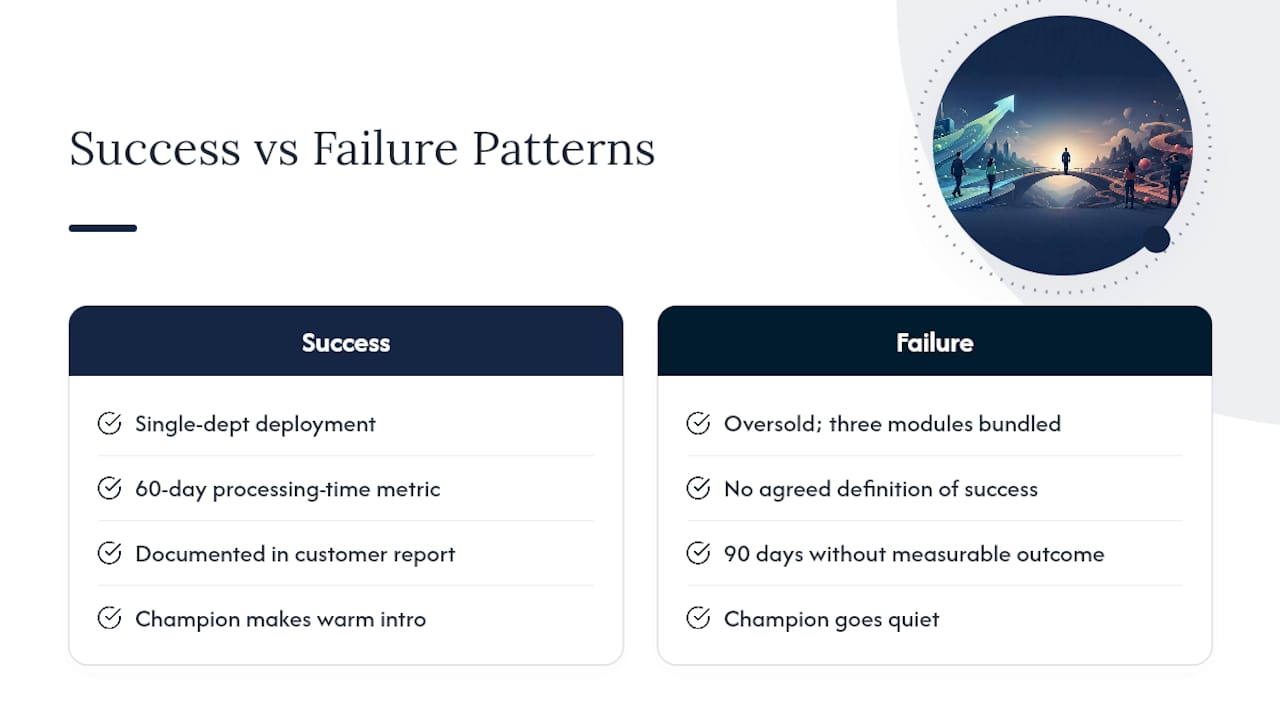
The negative pattern is just as consistent, and it usually starts at the contract stage rather than at implementation. An account gets oversold at land: three modules bundled in because the deal size looked better on the forecast, only one of which the buyer’s team ever actually configures. Ninety days pass with no measurable outcome to point to, because nobody agreed what “success” meant in the first place. The champion goes quiet. When the account manager finally raises expansion, the buyer’s honest response is that they haven’t finished using what they already paid for.
The lesson from both examples is the same: the land deal’s discipline determines the expand deal’s ceiling. A tightly scoped contract with a clear outcome creates a story worth retelling internally. An overbought contract with no proof creates a renewal risk dressed up as a customer.
A 90 to 120 day checklist you can start using this week
Copy this straight into your CRM or QBR template.
Onboarding checklist:
- Kickoff call within seven days of signature, with named owners on both sides.
- Baseline metric agreed and documented before any implementation work begins.
- Quick win delivered and reported by day 30.
- Adoption review and friction check by day 60.
- Formal outcome review and expansion readiness check by day 90.
QBR agenda that actually earns attention:
- Open with the outcome delivered against the original success metric.
- Surface usage data and any behavioural signals pointing toward expansion.
- Close with a specific, scoped expansion proposal, not a generic roadmap slide.
Discovery questions for a new department or stakeholder:
- What outcome would make this expansion an obvious win for you personally?
- Who else needs to sign off before budget moves?
- What’s the one thing the current team wishes had been included from the start?
Getting sales and customer success working from the same playbook
Land and expand collapses the wall between sales and customer success, whether or not your organisation chart admits it. The account manager who closes the land deal and the customer success lead who owns the relationship afterwards need the same success metric, the same timeline, and the same definition of what “value delivered” means, because a mismatch here is where most expansion opportunities quietly die.
Build shared ownership from the start rather than trying to bolt it on later. That means customer success has visibility into what was promised during the sales cycle, and sales has visibility into what’s actually being adopted post-signature. McKinsey’s research on disciplined growth makes a similar point at the corporate level: sustained outperformance comes from sequencing growth deliberately and governing it, not from letting each function chase its own incentive in isolation.
Compensation structures often work against this alignment without anyone intending it to. If your sales team is paid entirely on new logos and customer success is paid entirely on retention, neither has a direct incentive to collaborate on expansion revenue, which sits awkwardly between the two. The fix isn’t complicated in principle: build expansion revenue into both teams’ targets, even if the split isn’t perfectly even, so the incentive to hand off cleanly outweighs the incentive to protect territory. Account management practices that formalise this handoff, rather than leaving it to informal goodwill between individuals, tend to survive staff turnover far better.
Governance matters too. Someone needs to own the expansion pipeline the same way someone owns the new-business pipeline, with visibility into which accounts are ready, which are stalling, and why.
How should the approach change by segment or industry?
A single land and expand template rarely fits every customer segment, and forcing one usually shows up as slower TTV in the segments where it doesn’t belong.
Enterprise accounts typically need longer land phases, more formal success criteria, and multiple stakeholders signed off before expansion even gets discussed. The trade-off is worth it: enterprise expansion tends to be larger and stickier once it starts, because procurement friction that slowed the land deal down also protects it from easy churn.
Mid-market accounts often move faster in both directions. A 30-day land window is realistic here, and champions tend to have more autonomy to expand without lengthy committee sign-off, which is exactly why the champion relationship matters more in this segment than almost any other lever you control.
Solo operators and small service businesses need a different calibration entirely. The buyer and the champion are frequently the same person, so expansion discovery doesn’t need a separate stakeholder map. What it needs instead is a tightly compressed proof cycle, because a small business owner won’t tolerate a 90-day wait for evidence the way a large enterprise procurement team will.
Industry also shapes what “value” looks like. A SaaS platform’s land deal might prove itself through a usage metric inside a dashboard. A professional services engagement proves itself through a delivered outcome that’s harder to automate into a report. Neither is wrong, but pretending they use the same success criteria is how sales teams end up applying a SaaS-style expansion script to a relationship-driven services account, and wondering why it falls flat.
Why feedback and relationship management decide the expand phase
The expand phase runs on trust built during the land phase, and customer feedback is how you find out whether that trust is actually intact before you ask for more money.
Structured feedback loops, not just an annual satisfaction survey, catch the small frictions that quietly erode a relationship before they show up as a churn risk. A short check-in after the quick win, a specific question about what nearly went wrong during onboarding, a direct ask about what the customer would change: these surface the information a formal QBR often misses, because customers save their honest complaints for informal conversations.
Relationship management during expansion isn’t the same skill as relationship management during the land phase, and treating it as identical is a common mistake. The land phase rewards responsiveness and hand-holding. The expand phase rewards proof and strategic framing, because the buyer you’re now talking to (often a new stakeholder entirely) doesn’t need reassurance that you’ll show up. They need evidence that expanding is the obvious next decision, not a favour to your account manager.
The champion’s role shifts here too. During land, the champion is often the person doing the work. During expand, the champion becomes the internal narrator, retelling your outcome to people who weren’t in the original buying conversation. Growth strategy research makes the point plainly: measuring outcomes rather than usage gives that champion a story worth repeating internally, because “usage went up” doesn’t travel through an organisation the way “we cut processing costs by a documented margin” does.
Which tools actually support a land and expand motion?
Technology doesn’t create expansion revenue by itself, but the wrong tooling makes every step of the playbook slower and every signal harder to see in time.
A CRM configured with expansion-specific fields, not just deal stage and close date, is the foundation. You need a place to log the original success metric, the baseline, and the documented outcome, because that data is what your expansion pitch draws on months later. Without it, every expansion conversation starts from memory rather than evidence.
Usage analytics matter for any product-led element of the motion, flagging seat limits, feature adoption gaps, and the behavioural signals that tell you an account is ready before the customer says so out loud. Qualification tooling helps at the front end too: knowing who inside a target account actually holds budget authority before you invest discovery time is a problem tools built specifically for buyer qualification are designed to solve, and it saves the embarrassment of pitching expansion to someone who can’t say yes.
Customer success platforms that automate health scoring reduce the risk of a stalled account slipping through unnoticed between QBRs. None of this replaces judgement. A dashboard flags a threshold; it doesn’t tell you whether the champion who’d normally act on it just changed jobs. Tooling supports the playbook. It doesn’t run it for you.
What legal and contract details matter as accounts grow?
Expansion contracts create legal questions the original land deal often didn’t need to answer, and skipping them tends to surface as a dispute later rather than a clean conversation now.
Auto-renewal and notice period clauses deserve scrutiny at expansion time, not just at signature, because an expanded contract sometimes resets or extends terms the customer didn’t fully register agreeing to. Be transparent about this rather than letting it surface as a surprise on a future invoice; research on pricing communication makes the point that unclear changes to cost or terms are one of the fastest ways to damage a relationship you’ve spent months building.
Data and usage rights matter more with every expansion, particularly when a new department starts feeding different data into a shared platform. Confirm what’s covered under the existing agreement and what genuinely needs a new clause, rather than assuming the original contract quietly stretches to cover it.
Pricing structure clauses (tiered volume discounts, most-favoured-customer terms, multi-year lock-ins) can quietly constrain your expansion pricing later if they weren’t negotiated with growth in mind from the start. A land contract signed without any thought to future expansion terms sometimes forces an account manager into an awkward renegotiation just to price the second deal fairly.
None of this requires a legal department for every account. It requires someone on the commercial side asking, before the land contract is signed, what an expanded version of this relationship might need contractually, so the second deal doesn’t get stuck behind paperwork the first deal never anticipated.
How does competitive positioning shift once you’re expanding?
The competitive conversation changes shape entirely once you’re inside an account rather than pitching from outside it, and treating expansion sales like a fresh competitive bid usually undersells your actual advantage.
At the land stage, you’re competing on promise: capability claims, references, price. By the expand stage, you’re competing on delivered proof, and that proof is something a rival pitching into the same account from scratch simply cannot match on day one. A competitor can undercut your price. They can’t manufacture ninety days of documented results with your customer’s own numbers attached to them.
That advantage decays if you don’t use it. An account that’s expanded slowly, with vague outcomes and no fresh discovery for the new stakeholder, gives a competitor room to reposition against you as the incumbent who’s coasting. Position every expansion conversation explicitly against the counterfactual: what would it cost this customer, in time and risk, to rip out something that’s already proven and start again with an unproven alternative? That’s rarely a comfortable question for a buyer to answer honestly in your competitor’s favour.
Positioning inside a land and expand framework, then, isn’t about restating your features against a rival’s feature list. It’s about making the proven outcome impossible to ignore, and making the switching cost visible without ever having to say the word “competitor” out loud.
How Aheadofsales approaches land and expand coaching
Bespoke 1:1 coaching shortens time-to-value because it targets exactly where a specific sales team’s land process is slow, rather than teaching generic theory to a room. Structured onboarding for the sales function itself (clear success metrics, defined 90-day milestones) builds the same discipline into your own team that you’re asking your reps to build into customer accounts. If you’re a growth-minded B2B business or a solo service operator trying to make expansion repeatable rather than accidental, that’s exactly who this approach is built for.
— Jerry
Ready to build a land and expand programme that actually expands?
If you’ve read this far, you already know the theory. The harder part is installing it inside a sales team that’s busy hitting this quarter’s number while you’re trying to change how they sell next quarter’s. That’s precisely the gap Aheadofsales exists to close: bespoke 1:1 coaching combined with structured team training, built around your actual accounts rather than a generic sales curriculum.

Some businesses want expansion revenue to become a predictable line on the forecast rather than a happy accident; coaching and consultancy programmes can help install disciplines like tight land scoping, documented onboarding, and a repeatable expansion motion your whole team can run without you personally chasing every account. Solo service businesses looking for a faster route to the same outcome can consider focused sales acceleration packages.
The next step is straightforward: visit Aheadofsales’ sales training services to see which programme fits your team’s stage of growth, and book a discovery call to talk through where your own land and expand motion is currently losing momentum.
Sources
- Land and Expand Strategy: Stop Overselling the First Deal and Start Earning the Second One
- Why Client Retention Is A Daily Discipline, Not A Rescue Plan
- How to develop business growth strategies that drive results
- The ten rules of growth