
Sales management coaching is the discipline of training managers to diagnose a seller’s specific gap and correct it through structured questioning, not instruction. It differs from sales training, which teaches skills to reps directly. Done well, coaching lifts quota attainment across the whole team, and middle performers, not your stars or your stragglers, deliver the biggest return.
TL;DR:
- Formal, scheduled coaching significantly outperforms informal coaching, especially for middle performers who have the potential to improve most.
- Core coaching skills include diagnostic listening, question-led debriefs, pattern recognition, and motivating feedback, which require deliberate practice and reinforcement.
- Coaching success depends on a repeatable process, structured 1:1 templates, proper preparation, and integration with CRM and sales enablement tools.
- Managers need targeted training and calibration to develop genuine coaching behaviors, avoiding common mistakes like giving instructions and neglecting follow-up.
- Remote coaching demands a shorter, focused cadence, recorded calls, asynchronous feedback, and visible follow-up to replicate the office learning environment effectively.
Table of Contents
- What is sales management coaching and why does it matter?
- Core coaching skills every sales manager needs
- A repeatable coaching process and 1:1 template
- How to train managers to coach
- Measuring coaching impact: the KPIs that matter
- Common coaching mistakes and how to avoid them
- How Ahead of Sales approaches coaching in practice
- Integrating coaching with CRM and sales enablement tools
- Building a coaching culture across the team
- Coaching sales teams remotely
- What actually separates good coaching from good intentions
- Get hands-on help building your coaching programme
- Sources
What is sales management coaching and why does it matter?
Sales training teaches a rep a skill. Sales management coaching teaches a manager how to spot which skill a rep is missing and then draw the fix out of them through questions rather than instructions. That distinction gets blurred constantly in job descriptions, and it’s why so many “coaching” conversations are really just managers telling reps what to do differently, which rarely sticks.
The evidence for coaching as a discrete discipline is strong. Effective sales coaching can lift seller performance by up to 19%, and organisations running formal coaching programmes consistently report stronger revenue growth and higher quota attainment than those relying on ad hoc feedback. That’s not a marginal edge. It’s the difference between a team that hits target most quarters and one that scrapes by.
The biggest ROI usually sits with the middle performers, the reps doing fine but not great, who have the most room to move and the most capacity to absorb feedback without feeling threatened by it.
What this means in practice:
- Coaching and training are separate levers. You need both, but they solve different problems.
- Formal, scheduled coaching outperforms informal, reactive coaching almost every time.
- Your middle 60% of performers is where a manager’s coaching hours earn the highest return.
- Skill development in reps only compounds if managers themselves have been trained to coach, not just told to “coach more.”
Core coaching skills every sales manager needs
Most frontline sales managers get promoted because they sold well, not because anyone taught them to coach. Research from QUOTA Training confirms this gap is widespread: managers receive little or no formal coaching instruction before being handed a team, and four specific, trainable skills separate the ones who develop reps from the ones who just supervise them.
- Diagnostic listening. Listen for the root cause behind a missed deal, not the symptom the rep describes. A rep saying “the prospect went quiet” might actually mean they never secured a next-step commitment. Train yourself to ask one more “why” than feels comfortable.
- Question-led debriefs. Replace “here’s what you should have said” with questions like “What did you think the prospect’s biggest hesitation was?” or “If you replayed that call, where would you change your approach?” The rep should do most of the talking.
- Pattern recognition. Pull three or four call recordings or CRM notes from the same rep across a fortnight. One bad call is an anomaly. The same objection appearing in every deal is a skill gap worth coaching directly.
- Motivating feedback. Use a simple formula: specific behaviour, specific impact, specific next action. “You interrupted the prospect twice in the first two minutes, which cut off useful information, so try a three-second pause before responding next time” beats “be a better listener” every time.
Short, five-minute drills between real coaching sessions cement these skills faster than a single training day ever will. Have a manager practise diagnostic questions on a colleague’s mock objection before trying it live with a rep.
Pro Tip: Record your own coaching debriefs occasionally, not just the reps’ sales calls. Listening back to how many questions you asked versus how much you told will humble most managers fast.
A repeatable coaching process and 1:1 template
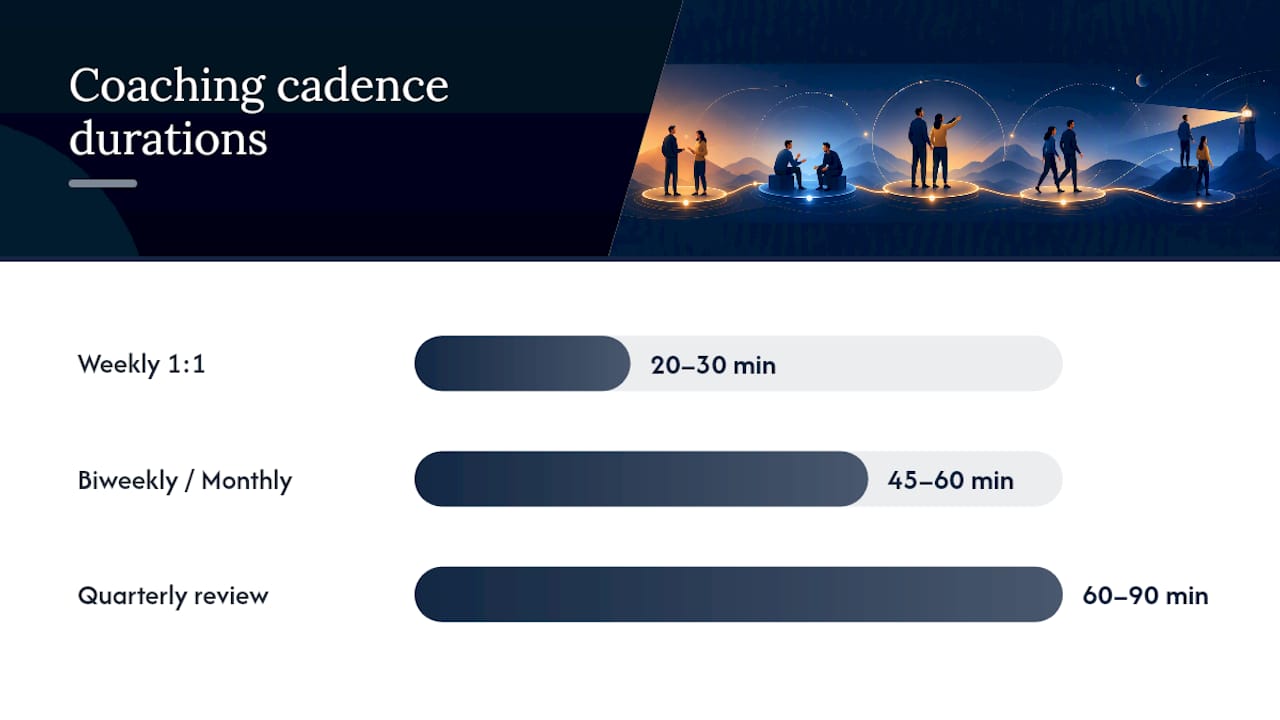
Coaching only works if it happens on a rhythm, not whenever a manager has a spare half hour. Different cadences serve different purposes, and mixing them up is what stops coaching from going stale.
- Weekly, 20 to 30 minutes: pipeline and deal-specific coaching. Focus on live opportunities, next steps, and one skill to practise before the next call.
- Biweekly or monthly, 45 to 60 minutes: skill development review. Look at patterns across several calls, revisit the four core skills above, and set one deliberate-practice goal.
- Quarterly, 60 to 90 minutes: career and performance conversation. Zoom out from individual deals to quota trajectory, development plans, and role fit.
A practical weekly 1:1 template, timed to 25 minutes:
- Minutes 0 to 3: Rep shares one win and one struggle from the week. No interruptions.
- Minutes 3 to 10: Manager asks diagnostic questions about the struggle. Aim for at least three “why” or “what did you notice” questions before offering any input.
- Minutes 10 to 18: Review one specific call or email exchange together. Identify the pattern, not just the one instance.
- Minutes 18 to 23: Agree one concrete action for the coming week, phrased as a behaviour the rep will try, not a vague intention.
- Minutes 23 to 25: Manager logs the action in the CRM or a shared coaching tracker, so it can be checked at the next session.
Come prepared. A manager should bring the rep’s current pipeline view, one recent call recording or transcript, and notes from the last 1:1’s agreed action. Skipping preparation is the single fastest way to turn a coaching session into a status update.
For managers building out a full team cadence, Ahead of Sales’ team management workflow sets out how these rhythms fit alongside pipeline reviews and forecasting without overloading the calendar.
How to train managers to coach
Handing a manager a coaching template and hoping for the best rarely works. Skill transfer needs deliberate practice, and certification alone is not enough: a manager can pass a coaching course and still freeze up in a real, awkward conversation with an underperforming rep.
Start by auditing what’s actually happening. Sit in on a sample of live coaching sessions across your management team and check for the basics: are managers asking questions or giving instructions? Is feedback specific or generic? Are actions from the last session being followed up?
From there, build practice into the calendar rather than treating it as a one-off event.
- Run short, weekly “coaching dojos”: 30 minutes where managers role-play a coaching conversation with each other, using a real (anonymised) scenario from the week.
- Use AI-powered role-play tools to let managers rehearse difficult conversations repeatedly, which Highspot’s coaching research flags as a way to build reps without eating into actual selling time.
- Pair newer managers with experienced ones for shadowed 1:1s, followed by a debrief on what the observer noticed.
- Calibrate standards monthly: bring two or three managers together to listen to the same coaching recording and score it against a shared rubric, so “good coaching” means the same thing across the team.
Pro Tip: If a manager keeps taking over deals during coaching sessions instead of asking questions, that’s usually a sign they’re still thinking like a top seller, not a coach. Address that mindset shift directly before drilling the four core skills.
Measuring coaching impact: the KPIs that matter
Coaching frequency is easy to track and tells you almost nothing. What matters is coaching quality and the downstream metrics it should move.
Track these consistently:
- Quota attainment rate, month on month, segmented by rep tenure
- Win rate on qualified opportunities
- Rep retention, particularly among middle performers
- Coaching quality score from a simple rubric (diagnostic depth, question ratio, follow-up completion)
- Time from coaching session to action completion in the CRM
Run a basic before/after comparison: pick a cohort of managers adopting the structured 1:1 template, track their team’s quota attainment over one or two quarters, and compare against a control group still coaching informally. It’s not a clinical trial, but it gives you a defensible signal.
Effective coaching can improve seller performance by up to 19%, and that uplift compounds when it’s the middle of your team improving rather than the edges.
Translate percentage uplifts into revenue by applying them to your average deal size and current pipeline conversion rate, then compare that projected gain against what you’re spending on manager development. For frameworks on connecting these numbers to a wider growth plan, Ahead of Sales’ performance improvement guide walks through the calculation in more depth.
Common coaching mistakes and how to avoid them
Most coaching failures aren’t dramatic. They’re small habits that quietly drain the value out of every session.
- Directive “fix-it” coaching. Telling a rep exactly what to say next time feels efficient, but it stops them building their own diagnostic muscle. Ask the question you’re tempted to answer instead.
- Coaching only the extremes. Pouring all your time into your best and worst reps leaves the middle, where most of your quota upside sits, neglected.
- No follow-up. An agreed action that’s never checked at the next session teaches reps that coaching commitments don’t matter. Log every action and open the next 1:1 by reviewing it.
- Coaching drift across managers. Without shared templates and calibration sessions, one manager’s “coaching” looks nothing like another’s, and reps notice the inconsistency fast.
- Treating certification as the finish line. A manager who’s completed a coaching course still needs live practice, feedback, and calibration before the skill genuinely transfers.
How Ahead of Sales approaches coaching in practice
Some providers blend bespoke 1:1 coaching with structured team training rather than treating them as separate services. A typical engagement pairs weekly manager coaching sessions with quarterly team workshops, so the skills taught to reps get reinforced by managers who’ve been trained on the same framework.
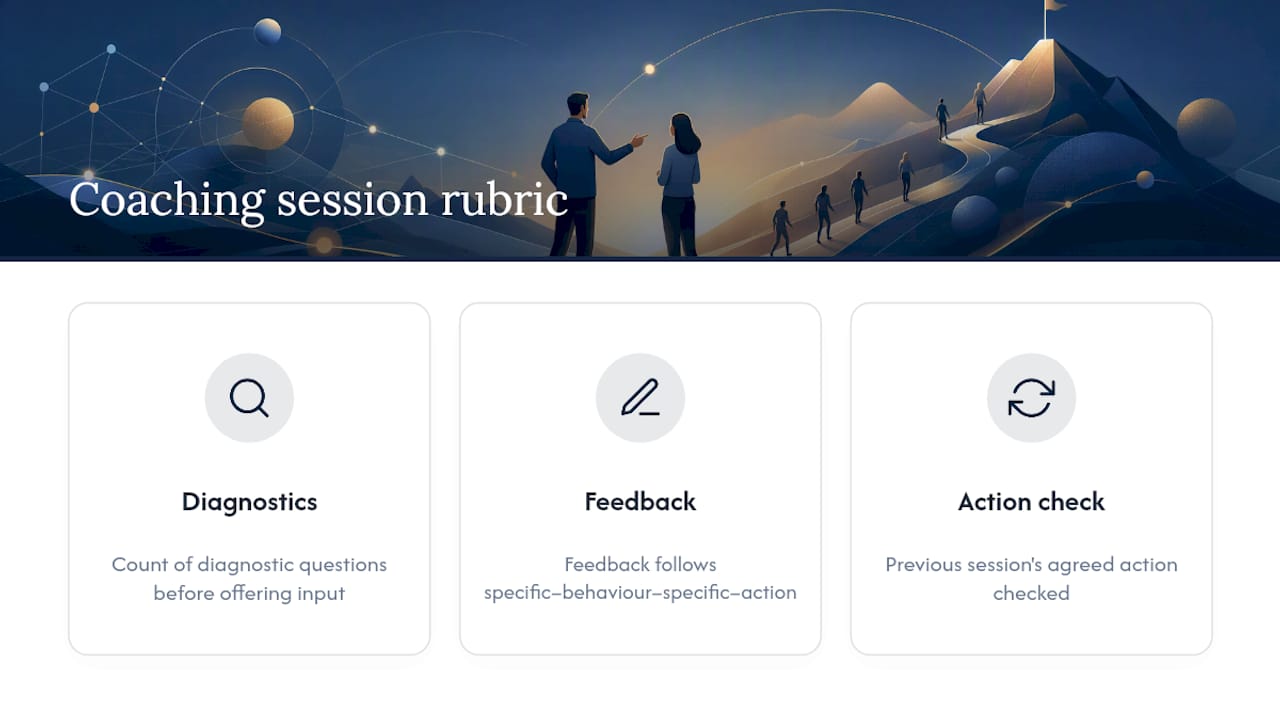
Session rubrics score three things consistently: how many diagnostic questions a manager asked before offering input, whether feedback followed the specific-behaviour-specific-action structure, and whether the previous session’s agreed action was checked. One anonymised example: a services business with six account managers restructured its weekly 1:1s around the timed template above and saw noticeably fewer stalled deals within a single quarter, largely because reps started raising blockers earlier instead of waiting for the pipeline review.
Packages are built around business size and stage, from growing B2B teams to solo consultants who need a fractional sales lead rather than a full internal hire. Full sales consultancy details outline how engagements are scoped for different team structures.
Integrating coaching with CRM and sales enablement tools
Coaching that lives outside the CRM tends to evaporate. If a manager’s notes, agreed actions, and call reviews sit in a separate notebook or spreadsheet, nobody revisits them, and the next 1:1 starts from scratch.
Build coaching directly into the tools reps already use. Most CRMs support custom fields or notes sections where a manager can log the week’s agreed action against the specific deal it relates to, which makes the follow-up automatic rather than something to remember. Call recording and conversation intelligence platforms, increasingly bundled into sales enablement suites, let managers pull three or four calls from the same rep without hunting through folders, which is exactly the pattern-recognition step the core coaching skills demand.
The enablement layer matters too. If your enablement platform stores objection-handling scripts, competitor battlecards, or onboarding content, tie coaching debriefs back to those resources directly. A rep who consistently fumbles a pricing objection should leave the 1:1 with a link to the relevant battlecard, not just a verbal reminder.
For teams weighing up which tools actually support this workflow rather than just adding another dashboard, Ahead of Sales’ comparison of coaching software breaks down what’s worth paying for versus what’s noise. And if coaching conversations are meant to move pipeline metrics, it’s worth aligning coaching priorities with how marketing and sales track revenue together, so a rep’s coaching plan connects to the leads actually landing in their pipeline.
Building a coaching culture across the team
A single well-trained manager can lift their own team’s numbers. A coaching culture is what happens when every manager, at every level, is expected to coach the same way, and senior leaders model it rather than delegating it entirely downward.
That starts with language. If “coaching” only ever means a formal quarterly review, reps will treat it as an event to survive rather than a habit that helps them. Encourage managers to use coaching questions in the small moments too: a two-minute exchange after a lost deal, a quick “what did you notice?” after a strong call. These informal touches, layered on top of the structured 1:1 cadence, are what make coaching feel like part of the culture rather than a box-ticking exercise.
Senior leaders need to be coached too, and visibly so. When a sales director sits in on their own coaching session with a regional manager, and that manager knows about it, it signals coaching isn’t just something that happens to junior reps. Calibration sessions, where multiple managers score the same recorded coaching conversation against a shared rubric, do double duty here: they improve consistency and quietly reinforce that coaching quality is being watched at every level, not just at the bottom of the org chart.
Recognise coaching behaviour explicitly, not just sales results. A manager who ran five structured 1:1s and moved a middle performer’s win rate deserves the same visibility in a leadership meeting as one who closed a big deal personally.
Coaching sales teams remotely
Remote coaching strips away the easy, informal moments, the overheard call, the quick shoulder-tap after a tough conversation, that used to happen naturally in an office. Managers need to recreate those deliberately rather than assume they’ll happen on their own.
Screen-recorded or CRM-logged calls become essential rather than optional. A manager coaching a remote rep can’t casually listen in, so building a habit of reviewing two or three recorded calls before each 1:1 replaces what used to be ambient awareness. Video, not just audio, matters more for debriefs than most managers assume: seeing a rep’s reaction to a tough question reveals hesitation or confidence that a transcript alone won’t show.
Shorten the cadence slightly for fully remote teams. A 20-minute weekly check-in with tighter focus tends to outperform a 45-minute session that tries to cover everything, partly because remote attention spans for video calls drop faster than for in-person conversation.
Use asynchronous coaching between live sessions. A short recorded video response to a rep’s call, sent the same day rather than saved for the next scheduled 1:1, keeps feedback timely without adding another meeting to the calendar. And make the follow-up visible: a shared document or CRM note that both manager and rep can see prevents remote coaching from feeling like it disappears into a video call nobody remembers.
What actually separates good coaching from good intentions
Most advice on sales coaching stops at “coach more” or “coach better,” which is about as useful as telling a rep to “sell more.” The gap isn’t intent. Managers want to coach well. The gap is that almost nobody trains them on the discrete mechanics: how to ask a diagnostic question instead of giving an instruction, how to spot a pattern across calls instead of reacting to one, how to structure feedback so it changes behaviour rather than just registering disapproval.
The conventional wisdom that coaching is a soft skill, something managers either have or don’t, doesn’t hold up. It’s closer to a technical skill, more like negotiation than charisma, and it responds to the same deliberate practice that improves any other trainable capability. Certification courses help managers understand the theory, but the CIPD’s own guidance is blunt about it: theory without live practice and feedback doesn’t transfer into changed behaviour.
If there’s one thing to prioritise this quarter, it’s this: stop coaching your best and worst reps disproportionately, and build one repeatable 1:1 structure that every manager uses the same way. Consistency beats brilliance here, and it’s far easier to scale.
— Jerry
Get hands-on help building your coaching programme
Reading a framework is one thing. Getting your managers to actually run diagnostic debriefs under real pipeline pressure, without slipping back into “fix-it” mode, is another. Ahead of Sales exists for exactly that gap: bespoke 1:1 coaching combined with team training, built around your actual deals rather than generic scenarios.

Packages are shaped around where you are. Growing B2B teams typically start with a blended coaching and training engagement to get managers running structured 1:1s within weeks, not quarters. SaaS businesses at Series B and beyond often need coaching tied specifically to sales cycle length and objection patterns, covered in the SaaS sales training programme. Solo consultants and service business founders who need a coaching structure without a full internal hire can look at the sales acceleration packages instead.
A typical discovery engagement starts with a short audit of how your managers currently run 1:1s, then builds a coaching cadence and rubric specific to your team. Full details on team and bespoke coaching options sit on the sales training services page. If you’re ready to see what a coaching programme built around your pipeline would look like, get in touch to arrange a discovery call.
Sources
For the statistics on coaching’s impact on seller performance and quota attainment, Pipedrive’s sales coaching overview is the clearest summary. On the four core manager coaching skills and practical training formats, QUOTA Training’s guide covers both the diagnosis and the fix. For structured manager curricula, HubSpot Academy’s sales manager training programme offers a useful syllabus reference, while Highspot’s 2026 coaching guide covers AI-assisted role-play and coaching at scale. For the case that certification alone isn’t sufficient without live practice, CIPD’s management development guidance is worth reading in full.
- Sales coaching 101 — Pipedrive
- Sales leadership coaching skills: train managers to develop reps — QUOTA Training
- CIPD — professional guidance on management development
- Ultimate guide to successful sales coaching in 2026 — Highspot