
Bespoke 1:1 coaching combined with short, productised workshops delivers the fastest, measurable improvement for consultants selling high-value services. Expect sharper discovery conversations and higher-value closes within weeks, not months. Specialist providers like Aheadofsales structure exactly this blend for solo consultants and boutique firms who need results, not theory.
TL;DR:
- 1:1 coaching is most effective for fixed deal issues like pricing or stalled negotiations, especially for solo consultants, and is personalized to current pipeline stages.
- Sector-specific cohort courses accelerate learning through real-world roleplays and case studies, typically lasting several weeks, with prices around £1,495 per participant.
- High-quality sales training should include discovery frameworks, value articulation, objection handling, pricing practice, recorded roleplay feedback, and ongoing follow-up coaching.
- When selecting a provider, verify measurable outcomes, training format, accountability methods, trainer experience, and clear post-program support to ensure value.
- Focusing on productizing a low-risk offering and practicing remote discovery skills can lead to measurable deal improvements within six to eight weeks.
Table of Contents
- Types of sales training for consultants and when to choose each
- What high-quality consultative sales training includes
- How to evaluate providers and what to ask before you commit
- A practical plan: turn training into higher-value closes
- How Aheadofsales designs training for consultants
- What three years of coaching consultants has taught me
- How Aheadofsales can help you close more, faster
- Sources
Types of sales training for consultants and when to choose each
Consultants tend to pick the wrong training format first. A solo advisor selling £15,000 retainers doesn’t need the same programme as a boutique firm pitching six-figure projects to procurement teams, yet both often end up on the same generic course because nobody explains the differences properly.
1:1 coaching works best when you’re stuck on something specific, closing a particular type of deal, pricing a retainer, handling a stalled prospect. It’s usually delivered online via video call, weekly or fortnightly, over 8 to 12 weeks. Solo consultants selling ongoing retainers get the most from this format because coaching can follow the actual deals in your pipeline rather than a generic script.
Cohort courses group several consultants together, often within the same sector, and run over a fixed number of weeks with live sessions plus assignments between them. The AESC’s executive search programme is a good example: four 2.5 hour virtual sessions with optional 1:1 coaching layered on top, focused on discovery and stakeholder mapping. Sector-specific cohorts accelerate learning because the roleplays and case studies mirror your actual market, not a hypothetical one.
Workshops are shorter and more intensive, usually a single day or a half day, and suit consultants who need a concrete skill fixed fast (objection handling, pricing conversations) rather than a full behavioural overhaul.
Productised training offers package a fixed curriculum with a fixed price, similar to how you’d sell your own consulting. These suit consultants who want budget certainty before committing.
Peer groups are lower cost and rely on shared accountability rather than a trainer. They work well as a supplement to formal training, not a replacement for it.
- 1:1 coaching: ongoing, tailored, best for closing specific deals or fixing pricing conversations
- Cohort courses: fixed weeks, sector-specific, best for structured skill-building with peer accountability
- Workshops: one day intensive, best for a single urgent skill gap
- Productised offers: fixed scope and price, best for consultants who dislike open-ended commitments
- Peer groups: low cost, ongoing, best as a supplement alongside formal training
Pro Tip: If you’re deciding between a cohort course and 1:1 coaching, ask yourself whether your problem is a skill gap (cohort) or a specific stuck deal (1:1). Mixing the two, a short cohort followed by targeted coaching, tends to outperform either alone.
Pricing for consultant-focused programmes varies by format. Group cohort courses with structured curricula, such as The Consultancy Growth Network’s high performance sales habits course, price around £1,495 per delegate for six 3.5 hour online workshops with DiSC profiling and group coaching pods. Bespoke 1:1 coaching engagements for solo consultants generally sit in a different band, reflecting the personalised attention and the fact that sessions follow your live pipeline rather than a fixed curriculum.
What high-quality consultative sales training includes
Plenty of courses call themselves “consultative selling” and just teach a script. That’s not consultative selling, it’s a script with a different label. A programme worth your money changes how you actually run a sales conversation, and that requires specific ingredients.
- Discovery frameworks that go beyond “tell me about your challenges” and teach you how to map stakeholders, uncover budget authority, and surface the real problem behind the stated one.
- Value articulation training that shifts you from describing what you do to describing the outcome the client gets, a distinction that sounds obvious and is routinely ignored.
- Objection handling built around real objections you’ve faced, not generic textbook ones.
- Pricing conversation practice, specifically how to hold a fee under pressure without immediately discounting.
- Roleplay with recorded feedback, reviewed by a live coach rather than left to self-assessment.
- An action plan and follow-up coaching, so the learning doesn’t evaporate the week after the course ends.
Active practice is the part most courses skip, and it’s the part that actually matters. Training that pairs roleplay with recorded feedback and live coaching produces sustained behavioural change far more reliably than lecture-only formats. Passive learning feels productive in the room and disappears within a fortnight.
Before you commit, ask for three trust signals: a case study with measurable outcomes (not just testimonials), a sample session agenda showing how much time is spent practising versus listening, and the trainer’s own sales background. A trainer who has never carried a quota teaching you objection handling is a red flag worth taking seriously.
How to evaluate providers and what to ask before you commit
Most consultants choose a training provider based on a slick sales page rather than the delivery model underneath it. That’s backwards, and it’s an expensive mistake given how much these programmes cost.
Run through this checklist before you sign anything:
- Outcomes: does the provider name a measurable result (conversion rate, average deal value, time to close) rather than vague “confidence building”?
- Format: is there a genuine mix of live coaching, roleplay, and follow-up, or is it mostly pre-recorded video?
- Accountability: does someone check whether you’ve applied what you learned, or does the relationship end at the last session?
- Cohort size: in group formats, how many delegates per trainer? Above 15 and you’re unlikely to get real feedback.
- Trainer involvement: is the person delivering the training the same person who built it, or has it been handed to a junior facilitator?
- Measurement: how will you know, in numbers, whether the training worked?
On the call itself, ask these directly:
- “Can you show me a case study with a specific before and after number?”
- “What does a typical session agenda look like, minute by minute?”
- “Who delivers the coaching, and what’s their own sales background?”
- “What happens after the programme ends, is there any follow-up?”
- “How do you measure whether this worked for a client like me?”
A provider who answers these fluently, with specifics, is worth your time. One who deflects into generalities about “empowering your sales journey” is telling you something important.
Watch for hidden costs too: some providers quote a low headline price then charge extra for materials, recordings, or “premium” coaching add-ons. Ask for the full price upfront, including VAT.
Finally, match the package to your actual model. If you sell productised audits, you need training focused on discovery and fast conversion. If you sell retained advisory work, you need training focused on relationship depth and renewal conversations. A generic “sales skills” course rarely distinguishes between the two, and service-based businesses selling professional services need that distinction made explicit, not assumed.
A practical plan: turn training into higher-value closes
Training that never gets applied is money wasted. Here’s a sequence that turns lessons into pipeline movement within two months.
- Week 1 to 2: Audit your discovery process. Record your last three sales calls (with permission) and identify where you talked more than the prospect did. This alone often reveals why deals stall.
- Week 3: Productise one offer. Take your most common engagement and package it as a fixed-scope, fixed-price entry point. Shifting from capability selling to what Deltek calls “service selling” makes your value easier to understand and easier to price.
- Week 4: Build a discovery checklist. Write down the five questions that reliably surface budget, timeline, and decision authority. Use it on every call from here on.
- Week 5: Run a pricing script test. Practise holding your fee on three live calls without immediately offering a discount.
- Week 6 to 7: Launch outreach using your productised offer. A documented delivery process turns a one-off audit into a repeatable front door for retainer work.
- Week 8: Review your numbers. Close rate, average contract value, and proposal-to-close time are the three KPIs that tell you whether the training stuck.
Realistically, expect the first measurable lift in close rate within 6 to 8 weeks of consistent application, not immediately after the last training session. Consultants who productise a single low-risk deliverable and sell it repeatedly, rather than trying to overhaul their entire offer at once, see the fastest return. Remote selling behaviour has also shifted permanently since the pandemic, and McKinsey’s analysis shows digital discovery and remote rapport building aren’t optional extras anymore, they’re core skills any training plan needs to cover directly.
How Aheadofsales designs training for consultants
Most sales training for consultants forces a choice: generic group courses that never touch your actual pipeline, or expensive 1:1 coaching with no structured curriculum underneath it. Aheadofsales blends both deliberately, because consultants rarely need just one.
The model pairs bespoke 1:1 coaching with short, focused workshops rather than a long generic course. Sessions follow live deals in your pipeline, so the coaching addresses the proposal you’re actually writing this week, not a hypothetical case study. Follow-up coaching is built into the structure rather than bolted on afterwards, which matters given how quickly untested learning fades.
Aheadofsales runs sales acceleration packages specifically for solo service businesses, offered at various price points depending on scope and duration, as explained by experts in IT consulting. That’s distinct from the firm’s team-focused packages, which start from £4,500 to £8,500 for businesses with 50 to 1,000 staff. The solo consultant bands typically include:
- Discovery and pipeline audit to identify where deals actually stall
- Bespoke 1:1 coaching sessions tied to live prospects and proposals
- Objection handling and pricing conversation practice
- A follow-up coaching cadence to embed the change rather than let it lapse
Pro Tip: When comparing packages, ask exactly how many live coaching hours versus self-directed material you’re getting. The ratio matters more than the total programme length.
Outcomes are measured against the same metrics any serious consultant should be tracking already, close rate, average contract value, and time from proposal to signed agreement, rather than vague satisfaction scores.
What three years of coaching consultants has taught me
Three lessons keep repeating, regardless of the consultant’s sector or fee level.
First, consultants underprice discovery. They rush to the pitch because sitting in someone else’s problem feels unproductive, and it costs them the leverage to charge properly later.
Second, roleplay feels awkward and works anyway. Every consultant resists it in the first session and thanks the coach for it by the third. Recorded feedback exposes habits you genuinely can’t see in yourself, filler words, over-explaining, answering questions nobody asked.
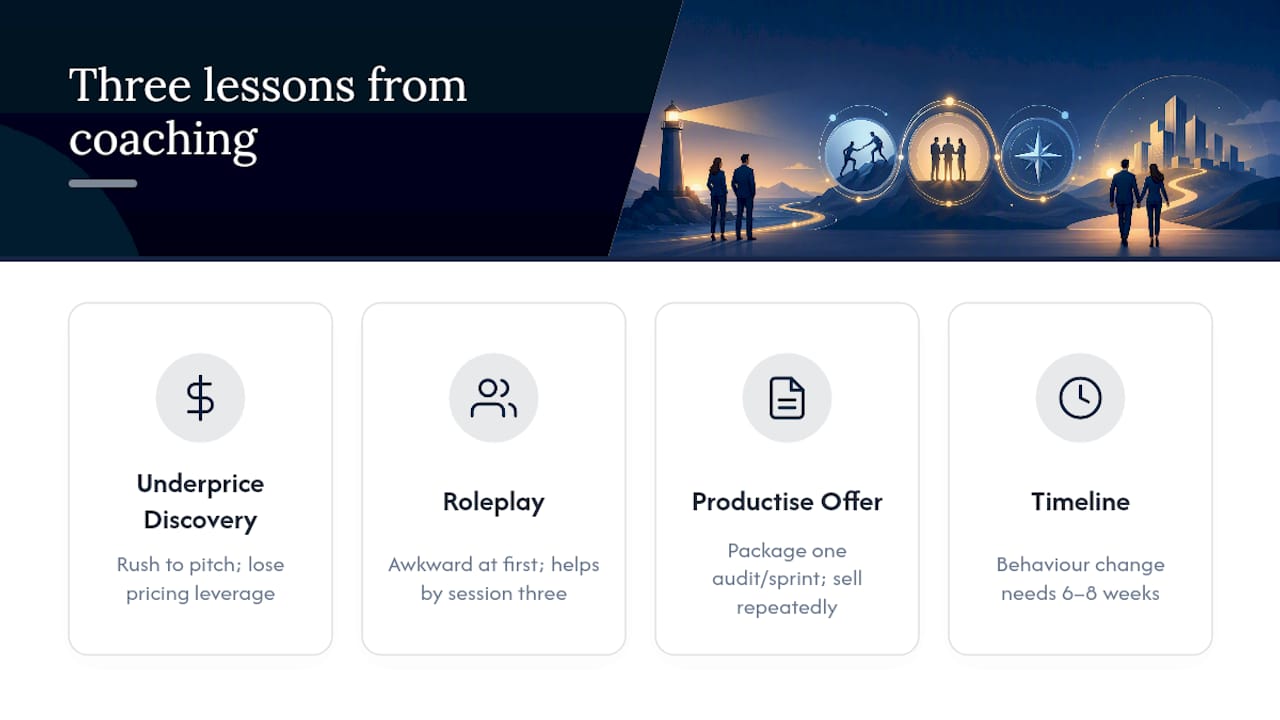
Third, productising one offer beats redesigning your entire business. Consultants who try to overhaul everything at once usually stall. Consultants who package a single audit or sprint and sell it five times build momentum fast, then expand from there.
On timelines, be realistic. Behavioural change in a sales conversation takes weeks to stick, not days. Expect genuine commitment for at least six to eight weeks before judging whether a programme worked.
— Jerry
How Aheadofsales can help you close more, faster
If you’ve read this far, you already know which format suits you, whether that’s 1:1 coaching tied to live deals or a shorter workshop to fix one specific skill gap. Aheadofsales is built around exactly that flexibility for independent consultants and solo service businesses, rather than forcing you into a fixed group curriculum designed for someone else’s sales cycle.
The sales acceleration packages for solo consultants combine bespoke coaching tied to your actual pipeline with structured practice on discovery, objection handling, and pricing conversations. Every engagement includes follow-up coaching to help embed the change over time. A discovery conversation is the natural next step: it’s a short call to map your current close rate, your pricing conversations, and where deals are actually stalling, before any package gets recommended. Visit the sales training services page to see the full range of packages and book a discovery call directly.
Sources
- Proactive Selling for Executive Search Consultants | AESC
- How to sell consulting services | Deltek
- Productized consulting: the complete guide | Alex Berman
- High performance sales habits course | The Consultancy Growth Network
- These eight charts show how COVID-19 has changed B2B sales forever | McKinsey
One Response