
Copy this spine: a weekly 30-minute deal-anchored 1:1, a separate 15-minute Monday pipeline scrub, a biweekly call-skill drill, and a monthly forecast retro, all measured against a one-page six-skill rubric. Keep coaching and pipeline review on different calendar slots or one swallows the other. This week, book the 1:1 and pick one metric to baseline, whether that’s session completion rate or quota attainment.
TL;DR:
- Weekly 1:1s should be deal-anchored, skill-focused, and no longer than 30 minutes to maximize attainment gains and maintain coaching discipline.
- Separate pipeline review from coaching sessions and keep rubrics limited to six observable competencies tailored to deal and team needs.
- Implement a phased 90-day rollout starting with a single weekly session, then gradually adding pipeline, skill drills, and retros, to embed lasting habits.
- Use calibration, process metrics, and lagging business outcomes to measure coaching effectiveness and adjust based on actual results.
- Distribute coaching effort through peer circles and AI tools to prevent manager overload and sustain structured coaching across larger teams.
Table of Contents
- What a real sales coaching structure looks like (and how it differs from training)
- How often should you coach, and how do you roll it out?
- Building a one-page rubric that managers will actually use
- Templates: the 30-minute 1:1 and the five-step call review
- Measuring whether the coaching structure is actually working
- Scaling coaching without burning out your managers
- Ahead of Sales: implementation milestones from real rollouts
- Why most coaching programmes fail before the first quarter ends
- Get a structured coaching programme built for your team
- Sources
What a real sales coaching structure looks like (and how it differs from training)
Coaching gets confused with two other things constantly: training and pipeline review. They’re not the same, and mixing them is the single fastest way to kill a coaching programme before it starts.
Training transfers knowledge, usually in a classroom or workshop format, covering product updates, new methodology, or objection handling scripts. Pipeline review interrogates deals: what’s stuck, what’s slipping, what needs an executive sponsor. Coaching is neither. It’s a manager working with a rep on a specific, observable skill, using a real artefact (a call recording, an email, a proposal) as the evidence base, with the goal of changing behaviour, not just discussing outcomes.
The distinction matters because when pipeline review creeps into the coaching slot, the rep spends thirty minutes justifying deal stages instead of practising a skill. One piece of background guidance worth internalising early: lock the coaching agenda to an artefact and one observable skill, and structurally separate it from pipeline review on the calendar. If you only take one operational rule from this article, take that one.
Once the boundary is clear, you need a framework for the conversation itself. Five dominate practitioner use, each suited to a different situation.
- GROW (Goal, Reality, Options, Will) works for general skill development conversations where the rep already has some self-awareness. It suits 20 to 30-minute sessions and is the default for weekly 1:1s.
- FUEL (Frame, Understand, Explore, Layout) is built for coaching that starts from a specific business problem rather than a skill gap. It suits managers coaching more senior reps who want a business case, not a script.
- CLEAR (Centre, Listen, Empathise, Act, Reflect) leans emotional and works best for reps navigating a difficult patch: a lost deal, a confidence knock, a tough manager transition.
- Situational coaching flexes the manager’s directness based on rep experience: high direction for a new starter, lighter touch for a seasoned closer who mostly needs a sounding board.
- Coach the Moment is the shortest and most tactical: a five to ten-minute burst tied to one clip or one call, used between formal sessions to reinforce a single behaviour before it decays.
A structured sales coaching framework increases win rates by roughly 17% and cuts ramp time by up to 30%, according to research summarised by Quota Training, which is a meaningful gap between managers who freestyle every conversation and those who show up with a repeatable method.
Choosing between them is less about preference and more about who’s sitting across from you. New reps in their first 90 days respond best to situational coaching with heavy direction, moving toward GROW as they build independence. Experienced reps handling complex, multi-stakeholder deals suit FUEL, because the conversation needs to start with the deal’s business logic, not a generic skill checklist. Smaller teams (under eight reps) can run all five frameworks fluidly depending on the moment; larger teams benefit from standardising on GROW for 1:1s and reserving CLEAR and Coach the Moment for exceptions, so managers aren’t relearning a new method every session.
How often should you coach, and how do you roll it out?
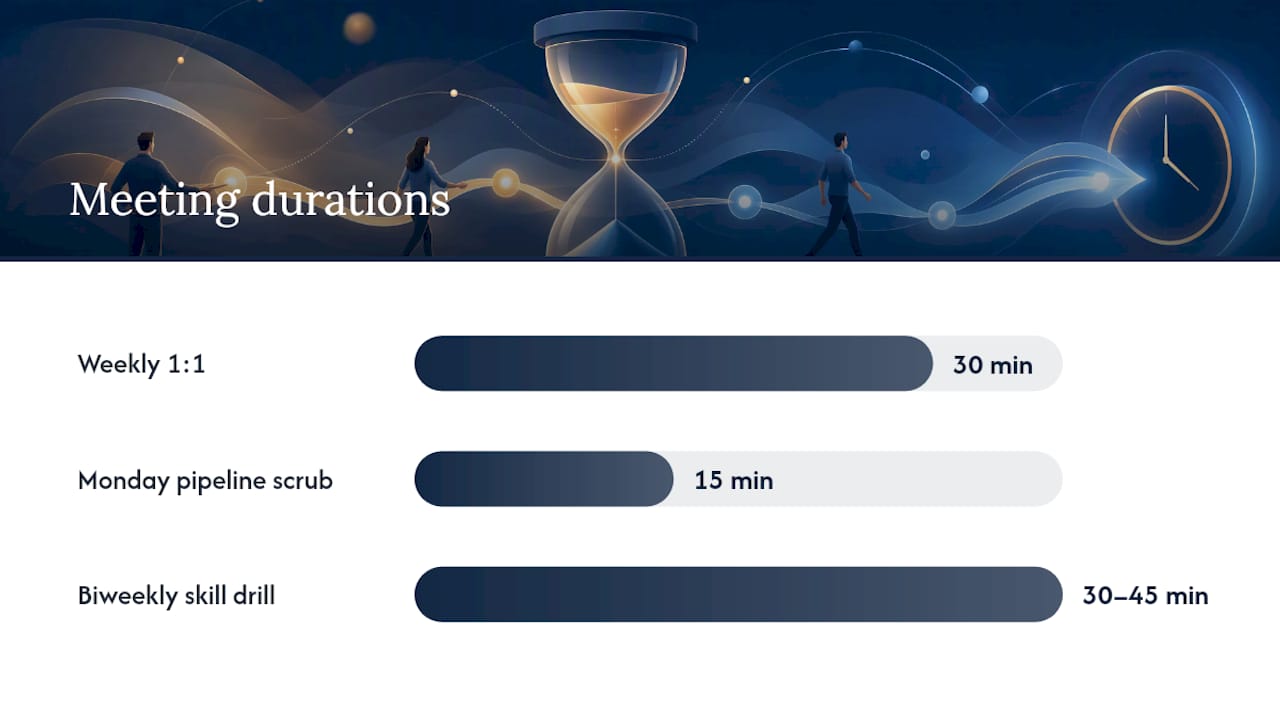
The cadence that produces measurable results is fixed, not ad hoc: a weekly 30-minute 1:1, a weekly 15-minute pipeline scrub kept entirely separate, a biweekly skill drill, and a monthly forecast retro. Installing this rhythm with proper scoring and inspection is linked to a 15-point attainment lift in analysis from PulseRevOps, which also recommends a precise 5/15/5/5 minute breakdown for the weekly 1:1 itself.
Here’s what each meeting looks like on the calendar.
The weekly 30-minute 1:1 is deal-anchored and skill-focused. The manager picks one deal or one call clip in advance, the rep talks through their approach, and the session closes with one specific behaviour to practise before the next session. Keeping this session at 30 minutes, separate from pipeline hygiene, produces larger attainment gains than combined or ad hoc formats, according to sales enablement research from Gangly.
The Monday pipeline scrub runs 15 minutes, covers stage accuracy, next steps, and risk flags across the rep’s active deals, and involves no skill coaching whatsoever. If a deal needs deeper strategic input, that becomes a topic for the coaching 1:1, not an extension of the scrub.
The biweekly skill drill is a 30 to 45-minute group or paired session focused on one competency from the rubric, practised through role play or live call review. This is where reps build muscle memory on things like discovery questioning or objection handling, using consultative selling techniques as the practical basis for what “good” looks like.
The monthly forecast retro brings the manager, the rep, and sometimes the CRO together to review forecast accuracy against actual outcomes over the past month, feeding lessons back into the following month’s coaching priorities.
Rolling all four out simultaneously is how coaching programmes die in week three. A phased 90-day sequence works better:
- Days 1 to 30: launch only the weekly 1:1, using a single framework (GROW is the easiest starting point) and one metric to baseline, such as quota attainment or average deal cycle length.
- Days 31 to 60: introduce the Monday pipeline scrub as a distinct meeting, and start the one-page rubric so managers score at least one competency per 1:1.
- Days 61 to 90: add the biweekly skill drill and the first monthly forecast retro, and begin comparing rubric scores against attainment data to see which competencies actually correlate with results.
Starting with a single weekly loop before layering in the rest of the cadence avoids overwhelming managers and gives the habit time to stick before you ask for more discipline.
Pro Tip: If a manager is coaching more than six reps, cap the weekly 1:1 at 25 minutes rather than skipping sessions when the calendar gets tight. A shorter, consistent session beats a longer one that gets cancelled every third week.
Building a one-page rubric that managers will actually use
Cap the rubric at six competencies, never more. Rubrics that exceed six skills consistently fail to get used in live coaching, because managers can’t hold more than that many criteria in their head during a real-time conversation, and a rubric nobody opens is worse than no rubric at all.

Pick the six based on where your reps actually lose deals, not a generic list lifted from a methodology textbook. A typical B2B new-business motion might land on: discovery depth, value articulation, objection handling, multi-threading, negotiation, and forecast accuracy. A renewals or customer success led motion would swap in relationship management and expansion questioning instead of cold discovery.
Each competency needs three to five observable behaviours, written so a manager can score them from a call recording without guessing.
- Discovery depth: asks at least three follow-up questions per pain point raised; uncovers a quantified business impact, not just a stated problem.
- Value articulation: connects the solution to the specific pain surfaced earlier in the call, rather than reciting a generic feature list.
- Objection handling: acknowledges the objection before responding; doesn’t argue past it or ignore it.
- Multi-threading: names at least two stakeholders beyond the primary contact and has a plan to reach them.
- Negotiation: anchors on value before discussing price, and doesn’t concede on price without trading for something (timeline, scope, referral).
Score each on a simple three-point scale (developing, solid, strong) rather than a ten-point system that invites false precision. Calibration matters more than the scale itself: managers should score the same three call clips independently once a month and compare notes, because uncalibrated scoring drifts fast, with one manager’s “solid” becoming another’s “strong” within weeks. Tie the scores to development, not just review: a rep scoring “developing” on objection handling for two consecutive months should get that as their biweekly skill drill focus, and persistent low scores on a competency tied to quota attainment are a legitimate input into performance conversations. The sales skill checklist approach works well as a companion reference when building out behaviour examples for each competency.
Templates: the 30-minute 1:1 and the five-step call review
A template only earns its place if a manager can paste it straight into a calendar invite and run it without rewriting it. Here’s the 30-minute 1:1, broken into the 5/15/5/5 structure that PulseRevOps’ cadence research recommends.
- Minutes 0 to 5, check-in: how’s the rep feeling about the week, any blockers unrelated to the skill focus.
- Minutes 5 to 20, the coaching core: review the pre-selected deal or call clip, ask GROW-style questions (“What was your goal on that call? What actually happened? What options did you have in the moment?”).
- Minutes 20 to 25, commitment: agree one specific behaviour to try in the next week, stated as an experiment, not a vague intention.
- Minutes 25 to 30, quick wins: close on something the rep did well, using the rubric’s language so the praise is specific and repeatable.
The five-step call review works alongside this for the biweekly skill drill:
- Manager and rep both listen to the same clip in advance, independently.
- Rep self-scores against the rubric first, before hearing the manager’s view.
- Manager shares their score and one specific timestamp where the behaviour showed up (or didn’t).
- They agree on the gap between self-score and manager score, and why it exists.
- They set one experiment to test in the next live call, tied to a single competency.
Coach the Moment sessions follow a tighter version of the same logic: pick one clip, name one skill, state one experiment. An example experiment statement might read: “On the next discovery call, ask a quantifying follow-up question after every pain point the prospect raises, before moving to the next topic.” That single-sentence discipline is what separates Coach the Moment from a rambling debrief.
Pro Tip: Write the experiment statement down in the CRM activity notes, not just in a coaching document. It creates a timestamped record you can check against the next call, and it means the commitment survives even if the manager forgets to follow up verbally.
Measuring whether the coaching structure is actually working
Two categories of metric matter, and confusing them is a common reason coaching programmes struggle to prove their value to a CRO.
Leading indicators tell you whether the programme is running as designed, and you can start capturing them from week one: session completion rate (did the 1:1 actually happen this week), clips reviewed per rep per month, and rubric scores logged per session. These are process metrics.
Lagging outcomes are the business proof: quota attainment, ramp time for new starters, and average deal cycle length. Structured coaching frameworks are associated with roughly 17% higher win rates and ramp time reductions of up to 30%, which gives you a realistic benchmark to aim for over a two to three-quarter horizon rather than expecting overnight movement.
Baseline both categories in month one, then report monthly against them:
- Session completion rate (target: above 90% by month two).
- Clips reviewed per rep per month.
- Average rubric score by competency, tracked over time.
- Quota attainment, ramp time, and deal cycle length, compared quarter over quarter.
Separate CRO-level spot-checks and manager calibration sessions are what keep the cadence from decaying once the initial rollout enthusiasm fades. When you present results upward, lead with the lagging outcome the CRO actually cares about (attainment, ramp time), then use the leading indicators to explain why it moved. A CRO doesn’t need to see session completion rates in isolation, but they’ll want to know the process is disciplined enough to trust the outcome.
Scaling coaching without burning out your managers
Manager time is the scarcest resource in any coaching programme, and the fix isn’t to ask managers to do more. It’s to split the workload across three channels: manager-led, peer-led, and self-directed practice.
Peer coaching circles work best with three to four reps of similar experience level, running the same five-step call review template used in manager-led drills, with the manager dropping in every second session to spot-check quality rather than running every one personally. This is also where distributing ownership pays off structurally, in the same way distributing workload has driven cost efficiency in other B2B growth functions.
AI role-play and conversation intelligence tools are genuinely useful for the observation layer: surfacing which calls contain a coachable moment, flagging objection-handling gaps at scale, and giving reps a low-stakes place to rehearse before a live call. Comparing coaching software options is worth doing before you commit budget, because the category ranges from simple call recording to full conversation-intelligence platforms.
The ownership boundary matters here: enablement should own the tooling, the rubric documentation, and the training content library. Managers own the coaching relationship, the scoring, and the development plan. Mature coaching programmes expect managers to spend 15 to 20% of their working time on coaching activities, and blurring that line, letting enablement run the actual coaching conversations, is one of the fastest ways to see ownership drift and adherence collapse within a quarter.
Ahead of Sales: implementation milestones from real rollouts
Ahead of Sales builds this exact structure into team coaching engagements, typically running £4,500 to £8,500 for businesses with 50 to 1,000 staff, and £2,995 to £5,995 for solo service business acceleration packages. The 90-day milestones we use mirror the phased rollout above: weeks 1 to 4 establish the weekly 1:1 and baseline metrics, weeks 5 to 8 introduce the rubric and pipeline scrub, and weeks 9 to 12 add the skill drill and forecast retro, with attainment and ramp time tracked throughout against the pre-engagement baseline.
The pattern holds across engagements: teams that keep pipeline review and coaching structurally separate see the rubric actually get used, while teams that merge them tend to abandon scoring within six weeks.
Why most coaching programmes fail before the first quarter ends
Most coaching advice focuses on frameworks, GROW versus FUEL versus CLEAR, as if picking the right acronym is the hard part. It isn’t. The hard part is the calendar discipline: keeping pipeline review out of the coaching slot, keeping the rubric to six skills, and getting a manager to actually run the 1:1 in week nine when the quarter is on fire and it feels easier to skip it.
Where conventional advice falls short is treating coaching as a skill managers either have or don’t. It’s closer to an operating habit, and habits need structure more than talent. A mediocre framework run every week for a quarter beats a brilliant one run twice and forgotten.
If you’re starting from nothing, don’t try to build the rubric first. Start the weekly 1:1, pick GROW as your default, and baseline one metric. Everything else, the scrub, the drill, the retro, the rubric, layers in over the following ninety days. Programmes that try to launch fully formed almost always stall by week three because managers can’t hold four new habits at once.
— Jerry
Get a structured coaching programme built for your team
If you’ve read this far, you already know the theory. What’s harder is finding the manager time and internal discipline to actually run a phased rollout while hitting quota every quarter. That’s the gap Ahead of Sales closes: instead of handing you a template and leaving you to police adoption yourself, we build the cadence, calibrate the rubric with your managers, and inspect adherence for you, so the structure survives past week three.

Whichever fits your situation, the next step is the same: visit our sales training services page to see how a bespoke rollout would map onto your team, and book a call to get your 90-day plan started this quarter.
Sources
- How to build a sales coaching cadence that lifts… in 2027
- Sales Coaching Framework: Build a Scalable Program in 2025 — QUOTA Training
- Coaching for all — 4 strategies for scaling coaching programmes
3 Responses