
If your business has product‑market fit but you’re still closing every deal yourself, a fractional sales leader is the right move. You get a senior sales director’s experience, part-time, focused on building systems and hiring reps rather than replacing you. Scope the engagement properly, hold them to 30, 90 and 180-day outcomes, and it works.
TL;DR:
- Fractional sales leadership is suitable for companies with revenue over £1 million, product-market fit, and limited delegation of sales from the founder.
- A weekly cycle of pipeline reviews, coaching, and process documentation is essential, with measurable progress visible within 30 to 60 days.
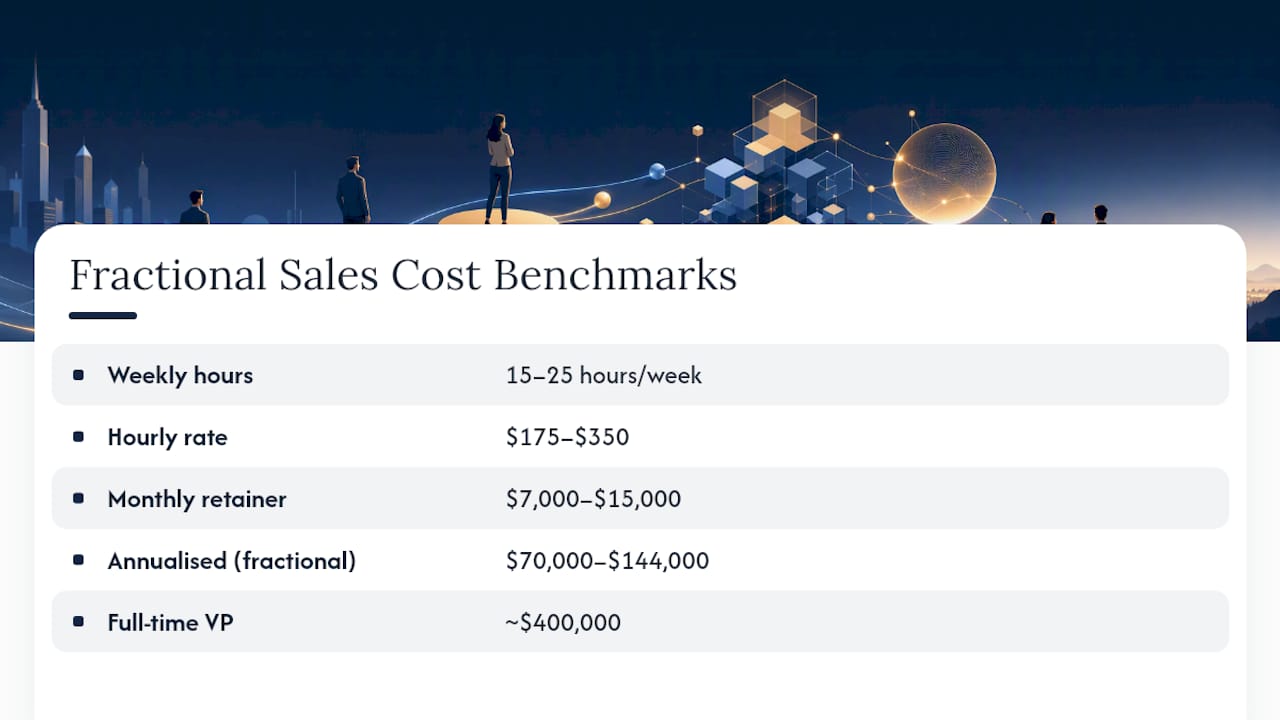
- Typical costs range from $70,000 to $144,000 annually, based on 15 to 25 hours per week, offering a cost-effective alternative to full-time VPs.
- Key signals for hiring include bottlenecked deals, inconsistent rep performance, or the need for scalable hires, particularly after losing a sales leader.
- Structuring scope with clear deliverables and expecting tangible results at 30, 90, and 180 days ensures progress and avoids vague engagement outcomes.
Table of Contents
- What is fractional sales leadership, and who is it for?
- What does a fractional sales leader actually do week to week?
- How much does fractional sales leadership cost?
- When should you hire a fractional sales leader?
- How do you scope and choose a fractional sales leader?
- What results should you expect at 30, 90 and 180 days?
- Why Aheadofsales fits this model
- What I’d tell a founder before they sign anything
- Ready to start? What working with Aheadofsales looks like
- Sources
What is fractional sales leadership, and who is it for?
Fractional sales leadership means bringing in a senior sales director on a part-time, operational basis rather than hiring one full-time. This isn’t advisory work where someone reviews your numbers once a month and emails suggestions. A genuine fractional leader gets embedded in your team, typically working 10 to 25 hours a week, running pipeline reviews, coaching calls, and building the playbook your reps will use for years.
That distinguishes it from three things people often confuse it with. Consultants advise from the outside and hand you a report. Full-time VPs cost far more and usually don’t suit a business that hasn’t yet worked out its sales motion. Outsourced sales teams take operational execution off your hands entirely, whereas a fractional leader keeps strategic control with you and simply does the building work alongside you, as Aexus explains in its comparison of the two models.
Fractional leadership tends to suit a specific profile of company:
- Revenue past £1 million, with product-market fit already proven
- Sales still running through the founder, with limited delegation
- One or two reps hired but underperforming without structure
- Growth targets set for the next 12 to 24 months
- No appetite yet for a £120,000+ full-time hire
If that’s you, the model earns its keep quickly.
What does a fractional sales leader actually do week to week?
The value of fractional sales leadership shows up in the rhythm, not the title. A good fractional leader runs a repeatable weekly cycle and produces artefacts you can point to, not just advice you have to trust.
Pro Tip: Ask any candidate to walk you through their calendar from a live client engagement. If they can’t show you a weekly structure, they’re consulting, not leading.
Expect a working week built around:
- Pipeline and deal reviews — checking coverage, stage conversion, and which deals are stalling and why.
- Call coaching — sitting in on live calls with reps and giving direct feedback the same day.
- Playbook and CRM/RevOps work — documenting the sales process and fixing the reporting so numbers can be trusted.
- Hiring support — writing the rep profile, running interviews, and building an onboarding plan that ramps new hires faster.
- Founder sync — a standing weekly call reporting progress against agreed KPIs.
A typical week includes exactly this mix: pipeline reviews, coaching, CRM work, and a founder sync, with measurable leading indicators appearing within 30 to 60 days.
When you scope the engagement, insist on four deliverables in writing: a documented sales playbook, a forecast model you can rely on, a hiring plan with defined rep profiles, and a reporting cadence that tells you what’s actually happening in the pipeline. Anything less than that and you’re paying for presence, not progress.
How much does fractional sales leadership cost?
Fractional engagements are usually structured one of three ways: a day rate, a monthly retainer, or a retainer with a performance component tied to revenue or hiring milestones. Equity is occasionally added for earlier-stage companies, though it’s far less common than a straightforward retainer.
Benchmark figures: Fractional VP of Sales engagements commonly run 15 to 25 hours a week, structured as monthly retainers of $7,000 to $15,000, or hourly rates from $175 to $350. Annualised, that puts most engagements in the $70,000 to $144,000 range, against roughly $400,000 for a full-time VP.
The hours vary depending on what stage the work is in. Building a playbook and hiring your first scalable reps demands more hours upfront than steady-state oversight once the machine is running. An interim engagement covering a departed VP tends to sit somewhere in between, weighted towards keeping momentum rather than building from scratch.
Judging value isn’t about comparing the retainer to a full-time salary line by line. It’s about comparing the retainer to the cost of another six months of founder-led selling, where growth stalls because you’re the bottleneck. That’s usually the more expensive option.
When should you hire a fractional sales leader?
Four signals tend to show up together, and any one of them is worth acting on:
- You’re the bottleneck. Deals only close when you’re personally on the call, and time-to-close is creeping up as you get busier.
- Rep performance is inconsistent. You have one or two reps but no forecasting discipline, no shared process, and results that swing wildly month to month.
- You need your first scalable hires. You’re ready to build a repeatable team, or expand into a new territory, but don’t know how to structure that hiring.
- You’ve lost a sales leader. A full-time VP has left and you need someone credible to hold the pipeline together while you recruit their replacement, avoiding the productivity drop that follows an unfilled leadership gap.
Any one of these on its own justifies exploring the model. Two or more together, and the case is hard to argue against.
How do you scope and choose a fractional sales leader?
Start with a written scope, not a verbal agreement. It should cover objectives, specific deliverables, expected hours per week, measurable outcomes, and a handover plan for when the engagement ends. Vague scopes produce vague results.
In interviews, ask direct questions:
- What stage and revenue range have you worked at before, and what was the sales motion?
- What measurable outcome did you deliver in your last two engagements?
- Walk me through your first 30 days, what would you actually do?
- How do you report progress, and how often?
- Can I speak to a previous client about results, not just working style?
Pro Tip: A candidate who can’t name the specific ARR stage they serve best is a warning sign. The strongest fractional leaders are explicit about the stage and motion they’re good at, because that fit determines whether the engagement succeeds.
On contract terms, pin down notice periods, exclusivity (are they working with a competitor?), who owns the playbook and CRM configuration once the engagement ends, and how often you’ll get reporting. Red flags worth walking away from: no execution plan beyond “let’s see how it goes”, pricing that’s the main selling point, and an inability or unwillingness to provide references.
What results should you expect at 30, 90 and 180 days?
Fractional sales leadership works on a predictable timeline, and you should hold any engagement to it.
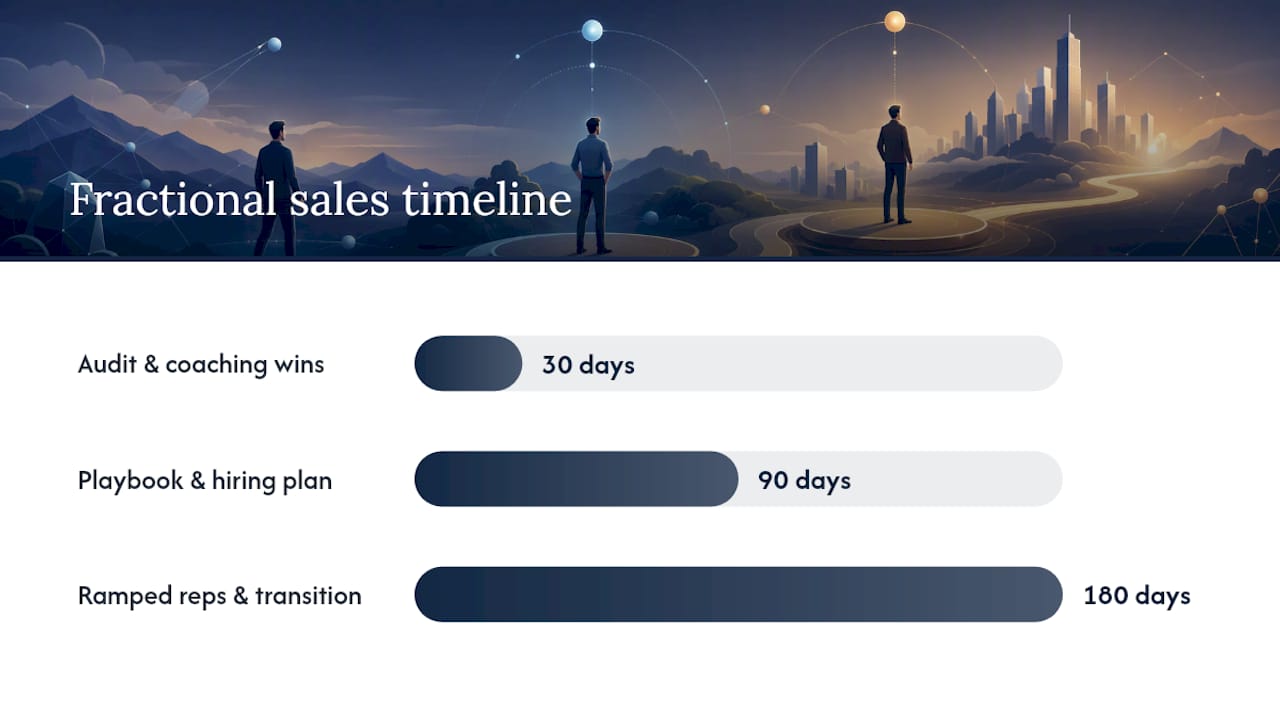
- 30 days: a full audit of pipeline, process and rep performance, agreed KPIs, and the first coaching wins already visible in call quality.
- 90 days: a documented playbook, a hiring plan for the next reps, and forecasting you can actually trust.
- 180 days: ramped reps performing against target, a repeatable pipeline, and either a transition plan to a full-time hire or a decision to continue.
Leading indicators, pipeline coverage and stage conversion rates, move first. Revenue follows once the operational fixes land and new reps ramp up. Measurable revenue improvement is usually visible within 90 to 180 days, not week one, so judge early progress on process, not top-line numbers.
Partner resources like Crono’s guide to pipeline design are worth reviewing alongside your fractional leader’s proposed reporting cadence, so you know what good pipeline hygiene looks like before you start measuring it.
Why Aheadofsales fits this model
Aheadofsales delivers fractional sales leadership through its sales director services, built specifically for B2B companies and growing service businesses that need senior execution without a full-time hire.
- Packages run from £4,500 to £8,500 for growth-stage teams, and £2,995 to £5,995 for solo service businesses needing sales acceleration
- Every engagement pairs 1:1 coaching with practical consultancy, not just advisory calls
- Deliverables map directly to the fractional sales director responsibilities covered above: playbook, hiring plan, forecasting, reporting
- The stated aim is at least 50% sales growth annually, with the team hitting target every quarter
If your business sits in the 50 to 1,000 staff range, or you’re a solo consultant scaling past founder-led selling, this is the engagement shape built for you.
What I’d tell a founder before they sign anything
Do get the deliverables in writing before day one; don’t accept “we’ll figure it out together” as a scope. Do ask for a named reference from a business at your stage; don’t hire on chemistry alone. Do expect the first month to feel slower than you’d like, it’s an audit, not a sprint.
I’ve seen founders panic at day 20 because pipeline numbers hadn’t moved, then watch conversion rates climb sharply once the playbook landed at day 75. Good oversight means a weekly report you can read in five minutes and a founder call where the numbers are never a surprise. If either of those is missing, that’s the moment to ask hard questions.
— Jerry
Ready to start? What working with Aheadofsales looks like
Aheadofsales is the practical alternative to a full-time hire you’re not ready to make and a generic consultancy retainer that never touches your CRM. Where a full-time VP locks you into a £120,000+ salary before you’ve proven the sales motion, and a pure advisory consultant leaves execution to you, Aheadofsales embeds directly into your pipeline reviews, coaching calls and hiring process from week one.
A discovery call covers your current pipeline health, where the founder bottleneck actually sits, and which package fits: fractional sales director support for growing teams, or an acceleration package if you’re a solo operator. From there you’ll get a scoped 30, 90 and 180-day plan before anything is signed. If you’re ready to stop being the only person who can close a deal, book a discovery call through the sales training services page and get a plan on the table this week.
Sources
For business context on employment status and company growth stages, gov.uk and the ONS remain the standard reference points. For deeper reading on fractional sales leadership models and market benchmarks, see Louie Bernstein’s guide to the fractional model and Fractional Pulse’s market data.
- What is a Fractional Sales Leader? The Capital-Efficient Model for Scaling Out of Founder-Led Sales | Louie Bernstein
- Fractional VP of Sales Jobs & Market Data | Fractional Pulse