
The fastest way to retain clients is to fix five things at once: structured onboarding, monthly value reporting, segmented retainer models, proactive quarterly business reviews (QBRs), and relationships with more than one contact per account. Each works because it removes a different cause of churn: confusion at the start, invisible value in the middle, and a single point of failure when your one champion leaves.
Here’s what to put in place this week:
- Build a one-page onboarding checklist with a clear “done” definition for the first 30 days.
- Send a short monthly value report, even to clients who never ask for one.
- Book a 30-minute quarterly business review with every client worth more than a token retainer.
- Map every account with more than one contact, and start a second relationship where there’s only one.
- Segment your client base into three tiers so your best accounts get proactive attention, not just your loudest ones.
Pro Tip: Pick one action from this list and implement it for your three biggest accounts before you read the rest of this guide. Momentum beats a perfect plan you never start.
According to Gartner’s 2025 survey, 73% of chief sales officers were prioritising growth from existing customers over new logo acquisition. That is where the leverage is right now.
The verdict: if you do nothing else this month, send every active client a one-page report showing what you delivered and what it was worth. It’s the single highest-leverage habit in this entire guide.
Key Takeaways
Client retention improves fastest when structured onboarding, monthly reporting, and quarterly business reviews replace ad-hoc account management.
| Point | Details |
|---|---|
| Calculate CRR monthly | Use ((end clients − new clients) ÷ start clients) × 100 to catch problems early. |
| Front-load the first 90 days | Structured onboarding clients averaged 4.2 years versus 1.8 for unstructured onboarding. |
| Run quarterly business reviews | QBRs force an explicit outcomes conversation that prevents renewal surprises. |
| Build multiple stakeholder relationships | Never let one contact be the only link between you and a client’s business. |
| Coach the whole team, not just top performers | Aheadofsales’s 1:1 coaching and training help retention hold up even when account managers change. |
Table of Contents
- What client retention actually means for a services business
- Why retention drives revenue, margin and referrals
- How do you calculate client retention rate and other key metrics?
- What retention rate should a services business aim for?
- What are the most effective retention strategies by client stage?
- A 30/60/90-day plan for building your retention programme
- How do you measure and test what actually improves retention?
- Ready-to-use templates and scripts for client retention
- What are the most common mistakes that cause client churn?
- Does sales coaching actually reduce client churn?
- How Aheadofsales helps you build a retention system that survives staff turnover
- Sources
What client retention actually means for a services business
Client retention is the discipline of keeping a paying client engaged and renewing beyond their first transaction, rather than treating each project as a one-off sale. For a consultancy, coaching firm, or agency, that means the difference between a client who pays once and disappears, and one who renews their retainer, expands their scope, and refers a colleague.
Retention isn’t a feeling. It shows up as specific, trackable outcomes:
- Retainer renewals at the contract’s natural review point, without a discount fight.
- Expansion revenue, where an existing client buys more scope than they started with.
- Repeat bookings from clients who came back for a second project without being chased.
Most services firms can picture the client lifecycle as a loop, not a line: onboarding leads to delivery, delivery leads to a value review, and a value review leads to renewal, which restarts the cycle with a broader scope. Two metrics anchor this loop in practice: Customer Retention Rate (CRR), which tells you how many clients you kept over a period, and Net Revenue Retention (NRR), which tells you whether the clients you kept are spending more or less than before. You’ll find a fuller breakdown of both in Aheadofsales’s guide to client retention.
Retention isn’t what happens after the sale. It’s the second half of the sale, and most firms stop selling the moment the contract is signed.
Why retention drives revenue, margin and referrals
Retention pays for itself faster than almost any other investment a services business can make, because keeping an existing client nearly always costs less than winning a new one. A new client typically requires a sales cycle, proposal work, and a pitch team, often costing several times more in time and budget than simply keeping a client you already have happy. HoneyBook’s research backs this up directly: 61% of small businesses say more than half their revenue now comes from clients who buy again, not first-time buyers.
Run the maths on a simple example. Say winning a new £5,000-a-month client costs you £8,000 in sales time, marketing and onboarding effort spread across a typical sales cycle. Retaining that same client for a second year costs you a fraction of that, mostly account management time. Over three years, the retained client has paid you £180,000 for a fraction of the acquisition cost. That’s the entire business case in one sentence.
Three benefits follow directly from that arithmetic:
- Predictability. Renewed retainers make revenue forecasting realistic instead of hopeful.
- Higher margin. You’re not re-selling the same client every quarter, so delivery time converts to profit rather than pitch time.
- Easier expansion and referrals. A client who trusts you enough to renew is far more likely to buy more, or introduce you to someone who will.
If you want the acquisition-side comparison spelled out, Aheadofsales’s piece on client acquisition walks through the sales-growth economics from the other direction.
How do you calculate client retention rate and other key metrics?
You need four numbers to run a retention programme properly: Customer Retention Rate, churn rate, Customer Lifetime Value (CLV), and Net Revenue Retention. A fifth, a simple client health score, tells you which accounts need attention before the renewal conversation, not during it.
1. Customer Retention Rate (CRR)
CRR = ((Clients at end of period − New clients acquired during period) ÷ Clients at start of period) × 100
Worked example: you start the quarter with 40 clients, win 6 new ones, and end the quarter with 42 clients.
2. Churn rate
Churn rate = (Clients lost during period ÷ Clients at start of period) × 100
Using the same numbers: you lost 4 clients during the quarter (40 + 6 − 4 = 42).
If they don’t, you’re mixing up your start and end populations somewhere.
3. Customer Lifetime Value (CLV)
CLV = Average monthly revenue per client × Average client lifespan (months)
If a client pays £2,000 a month and stays for an average of 24 months, CLV = £48,000. This single number, as Wharton’s research on lifetime value points out, is what should actually drive your acquisition budget, not gut feel about what a lead is “worth.”
4. Net Revenue Retention (NRR)
NRR = ((Starting revenue + Expansion − Contraction − Churn) ÷ Starting revenue) × 100
5. Client health score
A simple version scores each account 1 to 5 on three factors: engagement (are they responding and attending meetings?), usage or delivery uptake, and sentiment from your last check-in. Multiply and rank; anything scoring in the bottom quartile needs a proactive call this week, not a wait-and-see approach.
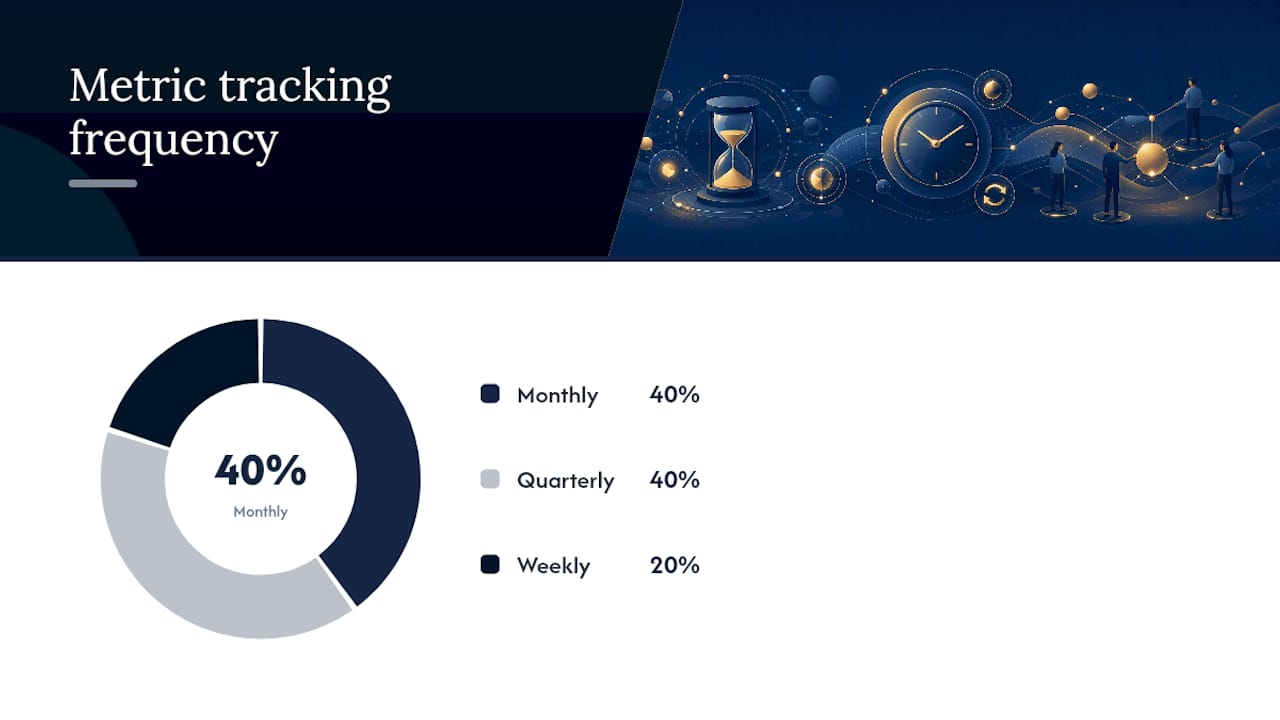
| Metric | What it tells you | Track how often |
|---|---|---|
| CRR | Overall account survival | Monthly |
| Churn rate | Speed and scale of losses | Monthly |
| NRR | Whether kept clients are growing | Quarterly |
| CLV | What you can afford to spend to win or keep a client | Quarterly |
| Health score | Which accounts need attention now | Weekly for at-risk accounts |
| Priority | Metric | Why it comes first |
|---|---|---|
| 1 | CRR | Simplest signal of whether your book is shrinking or holding |
| 2 | Health score | Gives you early warning before churn shows up in the numbers |
| 3 | NRR | Tells leadership whether retention is also driving growth |
| 4 | CLV | Informs how much you can invest in acquisition and retention alike |
Pro Tip: Don’t wait for quarter-end to calculate churn. Run CRR monthly even if you report it quarterly. Catching a bad month early gives you time to fix it before it becomes a bad quarter.
What retention rate should a services business aim for?
Realistic targets depend heavily on your client segment and contract type, so treat these as directional bands rather than universal rules.
- Excellent: CRR above 90%, churn under 10% annually, typically seen in firms with disciplined onboarding and QBR cadences.
- Typical: CRR of 80 to 90%, which is workable but leaves room for the tactics later in this guide.
- At-risk: CRR below 75%, which usually points to a single-champion problem, poor reporting, or scope drift going unaddressed.
Set different targets by tier. Project-based work naturally churns faster than retainer work because it has a defined end date, so don’t measure a project-only client book against retainer benchmarks; you’ll always look worse than you are.
Measure progress quarterly at minimum, but review your at-risk segment monthly. A quarter is too long to wait if a platinum account goes quiet.

What are the most effective retention strategies by client stage?
Retention tactics work best when they’re matched to where a client sits in their lifecycle, because the risks at month one look nothing like the risks at month eighteen. Group your playbook into five stages: onboarding, delivery cadence, relationship depth, renewal and expansion, and win-back.
Onboarding (first 30 to 90 days)
- Send a welcome pack within 24 hours of signing that sets expectations, timelines and named contacts. (High impact)
- Deliver a first “quick win” within the first two weeks, something small and visible, not the full scope. (High impact)
- Schedule the 30-day check-in before the contract even starts. (Medium impact)
- Confirm success criteria in writing so both sides agree what “working” looks like. (High impact)
A structured onboarding programme is not a nice-to-have. Practitioner data reported by Gatilab found clients who went through structured onboarding, kickoff, first deliverable, and 30/60/90 check-ins, averaged 4.2 years as a client, versus 1.8 years for those left to find their own footing. That’s the difference between a client relationship that pays for itself twice over and one that barely covers its acquisition cost.
Delivery cadence
- Send a monthly one-page value report, even a simple one, showing what was delivered and what it achieved.
- Keep response times under 24 hours for any client query, and say so explicitly if you’re going to take longer.
- Flag scope changes the moment you spot them, rather than absorbing them silently until margin disappears.
Pro Tip: Bad news travels faster than good news in a client relationship. If a deadline is slipping, tell the client the day you know, not the day it’s due. Clients forgive delays far more readily than surprises.
Relationship depth
Relying on one contact inside a client’s business is one of the most common, and most avoidable, causes of churn. When that person leaves, moves teams, or simply loses political capital internally, the relationship often leaves with them. Multi-threaded relationship research makes the case plainly: build at least two active relationships per account, ideally spanning a decision-maker and a day-to-day user.
- Identify a second stakeholder within the first 60 days and involve them directly in a working session.
- Map the org chart for every account above your median contract value.
- Invite a second contact to your quarterly review, even if they weren’t part of the original deal.
Renewal and expansion
Quarterly business reviews are, according to Perspective AI’s analysis of B2B services retention, the single highest-leverage ritual for preventing what they call “value drift”, the slow erosion of a client’s sense that they’re getting their money’s worth. A QBR forces an explicit conversation about outcomes before renewal becomes a negotiation.
- Run a QBR at least once a quarter for any retainer above your platinum threshold.
- Present outcomes against the success criteria you agreed at onboarding, not just activity.
- Raise expansion opportunities inside the QBR itself, not as a separate sales pitch weeks later.
Win-back
- Send a structured “we noticed” email within a week of a client going quiet or cancelling.
- Ask one direct question: what changed? Most churned clients will tell you if you actually ask.
- Offer a scaled-down re-entry point rather than the full package; a smaller yes is easier than a full renewal.
Coaching and account management skills sit underneath all five stages. Aheadofsales’s guide to account management best practices covers the ownership and cadence disciplines that make this playbook stick rather than fading after month two.
A 30/60/90-day plan for building your retention programme
You don’t need a new department to run this. You need a calendar, a named owner for each milestone, and a habit of checking whether the milestone actually happened.
Days 0 to 30: foundations
- Audit your current client book and calculate baseline CRR and churn.
- Build the onboarding checklist and monthly report template (see the next section).
- Segment clients into platinum, gold and silver tiers based on revenue and strategic value.
Days 31 to 60: rituals
- Send the first monthly value report to every active client.
- Book QBRs for every platinum and gold account for the coming quarter.
- Identify and start building a second stakeholder relationship on your top five accounts.
Days 61 to 90: measurement
- Recalculate CRR and compare it to your day-30 baseline.
- Run your first cohort review: are clients onboarded with the new checklist retaining better than those onboarded before it?
- Adjust the segmentation and reporting cadence based on what the data shows.
| Timeframe | Key activity | Owner |
|---|---|---|
| Days 0 to 30 | Baseline audit, checklist build, segmentation | Account lead |
| Days 31 to 60 | Reports live, QBRs booked, second contacts identified | Account lead + ops |
| Days 61 to 90 | Re-measure CRR, first cohort comparison | Executive sponsor |
- A milestone only counts as hit if it has a date, an owner and a written acceptance criteria, not a vague intention.
- An early win by day 60 looks like: every platinum client has received at least one value report and has a QBR on the calendar.
Pro Tip: Assign the executive sponsor role to someone senior enough to escalate a stalling account without waiting for permission. Retention programmes stall most often when nobody senior is watching the numbers.
How do you measure and test what actually improves retention?
A retention dashboard doesn’t need to be complicated. It needs four things visible at all times: current CRR, churn trend over the last four quarters, the number of at-risk accounts by health score, and NRR. If a dashboard shows more than that, most teams stop looking at it.
Cohort analysis is simpler than it sounds. Group clients by the month or quarter they joined, then track what percentage of each cohort is still active at 6, 12 and 24 months. This shows you whether retention is genuinely improving or whether recent good numbers are just a temporary blip from a strong sales quarter.
- Define your hypothesis: for example, “clients who receive a QBR in month three retain better than those who don’t.”
- Pick one metric to measure it against, typically 12-month retention rate.
- Split your book into a test group and a comparison group, ideally by account rather than randomly, to avoid contaminating relationships.
- Run it for at least two full quarters before drawing conclusions; anything shorter is directional, not proof.
| Dashboard element | What it shows | Update frequency |
|---|---|---|
| CRR | Overall retention health | Monthly |
| Churn trend (4 quarters) | Whether the problem is improving or worsening | Quarterly |
| At-risk account count | Where to focus this week | Weekly |
| NRR | Growth from existing clients | Quarterly |
Pro Tip: If your test group has fewer than 15 accounts, treat any result as a hypothesis worth watching, not a conclusion worth acting on firm-wide.
Ready-to-use templates and scripts for client retention
Templates only work if someone actually customises them; a script sent verbatim to every client reads as exactly that, a script. Use these as starting structures.
Onboarding checklist (one page)
- Welcome email sent within 24 hours, ✓
- Success criteria agreed in writing, ✓
- Named contacts on both sides confirmed, ✓
- First deliverable date set, ✓
- 30-day check-in booked, ✓
Monthly check-in email (template)
Subject: Your [Month] update, three wins and what’s next
Hi [Name], here’s what we delivered this month: [1 to 2 concrete outcomes]. Here’s the impact: [a number or outcome tied to their goals]. Here’s what’s coming next: [one line]. Anything you’d add to the priority list?
NPS follow-up or win-back email
Subject: We noticed things have gone quiet
Hi [Name], we haven’t heard from you in a while and wanted to check in properly rather than assume. Has something changed on your end, or is there something we could be doing differently? Happy to jump on a short call if useful.
Customise tone for segment: platinum clients get a personal note from the account lead; silver clients can reasonably receive a well-written template with light personalisation. Never send the exact same subject line to two clients in the same week; it’s a small tell that erodes trust fast. Babylovegrowth’s guide to customer retention tactics offers further engagement-focused scripts worth adapting.
| Template | Use for | Customise by |
|---|---|---|
| Onboarding checklist | Every new client | Contract complexity |
| Monthly check-in | All active accounts | Segment tier |
| Win-back email | Quiet or lapsed accounts | Relationship history |
Pro Tip: Keep every template under 150 words. A monthly report clients actually read beats a comprehensive one they skim and forget.
What are the most common mistakes that cause client churn?
Poor onboarding, single-champion relationships, and infrequent reporting sit at the top of nearly every churn post-mortem. Slow response times and unmanaged scope creep follow close behind, usually because nobody flagged them until margin had already disappeared.
Watch for these red flags specifically:
- A client goes quiet on email or Slack for more than a week without explanation.
- Meetings get rescheduled twice in a row, especially QBRs.
- Usage or engagement with your deliverables visibly drops month over month.
If you spot any of these, the remediation step is the same every time: a direct, human phone call within 48 hours, not another email. According to I Will Teach You To Be Rich’s client management research, clients rarely churn without warning signs; the warning is usually there weeks before the cancellation email arrives.
Does sales coaching actually reduce client churn?
Structured coaching and disciplined account management cadence show up repeatedly in the evidence as retention multipliers, not just soft skills. Gartner’s research on customer retention strategy makes the case that organising retention as a structured programme, with clear cadence, ownership and metrics, reduces reliance on any single account lead and stabilises renewal outcomes across the whole client book.
That matters because most firms’ retention performance currently rests on one or two naturally gifted account managers. When they leave, retention drops with them. Training that spreads the same disciplined onboarding, reporting and QBR habits across an entire team removes that fragility.
The firms with the most consistent retention numbers aren’t the ones with the best individual account managers. They’re the ones where the process works whoever is running it.
A typical before-and-after pattern looks like this: a firm running ad-hoc account management, inconsistent reporting, QBRs happening “when there’s time”, sees CRR in the 70s. After six months of structured coaching around onboarding, reporting cadence and QBR discipline, the same firm typically moves into the mid-to-high 80s. Bring in outside help when your retention numbers are inconsistent across account managers, when your best client relationships depend on one person’s memory rather than a documented process, or when your team knows what “good” looks like but can’t execute it consistently under pressure. Aheadofsales’s sales training explained page covers what a typical coaching engagement looks like in practice.
Pro Tip: Before hiring a coach or consultant, calculate your current CRR. It’s the single number that tells you, and them, whether the engagement worked.
| Signal | What it suggests | Response |
|---|---|---|
| Retention varies widely by account manager | Process isn’t documented or trained | Structured coaching |
| Best relationships depend on one person | Single point of failure | Multi-threading + coaching |
| Team knows the theory, not the execution | Skills gap under pressure | Live coaching, not just documentation |
Practitioner’s note: prioritise retention over last-minute fixes
The pattern I see most often isn’t a firm with no retention strategy. It’s a firm with a strategy that only gets remembered in month eleven of a twelve-month contract, right before the renewal conversation. That’s too late to fix a relationship that’s been quietly drifting for a year.
One small change I’d back over almost anything else in this guide: get the first monthly value report out within 30 days of kickoff, before the client has any reason to wonder if they made the right choice. Firms that do this consistently seem to spend far less time firefighting renewals, because there’s rarely anything left to explain away.
How Aheadofsales helps you build a retention system that survives staff turnover
Every tactic in this guide, onboarding structure, monthly reporting, QBR cadence, multi-stakeholder mapping, only compounds if your whole team runs it the same way, not just your strongest account manager. That’s the gap Aheadofsales closes: bespoke 1:1 coaching combined with team training, built specifically so your retention process doesn’t collapse the day your best person leaves.
Clients who work with Aheadofsales typically come away with a documented onboarding sequence, a QBR cadence their whole team actually runs, and a renewal process that stops relying on memory and starts relying on a system. Packages are built for businesses with growth ambitions, whether that’s a 50-person team or a solo consultancy, with fractional sales director support available where a full hire isn’t yet the right move.
If your retention numbers vary depending on who’s holding the account, that’s a coachable gap, not a hiring problem. Take a look at Aheadofsales’s sales training services and book a conversation about what a coaching engagement would look like for your team.
Sources
- Gartner press release (2025)
- How to retain clients and grow your business: 7 proven tactics — HoneyBook
- Client retention strategies: frameworks that reduce churn — Gatilab
- Client retention strategies for agencies and B2B services in 2026 — Perspective AI