
The main types of lead generation are inbound, outbound, content-led, referral and partner, account-based marketing (ABM), events and webinars, and paid advertising. If you are deciding where to start, the most practical move is to pick two channels matched to your immediate objective, score every lead on fit plus intent, and run an 8–12-week test before committing budget to scale.
Here is a quick verdict on where to start, depending on what you need most:
- Volume over time: Inbound (SEO, content, gated assets) combined with targeted outbound prospecting. Expect several months before inbound delivers consistent pipeline; outbound can produce first meetings relatively quickly.
- Speed to pipeline: Targeted outbound (personalised cold email, LinkedIn outreach) plus referral activation. Both can generate qualified meetings in under four weeks when your ICP is well-defined.
- Enterprise deals: ABM layered on top of referrals, with Adobe Marketo Engage handling orchestration across channels. Pair this with a fit plus intent scoring model so sales only receives accounts that match on both dimensions.
For your 8–12-week experiment, the most reliable starting combination for most UK B2B teams is inbound content plus targeted outbound, with a single scoring layer that treats every lead, regardless of source, the same way. LinkedIn consistently outperforms other social platforms for B2B visitor-to-lead conversion, so it belongs in almost every channel mix from day one.
Key takeaways
A portfolio approach to lead generation, scored on fit plus intent and tested in structured 8–12-week sprints, consistently outperforms single-channel programmes in both pipeline quality and resilience.
| Point | Details |
|---|---|
| Start with two channels | Match your first two channels to your objective: outbound plus referrals for speed, inbound plus outbound for volume. |
| Score on fit plus intent | Treat every lead, inbound or outbound, with the same scoring model to avoid duplicate work and improve routing accuracy. |
| Set a 4-hour SQL SLA | Faster follow-up materially improves qualification rates; a 4-hour response SLA for SQLs is a practical and achievable target. |
| Run an 8–12-week test | Define success criteria before you start; scale only the channels that produce SQLs within your target CPL. |
| Use three or more channels for resilience | A multi-channel portfolio prevents a single source failure from collapsing your pipeline. |
Table of Contents
- What are the main types of lead generation at a glance?
- How does inbound lead generation actually work?
- What does effective outbound lead generation look like today?
- Why referral and partner-led generation often outperforms everything else
- How does account-based marketing (ABM) fit into your channel mix?
- Getting real value from events and webinars
- How should you approach paid advertising for lead generation?
- Are your landing pages and forms actually converting?
- How do you qualify leads? The MQL, SQL, and fit plus intent model
- A practical fit plus intent workflow you can run next quarter
- How do you choose which lead generation types to test next?
- Which tools should UK teams use for lead generation?
- A practitioner’s honest notes on what actually goes wrong
- Ready to build a lead generation engine that actually converts?
- Sources
What are the main types of lead generation at a glance?
The table below compares each channel type across the dimensions that matter most when you are building or rebalancing a portfolio.
| Channel type | Mechanism | Best for | Time to first leads | Typical cost shape | Lead quality note |
|---|---|---|---|---|---|
| Inbound (SEO/content) | Organic search, gated assets, blog | Volume, trust, long-term pipeline | 3–6 months | Medium upfront, low per-lead at scale | High intent when content matches buyer stage |
| Outbound (prospecting) | Cold email, calling, LinkedIn DM | Speed, ICP precision, new markets | 2–4 weeks | Low-medium; scales with headcount | Variable; depends heavily on list quality |
| Referral and partner | Customer referrals, channel partners | Trust-based services, high LTV accounts | 1–3 weeks | Very low CPL | High close rate; warm introductions |
| ABM | Personalised, account-specific campaigns | Enterprise deals, named accounts | 6–12 weeks | High per account | Very high; tightly qualified |
| Events and webinars | Registration-gated attendance | Complex buying cycles, thought leadership | 4–8 weeks | Medium (webinars lower than in-person) | Medium-high; engagement signals intent |
| Paid advertising | Search, social, display, retargeting | Demand capture, scale, retargeting | 1–2 weeks | High and ongoing | Medium; depends on targeting precision |
According to The Enterprise World’s channel mix analysis, using three or more channels simultaneously produces more resilient pipeline than relying on any single source, because a dip in one (say, organic search after an algorithm update) is offset by referrals or paid activity.
Portfolio recommendation: For growth, combine inbound with outbound. For speed, lead with outbound and referrals. For enterprise, run ABM alongside inbound content.
How does inbound lead generation actually work?
Inbound lead generation attracts buyers to you by publishing content, ranking in search, and offering resources worth exchanging contact details for. The core channels are SEO-optimised blog content, gated assets (guides, templates, calculators), organic social, webinars, and podcasts.
The honest trade-off is time. Inbound builds compounding value, but it rarely produces a qualified pipeline meeting in the first 60 days. Webinars and gated assets are the fastest inbound tactics; a well-promoted webinar can generate registrations within days of launch. SEO, by contrast, typically takes 3–6 months before you see consistent organic leads.
A minimum viable inbound funnel has four components:
- A landing page with a single, clear offer and one call to action
- A lead magnet (a guide, checklist, or short course) that solves a specific problem your ICP faces
- A short nurture sequence (3–5 emails) that moves the lead from awareness to consideration
- A lead scoring rule that flags high-intent behaviour (multiple page visits, asset downloads, webinar attendance) for sales follow-up
Pro Tip: Capture first-party intent signals, such as which pages a lead visits and which assets they download, and feed those directly into your fit scoring. Adobe Marketo Engage is a practical orchestration hub for this: it can trigger nurture sequences based on behavioural signals and pass leads to sales automatically when a score threshold is met. This removes the manual handover bottleneck that kills most inbound programmes.
For a practical walkthrough of how to connect inbound channels into a repeatable process, the lead generation workflow guide from Aheadofsales is worth bookmarking.
What does effective outbound lead generation look like today?
Outbound starts with a tightly defined Ideal Customer Profile, not a purchased list. The modern approach, described well in Clay’s B2B lead generation playbook, combines firmographic filters (company size, sector, revenue band) with technographic data and live signal triggers such as recent funding rounds, new hires in relevant roles, or technology changes. That combination is what separates targeted outbound from mass prospecting.
The practical channels for outbound are:
- Personalised cold email sequences (3–5 touches, spaced over 10–14 days)
- Phone calls, particularly effective as a second or third touch after an email has been opened
- LinkedIn direct outreach, including connection requests with a short, relevant note
- Targeted paid ads used to warm a cold list before direct contact
UK compliance note: Outbound email to business contacts in the UK is governed by PECR (Privacy and Electronic Communications Regulations) alongside UK GDPR. The soft opt-in rule allows you to email existing customers about similar products, but cold outreach to new business contacts requires either consent or a demonstrable legitimate interest basis. Always include an unsubscribe mechanism and never use purchased lists that lack a clear lawful basis.
Outbound is faster than inbound but demands discipline. A poorly targeted list wastes everyone’s time and damages your sender reputation. The teams that get outbound right treat it as a precision instrument: fewer contacts, higher personalisation, better conversations.

Pro Tip: Run a single scoring layer across both inbound and outbound leads. A lead who found you via a blog post and a lead who responded to a cold email should both be scored on the same fit plus intent criteria before being routed to sales. This prevents duplicate outreach, reduces friction, and means your sales team always knows why a lead is in front of them.
Why referral and partner-led generation often outperforms everything else
Referral and partner-led lead generation works because the trust transfer is instant. When a satisfied client introduces you to a peer, the new prospect arrives with a pre-formed positive impression that no cold email can replicate. Salesforce’s lead generation research consistently identifies referrals as one of the highest-conversion channels in B2B, particularly for trust-based services.
The main models within this category are:
- Customer referrals: Existing clients recommend you to peers in their network
- Affiliate and introducer arrangements: Third parties refer leads in exchange for a fee or reciprocal arrangement
- Channel partnerships: Complementary businesses co-sell or bundle services
- Professional introducers: Accountants, lawyers, and consultants who refer clients needing your service
Referrals work best when your average deal value is high, your client satisfaction is strong, and your buyers talk to each other (which is true of most UK B2B sectors). They are less predictable than paid channels, but their cost per acquisition is typically the lowest of any channel.
For incentive models in a UK B2B context, consider this order of preference:
- Recognition and case study co-creation (non-monetary, high goodwill)
- Reciprocal referral arrangements with complementary partners
- Discounts on future services for referring clients
- Finder fees or commission for professional introducers (check legal and regulatory requirements for your sector)
Track referral performance separately: measure referral conversion rate, time from introduction to first meeting, and cost per acquisition compared with your paid channels. Most teams that do this are surprised by how wide the gap is.
How does account-based marketing (ABM) fit into your channel mix?
ABM flips the traditional funnel. Instead of attracting a broad audience and filtering down, you identify a shortlist of high-value target accounts first, then build personalised campaigns around them. It is the right approach when your deal sizes are large, your sales cycles are long, and your total addressable market is a named list of companies rather than a broad category.
ABM is not a replacement for inbound or outbound. It layers on top of them, using content and signals from both to inform account-level personalisation.
Here is a practical five-step ABM pilot you can run in 8–12 weeks:
- Identify 20–50 target accounts using firmographic and technographic filters aligned to your ICP. Keep the list tight; ABM quality degrades fast when the list grows beyond what your team can genuinely personalise.
- Gather account-level signals — hiring activity, funding announcements, technology changes, and content consumption — to prioritise which accounts are in an active buying window.
- Build personalised outreach sequences that reference the account’s specific context: their sector, their recent news, and the problem your service solves for companies like them.
- Align sales and content so that when a target account engages (visits a key page, attends a webinar, responds to an email), the sales team has a relevant follow-up ready within hours, not days.
- Measure pipeline contribution from ABM accounts separately: track engagement rate, meeting rate, pipeline value, and close rate versus your non-ABM pipeline.
Pro Tip: The most common ABM failure is running it as a marketing-only programme. ABM only works when sales and marketing agree on the target account list, share signal data in real time, and have a clear SLA for follow-up. If your sales team is not involved from step one, the programme will stall at the engagement stage.
Getting real value from events and webinars
Events and webinars generate leads with a built-in intent signal: someone who registers and attends has already invested time, which makes them meaningfully warmer than a cold contact. The challenge is converting that warmth into pipeline before it fades.
Pre-event (weeks 1–3):
- Gate registration with a short form (name, email, job title, company)
- Promote via email to your existing list, LinkedIn organic posts, and a small paid budget targeting your ICP
- Send two reminder emails: one a week before, one the morning of the event
During the event:
- Use polls and Q&A to capture engagement signals
- Record attendance and engagement duration (not just registration numbers)
- Identify the most engaged attendees for priority follow-up
Post-event (within 48 hours):
- Send a personalised follow-up email to attendees (different from the one sent to no-shows)
- Include the recording, a relevant resource, and a clear next step (a call booking link or a short assessment)
- Flag attendees who asked questions or stayed for the full session as high-priority for sales outreach
The metrics that actually matter are registration-to-attendance rate, engagement rate during the session, and follow-up meeting rate within 7 days. Registration numbers are a vanity metric if nobody shows up or converts.
Webinars outperform in-person events on cost per lead and geographic reach. In-person events win on relationship depth and deal acceleration for accounts already in your pipeline. For most UK B2B teams, a monthly webinar programme is a more sustainable engine than quarterly conferences.
How should you approach paid advertising for lead generation?
Paid advertising is the fastest way to generate leads at scale, but it is also the easiest way to burn budget without results. The channel you choose should match the type of demand you are trying to capture.
- LinkedIn: The strongest B2B intent signal of any social platform. Use it for sponsored content targeting by job title, company size, and sector. Lead Gen Forms (which pre-populate from LinkedIn profiles) reduce friction significantly.
- Google Search: Best for capturing active demand, where your buyer is already searching for a solution. High intent, but competitive and expensive in most B2B categories.
- Meta (Facebook/Instagram): Useful for retargeting and for reaching buyers earlier in the awareness stage. Lower CPL than LinkedIn, but lower intent.
- Programmatic display: Useful for brand awareness and retargeting at scale, but rarely a primary lead generation channel on its own.
For budgeting, a sensible test budget for a UK B2B team is £1,500–£3,000 per month per channel for the first 8 weeks. This gives you enough data to assess CPL and conversion to SQL without over-committing. Scale only the channels where cost per SQL is within your target economics.
The most effective paid strategy combines ads with gated content: drive traffic to a landing page with a specific offer (a guide, a webinar, a free assessment), capture the lead, and retarget non-converters with a follow-up ad. This approach improves CPL and generates richer intent data than a generic “contact us” campaign.
Measure paid channels on CPL, conversion rate from lead to SQL, and pipeline value generated, not on impressions or click-through rate alone.
Are your landing pages and forms actually converting?
A well-targeted campaign can still fail at the capture stage if your landing page or form creates friction. Here is a practical checklist:
- Clarity of offer: The headline should state exactly what the visitor gets and why it matters to them. No clever wordplay; just a clear, specific promise.
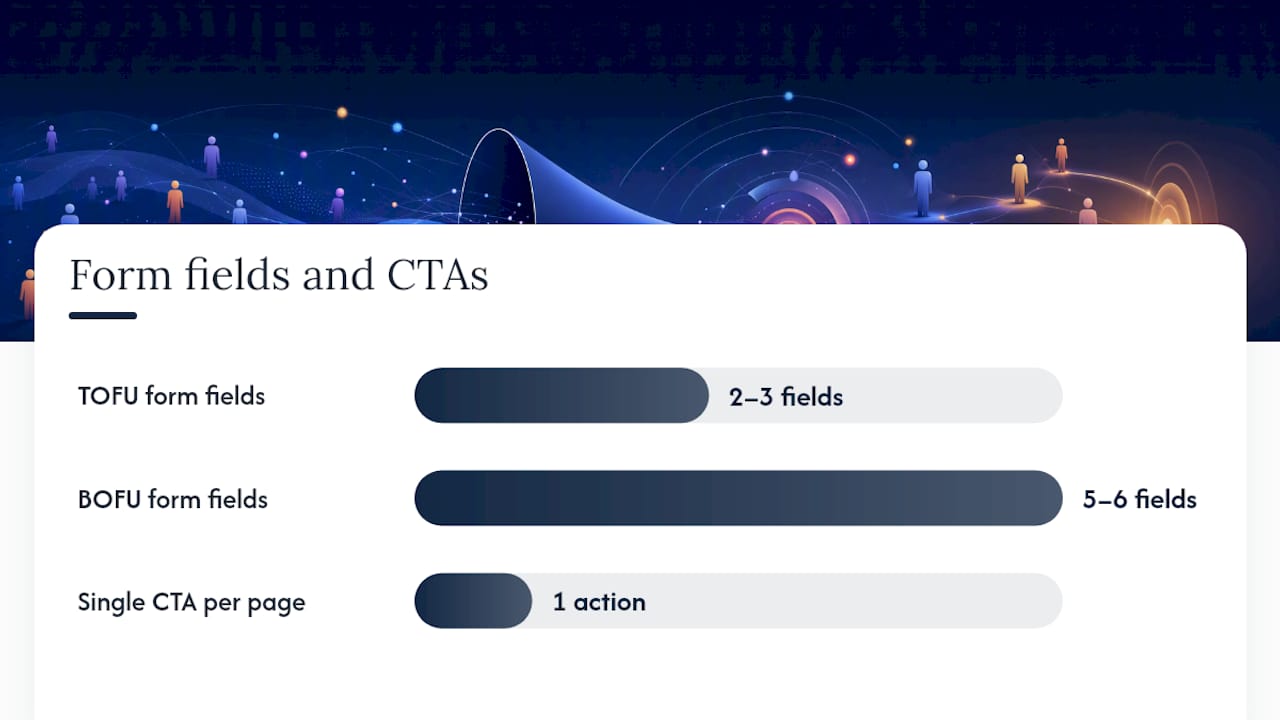
- Single CTA: One action per page. Remove navigation links, secondary offers, and anything that competes with the primary conversion goal.
- Minimal required fields: At the top of the funnel (TOFU), ask for email and job title only. Company name can come next. Budget, timeline, and team size belong at the bottom of the funnel (BOFU), either in a later form or during a sales call.
- Progressive profiling: Use tools that show different fields to returning visitors, so you build a complete picture over multiple interactions rather than asking for everything at once.
- Trust signals: A short testimonial, a recognisable client logo, or a privacy statement near the submit button all reduce abandonment.
For TOFU forms, two or three fields is the target. For BOFU forms (a demo request or a consultation booking), five or six fields is acceptable because the visitor’s intent is already high.
HubSpot’s guide to lead generation funnels maps TOFU, MOFU, and BOFU content types clearly and is worth reviewing when you are aligning your form strategy to buying stages.
A/B test one element at a time: headline, CTA button text, number of form fields, or page layout. Track conversion rate, form abandonment rate, and assisted conversions (leads that touched the page but converted elsewhere). After capture, enrich every record with company data and validate email addresses before routing to sales. A record with a misspelled domain or a personal Gmail address wastes a sales rep’s time.
Pro Tip: A “thank you” page after a lead magnet download is one of the most underused capture moments in B2B. While intent is at its peak, offer a direct next step: a webinar sign-up, a short consultation booking, or a relevant case study. Most teams send the download and stop there, which leaves high-intent leads in a nurture queue when they were ready to act immediately.
For more on lead nurturing tactics that keep leads moving through the funnel after capture, the partner guide from BabyLoveGrowth covers conversion optimisation in practical detail.
How do you qualify leads? The MQL, SQL, and fit plus intent model
A Marketing Qualified Lead (MQL) is a contact that has met a behavioural threshold, typically a score based on content downloads, page visits, or email engagement, that suggests they are worth further attention. A Sales Qualified Lead (SQL) is a contact that has been assessed against fit criteria and confirmed as a genuine opportunity worth a sales conversation.
The industry is moving away from behaviour-only MQL scoring because it produces too many false positives: a contact who downloads three guides but has no budget, no authority, and no timeline is not a real opportunity. DemandNexus recommends shifting focus to appointment quality and BANT-style qualification, prioritising decision-maker readiness over raw lead volume.
The fit plus intent model, as described in Clay’s B2B playbook, scores leads on two independent dimensions:
Fit attributes (who they are):
- Firmographic: company size, sector, revenue, geography
- Technographic: tools and platforms they use
- Structural: decision-maker role, budget authority
Intent attributes (what they are doing):
- Search behaviour: keywords they are researching
- Hiring signals: new roles that indicate a buying initiative
- Funding events: recent investment rounds
- Content engagement: specific pages visited, assets downloaded
Routing rules based on this model:
- High fit + high intent: Route to sales immediately with full context. SLA: contact within 4 hours.
- High fit + low intent: Enter a targeted nurture sequence. Monitor for intent signals weekly.
- Low fit + high intent: Deprioritise or redirect to a lower-touch channel.
- Low fit + low intent: Do not route to sales. Archive or suppress.
For a deeper look at the lead qualification process, Aheadofsales has a practical step-by-step guide that maps this model to real sales team workflows.
A practical fit plus intent workflow you can run next quarter
This workflow unifies inbound, outbound, and signal-based leads on a single process, so your team is not running three separate programmes with three separate scoring models.
Step-by-step:
- Source accounts from ICP filters (firmographic and technographic) and add them to a monitored list
- Monitor signals weekly: funding, hiring, technology changes, content engagement
- Enrich records with company data, contact details, and intent scores before any outreach
- Score on fit plus intent using the matrix below
- Route to sales (SQL) or nurture (MQL) based on combined score
- Measure outcomes at 4-week intervals: meetings booked, pipeline created, close rate by source
Sample score matrix:
| Fit attribute | Low intent signal | Medium intent signal | High intent signal |
|---|---|---|---|
| Strong fit (ICP match) | Nurture | Nurture + light outreach | Route to sales (SQL) |
| Moderate fit | Monitor | Light nurture | Nurture + outreach |
| Weak fit | Suppress | Suppress | Deprioritise |
Routing and SLAs:
- SQL threshold: strong fit plus medium or high intent
- Sales response SLA: 4 hours for SQLs, 24 hours for warm MQLs
- Enrichment owner: marketing or a dedicated RevOps function
- Handover format: a short context note (company, signal, fit score, suggested opening) passed with every SQL
Pro Tip: PXLPeak’s lead generation research shows that faster follow-up materially improves qualification rates compared with the common 24-hour response window. Test this yourself: take your current average response time, halve it for one month, and measure the difference in meeting rate. The improvement is almost always significant enough to justify the operational change.
How do you choose which lead generation types to test next?
Start with a decision checklist before you commit to any channel:
- Objective: Do you need volume, speed, or enterprise deal flow? Match the channel to the goal, not to what is fashionable.
- Team capacity: Inbound needs content production. Outbound needs a disciplined prospector. ABM needs sales and marketing aligned. Be honest about what your team can sustain.
- Budget: Paid channels need ongoing spend. Inbound needs upfront content investment. Referrals need relationship management time.
- Existing strengths: If you already have a strong client base, activate referrals first. If you have a content library, optimise it for SEO before building new assets.
Sample 8–12-week test plan:
- Weeks 1–2: Define your ICP, set up tracking (UTM parameters, CRM source fields), and agree on scoring criteria and routing rules before any outreach begins.
- Weeks 3–4: Launch your first channel (outbound prospecting or a gated asset). Set a target of 20–30 qualified conversations or 100 leads, whichever comes first.
- Weeks 5–8: Add a second channel. If outbound is running, add a webinar or a referral activation campaign. Track CPL and conversion to SQL by source.
- Weeks 9–12: Review results against your success criteria. A channel passes if CPL is within target and SQL conversion rate is above your baseline. Scale what passes; pause what does not.
Quick decision heuristics:
- Prioritise inbound when you have 6+ months of runway and want compounding returns
- Prioritise outbound when you need pipeline in the next 30–60 days
- Prioritise ABM when your average deal value exceeds £50,000 and your TAM is a named list
- Prioritise referrals when your client satisfaction is high and your buyers operate in tight professional networks
Which tools should UK teams use for lead generation?
Tool selection should follow strategy, not the other way around. Here are the practical categories and what to look for in each:
- CRM and marketing automation: The foundation. Adobe Marketo Engage handles omnichannel orchestration, lead scoring, and sales handover at enterprise scale. For smaller teams, a simpler CRM with basic automation rules is often sufficient. Check data residency: UK businesses handling personal data under UK GDPR should confirm where their CRM stores data.
- Intent and signal providers: Tools that surface buying signals (funding, hiring, technology changes) so you can prioritise outreach to accounts in an active buying window. Check UK data coverage before committing.
- Enrichment platforms: Append company and contact data to inbound leads automatically so sales receives complete records. The Microsoft AppSource marketplace lists enrichment and prospecting tools that integrate with common enterprise stacks.
- LinkedIn: The primary B2B social channel for UK teams. LinkedIn Sales Navigator is the standard tool for prospecting and signal monitoring. LinkedIn Lead Gen Forms reduce friction on paid campaigns.
- Webinar platforms: Zoom Webinars, Demio, and ON24 are all available in the UK and integrate with most CRMs for automated lead capture and follow-up sequencing.
- Ad platforms: Google Ads for search demand capture, LinkedIn Campaign Manager for B2B targeting, Meta Ads Manager for retargeting and awareness.
Vendor selection criteria for UK businesses: Confirm GDPR-compliant data processing agreements, UK or EU data residency options, and integration with your existing CRM before signing any contract. Support hours and onboarding quality matter more than feature lists for most teams.
A practitioner’s honest notes on what actually goes wrong
Most lead generation programmes fail for one of three reasons: single-channel reliance, poor routing, or slow response time. I have seen all three sink otherwise well-funded programmes.
Single-channel reliance is the most common. The fix is simple in principle: build at least two channels before you need them. In practice, it requires discipline to invest in a second channel when the first is working well.
Poor routing is quieter but equally damaging. A lead arrives, sits in a CRM queue for three days, and by the time a sales rep calls, the prospect has already spoken to someone else. The fix is a clear SLA: SQLs get a response within 4 hours, full stop. A simple handover document, one page with the lead’s context, fit score, and suggested opening, makes that response faster and more relevant.
Slow response time is the most fixable problem and the one teams most consistently underestimate. The PXLPeak research on speed-to-lead is clear: faster follow-up materially improves qualification rates. This is not a technology problem; it is a process and priority problem.
My practical advice: save your resources for two experiments rather than spreading budget thinly across five channels. Two channels done well will outperform five channels done poorly every time. Align your scoring, set your SLAs, write a one-page handover doc, and then run your test. The sales growth checklist from Aheadofsales gives you a structured framework for tracking progress across all of this.
Ready to build a lead generation engine that actually converts?
If you have read this far, you have a clear picture of the channel types, the scoring model, and the test plan. The next question is whether your sales team has the skills and the process to convert those leads once they arrive.
Aheadofsales works with UK businesses of 50–1,000 staff to build the sales capability that turns a good lead generation programme into consistent revenue growth. Our sales training and coaching packages are built around your specific channels, your ICP, and your team’s current capability gaps, not a generic curriculum. For teams that need strategic support alongside training, our sales consultancy services and sales acceleration packages give you a fractional sales director who can own the programme end-to-end.
Sources
These sources underpin the workflow, scoring recommendations, and channel comparisons in this article. Each is worth reading in full if you want to go deeper on a specific area.
- How to Generate B2B Leads: The Complete Playbook for 2026 | Clay
- Lead Generation Guide: Best Practices and Considerations
- How to Generate Sales Leads: 10 Lead Generation Strategies | Salesforce
- 5 Types of Lead Generation: Data, Trends & Channel Mix Guide | The Enterprise World