
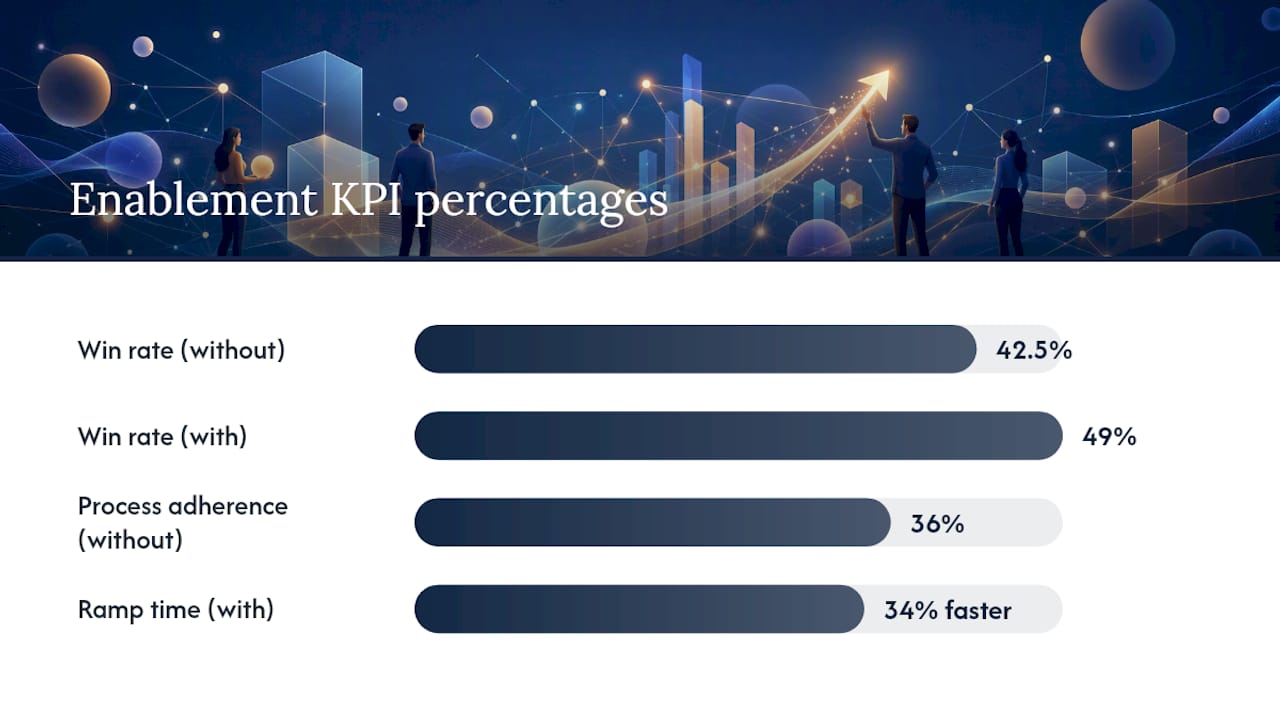
Structured sales enablement consistently delivers faster new-hire ramp, higher win rates, shorter sales cycles, better content adoption, and lower seller turnover. CSO Insights data shows organisations with formal enablement achieve a 49% win rate compared to 42.5% without it. That gap is not marginal — across a team of ten sellers, it compounds into a material revenue difference every quarter.
Here are the headline benefits you can expect when enablement is done properly:
- Faster ramp time — new sellers reach quota sooner when onboarding includes structured playbooks and coaching
- Higher win rates — formalised enablement correlates with a 6.5 percentage-point win-rate advantage
- Shorter sales cycles — guided qualification and objection-handling reduce time stuck in late-stage stalls
- Better content adoption — sellers use the right materials at the right stage instead of improvising
- Stronger marketing and sales alignment — shared messaging and buyer-stage content reduce internal friction
- Improved quota attainment — Zendesk notes that enablement trains reps to sell better and directly lifts attainment rates
- Lower seller turnover — reps who feel supported and coached stay longer, reducing costly replacement cycles
Seismic’s research points to 34% faster ramp for teams using integrated enablement platforms. That single metric alone often justifies the investment for a UK sales leader managing a growing team.
Key takeaways
Formal sales enablement delivers measurable commercial outcomes — higher win rates, faster ramp, and stronger quota attainment — but only when coaching, process enforcement, and content strategy work together rather than in isolation.
| Point | Details |
|---|---|
| Win rate advantage | Organisations with formal enablement achieve 49% win rates versus 42.5% without, per CSO Insights. |
| Ramp time improvement | Integrated enablement platforms correlate with 34% faster ramp for new sellers, per Seismic. |
| The execution gap | 89% of teams have a defined process, but only 36% follow it consistently — closing this gap drives quota attainment. |
| Measure deal behaviour | Track coaching minutes, content usage, and deal inspection frequency as leading indicators before lagging KPIs shift. |
| Aheadofsales | Bespoke coaching, team workshops, and fractional sales director services help UK businesses close the execution gap and hit target every quarter. |
Table of Contents
- What are the real benefits of sales enablement for your revenue?
- What does the research actually say about enablement’s impact?
- How does sales enablement actually deliver those benefits?
- How do you measure ROI and when will you see results?
- Why do enablement programmes fail to deliver?
- A six-step roadmap to capture these benefits faster
- What I have seen separate successful enablement from the rest
- How Aheadofsales helps teams realise these benefits
- Sources
What are the real benefits of sales enablement for your revenue?
Each benefit listed above connects to a specific commercial outcome. Understanding the mechanism behind each one helps you prioritise where to invest first.
Faster ramp time
New sellers who receive structured onboarding — combining a documented playbook, product knowledge modules, and early coaching sessions — reach their first closed deal significantly faster than those left to shadow colleagues. The mechanism is straightforward: you remove the guesswork from what good looks like. A rep who knows exactly what to say in a discovery call, how to handle a pricing objection, and which case study to send after a demo does not need six months to find their feet.
Higher win rates
Win rate improves when sellers consistently follow a proven process. Enablement enforces that consistency through playbooks, call frameworks, and manager inspection. Without it, each rep invents their own approach, and the variance in outcomes is enormous. Formalising the process narrows that variance and lifts the floor.
Shorter sales cycles
Deals stall when sellers cannot answer objections confidently, cannot find the right content quickly, or cannot articulate value at the right moment. Enablement addresses all three. A seller with instant access to a competitive battle card and a clear next-step framework moves deals forward rather than waiting for marketing to send something over.
Better content adoption
Most organisations produce more sales content than their sellers ever use. CSO Insights research links a documented content strategy to higher win rates and quota attainment — because content that is mapped to buyer stages and embedded in the CRM actually gets used. Content sitting in a shared drive does not.
Marketing and sales alignment
When marketing builds content based on what sellers actually need at each deal stage, and when sellers use that content consistently, the feedback loop improves both functions. Enablement creates the shared language and process that makes this possible. Lead nurturing strategies that align to buyer stages reinforce exactly this kind of cross-functional discipline.
Lower seller turnover
Sellers leave when they feel unsupported, under-coached, or unable to hit their numbers. Enablement addresses all three root causes. Seismic’s 2023 Value of Enablement Report links enablement technology to improved onboarding experience and employee retention — a finding that matters enormously when the cost of replacing a mid-market seller in the UK runs to several months of salary and lost pipeline.
Pro Tip: If you are a smaller team (under 20 sellers), prioritise ramp time and win rate first. Both produce measurable results within a quarter. Turnover and content adoption benefits take longer to surface and require more infrastructure to measure.
What does the research actually say about enablement’s impact?
The evidence base for sales enablement has matured considerably. Here are the most credible findings UK leaders can use in a business case.
CSO Insights’ 5th Annual Sales Enablement Study remains the most-cited benchmark. Quota attainment also improves materially when enablement is formalised — the study shows a consistent uplift across team sizes and sectors.
Seismic’s platform research documents 34% faster ramp for teams using integrated enablement technology, alongside significantly higher content engagement rates. Sellers spend less time searching for materials and more time in front of buyers.
The 2026 State of Sales Enablement report from Supered surfaces a striking finding: 89% of sales teams have a defined process, but only 36% see their reps follow it consistently. That gap — what the report calls the Enablement Execution Gap — is the single largest performance variable in most organisations. Teams that close it see the strongest quota attainment improvements.
Forrester’s 2025 B2B marketing and sales predictions confirm that enablement is no longer a nice-to-have: the integration of enablement with B2B marketing and sales priorities is accelerating, and organisations that treat it as operating infrastructure outperform those that treat it as a training event.
| KPI | Without enablement | With enablement | Source |
|---|---|---|---|
| Win rate | 42.5% | 49% | CSO Insights |
| Ramp time | Baseline | 34% faster | Seismic |
| Process adherence | Low (36% consistent) | Improves with inspection cadence | Supered 2026 |
| Quota attainment | Lower | Materially higher | CSO Insights |
One important caveat: these figures come from self-reported surveys and platform vendors, so treat them as directional benchmarks rather than guaranteed outcomes. Your actual uplift will depend on team size, current baseline, and how rigorously you implement the programme.
How does sales enablement actually deliver those benefits?
Benefits do not appear simply because you buy a platform or run a training day. They emerge from four interconnected components working together.
Training and coaching
Structured training gives sellers the knowledge. Coaching converts that knowledge into consistent behaviour. The two are not interchangeable. A seller who attends a two-day workshop and receives no follow-up coaching will revert to old habits within weeks. Coaching — whether 1:1 or in group deal reviews — is what makes training stick. Consultative selling techniques are a good example: the framework is learnable in a session, but the skill only develops through repeated coached practice.

Content and playbooks
A playbook documents what good looks like at every stage of your sales process: the right questions to ask, the objections to expect, the content to share, and the next steps to propose. When sellers have this in a format they can actually use — not a 40-page PDF — they execute more consistently. Gartner frames enablement as a continuous discipline requiring content, training, and governance — not a one-off project.
Technology and CRM integration
The most effective enablement guidance lives inside the tools sellers already use. When playbook prompts, battle cards, and next-step checklists are embedded in your CRM, adoption rises because the guidance appears at the moment of need rather than requiring sellers to go looking for it. Technology integration in sales is the difference between guidance that gets used and guidance that sits on a shelf.
Process enforcement and deal inspection
This is where most programmes fall short. The Supered 2026 report is unambiguous: deal inspection frequency correlates strongly with quota attainment. Managers who inspect deals weekly, using a consistent framework, catch stalls earlier and coach sellers through them. Without this cadence, even excellent content and training produce inconsistent results.
Integration checklist:
- CRM fields mapped to sales process stages
- Playbook content accessible from within deal records
- Coaching sessions scheduled weekly or fortnightly
- Deal inspection cadence documented and enforced
- Content usage tracked and reviewed monthly
Pro Tip: Embed your top three objection-handling responses directly into your CRM as a pinned note on each deal stage. Sellers will use them because they appear at exactly the right moment — no searching required.
How do you measure ROI and when will you see results?
Measurement is where most enablement programmes go wrong. Leaders track training hours and content produced rather than the deal behaviours that actually predict revenue. Shift your measurement to these KPIs:
Leading indicators (visible within weeks):
- Coaching minutes per seller per week
- Content usage rate by stage
- CRM field completion rate
- Deal inspection frequency
Lagging indicators (visible over months):
- Ramp time for new hires
- Win rate by stage
- Quota attainment percentage
- Average sales cycle length
A simple revenue calculation illustrates the stakes. If your team closes 100 deals per year at an average value of £15,000, a 6.5 percentage-point win-rate improvement (the CSO Insights gap) means roughly six to seven additional deals annually — around £90,000–£105,000 in incremental revenue. For a team of ten sellers, that figure scales proportionally.
Timeline to expect results:
- Weeks 6–12: Leading indicators improve. Sellers use content more consistently, CRM data quality rises, coaching cadence is established.
- Months 3–6: Win rate and cycle length begin to shift. New hires ramp faster. Deal inspection catches more stalls early.
- Months 9–12: Full quota attainment and turnover improvements become measurable. The programme pays for itself.
Gartner’s framing of enablement as an ongoing discipline rather than a single event is worth keeping in mind here: the organisations that see the strongest long-term results treat measurement as a permanent function, not a post-project review.
Why do enablement programmes fail to deliver?
The benefits of sales enablement are well-documented, but a significant number of programmes underdeliver. Here are the most common reasons, and what to audit first.
Absent content strategy. Content is produced reactively — a one-pager here, a case study there — with no mapping to buyer stages or deal objections. Audit: can every seller name the three pieces of content they use most, and do those pieces exist in an accessible format? CSO Insights data links a documented content strategy directly to higher win rates.
Poor process fit. The enablement programme is built around an idealised sales process that does not reflect how deals actually move in your market. Sellers ignore it because it does not help them. Audit: walk a recent won deal and a recent lost deal through the documented process — does it describe reality?
No manager enforcement. Managers are the single most important variable in enablement success. If they do not inspect deals using the framework, coach to the playbook, or hold sellers accountable to process, the programme collapses within weeks. Audit: how many deal reviews did each manager run last month?
Tool shelfware. A platform is purchased, a launch event is held, and adoption quietly drops to near zero within 90 days. The Supered 2026 report documents this pattern clearly: 89% of teams have a defined process, but only 36% follow it. Audit: check your CRM for field completion rates and content access logs.
Weak coaching design. Training without coaching produces short-term knowledge gains and long-term behavioural drift. Coaching sessions that are unstructured (“how’s your pipeline?”) produce no measurable improvement. Audit: do your coaching sessions have a documented agenda, and are outcomes tracked?
The Enablement Execution Gap is the thread connecting all five pitfalls. Behaviour change — not content volume — is what separates programmes that deliver from those that disappoint.
A six-step roadmap to capture these benefits faster
This sequence works for a team of 10 to 200 sellers. Adapt the timeline to your current baseline.
-
Assess (Weeks 1–2) — Owner: Sales Director. Audit current win rates, ramp times, and quota attainment by seller and segment. Identify the two or three biggest performance gaps. Do not skip this step — without a baseline, you cannot measure improvement.
-
Prioritise (Week 3) — Owner: Sales Director and Enablement Lead. Choose the one or two benefits to target first based on your gaps. A team with a 60-day ramp problem prioritises onboarding. A team with a 38% win rate prioritises process and coaching.
-
Design (Weeks 4–6) — Owner: Enablement Lead and Marketing. Build or update the playbook, map content to buyer stages, and design the coaching cadence. Keep the playbook to one page per deal stage — brevity drives adoption. Consultative selling step-by-step frameworks are a useful starting point for discovery and qualification stages.
-
Embed (Weeks 7–9) — Owner: IT and CRM Admin. Integrate playbook prompts and content links into your CRM. Map deal stages to process milestones. Set up content usage tracking. This step is what separates programmes that get used from those that do not.
-
Coach (Weeks 10–12 and ongoing) — Owner: Sales Managers. Launch the weekly coaching cadence. Use a consistent deal inspection framework. Record coaching sessions where possible so patterns can be reviewed. Coaching is not optional — it is the mechanism that converts training into revenue.
-
Inspect (Monthly, ongoing) — Owner: Sales Director. Review leading and lagging indicators monthly. Adjust content, coaching focus, and process based on what the data shows. Treat enablement as operating infrastructure, not a project with an end date.
Board/exec summary checklist:
- Baseline KPIs documented (win rate, ramp, quota attainment)
- Target improvement and timeline agreed
- Owner for each component named
- Budget allocated for coaching, content, and technology
- First 90-day review date set
What I have seen separate successful enablement from the rest
The most common mistake I see UK sales leaders make is treating enablement as a content project. They commission a set of playbooks, run a training day, and wait for win rates to improve. They rarely do — not because the content is poor, but because behaviour change requires repetition, inspection, and consequence.
The one pattern that always precedes improvement is this: a manager who starts inspecting deals weekly, using a consistent framework, and coaching sellers on specific behaviours rather than pipeline volume. Everything else — the playbook, the CRM integration, the content library — amplifies that behaviour. Without it, those tools produce very little.
I have also noticed that the teams who see the fastest results are those who start narrow. They pick one deal stage, one objection, one content piece, and one coaching habit. They get that working before expanding. The temptation to build a comprehensive programme from day one is understandable, but it almost always leads to the shelfware problem described above.
Pro Tip: Before investing in any enablement platform, run a 30-day coaching sprint with your managers. Use nothing but a shared deal-inspection template and weekly 1:1s. If win rates do not move at all in that period, the problem is not technology — it is management behaviour, and that needs addressing first.
How Aheadofsales helps teams realise these benefits
If you are preparing a business case for enablement investment, or you already have a programme that is not delivering, Aheadofsales offers a direct route to measurable results without the long lead times of a large consultancy engagement.
The services most relevant to the benefits covered in this article include bespoke 1:1 sales coaching (which addresses the manager behaviour gap directly), team workshops on objection handling and consultative selling, fractional sales director support for leaders who need senior oversight without a full-time hire, and implementation support for teams building or rebuilding their sales process.
To see what a structured engagement looks like in practice, explore the sales training services or the sales acceleration packages for a faster-start option. If you want to understand the commercial impact of consultancy-led enablement, the benefits of sales consultancy page sets out the outcomes in detail. Book a diagnostic call to identify your biggest performance gap and get a clear recommendation within one session.
Sources
These are the primary sources cited in this article. Each is worth bookmarking if you are building an internal case for enablement investment.
- Ultimate Guide to Sales Enablement Success in 2026 | Seismic
- The 2023 Value of Enablement Report (Seismic)
- Getting started with sales enablement — Zendesk blog