
A channel sales manager owns partner recruitment, enablement, and partner-sourced revenue for an assigned territory, measured on partner-sourced revenue, pipeline velocity, and time-to-first-deal. For most UK technology, SaaS, or distribution businesses, the right hire has at least five years in indirect or partner sales, demonstrable experience owning a partner programme end-to-end, and a track record of hitting quota through a PRM (partner relationship management) platform rather than a direct pipeline.
Key takeaways
A channel sales manager’s primary job is to grow partner-sourced revenue through structured recruitment, enablement, and joint go-to-market activity — measured on pipeline velocity and time-to-first-deal, not direct quota.
| Point | Details |
|---|---|
| Core remit | Recruit, onboard, enable, and expand channel partners; accountable for partner-sourced revenue quota. |
| Three must-have KPIs | Partner-sourced revenue vs. quota; time-to-first-deal (target 60–90 days); active partner ratio (target 60–70%). |
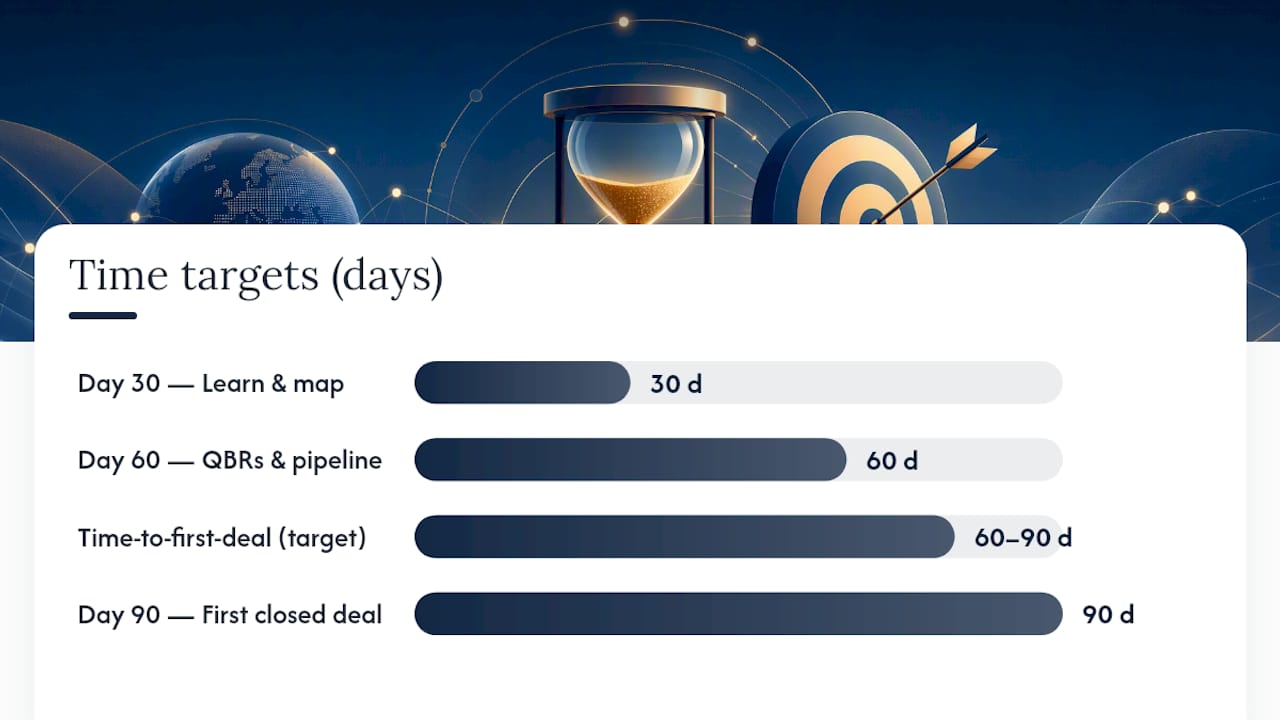
| 30/60/90 primary goals | Days 1–30: learn and map; days 31–60: QBRs and pipeline; days 61–90: first closed deal and 6-month plan. |
| UK pay benchmarking | Base typically £45,000–£70,000; OTE £65,000–£100,000; benchmark against portfolio size, not just title. |
| Aheadofsales | Provides bespoke sales training and partner enablement programmes for UK teams from £4,500. |
Table of Contents
- What does a channel sales manager actually do?
- Key responsibilities to include in your job description
- Skills and experience to look for when hiring
- Qualifications and person specification for screening
- KPIs and objectives to measure success in the role
- UK salary ranges and how to structure compensation
- Where the role sits in your organisation
- 30–60–90 day onboarding plan for a new channel hire
- How to write the advert and where to post it in the UK
- Full copy-paste job description template
- Interview questions and how to score candidates
- When to bring in external training or coaching
- What most hiring managers get wrong about this role
- Aheadofsales helps you onboard and enable your channel team faster
- Sources
What does a channel sales manager actually do?
The short answer: they grow revenue through other people’s businesses. Where a direct sales manager owns customer relationships, a channel sales manager owns partner relationships and is accountable for the revenue those partners generate. According to Impartner, core duties include developing channel sales strategies, enabling partners, creating joint sales targets, and managing deal registration and channel conflict resolution.
The distinction matters when you write your requisition. A direct sales hire is measured on their own pipeline. A channel hire is measured on the pipeline their partners build, which means the role demands a different skill set: programme design, partner enablement, and the ability to influence without authority.
Typical partner types this role manages in the UK:
- Resellers and value-added resellers (VARs)
- Managed service providers (MSPs)
- Independent software vendors (ISVs)
- Distributors
- Systems integrators (SIs) and global systems integrators (GSIs)
- Service providers and carriers
Channel teams at scale often cover all of these segments simultaneously and must adapt their go-to-market approach to each one. A reseller needs margin support and co-branded collateral; an ISV needs a technical integration story and joint pipeline reviews. Your JD should specify which partner types this hire will manage so candidates self-select accurately.
Key responsibilities to include in your job description
Channel sales managers are responsible for recruiting, training, supporting, analysing, and managing channel partners while coordinating across product, sales, and customer success. The bullets below are written in candidate-facing, active-voice language ready to paste into your advert:
- Recruit, qualify, and sign new channel partners aligned to territory and segment strategy
- Onboard new partners through a structured enablement programme, including product training, sales methodology, and access to the partner portal or PRM
- Develop and execute joint go-to-market plans with tier-one and tier-two partners
- Manage deal registration, route leads to partners, review and approve lead registrations, and forecast the indirect pipeline weekly
- Resolve channel conflict between direct and partner-led opportunities using agreed rules of engagement
- Coordinate market development fund (MDF) allocation and track utilisation against agreed outcomes
- Run quarterly business reviews (QBRs) with key partners to assess performance and agree next-quarter priorities
- Report partner-sourced pipeline, revenue attainment, and partner health metrics to the head of sales or VP of partnerships
Pro Tip: Scope the territory clearly in the JD. State whether the hire manages a named list of existing partners, a geographic patch, or a vertical segment. Ambiguity here is the single biggest cause of misaligned expectations in the first 90 days.
Skills and experience to look for when hiring
The single most important capability is partner programme ownership combined with commercial acumen. A candidate who has only supported a channel programme as a sales engineer or marketing manager will struggle with the commercial accountability this role carries.
Must-have skills:
- Partner programme design and tiering (gold/silver/bronze or equivalent)
- PRM and CRM experience (Salesforce, HubSpot, Alliances, Impartner, or similar)
- Negotiation and commercial structuring with partner principals
- Indirect pipeline forecasting and funnel management
- Cross-functional stakeholder management (product, marketing, legal, customer success)
- Partner enablement delivery: training sessions, playbooks, co-sell motions
Behavioural traits that predict success:
- Comfortable influencing without authority — partners are not employees
- Structured and process-oriented: can build a repeatable onboarding motion from scratch
- Data-driven: tracks partner health scores and acts on the numbers, not gut feel
On experience, benchmarks suggest around five years in a related role, with some supervisory or programme ownership experience. The role also appears under alternative titles — Business Channel Manager, OEM Sales Manager — so screen CVs for those variants when sourcing. Career progression data shows that entry-level channel roles focus on execution and onboarding, mid-level roles build programmes and analytics, and senior roles shape channel strategy and lead cross-functional initiatives. Match the seniority band to the scope of the role you are filling.
Qualifications and person specification for screening
Formal qualifications are rarely the deciding factor in channel sales, but they help you filter at volume.
Typical qualifications:
- Bachelor’s degree in business, marketing, or a related field (or equivalent experience)
- Sales methodology certification: MEDDIC, Challenger, or SPIN Selling
- CRM admin or advanced user certification (Salesforce, HubSpot)
- Partner programme certifications from relevant vendors (Microsoft, AWS, Cisco, Salesforce partner programmes)
Person specification (include these in your advert):
- Proven track record of hitting or exceeding partner-sourced revenue quota
- Experience managing a portfolio of at least ten active partners simultaneously
- Comfortable with regular travel to partner sites (typically 20–30% of working time in a field-split role)
- Able to work cross-functionally with marketing, product, and legal without formal authority
- Strong written communication for partner-facing proposals, playbooks, and QBR decks
KPIs and objectives to measure success in the role
Partner-sourced revenue is the primary KPI. Everything else is a leading indicator that predicts whether that number will be hit. Set this as the headline metric in the JD and in the probation review framework.
Core KPIs to include:
- Partner-sourced revenue: total closed-won revenue attributed to partner-led or partner-influenced deals, measured against quarterly quota
- Partner pipeline velocity: value and volume of partner-registered opportunities moving through the funnel each month
- Time-to-first-deal: days from partner signing to first closed deal (a strong predictor of onboarding quality)
- Partner enablement attendance: percentage of active partners completing quarterly enablement sessions
- MDF utilisation rate: percentage of allocated market development funds spent against agreed activities
- Partner satisfaction score: measured via annual or bi-annual partner survey (NPS or CSAT equivalent)
- Active partner ratio: percentage of signed partners generating at least one registered deal per quarter
Realistic target ranges to adapt: time-to-first-deal of 60–90 days for a new partner; active partner ratio of 60–70% of the signed base; MDF utilisation above 80% per quarter. These are starting points — adjust them to your partner tier mix and product complexity.
Operational duties such as lead routing and pipeline forecasting feed directly into these KPIs, so include them in the role’s weekly reporting cadence from day one. For further guidance on setting KPIs that drive consistent results, the sales best practices framework from Aheadofsales covers partner enablement and revenue metrics in practical detail.
UK salary ranges and how to structure compensation
UK base salaries for channel sales managers typically vary widely, and on-target earnings (OTE) including commission also vary significantly; senior or director-level hires managing large partner networks or enterprise accounts usually earn more than mid-level roles. Local benchmarking is recommended. Public salary data shows wide variance across markets, which is why local UK benchmarking against roles of comparable scope is the only reliable method.
Compensation components to advertise:
- Base salary: reflects experience band and partner portfolio complexity
- Commission: typically 20–30% of OTE, paid on partner-sourced revenue attainment
- Accelerators: above-quota commission rates (e.g., 1.5x or 2x rate above 100% attainment)
- MDF budget authority: not cash compensation, but a signal of seniority and autonomy
- Benefits: private health, pension above statutory minimum, car allowance or travel budget, home-working equipment
Practical benchmarking advice: size the base against the partner portfolio value (number of active partners, combined quota), not just job title. A manager running five enterprise resellers with a £2m combined quota warrants a different base than one managing twenty SMB resellers at £500k. Use Reed, LinkedIn Salary Insights, or Glassdoor for live UK market data, and cross-reference with specialist sales recruitment firms for niche channel roles.
Salary transparency in the advert increases application quality and reduces time-to-hire. State the base range and OTE clearly rather than “competitive salary.”
Where the role sits in your organisation
Most channel sales managers report to the Head of Sales, VP of Partnerships, or Chief Revenue Officer (CRO), depending on how mature the indirect channel is. In early-stage businesses, the role may report directly to the CEO or a founder who owns commercial relationships.
Key stakeholder teams:
- Direct sales: coordinate rules of engagement and deal registration to prevent conflict
- Partner marketing: co-develop MDF campaigns, co-branded content, and partner events
- Product: relay partner and end-customer feedback; align roadmap communication to partners
- Customer success: hand off partner-acquired customers and track retention by partner cohort
- Legal and finance: manage partner agreements, commission calculations, and MDF compliance
The role is most commonly an individual contributor managing a portfolio of partner accounts, though senior hires may manage one or two partner development representatives (PDRs) or channel account managers (CAMs) beneath them. State clearly in the JD whether this is an IC role or a people-management role — conflating the two is a frequent source of misaligned expectations.
30–60–90 day onboarding plan for a new channel hire
A structured 30/60/90 onboarding that sets a measurable first-deal milestone shortens time-to-first-deal and provides a fair probation assessment. Use the plan below as a template and adapt the milestones to your partner tier mix.

| Phase | Primary objective | Measurable outcome |
|---|---|---|
| Days 1–30 | Learn the product, existing partner base, and internal processes | Complete product certification; map all active partners by tier and revenue contribution |
| Days 31–60 | Build relationships with top ten partners; run first QBRs | Conduct QBR with at least five partners; identify three pipeline opportunities per partner |
| Days 61–90 | Drive first partner-sourced deal to close; present 6-month channel plan | First closed-won partner deal; channel plan signed off by head of sales |
Manager onboarding checklist:
- Grant CRM and PRM access on day one (not week two)
- Schedule introductions to all active partners within the first ten days
- Provide partner tier definitions, rules of engagement, and MDF policy documentation
- Run a joint partner mapping session to identify white-space opportunities
- Book the first enablement session with the top three partners by revenue potential
- Set 30/60/90 KPI targets in writing before the end of week one
How to write the advert and where to post it in the UK
A strong channel sales advert has five components: a clear headline, a one-sentence BLUF, a responsibilities list, the KPI expectations, and the package. Candidates in this space are experienced enough to self-select out of a vague advert, so specificity is your best tool.
Advert structure checklist:
- Headline: job title + partner type + location (e.g., “Channel Sales Manager — SaaS Resellers — London/Hybrid”)
- BLUF sentence: one line stating the core remit and the primary KPI
- Responsibilities: eight to ten active-voice bullets from the list above
- What success looks like: three to five KPIs with realistic targets
- Package: base range, OTE, benefits, and travel expectations
Where to post for UK channel sales roles:
- LinkedIn Jobs (highest volume for experienced channel hires)
- Reed and Totaljobs (broad UK reach, good for mid-market roles)
- CRN (Channel Register News) job board (specialist channel and IT channel audience)
- Partner community forums (Microsoft Partner Network, AWS Partner Network) for passive candidates
- Specialist sales recruitment firms for senior or niche hires — see search consulting guidance for sales leaders for how to brief a search firm effectively
Pro Tip: Include the OTE figure, not just the base. Channel sales candidates evaluate roles on total earnings potential. An advert that shows only the base salary will lose strong candidates to adverts that show the full package.
Inclusive language matters too. Audit the advert for unnecessarily gendered phrases (“aggressive hunter”, “rockstar”) and replace them with outcome-focused language (“exceeds partner revenue quota”, “builds scalable partner programmes”). This widens your applicant pool without lowering the bar.
Full copy-paste job description template
Job title: Channel Sales Manager
Reports to: Head of Sales / VP of Partnerships
Location: [City] / Hybrid / Remote
About the role
The Channel Sales Manager owns partner recruitment, enablement, and partner-sourced revenue for [territory/segment]. You will build and manage a portfolio of [resellers/MSPs/ISVs], drive joint go-to-market activity, and be accountable for a quarterly partner-sourced revenue quota of [£X].
Responsibilities
- Recruit and sign new channel partners aligned to the company’s partner programme tiers
- Onboard partners through a structured enablement programme covering product, sales methodology, and deal registration
- Develop joint business plans and co-sell motions with tier-one partners
- Manage deal registration, lead routing, and indirect pipeline forecasting
- Resolve channel conflict using agreed rules of engagement
- Allocate and track MDF spend against measurable campaign outcomes
- Run quarterly business reviews with key partners
- Report partner pipeline and revenue attainment weekly to the Head of Sales
What success looks like (KPIs)
- Partner-sourced revenue vs. quarterly quota
- Time-to-first-deal: target 60–90 days for new partners
- Active partner ratio: 60–70% of signed partners generating registered deals
- MDF utilisation: above 80% per quarter
Person specification
- Five or more years in indirect or partner sales
- Experience owning a partner programme or partner tier structure
- PRM/CRM proficiency (Salesforce, HubSpot, Impartner, or equivalent)
- Degree in business or related field, or equivalent experience
Package
- Base: £[X]–£[X] depending on experience
- OTE: £[X] (uncapped above 100% attainment)
- Benefits: [list]
Senior variant: add “Manage a team of one to two partner development representatives” and increase the base band by £10,000–£15,000.
Mid-level variant: remove team management; focus responsibilities on execution and partner onboarding rather than programme design.
For SaaS-specific roles, the SaaS sales job description template from Cornerstone Search provides additional wording guidance for partner-facing SaaS hires.
Interview questions and how to score candidates
A strong candidate demonstrates three things in interview: specific metrics from their current or previous channel role, evidence of programme ownership (not just participation), and the ability to translate a partner’s commercial model into a joint value proposition. A structured hiring process with role-specific screening and a practical assignment reveals execution capability more reliably than CV review alone.
Behavioural questions:
- Tell me about a channel programme you built or significantly improved. What was the before and after in partner-sourced revenue?
- Describe a time you resolved a conflict between a direct sales rep and a partner over the same deal. What was the outcome?
- Give me an example of a partner who was underperforming. What did you do, and what changed?
- How have you used data from a PRM or CRM to change your approach to a specific partner?
Technical questions:
- Walk me through how you would onboard a new reseller from contract signing to first deal.
- How do you structure a quarterly business review with a tier-one partner?
- What does your ideal deal registration process look like, and how do you handle disputes?
Role-play brief (partner onboarding scenario):
You have just signed a new MSP partner. They have ten sales reps, sell IT infrastructure, and have never sold a SaaS product before. You have 30 minutes with their sales director. Run the first onboarding conversation.
This tests the “translator” capability that separates strong channel managers from average ones: the ability to reframe your product’s value in the partner’s commercial language.
Simple scoring rubric:
| Competency | 1 (Weak) | 3 (Meets bar) | 5 (Strong) |
|---|---|---|---|
| Commercial acumen | Vague on metrics | Cites quota and attainment | Cites partner-sourced revenue, pipeline velocity, and margin |
| Programme ownership | Supported a programme | Ran part of a programme | Designed and owned a full programme |
| Partner translation | Generic product pitch | Adapts message to partner type | Builds joint value proposition in partner’s language |
| Conflict resolution | Avoids conflict | Escalates to manager | Resolves at peer level with documented rules of engagement |
Pro Tip: Ask every candidate to bring a one-page partner onboarding plan to the second interview. Candidates who can produce a structured, metrics-led plan in 48 hours are almost always the ones who can execute in the role.
When to bring in external training or coaching
Internal enablement works well when you have a mature partner programme, a dedicated enablement team, and a stable product. When any of those conditions are missing, external support closes the gap faster than building from scratch.
Signs you need external help:
- The new hire is your first or second channel manager and there is no internal programme to inherit
- You are launching a new partner tier or partner type (e.g., moving from resellers to MSPs)
- Partner-sourced revenue has plateaued and internal QBRs are not diagnosing why
- The team lacks a consistent sales methodology across partner-facing conversations
Decision checklist for buying external training:
- Is the capability gap in skills (training fixes it) or process (consultancy fixes it)?
- Do you need a one-off intervention or an ongoing coaching cadence?
- Can you measure the outcome in partner-sourced revenue or time-to-first-deal within 90 days?
When briefing an external provider, give them four things: the specific capability gap, the audience (how many people, what seniority), the measurable outcome you expect, and the timeline. A provider who cannot map their programme to your KPIs is not the right fit. The effective sales consultancy process guide from Aheadofsales walks through exactly how to scope and brief a consultancy engagement so you get measurable outcomes rather than a workshop that fades within a month.
Pro Tip: Ask any external provider for a case study where they improved partner-sourced revenue or reduced time-to-first-deal. If they cannot point to a specific outcome, keep looking.
What most hiring managers get wrong about this role
The most common mistake is writing a channel sales manager job description that is half direct sales and half partner management. You end up with a role that does neither well, and you attract candidates who are strong at one but not both.
Here is what I see repeatedly: hiring teams list “manage a direct territory” alongside “recruit and enable partners” as if they are equivalent tasks. They are not. Direct sales is a daily cadence of prospecting, demos, and closing. Partner management is a weekly cadence of enablement, QBRs, and pipeline reviews. Mixing them without a clear time split means the direct quota always wins because it is more immediate, and the partner programme quietly stagnates.
The second pitfall is skipping programme design evidence in the interview. Asking “have you worked in channel sales?” is not the same as asking “show me a partner programme you built.” The former gets you a yes; the latter gets you evidence. Use the role-play brief and the one-page onboarding plan assignment to test execution, not just experience.
Finally, do not underestimate the “translator” skill. Successful channel managers act as internal translators between partner business models and product or sales teams, and misalignment in this translation is a leading cause of partner adoption failures. Test it explicitly in the interview, not as an afterthought.
Aheadofsales helps you onboard and enable your channel team faster
Hiring the right channel sales manager is only half the job. The other half is giving them a programme worth managing and a team capable of executing it. Aheadofsales works with UK businesses of 50–1,000 staff to design and deliver bespoke sales training programmes that cover partner enablement, objection handling, and commercial acumen — the exact capabilities your new hire will need from their partners on day one.

Whether you need a structured onboarding programme for a new channel hire, a partner enablement workshop, or a fractional sales director to hold the channel strategy while you recruit, Aheadofsales can scope and deliver it. Packages for teams start from £4,500. Book a briefing call to discuss what your channel programme needs in the next 90 days.
Sources
- Here’s how to excel as a channel sales manager
- What Is a Channel Sales Manager? Definition | Impartner
- Salary
- Channel Sales Manager (Job Role) — Oracle documentation
- What is a Channel Sales Manager? – Career Insights | Teal
- Channel sales team responsibilities — Zoom careers