
The highest-impact lead generation examples for most UK B2B and SMB readers are gated research assets, LinkedIn outreach sequences, Google Search ads with demo-request landing pages, webinar funnels, referral programmes, and content upgrades inside blog posts. Pick one, build it properly, and measure it for 90 days before adding another.
Here is a shortlist of the examples covered in this article:
- Gated industry research or whitepaper — captures contact details in exchange for genuine value
- Webinar + Q&A funnel — builds trust and creates a natural demo-request moment
- LinkedIn outreach sequences — targeted, personal, and measurable for B2B
- Google Search ads with a demo-request landing page — captures high-intent buyers actively searching
- Referral programme — low cost, high quality, often overlooked
- Content upgrade inside a blog post — converts existing traffic without extra ad spend
- Interactive quiz or assessment — qualifies prospects while they engage
- Free trial or product-qualified lead (PQL) flow — lets the product do the selling for SaaS
By business type, the fastest starting point is:
- SaaS: Free trial or PQL flow, then Google Search ads
- Professional services: LinkedIn outreach + gated research
- Retail/ecommerce: Quiz or assessment + content upgrade
- Consultancies: Webinar funnel + referral programme
Your immediate next step: choose one gated asset (a one-page checklist, a short research summary, or a template), build a simple two-field form (name + business email), and publish it within 72 hours. That single action starts your lead generation workflow and gives you a real data point within a week.
Key takeaways
The highest-impact lead generation examples for UK B2B businesses combine intent capture (Google Search ads, LinkedIn outreach) with trust-building assets (webinars, gated research) and systematic referrals, all underpinned by a qualification process that routes the right leads to sales at the right time.
| Point | Details |
|---|---|
| Start with one channel | Pick the channel that matches your ACV and capacity; run it for 90 days before adding another. |
| Minimise form fields | Name and business email are sufficient for most gated assets; longer forms reduce conversion. |
| Automate early follow-up | Use CRM automation for day-0 and day-2 emails; keep humans for high-value qualification calls. |
| Score before routing | Combine fit and behaviour scores; route to sales only when the threshold is reached (e.g. score ≥ 40). |
| Aheadofsales for conversion | Aheadofsales provides bespoke qualification training and sales coaching to help UK businesses convert more of their existing leads into pipeline. |
Table of Contents
- Why these examples produce results
- Practical lead generation examples you can copy
- How to select which lead generation example to test first
- Lead capture form examples and templates
- Lead qualification and nurturing: scoring, automation and SLA templates
- Expert insight: prioritise intent, referrals and lead quality over volume
- How Aheadofsales approaches lead generation for UK B2B clients
- Aheadofsales can help you turn leads into revenue
- Sources
Why these examples produce results
The reason these methods consistently outperform generic outreach comes down to three mechanisms: intent capture, trust-building, and timely follow-up. Understanding each one helps you adapt any example to your specific market rather than copying it blindly.
Intent capture means reaching prospects at the moment they are actively looking for a solution. Google Search ads are the clearest expression of this: someone typing “sales training for SaaS teams UK” has already decided they have a problem. Intent data and qualification before handing leads to sales is particularly valuable for higher-ACV deals, where a poorly timed conversation wastes everyone’s time.
Trust-building is what gated assets, webinars, and case studies accomplish before a sales conversation ever happens. Salesforce’s lead generation guide recommends evidence-based assets like webinars and case studies precisely because they let prospects self-qualify against your expertise. A prospect who has watched your 45-minute webinar and downloaded your research report arrives at the demo already half-convinced.
Timely follow-up is where most businesses lose leads they have already paid to acquire. Sales leaders consistently advise that automation should handle early follow-up so that humans can focus on high-value conversations. A lead who fills in a form and hears nothing for three days is a lead you have effectively discarded.
The practical principle: prioritise intent, reduce friction on your forms, sequence your nurture, and measure velocity (how fast leads move to opportunity) rather than just volume.
Practical lead generation examples you can copy
Each example below follows the same structure: how it works, implementation steps, sample CTA or form copy, estimated cost and time-to-first-results, KPIs to track, and a UK-specific note.
1. Gated industry research or whitepaper
You publish a short research report (even 8–12 pages) on a topic your ideal client cares about, and gate it behind a two-field form. The perceived value of proprietary data is high, so conversion rates on these pages tend to be strong. Coursera’s lead generation guide highlights gated assets as one of the most reliable channel tactics for B2B.
Steps: Identify a question your ICP asks repeatedly. Compile data from public sources or a short survey. Write a summary with three to five findings. Build a landing page with a headline, three bullet benefits, and a form. Set up an automated email to deliver the PDF. Add a follow-up email at day three with a soft CTA.
Sample CTA: “Download the 2026 UK Sales Benchmark Report — free for business owners and sales leaders.”
Form fields: First name, Business email
Cost: £200–£800 (design + copywriting if outsourced); near zero if done in-house.
Time to first results: 1–2 weeks after publication.
KPIs: Form conversion rate, cost per lead (CPL), download-to-demo rate.
UK note: Include a GDPR-compliant consent line: “By submitting this form, you agree to receive occasional emails from [Company]. You can unsubscribe at any time.”
2. Webinar + Q&A funnel
A 45-minute live webinar on a specific problem your audience faces, followed by a Q&A, creates a natural moment to offer a follow-up call or demo. Webinars work because they compress trust-building: attendees spend time with you before any sales conversation. Platforms like Zoom and Microsoft Teams make this accessible at minimal cost.
Steps: Choose a topic that solves one specific problem (not a product pitch). Set a date 3–4 weeks out. Build a registration page with a clear outcome statement. Promote via LinkedIn, email, and your website. Run the webinar with a structured Q&A. Send a replay link within 24 hours, with a CTA to book a call.
Sample CTA: “Register free: How to qualify leads faster and close more deals in 2026.”
Form fields: First name, Business email, Job title (optional for routing)
Cost: £0–£200/month for Zoom or Teams; promotion costs vary.
Time to first results: 3–5 weeks (including promotion period).
KPIs: Registration rate, attendance rate, post-webinar demo-request rate.
UK note: Collect explicit marketing consent at registration; do not rely on legitimate interest for email follow-up sequences.
3. LinkedIn outreach sequences
LinkedIn remains the most direct channel for B2B prospect outreach in the UK. A three-step sequence (connection request with a personalised note, value message, soft CTA) consistently outperforms cold email for senior decision-makers. The B2B lead generation playbook from MarkCMO recommends sequencing outbound for near-term pipeline while building inbound for longer-term predictability.
Steps: Define your ICP by job title, company size, and industry. Use LinkedIn Sales Navigator or the free search to build a list of 50–100 prospects. Send a connection request with a one-line personalised note (reference their role or a recent post). After connecting, send a short value message (two to three sentences, no pitch). On day seven, send a soft CTA: “Would a 15-minute call be useful?”
Sample connection note: “Hi [Name], I work with [industry] leaders on [specific outcome]. Thought it worth connecting.”
Form fields: N/A (LinkedIn native)
Cost: £0 (free LinkedIn) to £79.99/month (Sales Navigator).
Time to first results: 1–3 weeks.
KPIs: Connection acceptance rate, reply rate, meeting-booked rate.
UK note: LinkedIn outreach is not subject to PECR in the same way as email, but keep messages professional and relevant.
4. Google Search ads with a demo-request landing page
Paid search captures prospects who are actively searching for what you sell. Google Ads CPL benchmarks vary by industry, so check the relevant vertical before setting your budget. The key is pairing a tightly themed ad group with a single-purpose landing page: one offer, one form, no navigation.
Steps: Identify three to five high-intent search terms (e.g. “sales training UK”, “B2B lead generation agency London”). Build a dedicated landing page with a headline matching the ad copy, three benefit bullets, social proof (a client logo or short testimonial), and a demo-request form. Set a daily budget. Monitor quality scores and adjust bids weekly.
Sample CTA: “Book a free 20-minute sales audit — no obligation.”
Form fields: First name, Business email, Phone (optional), Company size
Cost: £500–£3,000/month depending on industry and competition.
Time to first results: 1–2 weeks.
KPIs: CPL, click-through rate (CTR), demo-to-opportunity rate.
UK note: Ensure your landing page is mobile-optimised. Mobile internet usage is widespread, and a poor mobile experience will inflate your CPL significantly.
5. Referral programme
Referrals are among the lowest-cost, highest-quality lead sources available, yet most businesses treat them as accidental rather than systematic. Salesforce’s lead generation best practices support building referral incentives into your client close and delivery processes. The simplest version: ask at the point of project completion, when satisfaction is highest.
Steps: Identify your top ten happiest clients. Script a short referral ask (see template in Section 7). Decide on an incentive (a discount on future work, a gift card, or a charitable donation in their name). Add the ask to your project close checklist. Track referrals in your CRM. Follow up with the referring client to close the loop.
Sample CTA: “Know someone who’d benefit from [outcome]? We’d love an introduction.”
Form fields: N/A (conversation-based)
Cost: Near zero (incentive cost only).
Time to first results: 2–4 weeks after first ask.
KPIs: Referral conversion rate, CPL vs other channels, referral-to-close rate.
UK note: If you offer a financial incentive, check FCA guidance on referral fees for regulated sectors.
6. Content upgrade inside a blog post
A content upgrade is a piece of bonus content (a checklist, template, or calculator) offered within a blog post in exchange for an email address. It converts existing organic traffic without additional ad spend. The offer is hyper-relevant because it matches the topic the reader is already consuming.
Steps: Identify your three highest-traffic blog posts. Create a one-page bonus asset that extends the post’s value (e.g. a checklist version of a “how to” post). Add an inline CTA with a simple two-field form. Set up an automated delivery email. Track conversions in Google Analytics or your CRM.
Sample CTA: “Download the free checklist: 10 steps to qualify a lead in under 5 minutes.”
Form fields: First name, Business email
Cost: £0–£300 (design).
Time to first results: 2–4 weeks (depends on existing traffic).
KPIs: Upgrade conversion rate, email list growth rate, lead-to-opportunity rate.
UK note: GDPR consent required; do not pre-tick the marketing opt-in box.
7. Interactive quiz or assessment
A quiz or self-assessment tool qualifies prospects while they engage. A “Sales Readiness Score” or “Lead Generation Audit” gives the prospect something useful (a personalised result) while giving you firmographic and behavioural data. Tools like Typeform and Outgrow make these buildable without a developer.
Steps: Define five to eight questions that reveal ICP fit (company size, current process, biggest challenge). Map answers to a scoring matrix. Build the quiz in Typeform or a similar tool. Gate the results behind a name and email field. Send a personalised results email with a relevant next step. Route high-scorers to a sales conversation.
Sample CTA: “Take the 3-minute Sales Readiness Assessment — get your personalised score instantly.”
Form fields: First name, Business email (before results reveal)
Cost: £0–£99/month (Typeform or Outgrow).
Time to first results: 2–3 weeks.
KPIs: Quiz completion rate, lead capture rate, score-to-demo conversion rate.
UK note: Personalised results emails count as direct marketing under PECR; collect explicit consent.
8. Free trial or PQL flow (SaaS)
For SaaS businesses, a free trial lets the product generate the lead. A product-qualified lead (PQL) is a user who has reached a specific activation milestone during a trial, signalling genuine intent to buy. This is the highest-intent lead type available to a SaaS company. For further process guidance, the lead generation process for tech companies outlines how to structure trial-to-paid conversion sequences.
Steps: Define your activation milestone (e.g. “created first project” or “invited a team member”). Set up in-app tracking for that event. Trigger a personalised email when the milestone is hit. Assign PQLs to a sales rep for a short qualification call. Track trial-to-paid conversion rate weekly.
Sample CTA: “Start your free 14-day trial — no credit card required.”
Form fields: Business email (single field for maximum conversion)
Cost: Development time; near zero marginal cost per lead.
Time to first results: 2–4 weeks after launch.
KPIs: Trial sign-up rate, activation rate, trial-to-paid conversion rate.
UK note: Clearly state what happens at trial end; auto-renewal without clear notice may breach Consumer Rights Act 2015.
9. Chat-to-book-demo using website chat
A live chat or chatbot on your website can convert visitors who are not ready to fill in a form but will answer a question. The key is a qualifying script that routes high-fit visitors to a calendar booking rather than a generic “how can we help?” prompt.
Steps: Install a chat tool (HubSpot CRM’s free chat, Intercom, or Tidio). Write a qualifying script: “What brings you here today? / What’s your team size? / Would a 15-minute call be useful?” Route visitors who answer positively to a Calendly or HubSpot booking link. Log all conversations in your CRM.
Sample opening message: “Hi there — are you looking to grow your sales pipeline? I can point you in the right direction in two minutes.”
Form fields: Name, Email (captured in chat)
Cost: £0 (HubSpot CRM free tier) to £74/month (Intercom Starter).
Time to first results: 1–2 weeks.
KPIs: Chat engagement rate, chat-to-booking rate, CPL.
UK note: Display a privacy notice in the chat widget; GDPR applies to data collected via chat.
10. Partnership co-marketing
A co-marketing campaign with a complementary (non-competing) business lets you reach a warm, pre-qualified audience at near-zero cost. A joint webinar, co-authored guide, or shared email campaign splits the effort and doubles the reach.
Steps: Identify two or three businesses serving the same ICP without competing. Propose a joint asset (a guide, a webinar, or a podcast episode). Agree on list-sharing terms and GDPR compliance. Promote to both audiences. Capture leads via a shared landing page with dual consent.
Sample CTA: “Join [Company A] and [Company B] for a free live session on [topic].”
Form fields: First name, Business email, Consent checkbox for each partner
Cost: Near zero (time investment only).
Time to first results: 4–6 weeks.
KPIs: Joint registrations, new contacts acquired, post-campaign pipeline.
UK note: Each partner must have independent consent to market to shared leads; do not assume one consent covers both.
11. Retargeting ads
Retargeting shows ads to people who have already visited your website, watched a video, or engaged with your content. These prospects already know you exist, so conversion rates are typically higher than cold traffic. Google Display Network and LinkedIn Matched Audiences are the primary platforms for UK B2B retargeting.
Steps: Install the Google Tag or LinkedIn Insight Tag on your website. Build audience segments (e.g. “visited pricing page”, “watched demo video”). Create ads with a specific offer (a free audit, a guide download, or a webinar registration). Set a frequency cap to avoid overexposure. Review CPL weekly.
Sample CTA: “Still thinking about it? Book a free 20-minute audit this week.”
Form fields: Name, Business email (on landing page)
Cost: £300–£1,500/month.
Time to first results: 2–4 weeks.
KPIs: CPL, return on ad spend (ROAS), retargeting-to-demo rate.
UK note: UK GDPR requires cookie consent before placing retargeting pixels; use a compliant consent management platform (CMP).
12. Event or workshop sign-ups
Hosting a free in-person or virtual workshop positions you as the expert and creates a natural next step (a follow-up call or proposal). Events work particularly well for professional services and consultancies where trust is the primary buying criterion. Zendesk’s lead generation guide lists events and webinars among the most effective lead magnets for service businesses.
Steps: Choose a topic that solves a specific, urgent problem. Set a date and venue (or virtual platform). Build a registration page with a clear outcome statement. Promote via LinkedIn, email, and local business networks. Follow up with all attendees within 48 hours. Offer a free consultation as the next step.
Sample CTA: “Reserve your place: Free Sales Pipeline Workshop — London, March 2026.”
Form fields: First name, Business email, Company name, Job title
Cost: £0–£500 (venue hire or virtual platform).
Time to first results: 4–6 weeks.
KPIs: Registration rate, attendance rate, post-event consultation-request rate.
UK note: In-person events require a clear privacy notice at registration; virtual events need the same GDPR consent as webinars.
Channel comparison at a glance
| Channel | Best for | Estimated cost | Time to first results | Key skill required | Scalability | Primary KPI |
|---|---|---|---|---|---|---|
| Gated research | B2B, professional services | £200–£800 | 1–2 weeks | Copywriting | High | CPL, download-to-demo rate |
| Webinar funnel | B2B, consultancies | £0–£200/month | 3–5 weeks | Presentation, promotion | Medium | Attendance rate, demo-request rate |
| LinkedIn outreach | B2B, high-ACV | £0–£80/month | 1–3 weeks | Prospecting, copywriting | Medium | Reply rate, meeting-booked rate |
| Google Search ads | B2B and B2C, any | £500–£3,000/month | 1–2 weeks | PPC, landing page | High | CPL, CTR |
| Referral programme | B2B, services | Near zero | 2–4 weeks | Relationship management | Low–Medium | Referral conversion rate |
| Content upgrade | B2B and B2C, any | £0–£300 | 2–4 weeks | Content, SEO | High | Upgrade conversion rate |
| Interactive quiz | B2B and B2C | £0–£99/month | 2–3 weeks | Quiz design, copy | High | Completion rate, lead capture rate |
| Free trial / PQL | SaaS | Dev time | 2–4 weeks | Product, CRM | Very high | Trial-to-paid rate |
| Chat-to-book | B2B, services | £0–£74/month | 1–2 weeks | Copywriting, CRM | Medium | Chat-to-booking rate |
| Co-marketing | B2B, any | Near zero | 4–6 weeks | Relationship, project management | Medium | New contacts acquired |
| Retargeting ads | B2B and B2C, any | £300–£1,500/month | 2–4 weeks | PPC, creative | High | CPL, ROAS |
| Event/workshop | Professional services | £0–£500 | 4–6 weeks | Facilitation, promotion | Low–Medium | Post-event consultation rate |
How to select which lead generation example to test first
The fastest way to pick is to match your lead type (PQL, demo-ready, consultation-ready) to the channel that fits your capacity and average contract value (ACV). Trying to run five channels at once is how most businesses end up with mediocre results across all of them.
Decision checklist:
- ACV above £10,000? Start with LinkedIn outreach or Google Search ads. High-ACV deals justify the time investment in personalised outreach and paid acquisition.
- ACV below £5,000? Content upgrades, quizzes, and retargeting ads give you volume at lower cost per lead.
- SaaS product? Free trial or PQL flow first, then paid search to drive trial sign-ups.
- Professional services or consultancy? Webinar funnel or gated research, combined with a referral ask at project close.
- Limited budget (under £500/month)? LinkedIn outreach, content upgrade, and referral programme require minimal spend.
- Strong existing traffic? Content upgrade is your fastest win; no new acquisition cost.
- No existing audience? Google Search ads or LinkedIn outreach give you immediate reach.
Three questions to ask before committing:
- Do we have the internal resource to follow up every lead within 24 hours?
- Is our ICP clearly defined (job title, company size, industry, geography)?
- How will we qualify leads before passing them to a senior salesperson?
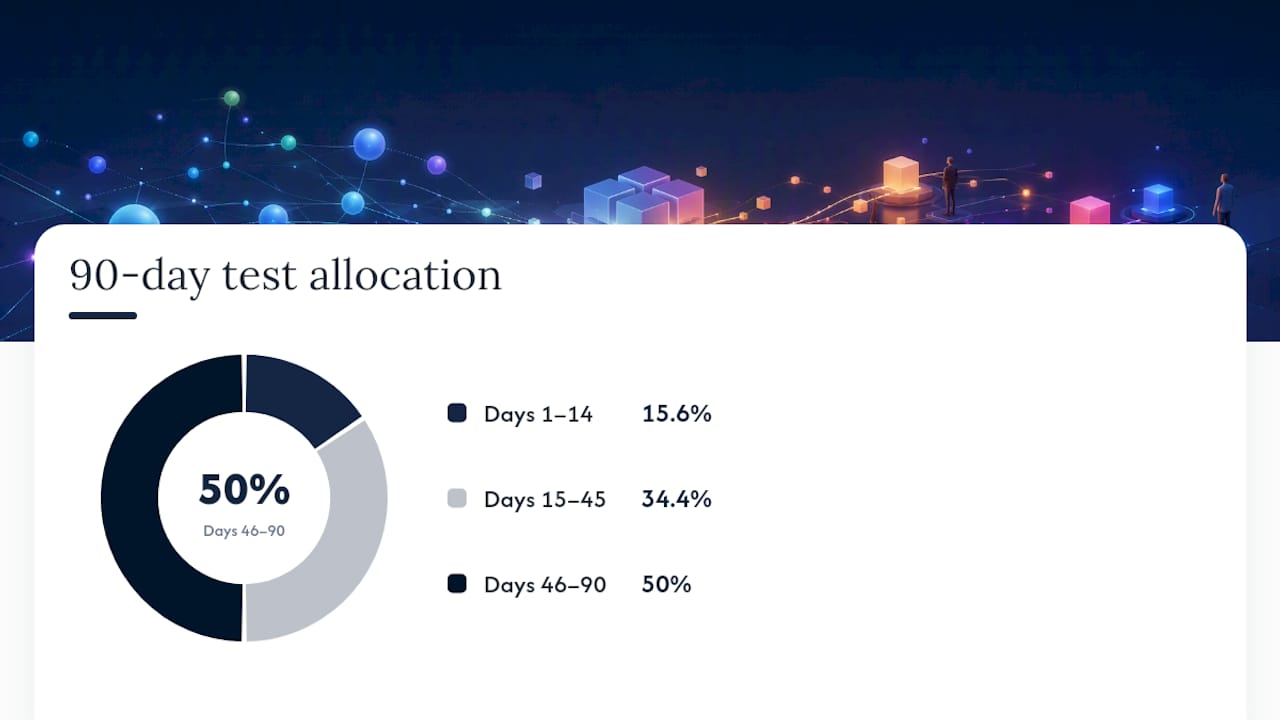
90-day test plan:
- Days 1–14: Choose one channel. Build the asset or set up the campaign. Define your KPIs and set up tracking in your CRM (HubSpot CRM or equivalent).
- Days 15–45: Run the channel. Track CPL, conversion rate, and lead quality weekly. Do not change the channel; adjust copy or targeting only.
- Days 46–90: Analyse results. If CPL is within target and lead quality is acceptable, scale the budget or effort by 50%. If not, pick the next channel from the list and repeat.
Pro Tip: Run a simple A/B test on your landing page CTA copy during days 15–45. Test “Book a free audit” against “Download the guide” on the same page. The winner tells you whether your audience is closer to decision-ready or still in research mode, which shapes your entire nurture sequence.
The B2B lead generation playbook recommends sequencing outbound for near-term pipeline while building inbound for predictability over 12–18 months. That is a sound framework: get early wins with outbound (LinkedIn, referrals), then build inbound (content, SEO, ads) as your primary engine.
Lead capture form examples and templates
The single most important principle in form design is to collect only what you need. VWO’s analysis of lead generation forms confirms that keeping fields minimal (usually name and business email) maximises conversion rates, while longer forms reduce sign-ups. Different intents require different fields, but the default should always be: fewer is better.
Form templates by intent:
Newsletter / blog subscription
- Fields: Email address only
- CTA button: “Send me the weekly tips”
- Consent line: “Weekly sales tips. No spam. Unsubscribe any time.”
Gated whitepaper or research download
- Fields: First name, Business email
- CTA button: “Download the free report”
- Consent line: “By downloading, you agree to receive occasional emails from [Company]. Unsubscribe any time.”
Demo request (B2B SaaS or services)
- Fields: First name, Business email, Company name, Team size (dropdown: 1–10 / 11–50 / 51–200 / 200+)
- CTA button: “Book my free demo”
- Consent line: “We’ll use your details to arrange your demo and send relevant updates. Privacy policy.”
Consultation request (professional services)
- Fields: First name, Last name, Business email, Phone, What’s your biggest sales challenge? (short text)
- CTA button: “Request my free consultation”
- Consent line: “Your details are used to arrange your consultation only. We will not share them with third parties.”
Free trial sign-up (SaaS)
- Fields: Business email only
- CTA button: “Start my free trial”
- Consent line: “14-day free trial. No credit card required. Cancel any time.”
Webinar registration
- Fields: First name, Business email, Job title (optional)
- CTA button: “Reserve my place”
- Consent line: “You’ll receive a confirmation and reminder email. We may also send you related content — unsubscribe any time.”
Given that mobile internet usage is widespread, every form should be tested on a mobile device before going live. A form that requires pinching or horizontal scrolling on a phone will lose a significant share of completions.
Pro Tip: Progressive profiling lets you collect additional data over multiple interactions rather than asking for everything upfront. On a first download, ask for name and email only. On a second download, pre-fill those fields and ask for company size. By the third interaction, you have a complete picture without ever presenting a long form. HubSpot CRM’s smart forms do this natively.
Lead qualification and nurturing: scoring, automation and SLA templates
Effective nurture converts leads to sales-qualified leads (SQLs) by combining fit (firmographic data) and behaviour (engagement signals). A lead who matches your ICP but has never opened an email is very different from one who has attended your webinar, downloaded two guides, and visited your pricing page.
Simple lead scoring model:
| Criterion | Signal | Points |
|---|---|---|
| Fit: Job title | Director, VP, C-suite | +15 |
| Fit: Company size | 50–1,000 employees | +10 |
| Fit: Industry | Target sector match | +10 |
| Behaviour: Email open | Opened any email | +2 |
| Behaviour: Email click | Clicked a link | +5 |
| Behaviour: Content download | Downloaded an asset | +8 |
| Behaviour: Webinar attendance | Attended live | +12 |
| Behaviour: Pricing page visit | Visited pricing page | +15 |
| Behaviour: Demo request | Submitted demo form | +25 |
| Negative: Personal email | Gmail/Hotmail address | -10 |
| Negative: Unsubscribed | Unsubscribed from email | -20 |
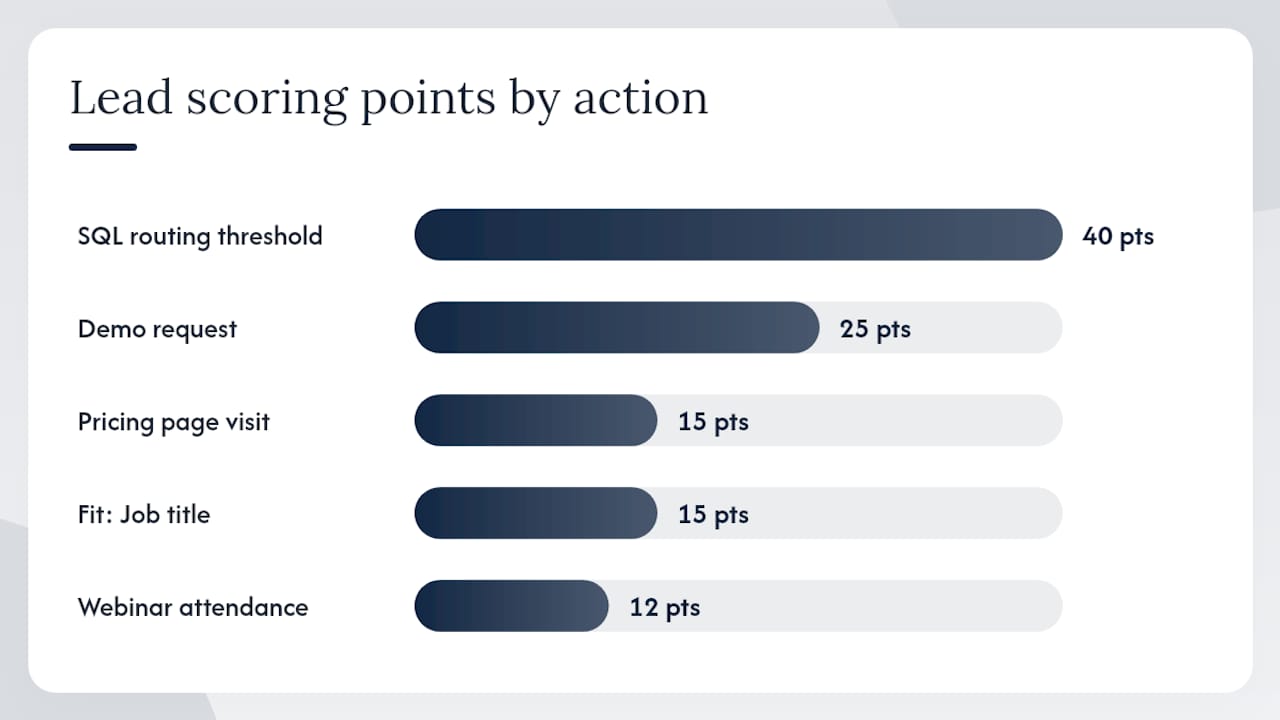
Route leads to sales when their combined score crosses 40. Below 40, keep them in nurture.
Automation flows by lead type:
Content download lead:
Day 0: Deliver asset via automated email. Day 2: Send a related tip or short case study. Day 5: Send a “did this help?” email with a soft CTA (book a call or take the quiz). Day 10: If no engagement, move to a monthly newsletter sequence. If clicked, trigger the demo-request sequence.
Demo request lead:
Day 0: Automated confirmation email with calendar link (Calendly or HubSpot CRM). Day 1: If no booking, send a follow-up with two alternative times. Day 3: If still no booking, assign to a sales rep for a personal LinkedIn message or call. Route immediately to sales upon booking.
Webinar attendee:
Day 0 (post-webinar): Send replay link + one key takeaway. Day 2: Send a related resource. Day 5: Send a personalised CTA based on the Q&A questions they asked (if tracked). Day 7: Offer a free consultation or audit. Route to sales if they click the consultation CTA.
For a practical guide to the full lead qualification process, including routing SLAs and scoring templates you can adapt in your CRM, that resource covers the mechanics in detail.
SLA template (marketing to sales handoff):
- SQL threshold: Lead score ≥ 40 OR demo request submitted
- Response time: Sales rep contacts SQL within 4 business hours of routing
- First contact method: Phone call first, LinkedIn message if no answer, email if no response within 24 hours
- Qualification call: 15–20 minutes, BANT framework (Budget, Authority, Need, Timeline)
- Feedback loop: Sales rep marks lead as “Qualified” or “Returned to nurture” in CRM within 48 hours of contact
Expert insight: prioritise intent, referrals and lead quality over volume
Prioritising high-intent, qualified leads and systematic referrals is the most cost-effective growth lever available to most UK B2B businesses. The shift from raw lead counts to revenue opportunity generation is not a trend; it is a structural change in how effective sales teams operate.
Checklist for senior sales leaders:
- Add a referral ask to your project close process (script it, do not leave it to chance)
- Set up SDR-led 15–20 minute qualification calls for all high-ACV leads before passing to a senior salesperson
- Use intent signals (job postings, funding announcements, LinkedIn activity) to trigger outreach at the moment of need
- Review CPL by channel monthly and cut channels where CPL exceeds your target by more than 30%
- Set a lead response SLA and measure compliance weekly (target: 100% of SQLs contacted within 4 hours)
- Score leads in your CRM and review the scoring model quarterly as you learn what actually converts
Sample referral email template:
A well-timed referral ask at project close, when client satisfaction is at its peak, consistently produces the highest-quality leads at the lowest cost of any channel. The consultative selling approach naturally creates the relationship depth that makes referral asks feel genuine rather than transactional.
How Aheadofsales approaches lead generation for UK B2B clients
Working with UK B2B businesses across professional services, SaaS, and consultancies, the pattern I see most often is this: businesses invest in lead generation tactics without first clarifying what a qualified lead looks like for their specific sales process. They generate volume, then wonder why conversion is low.
The examples in this article reflect the practical priorities I recommend to clients: start with one or two high-intent channels, build a simple qualification process, and measure velocity rather than volume. For UK businesses, GDPR compliance is not optional, and the channels that work best (LinkedIn, Google Search, webinars, referrals) all have clear, manageable compliance requirements.
Aheadofsales works with businesses of 50–1,000 staff and solo service businesses to build lead generation and qualification processes that produce consistent pipeline. The focus is always on leads that convert, not leads that look impressive in a dashboard.
Aheadofsales can help you turn leads into revenue
Most businesses generating leads are losing them somewhere between capture and conversation. The form converts, the email goes out, and then nothing happens because there is no qualification process, no SLA, and no training for the person who picks up the phone.
Aheadofsales offers bespoke sales training and qualification coaching for UK businesses that want to convert more of the leads they are already generating. Whether you need a structured SDR qualification process, objection handling training for your team, or a fractional sales director to build the whole system, the work is tailored to your ICP, your ACV, and your current pipeline. Packages start from £4,500 for teams of 50 or more, and from £2,995 for solo service businesses. To find out which engagement fits your situation, book a short discovery call directly from the sales training services page.
Sources
The sources below underpin the key recommendations in this article, from form best practices and lead scoring to channel benchmarks and referral programme design.
- Monday
- Lead generation strategies | DemandNexus
- Lead Generation: Guide & Best Practices | Salesforce
- Mobile internet | Statista
- Lead Generation: Meaning, Examples, and How to Get Started | Coursera
- What is lead generation? A guide to generating leads | Zendesk