
TL;DR:
- An assistant sales manager acts as the operational link between sales reps and leadership, focusing on pipeline management and coaching. Their role in the UK involves tactical execution and cross-functional liaison, with career progression to sales manager typically in two to three years. Success depends on measurable outcomes, CRM expertise, coaching ability, and strategic contribution.
An assistant sales manager is the operational engine between front-line sales reps and the sales director, responsible for keeping the pipeline moving, coaching the team, and translating strategy into quarterly results. In the UK, typical base salaries are competitive, with total earnings varying widely due to commission and bonus structures depending on sector and location. If you are weighing up whether to apply, the immediate next step is straightforward: check your CV against the core skills listed below and cross-reference it with live postings on Indeed or LinkedIn.
A few facts worth knowing before you read on:
- McKinsey research shows that top-performing companies devote roughly 50–60% of their sales employees to support functions, with twice the share of operations and administrative support compared with lower-performing peers.
- Teal’s career profile notes that a formal degree is helpful but not mandatory; many successful candidates progress from sales rep roles backed by professional certifications.
- Salesforce positions the role as far more than clerical: in growth-focused B2B teams it demands CRM ownership, lead management, and strategic foresight.
Table of Contents
- What does an assistant sales manager actually do in the UK?
- Core duties and responsibilities employers list in job ads
- What does a typical day and week look like?
- Which sectors and employers hire assistant sales managers in the UK?
- What skills and qualities do employers prioritise?
- What qualifications and training do you need?
- What salary and benefits can you expect in the UK?
- How does the career path progress from here?
- How to get hired as an assistant sales manager in the UK
- Expert tactics to accelerate promotion and add measurable value
- Key takeaways
- Is this role a good route for career growth in the UK?
- How Aheadofsales helps you move faster
- Useful sources
What does an assistant sales manager actually do in the UK?
The assistant sales manager sits one level below the sales manager or sales director and one level above the sales reps. That positioning is deliberate. The role exists because senior managers cannot simultaneously close deals, coach reps, maintain CRM hygiene, and produce accurate forecasts. Something has to give, and in under-resourced teams it is usually coaching and pipeline discipline.

Employers hire for this position when they want revenue predictability without adding a full sales director headcount. The assistant takes on operational execution so the director can focus on strategy, key accounts, and hiring. McKinsey’s analysis found that under-investing in sales-support roles correlates directly with higher rep burnout and lower quota achievement.
The scope covers four broad areas: pipeline management, team coaching, reporting, and cross-functional liaison. In mid-sized UK B2B firms the role often blurs into sales operations, which means technical CRM fluency (Salesforce or HubSpot admin skills) frequently separates a replaceable assistant from an indispensable operator.
Pro Tip: The behavioural indicator that separates a genuine player-coach from an administrator is this: does the candidate talk about rep outcomes, or their own activity? Employers want to hear “I reduced average deal cycle by two weeks by restructuring our follow-up sequence,” not “I managed the CRM.”
Core duties and responsibilities employers list in job ads
Most UK job adverts for this role cluster around the same set of responsibilities. Knowing them precisely helps you frame your CV in the language hiring managers use.
- Pipeline management: — reviewing deal stages in the CRM, challenging stale opportunities, and maintaining forecast accuracy.
Teal’s career profile notes that high-performing assistants spend roughly 60–70% of their time on tactical execution and the remainder on coaching and process improvement. That split matters when you are writing CV bullet points: lead with the tactical wins (pipeline value managed, conversion rate improvements, forecast accuracy achieved) rather than listing duties.
Typical KPIs you will be measured against include lead-to-opportunity conversion rate, forecast accuracy (within ±10% of actual), average deal cycle length, and rep ramp time for new starters.
What does a typical day and week look like?
A realistic day starts with a 15-minute CRM review: which deals moved overnight, which are stalled, and which need a nudge before end of day. That feeds a brief stand-up with the team, usually no longer than ten minutes, covering priorities and blockers.

The mid-morning block tends to be the most productive for outbound activity: supporting reps on live proposals, joining calls as a second voice on complex deals, or reviewing pipeline with individual reps. Salesforce research confirms that sales support roles focused on lead management, CRM upkeep, and customer communication free reps to spend more time actually selling, which is the core justification for the role’s existence.
Afternoons often shift to reporting, coaching prep, and cross-functional meetings. A weekly rhythm typically looks like this:
- Monday: pipeline review with the full team; flag at-risk deals.
- Tuesday/Wednesday: structured 1:1 coaching sessions with individual reps.
- Thursday: forecast submission to the sales director; deal-desk reviews on complex pricing.
- Friday: admin, CRM hygiene, and planning the following week’s priorities.
On working hours: most UK assistant sales manager roles are 37.5–40 hours per week. Hybrid working is now common in B2B and SaaS sectors, with two to three days in the office. Retail and field sales roles tend to require more on-site presence and may include weekend or evening cover depending on the business.
Which sectors and employers hire assistant sales managers in the UK?
The role appears across a wide range of sectors, but some hire more consistently than others.
- Professional services: — accountancy, legal, and consultancy firms with dedicated business development teams increasingly hire for this position.
For job hunting, Indeed, LinkedIn, and Reed carry the highest volume of UK postings. Searching “assistant sales manager” alongside a sector or city narrows results quickly. Many mid-market B2B firms also recruit through specialist sales recruiters such as DeLacy Executive, who publish detailed career profiles for the role.
What skills and qualities do employers prioritise?
Hard skills and soft qualities carry roughly equal weight in shortlisting decisions. Here is what employers consistently look for:
Hard skills:
- CRM proficiency (Salesforce, HubSpot, or Pipedrive at admin or power-user level)
- Pipeline analysis and forecasting
- Data literacy: reading conversion dashboards, identifying trends, and presenting findings clearly
- Negotiation and deal structuring
- Sales methodology knowledge (SPIN, Challenger, MEDDIC, or similar)
Personal qualities:
- Coaching mindset: genuine interest in developing others, not just hitting personal numbers
- Resilience under pressure, particularly at month-end
- Decisive troubleshooting: the ability to make a call quickly when a deal is at risk
- Commercial focus: understanding margin, not just revenue
Pro Tip: To demonstrate coaching skill in an interview, prepare a STAR-format example where you helped a specific rep improve a measurable metric. “I noticed one of our reps had a 12% discovery-to-demo conversion rate against a team average of 28%. I listened to five of their calls, identified two recurring objection-handling gaps, and ran three focused coaching sessions. Within six weeks their rate was at 24%.” That level of specificity wins interviews.
What qualifications and training do you need?
A business, marketing, or sales degree can help at the application stage, particularly in larger corporate employers. That said, many hiring managers in the UK prioritise demonstrable sales experience and measurable results over academic credentials. A strong track record as a senior sales rep, combined with relevant certifications, is often more persuasive than a 2:1 from a good university.
Certifications and short courses worth considering:
- CRM certifications: — Salesforce Administrator or HubSpot Sales Software certification are practical and verifiable.
Apprenticeship routes are worth noting too. The Level 4 Sales Executive Apprenticeship and the Level 5 Operations/Departmental Manager Apprenticeship are both relevant pathways for candidates already in employment who want to formalise their skills without leaving their current role.
What salary and benefits can you expect in the UK?
Base salaries for assistant sales managers in the UK typically range from £28,000 to £45,000, with London and the South East sitting at the upper end and regional roles often starting closer to £28,000–£32,000. On-target earnings (OTE) with commission and bonus can push total compensation to £55,000–£65,000 in high-performing B2B and SaaS environments.
Common benefits packages include:
- Employer pension contribution (typically 4–6% above the statutory minimum in larger firms)
- Private healthcare (more common in tech and financial services)
- Company car allowance or travel reimbursement for field-based roles
- Annual training budget (£500–£2,000 is typical in growth-focused businesses)
- Hybrid working and flexible hours
McKinsey’s research on sales-support staffing shows that top-performing companies invest significantly more in support roles than their lower-performing peers, which partly explains why well-funded scale-ups and established B2B firms tend to offer more competitive packages than smaller businesses.
Pro Tip: When negotiating, focus on the bonus structure before the base salary. Ask specifically: “What does hitting 100% of target look like in terms of total earnings, and what percentage of the team achieved that last year?” That single question tells you whether the OTE is realistic or aspirational.
How does the career path progress from here?
The typical progression in UK B2B sales looks like this: assistant sales manager → sales manager → regional or national sales manager → sales director. Realistic timeframes vary, but two to three years in the assistant role before moving to sales manager is common in mid-market firms, assuming you are hitting targets and demonstrating people development.
Promotion criteria that hiring managers and directors look for:
- Quota ownership: have you managed a team that consistently hits target, not just supported one?
- Process improvement wins: can you point to a specific change you made that improved a measurable metric?
- People development: have you promoted or significantly developed someone on your team?
McKinsey’s analysis identifies an optimal non-manager-to-manager ratio of around 8:1 in high-performing sales organisations. Ratios above 10:1 or below 5:1 both harm outcomes. This matters for your promotion timeline: if your current team is already at 8:1, a new sales manager headcount may not open up until the team grows. Understanding your employer’s headcount plans is a practical part of managing your own progression. You can explore sales team optimisation frameworks to understand how growth-stage businesses structure roles as they scale.
How to get hired as an assistant sales manager in the UK
CV and cover letter
Your CV should lead with outcomes, not duties. Here are three bullet-point formats you can adapt:
- Managed a pipeline of £1.2m across 14 active opportunities, maintaining forecast accuracy within ±8% over two consecutive quarters.
- Coached three junior reps from 65% to 92% of quota over a six-month period through weekly structured 1:1s and call-review sessions.
- Reduced average deal cycle from 47 days to 31 days by redesigning the follow-up sequence and introducing a mutual action plan template.
For your cover letter: open with a one-line value proposition tied to the specific job ad, include one achievement that directly matches the role’s stated priorities, and close with a clear next step (“I would welcome a conversation to discuss how my experience in [sector] maps to your current targets”).
Interview preparation
Common interview questions for this role:
- “Tell me about a time you turned around an underperforming rep.” (Use the STAR format; include a specific metric.)
- “How do you manage a pipeline review when three deals are at risk in the same week?”
- “What CRM reports do you run weekly, and what decisions do they inform?”
- “How do you balance your own sales activity with coaching responsibilities?”
Application checklist:
- Tailor your CV to each job ad (mirror the language in the person specification)
- Confirm your right to work in the UK and have documentation ready
- Know your notice period and be upfront about it at first-stage interview
- Prepare two professional references, ideally one line manager and one peer or direct report
Expert tactics to accelerate promotion and add measurable value
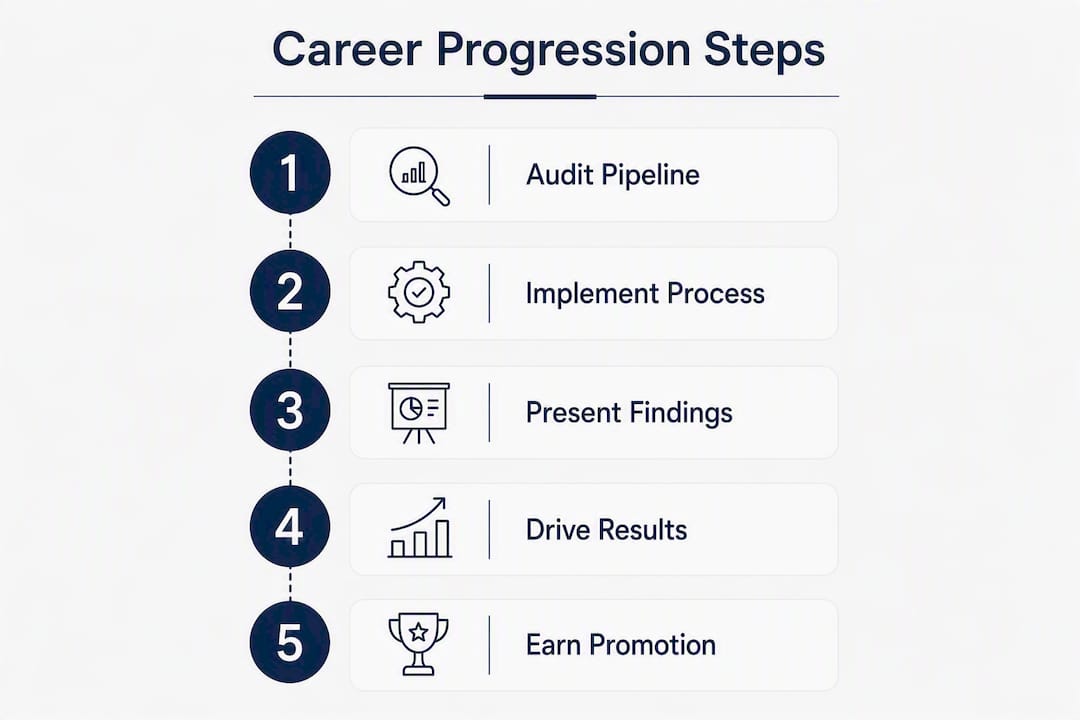
The fastest way to move from assistant to full sales manager is to make your impact visible and quantifiable from day one. A structured 90-day plan is the most reliable way to do that.
Days 1–30: audit the pipeline. Identify the top five stalled deals and the three reps with the widest gap between activity and results. Document your baseline metrics: conversion rates, average deal cycle, forecast accuracy, and rep quota attainment.
Days 31–60: implement one process change. This could be a lead-scoring adjustment in the CRM, a revised follow-up cadence, or a new call-review framework. Track the before-and-after numbers. Pipeline management discipline is often where the quickest wins appear.
Days 61–90: present your findings to the sales director. Show the metric movement, name the reps who improved, and propose one further change. This positions you as someone who thinks like a manager, not an assistant.
A simple results-tracking table to maintain throughout:
| Metric | Baseline | Week 4 | Week 8 | Week 12 |
|---|---|---|---|---|
| Pipeline conversion rate | % | % | % | % |
| Forecast accuracy (±%) | % | % | % | % |
| Average deal cycle (days) | days | days | days | days |
| Rep quota attainment (avg) | % | % | % | % |
One non-obvious lever that produces quick wins: CRM lead-routing automation. Most teams assign leads manually, which introduces delay and inconsistency. Setting up automatic round-robin assignment based on rep capacity and territory in Salesforce or HubSpot typically reduces lead response time within days and gives you a clean, attributable metric to present upward.
On decision-making authority: negotiate clear boundaries early. Ask your sales director explicitly which decisions you can make independently (lead distribution, small discount approvals, rep scheduling) and which require sign-off. Practitioners who secure this clarity early avoid the shadow-manager trap, where they carry accountability for outcomes without the authority to drive them.
Pro Tip: Use sales acceleration techniques to identify the one pipeline stage where deals stall most often in your team. Fixing a single bottleneck consistently produces more measurable impact than trying to improve everything at once.
Key takeaways
An assistant sales manager who combines tactical pipeline discipline with genuine rep coaching is the most promotable person in any UK sales team.
| Point | Details |
|---|---|
| Salary range | UK base pay typically runs £28,000–£45,000, with OTE reaching £55,000–£65,000 in B2B and SaaS. |
| Top three skills to highlight | CRM proficiency, structured coaching, and forecast accuracy are the skills that appear most consistently in UK job ads. |
| 90-day impact plan | Audit the pipeline, implement one measurable process change, and present results to the director within three months. |
| Promotion timeline | Two to three years is a realistic path to sales manager in UK mid-market firms, provided you own measurable team outcomes. |
| Aheadofsales coaching | Bespoke 1:1 coaching from Aheadofsales can accelerate promotion by helping you build the skills and evidence base hiring managers look for. |
Is this role a good route for career growth in the UK?
My honest view is that the assistant sales manager role is one of the most underrated entry points into senior sales leadership in the UK. It gives you something that a pure sales rep role rarely does: exposure to the full commercial picture. You see pipeline health, rep development, forecasting, cross-functional politics, and strategic planning all at once. That breadth is exactly what sales directors look for when they promote.
The caveat is temperament. If you thrive on personal deal-closing and find coaching others frustrating, this role will feel like a step sideways rather than forward. The people who accelerate fastest are those who genuinely enjoy fixing other people’s problems, not just their own.
For a recent graduate or someone moving from a junior rep role, this is an excellent first management step. For a mid-career rep who has been closing deals for five or more years, the transition requires a real mindset shift: your numbers are now the team’s numbers, not yours. For someone aiming at a sales director position within five years, this role is almost essential. You will not get to director level in most UK B2B firms without having managed a team through a full annual cycle, and this role is where that experience starts.
How Aheadofsales helps you move faster
The gap between a competent assistant sales manager and one who gets promoted in 18 months rather than three years usually comes down to one thing: structured skill development with real accountability. Aheadofsales delivers bespoke 1:1 coaching and in-person or online sales training programmes designed specifically for B2B sales professionals who want measurable results, not generic content.

A typical engagement focuses on the three areas that move the needle fastest for someone in this role: pipeline discipline, rep coaching frameworks, and commercial communication with senior stakeholders. Packages for businesses with 50–1,000 staff start from £4,500, and the goal is straightforward: at least 50% sales growth per year and a team that hits target every quarter. If you want to understand what a tailored coaching engagement would look like for your situation, book a discovery conversation with the Aheadofsales team.
Useful sources
The following sources informed this article:
- Sales support: How to get it just right — McKinsey analysis on sales-support staffing ratios, the 8:1 manager ratio, and the correlation between support investment and revenue performance.
- Sales Support: What It Is and Why It’s Essential — Salesforce’s definition of sales support functions, CRM ownership, and the strategic scope of the role.
- What is an assistant sales manager? Career Insights — Teal’s career profile covering role definition, the 60–70% tactical execution split, education requirements, and progression routes.
- Assistant Sales Manager Career Profile — DeLacy Executive’s UK-specific career profile, used for role framing and sector context.