
TL;DR:
- An inside sales manager leads a remote or office-based team responsible for high-volume, short-cycle sales through digital channels.
- The role involves coaching reps, managing pipelines, and driving quota attainment while using data-driven KPIs to measure success.
An Inside Sales Manager leads a remote or office-based sales team, owning team quota, coaching performance, and managing the full sales pipeline through digital and telephone channels.
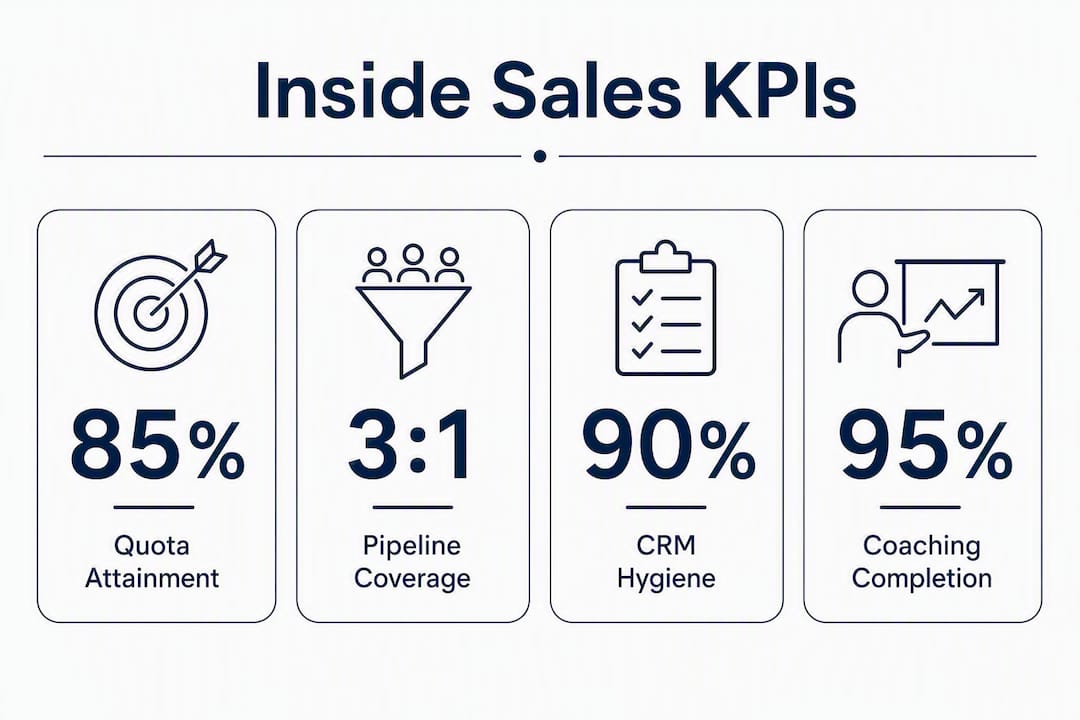
Copy-ready summary: The Inside Sales Manager oversees a team of inside sales representatives, driving revenue through structured coaching, pipeline management, and data-led forecasting. The role owns team quota attainment, rep ramp and retention, and cross-functional alignment with marketing and customer success.
Three immediate hiring signals to screen for:
- Proven people management experience, ideally leading a team of five or more inside sales representatives
- Hands-on proficiency with a CRM platform (Salesforce or HubSpot) at reporting and pipeline-hygiene level, not just rep-level data entry
- Demonstrable track record of coaching reps to quota, not just hitting personal quota as an individual contributor
Table of Contents
- What does an inside sales manager do, and when should you hire one?
- Key responsibilities to include in your job description
- What objectives and KPIs should you include?
- Required and preferred skills: how to write the two lists
- UK salary and compensation guidance for this role
- Paste-ready inside sales manager job description template
- How to screen and interview candidates effectively
- Onboarding and first 90 days: a practical plan
- What high-performing inside sales managers actually do differently
- How to tailor the job description to your company and role level
- Key takeaways
- What I have seen go wrong with inside sales manager hiring
- Aheadofsales helps you build managers who actually develop their teams
What does an inside sales manager do, and when should you hire one?
The inside sales manager is the operational layer between your sales representatives and senior sales leadership. Where a field or outside sales manager spends significant time travelling to meet prospects and clients in person, the inside sales manager manages remote selling through phone, email, video, and digital engagement tools. The focus is on volume, velocity, and repeatable process rather than long-cycle relationship management.

The distinction matters when you are writing the role profile. An inside sales manager typically handles shorter, higher-volume sales cycles and relies heavily on CRM dashboards and conversation intelligence to monitor performance. A field sales manager’s value is more relationship-led and territory-based. Getting that framing right in your job description will filter out the wrong applicants before the first CV lands.
When to hire: the clearest trigger is a team of five or more inside sales reps with no dedicated management layer. Other signals include missed quota two quarters running with no structured coaching in place, a new product entering a high-volume market, or a growth phase where the founder or head of sales is still running 1:1s with every rep. If your revenue leader is spending more than a third of their week on rep-level coaching, you needed this hire yesterday.
One-line comparison: an inside sales manager focuses on coaching volume, CRM hygiene, and short-cycle conversion; a general sales manager often carries broader strategic and territory responsibilities with longer average deal cycles.
Key responsibilities to include in your job description
Sales managers plan, direct, and coordinate the delivery of a product or service to the customer, and the inside sales version of that role is no different in principle, only in execution. The responsibilities below are written to be measurable and assessable at interview. Use them as a starting point and trim to match your seniority level.
- Coach inside sales representatives through weekly 1:1s, call reviews, and structured skill-gap sessions, targeting one observable behaviour per session
- Own team quota attainment and report weekly pipeline status to the head of sales or revenue director
- Manage pipeline hygiene standards, including CRM stage definitions, deal data accuracy, and weekly pipeline reviews
- Prepare and present monthly and quarterly sales forecasts, with variance analysis against target
- Recruit, interview, and onboard new inside sales representatives, including a structured 60–90 day ramp plan
- Collaborate with marketing on lead quality, campaign feedback, and inbound pipeline generation
- Work with customer success to manage handoffs, reduce churn risk, and identify expansion opportunities
- Set individual rep targets aligned to team quota, monitor progress, and implement performance improvement plans where needed
- Analyse conversion rates, average deal size, and sales cycle length to identify process improvements
- Maintain and enforce CRM usage standards across the team, treating pipeline data as the single source of truth
Pro Tip: Write each responsibility with a verb and a measurable outcome. “Conduct weekly call coaching sessions targeting one skill gap per rep, with follow-up review within two weeks” is assessable in interview. “Responsible for coaching” is not.
What objectives and KPIs should you include?
Specifying KPIs in the job description does two things: it signals to strong candidates that you run a data-led team, and it gives you a ready-made performance framework for the first review cycle. The table below pairs each core objective with a KPI definition and measurement cadence you can paste directly into your role profile or performance review template.
| Objective | KPI | Calculation / Cadence |
|---|---|---|
| Quota attainment | Team quota attainment % | — |
| Pipeline health | Pipeline coverage ratio | Total pipeline value ÷ quarterly quota target — reviewed weekly |
| Rep productivity | Ramp-to-productivity timeline | Days from start date to first closed deal at target pace — tracked per cohort |
| Forecast accuracy | Forecast vs actual variance | (Forecast revenue − actual revenue) ÷ forecast revenue — reviewed monthly |
| Team retention | Rep retention rate | — |
| Conversion efficiency | Lead-to-close conversion rate | Closed deals ÷ qualified leads entered — reviewed monthly |
A pipeline coverage ratio of 3:1 is a widely used benchmark (three pounds of pipeline for every pound of quota), though the right number varies by average deal size and sales cycle length. Forecast accuracy within 10% of actual is a reasonable expectation for a manager with a mature CRM dataset. Include both in the JD and you will attract candidates who already think in these terms.
Required and preferred skills: how to write the two lists
Splitting skills into “required” and “preferred” is one of the most practical things you can do in a job description. It sets clear expectations, reduces time wasted screening unsuitable candidates, and signals to strong applicants that you know what the role actually demands.
Required skills (must-have)
- People management: experience leading, coaching, and developing a team of inside sales representatives
- CRM proficiency at manager level, including building reports, auditing pipeline data, and enforcing hygiene standards (Salesforce or HubSpot)
- Pipeline analysis: ability to interpret conversion data, identify bottlenecks, and recommend process changes
- Objection coaching: proven ability to identify specific skill gaps in rep calls and deliver targeted, measurable feedback
- Forecasting: experience preparing weekly or monthly sales forecasts with documented variance analysis
- Communication: clear written and verbal communication across rep, peer, and senior leadership audiences
Preferred skills (nice-to-have)
- Experience with structured sales methodologies such as MEDDIC, Challenger, or SPIN Selling
- Familiarity with sales engagement platforms (SalesLoft) and conversation intelligence tools (Gong)
- Sector experience relevant to your product (SaaS, professional services, financial services)
- A sales management or coaching credential, such as the Certified Inside Sales Professional (CISP) qualification offered through the AA-ISP
Sample phrasing for your JD:
- Must have: “Minimum two years’ experience managing an inside sales team of five or more representatives, with demonstrable quota attainment results.”
- Nice to have: “Familiarity with MEDDIC or Challenger sales methodology; experience using Gong or a comparable conversation intelligence platform.”
Tools and tech stack: what to list in the job description
The tools you name in a job description send a signal about the maturity of your sales operation. Listing Salesforce and a conversation intelligence platform like Gong tells a strong candidate you run a data-led team. Listing nothing tells them you probably do not.

The distinction between manager-level and rep-level tool expectations matters here. Reps need to log activity and update deal stages. Managers need to build pipeline reports, interpret conversion dashboards, enforce CRM hygiene, and use call recordings for objective coaching. That is a different skill set, and your JD should reflect it.
Common platforms to cite by category:
- CRM (manager-level): Salesforce, HubSpot CRM
- Sales engagement: SalesLoft, Outreach
- Conversation intelligence: Gong, Chorus
- Reporting and forecasting: native CRM dashboards, supplemented by tools such as Clari or Tableau for larger teams
Example single-line job requirement: “Proficiency with Salesforce at reporting and pipeline-management level; experience with a conversation intelligence platform (Gong or equivalent) preferred.”
Team structure, reporting lines, and span of control
The inside sales manager typically reports to the Head of Sales, VP of Sales, or Revenue Director, depending on the size of the organisation. In smaller businesses, the reporting line may be directly to the founder or managing director. In larger revenue organisations, the role sits between the individual contributor layer and a regional or divisional sales director.
Effective span of control for an inside sales manager is six to twelve representatives. Beyond twelve, coaching quality drops without an additional management layer, because there are simply not enough hours in the week to run meaningful 1:1s, review calls, and still manage pipeline and forecasting. Deal complexity matters too: a team selling a high-volume, low-ACV (average contract value) product can sustain a wider span than a team working complex, multi-stakeholder deals.
| Org layer | Role | Typical headcount |
|---|---|---|
| Senior leadership | Head of Sales / VP Sales | 1 |
| Middle management | Inside Sales Manager | 1 per 6 to 12 reps |
| Individual contributors | Inside Sales Representatives | 6 to 12 per manager |
| Support functions | Marketing, Customer Success, Enablement | Cross-functional |
The inside sales manager intersects regularly with marketing (lead quality and campaign feedback), customer success (handoff quality and expansion signals), and sales enablement (training content and onboarding materials). Include these cross-functional relationships in the JD so candidates understand the full scope of the role.
UK salary and compensation guidance for this role
UK salary ranges for inside sales managers vary by sector, team size, and seniority. These ranges are indicative guidance for UK hiring; always verify against current market data such as the Reed Salary Checker, Glassdoor UK, or your internal compensation bands before publishing a vacancy.
UK candidates in this role typically expect benefits including auto-enrolment pension contributions, private medical insurance in certain sectors, flexible working arrangements, annual leave plus bank holidays, and professional development budgets.
Statistic callout: Research indicates that an inside sales manager’s effective span of control is typically six to twelve representatives. Compensation should reflect variations in team and deal complexity.
Always check live UK salary data before publishing. Market rates shift with demand.
Paste-ready inside sales manager job description template
Copy the template below, replace the bracketed placeholders with your own details, and adapt the responsibilities and KPIs to match your seniority level and sector.
Job title: Inside Sales Manager
Reporting to: [Head of Sales / VP Sales / Revenue Director]
Location: [City / Hybrid / Remote] — [Office days per week if hybrid]
Salary: £[X] base + up to £[Y] OTE + benefits
Role summary
[Company name] is looking for an experienced Inside Sales Manager to lead a team of [team size] inside sales representatives. You will own team quota attainment, drive a structured coaching culture, and manage pipeline and forecasting through our CRM. This is a hands-on management role for someone who gets results through their team, not just their own activity.
Key responsibilities
- Coach inside sales representatives through weekly 1:1s and structured call reviews, targeting measurable skill improvements
- Own and report team pipeline health and weekly forecast to [reporting line]
- Recruit, onboard, and ramp new inside sales representatives using a structured 60–90 day plan
- Set individual rep targets aligned to a team quota of [£X per quarter / year]
- Manage CRM hygiene standards and enforce pipeline stage definitions across the team
- Collaborate with marketing on lead quality and campaign performance
- Prepare monthly and quarterly forecast reports with variance analysis
- Implement and manage performance improvement plans where required, with documented weekly checkpoints
Essential skills and experience
- [X]+ years’ experience managing an inside sales team of five or more representatives
- Proven track record of coaching reps to quota attainment
- CRM proficiency at reporting and pipeline-management level (Salesforce or HubSpot)
- Strong forecasting and data analysis skills
- Excellent communication and stakeholder management
Desirable skills
- Experience with MEDDIC, Challenger, or SPIN Selling methodology
- Familiarity with SalesLoft, Gong, or comparable sales engagement / conversation intelligence platforms
- Sector experience in [SaaS / professional services / financial services]
- CISP or equivalent sales management qualification
KPIs for this role
- Team quota attainment: [X]% of quarterly target
- Pipeline coverage ratio: minimum 3:1 against quarterly quota
- Forecast accuracy: within 10% of actual closed revenue
- Rep ramp-to-productivity: [X] days from start date
Working pattern
[Full-time / Hybrid — X days in office per week]. Occasional travel to [locations] may be required.
Compensation and benefits
- £[X] base salary
- Up to £[Y] OTE (uncapped / capped at [Z])
- [X]% employer pension contribution
- Private medical insurance
- [X] days’ annual leave plus bank holidays
- Flexible working policy
- Professional development budget of £[X] per year
Equal opportunities statement
[Company name] is an equal opportunities employer. We welcome applications from all qualified candidates regardless of age, disability, gender reassignment, marriage and civil partnership, pregnancy and maternity, race, religion or belief, sex, or sexual orientation.
Localising this template: Shorten the responsibilities list for a junior first-time manager role (aim for six to eight bullets). Expand the KPI section and add enterprise-specific requirements (multi-stakeholder deal experience, board-level reporting) for a senior hire. Swap “own quota” language for “manage team quota” if the manager does not carry a personal number. Always include the equal opportunities statement — it is good practice and signals a professional employer brand.
How to screen and interview candidates effectively
Screening for an inside sales manager is different from screening for a top-performing rep. The skills that make someone excellent at closing deals are not the same skills that make them effective at developing others. Structure your process to test coaching ability, data literacy, and process thinking, not just sales instinct.
CV and phone screen questions
- “Walk me through the last team you managed: size, quota, and attainment over the last four quarters.”
- “Describe a rep who was underperforming. What did you do, and what was the outcome?”
- “Which CRM have you used at manager level, and what reports did you build or own?”
Behavioural and competency interview questions
- “Tell me about a time you had to deliver difficult performance feedback. How did you structure it, and what happened next?”
- “How do you decide which rep to coach first when you have limited time and multiple people missing target?”
- “Describe your forecasting process. How do you handle a rep who consistently over-forecasts?”
- “Give me an example of a process change you made that improved conversion rates. How did you measure it?”
Practical assessment tasks
- Call review exercise (30 minutes): Provide a recorded sales call (real or scripted) and ask the candidate to identify two or three coaching points, prioritise one, and explain how they would deliver the feedback. This tests whether they can isolate a single observable behaviour rather than giving broad, emotive critique.
- Pipeline review role-play (20 minutes): Give the candidate a fictional pipeline snapshot and ask them to run a pipeline review with you as the rep. Tests CRM literacy, questioning technique, and ability to challenge without demoralising.
- Forecasting exercise (15 minutes): Provide a simple deal list with stages and values and ask the candidate to produce a forecast and explain their assumptions.
Red flags to watch for
- Coaching examples that are vague or emotion-led (“I just motivated them”) with no specific behaviour or measurable outcome
- Inability to describe a CRM report they built or owned
- Attributing team success entirely to their own selling activity rather than rep development
- No structured approach to performance management or documentation
Onboarding and first 90 days: a practical plan
A structured ramp plan for a new inside sales manager is as important as the one you build for a new rep. Without clear milestones, even a strong hire can spend the first three months firefighting rather than building the systems and culture the role demands. Structured 60–90 day ramp plans with regular call reviews and data-backed 1:1s are a consistent feature of high-performing inside sales teams.
| Period | Objectives | Key activities | Measurable outcome |
|---|---|---|---|
| Days 1–30 | Learn the business, team, and tools | Stakeholder introductions; CRM audit; shadow rep calls; review existing pipeline | Produce a written assessment of team strengths, gaps, and CRM health |
| Days 30–60 | Begin coaching and process ownership | Run weekly 1:1s; conduct first structured call reviews; set individual rep targets | First forecast submitted; coaching notes documented for each rep |
| Days 60–90 | Own pipeline and performance | Lead pipeline reviews; implement any process changes; begin performance documentation | Pipeline coverage at 3:1; first month’s forecast accuracy within 15% |
Onboarding checklist for the hiring manager:
- Schedule introductions with marketing, customer success, and enablement in week one
- Provide access to CRM with manager-level permissions from day one
- Share historical pipeline data, quota attainment records, and rep performance history
- Arrange shadowing sessions with two or three reps in the first two weeks
- Schedule a 30-day check-in with the reporting line to review the written assessment
The manager-specific task that most businesses skip is asking the new hire to document the existing sales process as they find it. That document becomes the baseline for every process improvement conversation in the first year.
What high-performing inside sales managers actually do differently
The gap between a competent inside sales manager and a genuinely high-performing one usually comes down to three habits: they treat the CRM as the single source of truth rather than an administrative burden, they coach to specific observable behaviours rather than general performance, and they build psychological safety deliberately in a remote or hybrid environment.
On CRM: high performers own pipeline hygiene standards, define stage criteria clearly, and audit CRM data weekly during the ramp period. They do not accept “it’s in the system” as an answer; they check whether the data actually reflects reality. That discipline is what makes their forecasts reliable.
On coaching: the most effective approach isolates a single observable behaviour per session, sets a measurable micro-goal, and follows up within two weeks using a call recording to check for behavioural change. Gong and similar conversation intelligence platforms make this objective and remove the subjectivity that derails so many coaching conversations. A manager who can say “in your last five calls, you moved to the demo before confirming the business problem” is far more useful than one who says “you need to listen better.”
On psychological safety: remote inside sales teams are particularly vulnerable to burnout and isolation. High-performing managers build structure deliberately, celebrate early wins visibly, and create routines that make the team feel connected. That is not a soft skill; it is a retention strategy.
Pro Tip: Ask every candidate in interview to describe their first 1:1 agenda with a new rep. A strong manager will describe a structured conversation: reviewing the rep’s goals, understanding their current challenges, agreeing one focus area, and scheduling a follow-up. A weak candidate will describe a general “getting to know you” chat with no documented outcome.
How to tailor the job description to your company and role level
The template in this guide is a starting point, not a finished document. Before you post it, make three targeted edits.
Adjust for seniority. For a first-time or junior manager role, reduce the responsibilities list to six or eight bullets, remove enterprise-specific requirements, and lower the CRM expectation to “proficient user” rather than “report builder.” For a senior hire managing a complex-deal team, add requirements around board-level reporting, multi-stakeholder deal oversight, and experience with structured methodologies like MEDDIC.
Swap quota language where it does not apply. Not every inside sales manager carries a personal quota. If the role is purely a people manager with no individual number, replace “own quota” with “manage team quota” and remove any reference to personal commission. Candidates will notice the mismatch if you leave quota language in a role that does not carry one.
Add the required legal lines. UK job descriptions should include a right-to-work statement (candidates must have the right to work in the UK), a brief note on data handling (applicant data will be processed in accordance with your privacy policy), and the equal opportunities statement already included in the template. These are single-sentence additions, not a legal section. If your role involves regulated activities, take specific legal advice.
Job descriptions that specify clear KPIs and career progression attract stronger candidates than generic listings. Add one line on the typical progression path from this role (for example, “with strong performance, this role has a clear path to Head of Inside Sales or Revenue Director”) and you will see a measurable improvement in application quality.
Key takeaways
A strong inside sales manager job description combines a clear role summary, measurable KPIs, explicit tech expectations, and a structured interview process to attract candidates who can coach, not just close.
| Point | Details |
|---|---|
| Specify KPIs in the JD | Include quota attainment %, pipeline coverage ratio, and forecast accuracy to attract data-led candidates. |
| Set span-of-control expectations | An effective inside sales manager typically leads six to twelve reps; state team size in the role summary. |
| Name the tech stack | List Salesforce or HubSpot CRM, SalesLoft, and Gong to signal a mature, data-led sales operation. |
| Use practical interview tasks | A call-review exercise and pipeline role-play reveal coaching ability far better than competency questions alone. |
| Aheadofsales coaching support | Aheadofsales provides bespoke 1:1 manager coaching and onboarding support to accelerate new hire ramp and team performance. |
What I have seen go wrong with inside sales manager hiring
The single most common mistake I see businesses make is promoting their top-performing rep into the management role without any structured transition support. It feels logical: they know the product, they know the process, the team respects them. But the skills that make someone brilliant at closing deals are genuinely different from the skills that make someone effective at developing others. A rep who hits 140% of quota by instinct and force of personality often has no framework for explaining what they do, let alone coaching someone else to replicate it.
The second mistake is writing a job description that describes what the manager will do without specifying how performance will be measured. Candidates who are serious about the role want to know the KPIs before they accept an offer. If your JD does not include them, you are either attracting candidates who do not think in those terms, or you are losing the best ones to employers who do.
What I recommend instead is a hiring process that tests coaching ability explicitly, a 90-day onboarding plan that is written before the hire starts, and a clear performance framework that both sides agree on in the first week. That combination reduces the ramp period, reduces early attrition, and gives you a defensible process if performance management becomes necessary later.
The sales coaching examples that produce the best outcomes share one feature: they are specific, documented, and followed up. Vague encouragement does not move the needle. A manager who can point to a call recording, name the behaviour they worked on, and show the improvement in the next recording is worth their salary many times over.
Aheadofsales helps you build managers who actually develop their teams
Hiring the right inside sales manager is only half the challenge. The other half is making sure they ramp quickly, coach effectively, and build the kind of performance culture that keeps your best reps engaged. That is exactly where most businesses lose the value of a good hire.

Aheadofsales works with UK businesses to provide bespoke 1:1 sales manager coaching and structured onboarding support, so your new inside sales manager is running effective call reviews, managing pipeline with discipline, and hitting their first-quarter targets rather than still finding their feet at month four. Packages are tailored to your team size and growth stage, with no long-term subscription required. If you want your new hire to ramp faster and your team to hit target every quarter, speak to Aheadofsales about manager coaching and onboarding support.
Useful sources and market data
The table below lists the primary sources used in this guide, what each one informs, and a reminder to check live data before publishing your vacancy.
| Source | What it informs | Note |
|---|---|---|
| JobDescription.org — Inside Sales Manager | Ramp timelines, span of control, coaching cadence | Use for onboarding plan and team structure guidance |
| Rework — Inside Sales Manager Template | Responsibilities list, skills framework, tech stack | Use for template structure and skills phrasing |
| Teal — Inside Sales Manager Career Guide | CRM expectations, psychological safety, career progression | Use for tools section and candidate attraction guidance |
| HubSpot — Inside Sales Representative | JD quality signals, career progression lines | Use when tailoring the template for candidate attraction |
| U.S. Bureau of Labor Statistics — Sales Managers | Core management functions, skills framework | US-market data; use for general skills and responsibilities framing only |
| Reed Salary Checker / Glassdoor UK | Live UK salary and OTE benchmarks | Always verify before publishing — market rates change quarterly |
Salary figures in this guide are indicative for 2026 UK hiring. Verify against live UK market data and your internal compensation bands before posting any vacancy.