
The lead qualification process is the structured workflow your sales team uses to decide which leads are worth pursuing and which are not. At its core, it evaluates four dimensions: budget, authority, need, and timing. But a well-built system goes further than those four letters, combining Ideal Customer Profile (ICP) matching, behavioural intent signals, automated enrichment, and clear routing rules to make every decision consistent and objective.
Here is what a complete qualification workflow covers:
- ICP definition: Establish firmographic and behavioural traits that describe your best-fit buyers before a single lead enters the funnel.
- Lead capture: Use intent-aware forms and progressive profiling to gather minimal but meaningful data at the point of entry.
- Enrichment: Pull third-party firmographic data to complete lead profiles automatically, reducing manual research.
- Scoring: Assign points for explicit fit (company size, industry, role) and implicit intent (page visits, content downloads, email engagement).
- Routing: Send leads to the right SDR, territory, or nurture sequence based on score, source, and geography.
- Validation: Run a discovery touchpoint to confirm what the data suggests before promoting a lead to sales-qualified status.
- Decision: Disqualify, nurture, or advance based on clear criteria, then feed outcomes back into your scoring model.
Lead scoring is an input to qualification, not a synonym for it. Scoring tells you how a lead ranks; qualification adds ownership, workflow, and the human judgement call that turns a score into a pipeline decision. Combining fit and intent at the scoring stage is what separates a pipeline full of genuine buyers from one padded with curious researchers.
Table of Contents
- What types of qualified leads should you know about?
- How to build a step-by-step lead qualification system
- Which qualification framework fits your sales process?
- Expert insights and key metrics for UK sales teams
- How Aheadofsales helps you qualify better and sell more
- Key takeaways
What types of qualified leads should you know about?
Not every lead that enters your funnel deserves the same treatment, and recognising the distinctions saves your team from chasing the wrong conversations.
Marketing Qualified Leads (MQLs) are prospects who have engaged with your marketing content at a level that suggests genuine interest. They have typically downloaded a guide, attended a webinar, or visited key pages multiple times. Marketing owns them at this stage, and the qualification criteria are usually behavioural: engagement frequency, content type consumed, and source channel.
Sales Accepted Leads (SALs) sit between marketing and sales. When a sales development representative (SDR) reviews an MQL and agrees it meets the agreed handoff criteria, it becomes an SAL. This stage is often skipped in smaller teams, but in organisations with separate SDR and account executive (AE) functions, it is the formal acknowledgement that sales has accepted responsibility.
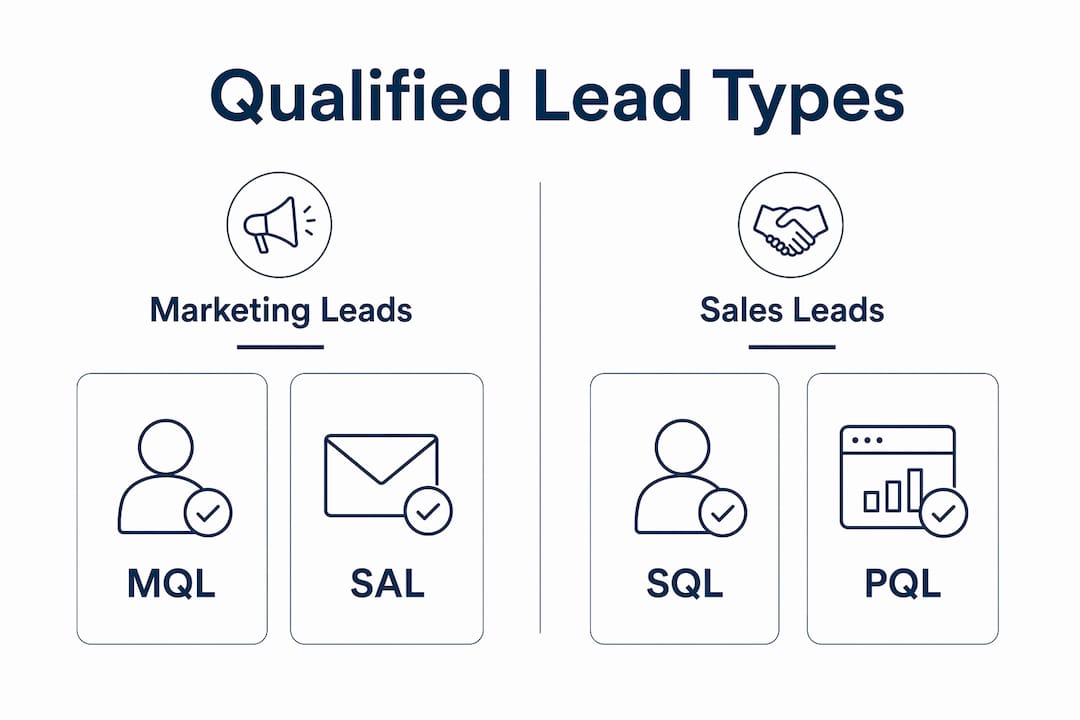
Sales Qualified Leads (SQLs) have passed a discovery conversation. The SDR has confirmed budget, authority, need, and timing to a sufficient degree that the lead is worth an AE’s time. SQLs enter the active pipeline.
Product Qualified Leads (PQLs) are specific to SaaS and subscription businesses. A PQL has already experienced value through a free trial or freemium tier. Their in-product behaviour, such as reaching a usage threshold or activating a key feature, triggers qualification. PQLs often convert faster than MQLs because the product has already done part of the selling.
The practical implication: each lead type requires different qualification criteria, different owners, and different follow-up cadences. Treating an MQL like an SQL wastes AE time; treating a PQL like a cold MQL wastes a warm signal. Getting these distinctions right is one of the fastest ways to improve pipeline velocity without adding headcount.
How to build a step-by-step lead qualification system
A repeatable qualification system does not happen by accident. Here is how to build one that holds up under pressure.
1. Define your ICP with precision
Start with firmographics: industry, company size (headcount and revenue), geography, and technology stack. Then add behavioural traits: what does a buyer who closes typically do before they speak to sales? Which content do they consume? Which pages do they visit? Vague ICP definitions are the single most common reason qualification automation produces low-quality pipelines, regardless of how sophisticated the tooling is.
2. Capture minimal, high-signal data
Progressive profiling collects information across multiple touchpoints rather than demanding everything upfront. A first-touch form might ask for name, email, and company. A second-touch asset asks for role and team size. By the third interaction, you have enough to score accurately without having scared anyone off with a 12-field form.
3. Enrich automatically
Tools such as Clearbit and ZoomInfo append firmographic data to your leads the moment they enter your CRM, filling gaps that manual research would take hours to close. Enrichment feeds your scoring model with accurate data and removes the subjective guesswork that creeps in when SDRs assess leads on instinct alone.
4. Score on fit AND intent
A well-calibrated scoring model assigns points across three dimensions: behavioural signals (up to 50 points), firmographic fit (up to 30 points), and intent signals (up to 20 points), giving a 100-point composite score used for routing decisions. A lead with a high firmographic score but low behavioural engagement is likely a researcher. A lead with strong intent signals but poor ICP fit is probably not worth an AE’s diary. You want both dimensions pointing in the same direction.

5. Route quickly and accurately
Speed matters here. Contacting leads promptly after their first high-intent action greatly increases qualification chances compared to waiting longer. Route by score threshold, source channel, and sales territory simultaneously so the right SDR picks up the right lead without a queue forming.
6. Validate through discovery
Before promoting a lead to SQL status, run a structured discovery call or sequence. Limit your qualification questions to 3–5 targeted ones spread across multiple touches. Asking everything at once reduces response rates sharply; spacing questions across emails, calls, and follow-ups keeps the conversation alive and gathers richer data.

7. Decide: disqualify, nurture, or advance
Every lead needs a clear outcome. Disqualified leads should feed back into your ICP and targeting decisions. Nurtured leads re-enter a sequence calibrated to their current stage. Advanced leads move to the AE with a complete handoff note covering what was confirmed and what still needs exploring.
CRM and automation integration is what makes this repeatable. Platforms such as Salesforce, HubSpot, and Microsoft Dynamics 365 (which now includes a Sales Qualification Agent that evaluates leads against custom criteria using CRM fields and public web data) can automate scoring updates, trigger routing rules, and enforce SLA timers. The SLA between SDR and AE should be explicit: how long does an SDR have to action a routed lead, and what happens if they miss the window?
Which qualification framework fits your sales process?
BANT, CHAMP, and MEDDPICC are the three frameworks most widely adopted by UK sales teams. Each structures your qualification conversations differently, and choosing the right one depends on your deal complexity and sales cycle length.
BANT (Budget, Authority, Need, Timing) is the classic starting point. It works well for transactional or mid-market deals where the buying decision is relatively straightforward. The risk is that it can feel interrogative if applied too rigidly, and it front-loads financial questions before trust is established.
CHAMP (Challenges, Authority, Money, Prioritisation) flips the order deliberately. It opens with the prospect’s pain points rather than their budget, which tends to produce more honest conversations. The “Prioritisation” dimension is particularly useful: a prospect might have a genuine need and available budget, but if solving this problem is not in their top three priorities for the quarter, the deal will stall.
MEDDPICC (Metrics, Economic buyer, Decision criteria, Decision process, Identify pain, Champion, Competition) is built for complex, multi-stakeholder enterprise sales. It requires you to identify a champion inside the buying organisation, map the full decision process, and understand the competitive landscape. It is more demanding to execute but produces far more accurate pipeline forecasts.
| Framework | Best for | Core focus | Key risk |
|---|---|---|---|
| BANT | Transactional / mid-market | Budget and timing | Can feel interrogative |
| CHAMP | Consultative / mid-market | Pain and priority | Requires skilled discovery |
| MEDDPICC | Enterprise / complex sales | Multi-stakeholder process | Time-intensive to complete |
Tailoring by buyer persona matters too. A CFO-led deal benefits from MEDDPICC’s economic buyer and metrics dimensions. A founder-led SME purchase often responds better to CHAMP’s challenge-first approach. For consultative selling environments, CHAMP tends to open more genuine dialogue than BANT’s budget-first structure.
Pro Tip: Use BANT as your initial scoring filter and MEDDPICC as your deep-qualification tool for deals above a certain value threshold. You get the speed of BANT for pipeline triage and the rigour of MEDDPICC for the deals that actually move the needle.
Expert insights and key metrics for UK sales teams
The most common mistake I see in B2B sales teams is treating qualification as a one-time event rather than an ongoing evaluation. A lead that fails to qualify in January may be a strong SQL by March if their budget cycle has reset or their team has grown. Treating qualification as a continuous lifecycle, including formal disqualification and requalification protocols, keeps your pipeline accurate and your targeting sharp.
Combine explicit and implicit scoring deliberately. Top-performing teams recalibrate their scoring models against closed-won deal data every quarter. If your model consistently scores a certain job title highly but those leads rarely close, the weight needs adjusting. Effective qualification blends explicit ICP fit with implicit behavioural intent, continuously refined against real outcomes.
Early disqualification is a strategic advantage, not a failure. Removing leads that lack financial readiness or decision authority preserves finite sales resources, particularly for high-ticket offerings. The time an AE saves by not pursuing a dead-end deal is time they can invest in a live one.
Rapid response is the highest-impact single action in the qualification process. Contacting a lead within 5 minutes of a high-intent trigger increases qualification likelihood by up to sevenfold versus waiting more than an hour.
Common pitfalls to address:
- Overly broad ICP definitions produce high lead volumes but low conversion rates. Tighten your ICP criteria and accept a smaller, higher-quality funnel.
- Slow SDR follow-up is the most preventable conversion killer. Set explicit SLA timers in your CRM and escalate missed windows automatically.
- Misaligned MQL definitions between marketing and sales create friction at handoff. Sales and marketing need a shared, written definition of what constitutes an MQL before any scoring model goes live.
- Skipping the feedback loop means your scoring model never improves. Every disqualified lead should update your ICP assumptions.
Key metrics to track:
- Lead-to-MQL rate
- MQL-to-SQL conversion rate (a well-calibrated model typically produces a moderate MQL-to-SQL rate)
- SQL-to-opportunity conversion
- SDR-to-AE handoff acceptance rate
- SLA compliance rate
- Pipeline velocity (average deal value × win rate ÷ average sales cycle length)
Pro Tip: Treat your lead score threshold as a strict gate, not a leaderboard. A rule-based cut-off that defines which leads receive sales follow-up eliminates gut-feel bias and keeps your pipeline honest. Review the threshold quarterly against closed-won data.
For UK sales teams specifically, the alignment piece between sales and marketing is where most qualification systems break down. A shared SLA document, a joint definition of each lead type, and a monthly review of handoff acceptance rates will do more for your lead funnel than any new tool. The process has to be owned by people, not just automated by software.
How Aheadofsales helps you qualify better and sell more
If you have read this far, you already know that a strong qualification system is not just about frameworks and scoring models. It is about having the skills to ask the right questions, the discipline to disqualify early, and the confidence to run a discovery conversation that actually reveals what a buyer needs.
Aheadofsales works with UK businesses of 50–1,000 staff to build exactly that capability. Through bespoke 1:1 coaching, team training programmes, and fractional sales director support, we help sales teams embed qualification disciplines that stick, not just frameworks that get forgotten after a workshop. Our clients do not just learn BANT or MEDDPICC in theory; they practise applying them in their specific market, against their actual buyer personas, with coaching that adapts to what their pipeline data reveals.
Packages start from £4,500, and every engagement is built around your sales process, not a generic template. For solo service businesses, our sales acceleration packages start from £2,995 and are designed to sharpen your qualification and close rate fast.
If your team is losing time on leads that never convert, or your MQL-to-SQL rate is low, that is a qualification problem, and it is one we can fix. Book a discovery call with Aheadofsales through our sales training services page to find out what a structured qualification overhaul looks like for your business.
Key takeaways
A structured lead qualification process, combining ICP precision, fit-and-intent scoring, and rapid response, is the most direct route to a cleaner pipeline and higher conversion rates.
| Point | Details |
|---|---|
| Score fit AND intent together | Combine firmographic fit (up to 30 points), behavioural intent (up to 50 points), and intent signals (up to 20 points) for a composite score out of 100 that reflects true buyer readiness. |
| Speed of response is critical | Contacting a lead within 5 minutes of a high-intent trigger increases qualification likelihood by up to sevenfold versus waiting over an hour. |
| Choose your framework by deal complexity | Use BANT for transactional deals, CHAMP for consultative mid-market, and MEDDPICC for multi-stakeholder enterprise sales. |
| Treat qualification as a lifecycle | Disqualification and requalification are part of the process; feeding outcomes back into your ICP keeps your pipeline accurate over time. |
| Aheadofsales builds qualification capability | Bespoke coaching and team training from Aheadofsales embeds practical qualification skills that improve MQL-to-SQL rates and reduce wasted sales effort. |