
What is objection handling in sales?
Objection handling in sales is the process of addressing buyer concerns about budget, timing, authority, need, or trust so that deals can continue moving forward. It is not about overcoming resistance through pressure. It is about understanding what is holding a prospect back and resolving it with genuine clarity and evidence.
Here is what separates good objection handling from average:
- Objections signal engagement, not rejection. A prospect raising a concern is still in the conversation.
- The goal is collaborative dialogue, not a battle of wills. You want the buyer to reach their own decision to proceed.
- Unresolved objections do not disappear. They grow stronger the longer they go unaddressed.
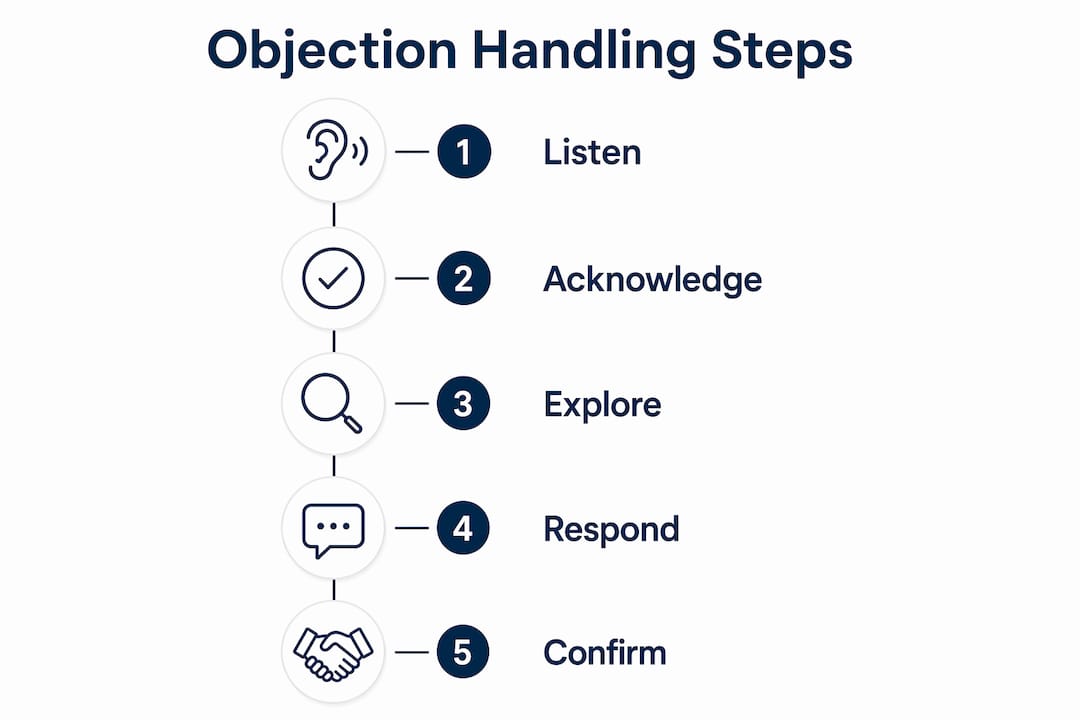
- The LAER framework (Listen, Acknowledge, Explore, Respond) gives you a repeatable structure to follow in any objection scenario.
The LAER model, developed by Carew International, is widely regarded as one of the most effective frameworks for this. You listen without interrupting, acknowledge the concern to validate the prospect’s feelings, explore the underlying worry through open questions, and then respond with a targeted, evidence-backed answer. Many experienced reps extend this with a Confirm step (checking the concern is resolved) and a Trial Close (testing readiness to move forward).
Think of every objection as the prospect telling you exactly what they need to hear before they can say yes. That reframe changes everything.
Why effective objection handling directly impacts your revenue
Objection handling is not a soft skill sitting at the edges of the sales process. It sits at the centre of it. Sellers who successfully defend their product against buyer objections can achieve a close rate as high as 64%, which puts it among the highest-leverage activities a rep can invest time in mastering.
Beyond close rates, there are broader benefits worth understanding:
- Pipeline velocity improves when reps can distinguish a solvable concern from a genuine stall, rather than letting deals drift.
- Forecast accuracy increases because objection management helps revenue teams identify which deals are genuinely progressing versus which are stuck on unresolved issues.
- Buyer trust deepens when prospects feel heard rather than handled. Sales coach Niraj Kapur puts it plainly: “An objection shows that the prospect is not ready to buy and you need to build more trust.”
- Long-term relationships form when objection handling is done with empathy. Buyers remember how you made them feel when they pushed back.
The risk of mishandling objections is equally clear. Letting a concern go unaddressed until the final stages of a deal allows it to become entrenched. By then, it is far harder to shift. The reps who treat every objection as an early-warning signal, rather than an inconvenience, are the ones who consistently hit target.
Common types of sales objections and how to handle each
The BANT framework (Budget, Authority, Need, Timing) classifies the most frequent sales objections B2B reps encounter. Beyond BANT, trust, competition, feature gaps, and risk concerns round out the full picture. Here is how each plays out in practice, with a response approach for each.

Budget objections
The objection: “It’s too expensive” or “We don’t have budget right now.”
Budget objections are rarely just about money. They usually signal that the prospect has not yet connected your solution to a clear return. Your job is to reframe cost as investment. Ask: “If this solved [specific problem], what would that be worth to your business over the next 12 months?” Then let them do the maths.
Authority objections
The objection: “I need to run this past my director” or “I’m not the decision-maker.”
This one requires you to map the buying committee early. Ask who else will be involved in the decision and offer to support your contact in presenting the case internally. Providing a concise business case document or a short summary deck gives them the tools to champion your solution upward.
Need objections
The objection: “We’re managing fine with what we have” or “I don’t think this is relevant for us.”
A need objection usually means the prospect has not yet felt the pain sharply enough. Use discovery questions to surface the cost of inaction: “What happens if this problem is still there in six months?” Connecting your solution to a specific, named business goal tends to shift the conversation quickly.
Timing objections
The objection: “Now isn’t the right time” or “Let’s revisit this next quarter.”
Timing objections are often smokescreens for a deeper concern. Before accepting the delay, ask: “What would need to be true for the timing to feel right?” If there is a genuine constraint, agree a specific follow-up date rather than leaving it open-ended.
Trust objections
The objection: “We’ve been let down by a supplier before” or “I’m not sure your company can deliver.”
Trust objections call for social proof, not persuasion. Case studies, references from similar businesses, and transparent conversations about how you handle problems go further than any sales pitch. Slowing down and
signals that you are taking the concern seriously, which itself begins to rebuild confidence.
Competition objections
The objection: “We’re already talking to another provider” or “Your competitor offers this at a lower price.”
Resist the urge to criticise the competition. Instead, ask what the prospect values most in a solution and then demonstrate, specifically, how you deliver that. Differentiate on outcomes and service, not features.
Feature gap objections
The objection: “You don’t have [specific feature] that we need.”
Clarify whether the feature is a genuine dealbreaker or a nice-to-have. If it is the former, be honest about your roadmap. If it is the latter, redirect the conversation to the capabilities you do have and the results they produce.
Risk and implementation concerns
The objection: “What if the rollout disrupts our team?” or “We’ve had bad experiences with implementations.”
Acknowledge the concern directly. Walk through your onboarding process step by step, share examples of similar implementations, and offer a phased approach where possible. Concrete specifics reduce perceived risk far more than reassurances.
Common mistakes to avoid across all objection types:
- Jumping in with a response before the prospect has finished speaking.
- Treating the first objection as the only one without checking for others.
- Minimising or dismissing the concern rather than validating it.
- Failing to confirm that the objection has actually been resolved before moving on.
| Objection type | Core concern | Key response tactic |
|---|---|---|
| Budget | ROI not yet clear | Reframe as investment; quantify value |
| Authority | Wrong contact or committee not mapped | Identify stakeholders early; provide internal tools |
| Need | Problem not felt acutely | Surface cost of inaction through discovery |
| Timing | Delay or competing priorities | Uncover the real blocker; set a specific date |
| Trust | Past bad experience or low confidence | Use case studies, references, and deliberate listening |
| Competition | Evaluating alternatives | Differentiate on outcomes, not features |
| Feature gap | Missing capability | Clarify priority; redirect to proven strengths |
| Risk | Fear of disruption or failure | Walk through process; offer phased approach |
How to handle objections with a structured framework
A repeatable framework turns objection handling techniques from improvisation into a consistent skill. The steps below draw on both the LAER model and the universal six-step process, giving you a practical sequence you can apply to any objection in any B2B conversation.
-
Prepare before the call. Strong discovery before you pitch is the single best way to reduce objections at close. Use a framework like P.O.W.E.R.F.U.L. (Pain, Opportunity costs, Wants, Resources, Fear of failure, Unequivocal trust, Little things) to uncover motivations and constraints early, so you are not caught off-guard later.
-
Listen fully without interrupting. When the objection arrives, stop. Let the prospect finish completely. Interrupting signals that you are more interested in your response than their concern, and it often means you miss the real issue sitting beneath the surface.
-
Acknowledge and validate. A simple “I hear that a lot, and I completely understand why that would be a concern” does more than you might expect. It builds rapport, reduces defensiveness, and opens the door to a genuine conversation. Acknowledgement is not agreement; it is respect.
-
Explore the root concern with open questions. Ask “When you say [objection], what do you mean specifically?” Treat the objection like an onion: your questions peel back the layers until you reach the real concern. Before you respond, also check: “Aside from that, is there anything else holding you back?” This prevents you from resolving one objection only to be hit with three more.
-
Respond with value and evidence. Once you understand the real concern, address it with specifics: case studies, data, references, or a concrete demonstration of how your solution solves their exact problem. Backing your claims with proof is far more persuasive than reassurance alone.
-
Confirm the objection is resolved. Ask directly: “Does that address your concern?” Do not assume. A prospect who nods politely but still has doubts will stall later.
-
Trial close and lock in next steps. Once the objection is resolved, move forward immediately. “Great. Shall we look at getting a proposal over to you by Thursday?” Momentum matters. Do not let the conversation end without a concrete next action.
Pro Tip: Preemptive objection handling is one of the most underused tactics in B2B sales. If you know a particular concern comes up repeatedly, address it proactively in your pitch before the prospect raises it. This signals confidence, reduces friction, and often prevents the objection from surfacing at all.
One more thing worth knowing: not every objection can be resolved, and that is fine. Recognising when to disengage from a prospect stuck on a single unresolvable concern protects your credibility and keeps your focus on deals with genuine potential. Walking away gracefully, with the door left open, is a professional move, not a failure.
The psychology behind why buyers raise objections
Objections are not obstacles. They are expressions of incomplete confidence. Understanding the psychology behind them changes how you respond, and it makes you a significantly better sales professional.

B2B purchases carry real career risk for the buyer. If a decision goes wrong, it reflects on them personally. Objections are, in large part, risk management. The prospect is not trying to make your life difficult; they are trying to protect themselves. When you approach an objection with that understanding, empathy comes naturally rather than feeling forced.
Experienced salespeople distinguish between genuine objections and smokescreens. A genuine objection is specific and addressable. A smokescreen is vague and non-committal, often masking a deeper concern the prospect has not yet articulated. The way to tell the difference is through skilled discovery: ask open questions, listen carefully, and notice whether the concern becomes more specific as the conversation deepens or stays frustratingly vague.
There is also a principle worth applying here: people are far more persuaded by conclusions they reach themselves than by conclusions handed to them. Successful objection handling replaces pressure with collaboration, using tactful questioning to lead prospects to their own decision to proceed. When you ask a prospect “What did you like most about our solution?” and then stop talking, you are not being passive. You are using one of the most effective psychological tools in sales.
How to measure whether your objection handling is actually working
You cannot improve what you do not track. Measuring the effectiveness of your objection handling gives you the data to coach your team, refine your messaging, and close more deals.
Start by logging objections in your CRM. Track which objections come up most often, at which stage of the pipeline they appear, and which reps handle them most successfully. Patterns emerge quickly. If a particular objection keeps surfacing at the proposal stage, that is a signal your earlier discovery or positioning needs adjusting, not just your response.
Key metrics to monitor include:
- Objection-to-close rate: Of the deals where a specific objection was raised, what percentage closed? This tells you which objections your team handles well and which ones stall deals.
- Pipeline velocity: Are deals moving through stages faster after objection handling training? A slowdown at a particular stage often points to a recurring unresolved concern.
- Win/loss analysis: Review lost deals specifically for objections that were raised but never fully resolved. This is where the most instructive data lives.
Regular training for objection handling should include role-play scenarios built around your most common objections, with managers reviewing recordings to identify where reps are jumping in too early, failing to confirm resolution, or missing the real concern beneath the surface. The reps who improve fastest are those who treat every lost deal as a case study rather than a closed chapter. You can also explore how AI tools now support objection replies in real time, flagging patterns and suggesting responses based on conversation data.
Key takeaways
Effective objection handling is the single highest-leverage skill a B2B sales rep can develop, directly linking to a 64% close rate for those who master it.
| Point | Details |
|---|---|
| Objections signal interest | A prospect raising a concern is still engaged; treat it as an invitation to provide clarity. |
| LAER gives you structure | Listen, Acknowledge, Explore, Respond: follow this sequence to handle any objection consistently. |
| BANT covers most objections | Budget, Authority, Need, and Timing account for the majority of concerns you will encounter in B2B sales. |
| Confirm before moving on | Always verify the objection is resolved before advancing; unresolved concerns stall deals later. |
| Track objections in your CRM | Logging patterns by stage and rep reveals coaching gaps and improves forecast accuracy. |
Ready to build a team that handles objections with confidence?

At Aheadofsales, we work with B2B sales teams across the UK to build the skills that turn objections into closed deals. Our bespoke sales training programmes combine 1:1 coaching, live role-play, and consultancy to help your team hit target every quarter. Whether you have a team of 10 or 500, we build the objection handling capability that drives consistent, measurable growth. Packages start from £4,500, and we work with businesses that are serious about reaching at least 50% sales growth year on year.
If you are a solo service business, our sales acceleration packages start from £2,995 and are built specifically to help you close more of the right conversations faster.
One Response