
TL;DR:
- Commercial strategy connects a business’s market choices, customer value, and revenue model to drive growth. It requires balancing acquisition, monetization, and retention while making deliberate, focused decisions. Businesses must review and adapt their strategy regularly to succeed in dynamic markets.
Commercial strategy is defined as the connected logic between a business’s market choices, its customer value proposition, and its revenue model. It sits above a sales plan or marketing plan. Where a sales plan tells your team what to sell and to whom this quarter, a commercial strategy answers the deeper question: why should customers choose us at all, and where do we have a credible right to win? B2B organisations with unified commercial strategies achieve 50% higher revenue growth than competitors. That single figure tells you everything about the importance of commercial strategy for any business serious about growth.
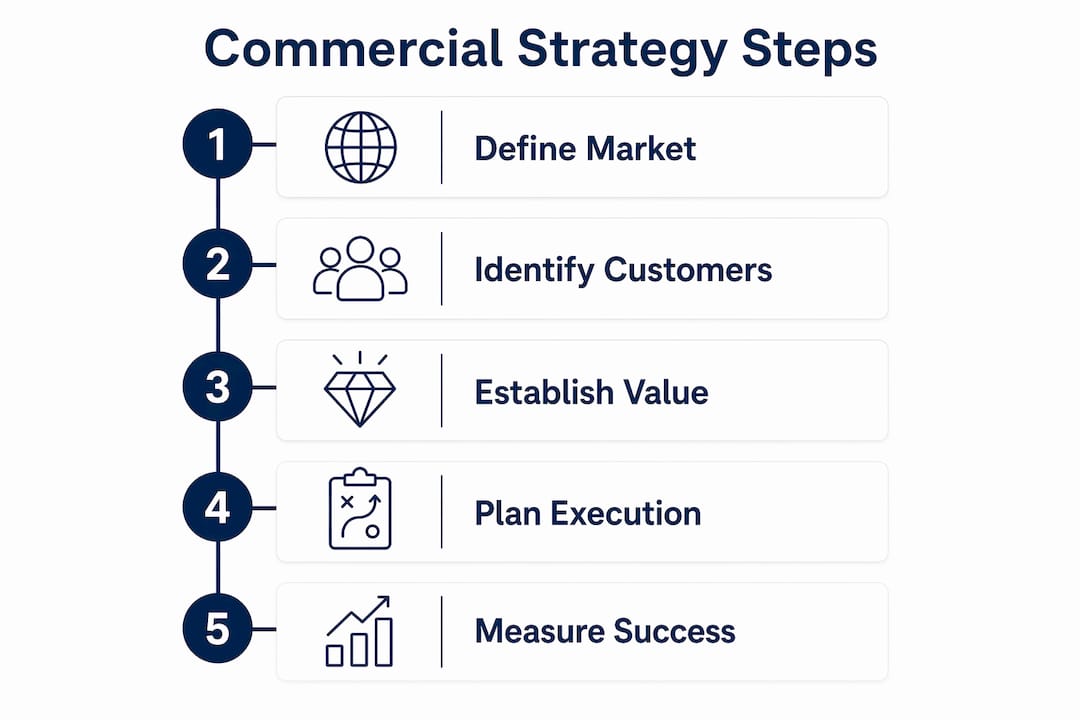
What is commercial strategy and what does it actually include?
Commercial strategy is the connective tissue between market, value, and revenue model. Many executives mistakenly treat it as a growth target or a sales quota. It is neither. It is the overarching logic that determines which markets you enter, what you offer, how you price it, and how you sustain customer relationships over time.
A well-built commercial strategy rests on three interdependent pillars: acquire, monetise, and retain.
- Acquire covers how you attract the right customers. This includes channel selection, messaging, and targeting criteria.
- Monetise covers how you generate revenue per customer. Pricing models, upsell paths, and contract structures all live here.
- Retain covers how you extend customer lifetime value. Onboarding quality, service standards, and renewal processes determine this.
These three pillars must work together. A business that pours budget into acquisition while neglecting retention will constantly refill a leaking bucket. Unbalanced acquisition-focused strategies that neglect retention damage customer base value over time. The most effective commercial strategies treat all three pillars with equal discipline.
Pricing deserves special mention here. Behavioural pricing leverages consumer psychology to tailor prices and deepen long-term customer relationships. This goes well beyond setting a number. It means understanding how customers perceive value, what anchors their decisions, and how pricing signals quality or accessibility in your market.

Pro Tip: Before reviewing your pricing model, map your retention data first. If churn is high, a pricing change will not fix the underlying problem. Retention is a product and service issue before it is a commercial one.
How does commercial strategy differ from a sales plan or GTM strategy?
This is the question I get asked most often, and the confusion is understandable. The three concepts overlap in practice but serve very different purposes.
Commercial strategy is the overarching logic that aligns market choices to customer value and revenue models. A sales plan is operational. It translates commercial intent into targets, territories, and activities for a given period. A go-to-market (GTM) strategy sits between the two. A GTM strategy is a repeatable, adaptable operating manual that outlines who buys, why they buy, through which channels, and how pricing and competitive framing work.
The table below makes the distinctions concrete.
| Dimension | Commercial strategy | Sales plan | GTM strategy |
|---|---|---|---|
| Time horizon | Multi-year | Quarterly or annual | Launch to scale |
| Primary question | Where do we compete and why will we win? | What do we sell and to whom this period? | How do we reach and convert our market? |
| Owner | Executive leadership | Sales leadership | Sales, marketing, and product jointly |
| Nature | Directional logic | Operational targets | Repeatable execution manual |
| Output | Strategic choices and trade-offs | Revenue targets and activity plans | Channel, pricing, and messaging playbooks |
The critical distinction is ownership and time horizon. A commercial strategy is set at executive level and guides decisions across functions for years. A sales plan is reviewed quarterly. A GTM strategy is dynamic and should be updated as market conditions shift.
Pro Tip: If your commercial strategy fits on a slide deck and has not changed in three years, it is not a strategy. It is a wish list. A living commercial strategy forces you to revisit your market choices at least annually.
For a deeper look at how sales strategy and commercial strategy relate in practice, the Aheadofsales guide on sales strategy is worth reading alongside this article.
What three questions must every commercial strategy answer?
Effective commercial strategies answer three foundational questions: where to compete, what customers value, and what establishes a credible right to win. These are not rhetorical. They demand specific, defensible answers.
Where to compete?
This question forces you to choose segments, geographies, and use cases deliberately. Choosing where to compete also means choosing where NOT to compete. A business that tries to serve every segment ends up serving none of them well.
What do customers value?
Most businesses answer this question from the inside out. They start with their product features and work backwards to a value claim. The correct approach is outside in. Talk to your best customers. Understand what problem they were trying to solve before they found you. Your value proposition should reflect their language, not your internal vocabulary.
What is our credible right to win?
This is the hardest question and the one most executives avoid. A credible right to win is not a list of product features. It is a combination of capabilities, relationships, market position, and proof points that make your claim believable to a sceptical buyer. Without a clear answer here, your commercial strategy is aspirational rather than grounded.
Pro Tip: Never start building your commercial strategy from your existing products or capabilities. Start from the market and work backwards. Ask: if we were building this business today, which customers would we target and why? That question surfaces the honest answer to right to win.
The shift from inside-out to outside-in thinking is the single biggest change most businesses need to make. It changes what you build, how you price it, and which channels you prioritise.
How to develop a commercial strategy that actually works
Developing a commercial strategy is not a one-time exercise. The businesses that get the most from theirs treat it as a living document, updated as markets shift and new data arrives.
Here are the practical steps that Aheadofsales recommends to executives building or rebuilding their commercial strategy:
- Conduct a rigorous market analysis. Identify your addressable segments, the jobs customers are trying to do, and the competitive alternatives they consider. Use customer interviews, win/loss data, and market research. Do not rely solely on internal assumptions.
- Define a sharp value proposition. Your value proposition must be specific to a customer segment and grounded in evidence. Vague claims like “we deliver quality and service” are not value propositions. They are noise.
- Prioritise ruthlessly. Choose two or three high-impact priorities for the year. A commercial strategy must force explicit choices about what not to do. Every initiative you add dilutes leadership attention and execution quality.
- Align cross-functional teams. Commercial strategy only works when sales, marketing, product, and service teams operate from the same logic. Misalignment between these functions is the most common reason strategies fail in execution.
- Build in digital integration. B2B buyers spend only 24% of their buying time with suppliers. The rest of their journey happens through digital research, peer networks, and self-serve channels. Your commercial strategy must account for this. Aheadofsales covers the implications in detail in its guide on B2B sales trends.
- Treat the strategy as an operating manual. A static presentation limits impact. Schedule quarterly reviews. Track leading indicators, not just revenue. Adjust when the data tells you to.
Commercial strategy examples from brands like Jif show what is possible when digital and cultural engagement are built into the commercial model. Digital strategies tied to cultural moments can transform commerce into a brand-building growth engine, not just a transaction channel. That principle applies equally to B2B businesses building community, thought leadership, and digital self-serve into their commercial model.
Pro Tip: Assign a named executive owner to each pillar of your commercial strategy. Acquisition without an owner becomes a marketing debate. Retention without an owner becomes nobody’s problem. Ownership creates accountability.
Key takeaways
A commercial strategy is the overarching logic that connects market choices, customer value, and revenue model, and businesses that align all three pillars consistently outgrow those that do not.
| Point | Details |
|---|---|
| Definition matters | Commercial strategy is not a sales plan; it is the logic connecting market choices, value, and revenue model. |
| Three pillars are interdependent | Acquire, monetise, and retain must all be managed together for sustained growth. |
| Three questions drive the framework | Answer where to compete, what customers value, and what your credible right to win is. |
| Prioritisation is non-negotiable | Effective strategies make hard choices about what not to do, not just what to pursue. |
| Treat it as a living document | Review and adapt your commercial strategy quarterly as market conditions and data evolve. |
Why most commercial strategies fail before they reach the market
I have worked with businesses across a wide range of sectors, and the pattern I see most often is not a lack of ambition. It is a lack of focus. Executives build strategies that try to do everything, serve everyone, and win in every segment simultaneously. The result is a document that looks impressive in a board presentation and achieves very little in practice.
The hardest part of building a commercial strategy is not the analysis. It is saying no. Deciding which customers you will not pursue, which channels you will not invest in, and which product lines you will not extend takes real courage at leadership level. Most teams avoid those conversations because they feel like admissions of limitation. They are not. They are the decisions that make everything else work.
I also see businesses treat their commercial strategy as a static artefact. It gets built, presented, filed, and forgotten until the next annual planning cycle. Markets do not wait for your planning cycle. Competitors move, customer needs shift, and digital channels evolve. The businesses I have seen grow consistently are the ones that treat their commercial strategy the way a good sales team treats its pipeline: reviewed regularly, updated honestly, and acted upon immediately.
The importance of commercial strategy is not just about having one. It is about having one that your leadership team genuinely owns, that your sales and marketing teams understand, and that your customers can feel in every interaction they have with you.
— Jerry
How Aheadofsales supports commercial strategy execution
A well-designed commercial strategy only delivers results when your sales team can execute it. That is where most businesses lose ground. The strategy is sound, but the skills, habits, and confidence needed to bring it to life in front of customers are missing.

Aheadofsales combines bespoke 1:1 coaching with structured sales training programmes designed to help businesses with 50–1,000 staff hit their quarterly targets and achieve at least 50% sales growth year on year. Whether your priority is strengthening acquisition, improving monetisation through better conversations, or building the retention behaviours that extend customer lifetime value, Aheadofsales has a package built for your stage of growth. Packages start from £4,500, and every engagement is tailored to your commercial context, not a generic curriculum.
FAQ
What is commercial strategy in simple terms?
Commercial strategy is the plan that defines where a business competes, what value it delivers to customers, and how it generates and sustains revenue. It sits above sales plans and marketing plans.
How does commercial strategy differ from a sales strategy?
A commercial strategy sets the overarching direction across acquisition, monetisation, and retention. A sales strategy is the operational plan that executes one part of that direction, typically focused on winning new customers within a defined period.
What are the core elements of a successful commercial strategy?
The core elements are a clear market focus, a specific value proposition, a credible right to win, and aligned execution across sales, marketing, product, and service functions.
How often should a commercial strategy be reviewed?
A commercial strategy should be reviewed at least quarterly. Markets shift, customer needs evolve, and digital channels change fast enough that an annual review cycle is too slow for most businesses.
Why do commercial strategies fail?
Most commercial strategies fail because they try to pursue too many priorities at once, lack cross-functional alignment, or are treated as static documents rather than living operating frameworks.