
TL;DR:
- Effective sales training increases revenue by boosting win rates and reducing ramp-up time. It also improves employee retention and shortens sales cycles through continuous reinforcement and manager-led practice. Measuring improvements in win rates and deal sizes within three months justifies the training investment.
Sales training is the structured process of developing a sales team’s skills, knowledge, and behaviours to improve commercial performance and drive revenue growth. The benefits of sales training extend well beyond individual skill development. Organisations that invest consistently in training see measurable gains in quota attainment, deal size, employee retention, and overall revenue. Research shows 353% average ROI from sales training programmes, returning £4.53 for every £1 spent. That figure alone makes the case for any growth-minded business leader. Tools like Gong, Highspot, and AI-driven simulations are accelerating these results further by embedding real-time feedback directly into daily selling workflows.
1. What are the core benefits of sales training for revenue growth?
Structured sales training produces direct, quantifiable revenue gains. Organisations with formal programmes achieve 15–25% higher quota attainment and 16.7% higher win rates than those without. Those numbers represent real deals closed and real targets hit, not theoretical improvements.
The revenue case becomes even clearer when you look at ramp-up time. Effective training reduces ramp-up time by up to 50%, meaning new hires start contributing to the pipeline significantly faster. For a growing team, that acceleration compounds quickly across every new hire you bring on board.
| Metric | Pre-training baseline | Post-training result |
|---|---|---|
| Quota attainment | Standard | 15–25% higher |
| Win rate | Standard | 16.7% higher |
| Ramp-up time | Standard | Up to 50% faster |
| Sales cycle length | Standard | 8–14% shorter |
| Average deal size | Standard | 20–30% larger |
Pro Tip: Track your win rate before and after any training programme. That single metric gives you the clearest picture of whether the investment is working.
2. How sales training improves employee retention
High staff turnover is one of the most expensive problems a sales leader faces. Replacing a sales rep costs between 50% and 200% of their annual salary, when you account for recruitment, onboarding, and lost pipeline. Reps who receive structured development are 34% more likely to stay with their employer. That retention improvement alone can justify the cost of a training programme.

The reason is straightforward. Salespeople who feel invested in perform better and feel more confident. Confidence reduces the anxiety that drives early exits, particularly among newer reps who are still finding their feet. Training signals to your team that you are committed to their growth, not just their output.
The performance and retention benefits of consistent sales skills development include:
- Faster time to first deal for new hires
- Higher confidence in discovery and objection handling conversations
- Reduced anxiety around pipeline reviews and forecast calls
- Stronger motivation to hit and exceed quarterly targets
- Lower voluntary turnover across the sales team
- Better cultural alignment as reps share a common sales language and methodology
3. What modern practices ensure sales training effectiveness?
A one-off workshop does not build lasting capability. Without manager reinforcement, 80% of training knowledge is lost within 90 days. That is not a failure of the training content. It is a failure of the delivery model.
High-performing sales organisations treat training as an ongoing revenue investment rather than a calendar event. They embed short, frequent learning bursts into the working week, rather than relying on annual off-sites. This approach keeps skills sharp and gives managers a natural opportunity to reinforce what has been taught.
“The shift from script-based training to system-based training is the single biggest change I see in high-growth sales teams. Scripts break under pressure. Systems hold.”
Technology plays a growing role here. Platforms like Gong and Highspot analyse real sales calls and provide data-driven feedback at scale. AI coaching tools improve deal sizes by 35% compared with training-only programmes. That gap exists because AI tools give reps feedback on actual conversations, not simulated ones.
Pro Tip: Ask your managers to run a 15-minute weekly debrief tied directly to one skill from the training programme. Repetition at the manager level is what makes training stick.
4. How sales training shortens sales cycles and improves deal outcomes
Longer sales cycles drain pipeline capacity and slow revenue. Training directly addresses the behaviours that cause deals to stall. When reps improve their qualification, discovery, and objection handling skills, they move opportunities forward with more confidence and less friction.
Effective training reduces average sales cycles by 8–14%. That reduction frees up capacity for more deals within the same period. A team closing 10% more deals per quarter, at the same average deal value, produces a material uplift in annual revenue without adding headcount.
Deal size also improves. Top performers with formal training close deals 20–30% larger than untrained peers. The reason is that trained reps ask better discovery questions, uncover broader business needs, and position value more effectively. They sell the full solution rather than the minimum viable proposal.
For a deeper look at how to shorten your sales cycle and convert more pipeline into revenue, the Aheadofsales guide covers the practical steps in detail.
5. Why skill gaps, not motivation, cause missed quotas
Missed quotas are rarely a motivation problem. Skill gaps cause missed quotas, and training is the most direct way to close them. A rep who consistently loses deals at the proposal stage does not need a pep talk. They need better training on how to build and present a compelling business case.
This distinction matters enormously for how you diagnose underperformance. If you treat a skill gap as a motivation problem, you apply the wrong solution. You might increase pressure, adjust commission structures, or even manage someone out, when a targeted training intervention would have fixed the issue in weeks.
Repeatable systems training outperforms script-based training in real-world selling environments. Scripts give reps words to say. Systems give reps a framework for thinking, which holds up under pressure, across different buyer types, and in complex multi-stakeholder deals.
6. How does training improve sales confidence and buyer conversations?
Confidence in a sales conversation is a direct product of preparation and practice. Reps who have rehearsed discovery frameworks, practised objection responses, and received feedback on their delivery approach conversations differently. They listen more actively, ask sharper questions, and handle pushback without becoming defensive.
Best training programmes combine methodology with data tools that remove research friction from selling workflows. When reps spend less time searching for information and more time in conversation, the quality of those conversations rises. Buyers notice the difference between a rep who is reading from a script and one who is genuinely engaged with their problem.
For teams selling consultatively, the consultative selling skills that Aheadofsales develops are particularly relevant. Consultative selling requires a different skill set from transactional selling, and it takes deliberate practice to build.
7. Why invest in sales training rather than hiring more reps?
Hiring is expensive and slow. A new sales rep typically takes six to twelve months to reach full productivity, even with a reasonable onboarding process. Training your existing team produces results in weeks, not months, and at a fraction of the cost of a new hire.
The return on investment comparison is stark. A training programme that costs £6,000 and improves win rates by 16.7% across a team of ten reps generates far more revenue than a single new hire at £40,000 to £60,000 per year. The maths favours training, particularly for teams that already have pipeline but are not converting it efficiently.
The role of training in sales growth is also cumulative. Skills compound over time. A rep who improves their discovery technique this quarter will carry that improvement into every deal they work for the rest of their career. That compounding effect is something a new hire cannot replicate immediately.
8. What does good sales training actually look like in practice?
Good sales training is specific, measurable, and reinforced. It targets defined skill gaps, uses real deal scenarios rather than generic role plays, and includes a mechanism for managers to coach the skills back on the job. It is not a two-day event followed by silence.
The effective sales training methods that produce lasting results share three characteristics. They install repeatable systems rather than scripts. They are reinforced by managers in weekly one-to-ones. And they are measured against commercial outcomes, specifically win rate, deal size, and ramp time, rather than attendance or completion rates.
Aheadofsales builds programmes around these principles. Every engagement starts with a skills audit to identify where the gaps actually are, rather than delivering a generic curriculum that may not address the real problem.
9. How to measure the return on sales training investment
Measuring training ROI requires linking the programme to business metrics, not activity metrics. Attendance figures and completion rates tell you nothing about commercial impact. Win rate delta and ramp time reduction are the two metrics that give CFOs credible evidence for continued investment.
Win rate delta is simple to calculate. Take your team’s win rate in the three months before training and compare it with the three months after. Any improvement is directly attributable to the programme, assuming nothing else changed materially in the same period. Ramp time reduction works the same way. Track how long it takes new hires to close their first deal before and after you introduce structured onboarding training.
These two metrics make the business case for training in language that finance teams understand. They also give you a clear benchmark for evaluating different training providers and approaches.
Key takeaways
Sales training delivers measurable commercial returns through higher win rates, shorter sales cycles, larger deal sizes, and significantly reduced staff turnover.
| Point | Details |
|---|---|
| Revenue ROI is proven | Sales training returns an average of £4.53 for every £1 invested, with a 353% ROI. |
| Retention improves significantly | Trained reps are 34% more likely to stay, cutting costly replacement expenses. |
| Knowledge needs reinforcement | Without manager-led reinforcement, 80% of training knowledge is lost within 90 days. |
| Skill gaps drive missed quotas | Underperformance is usually a skill problem, not a motivation problem. |
| Measure win rate delta | Track win rate before and after training to prove commercial impact to stakeholders. |
What I have learned from years of sales training investment
One thing I see consistently is that businesses measure training by the wrong things. They count how many people attended, how high the satisfaction scores were, and whether the trainer was engaging. None of that tells you whether the training worked.
The only question that matters is: did win rates go up? Did reps ramp faster? Did deal sizes increase? If you cannot answer those questions three months after a programme ends, you have not measured training. You have measured an event.
I have also seen the damage that one-off training does. A team goes through a two-day workshop, feels energised, and then returns to the same environment with the same manager behaviours and the same pipeline reviews. Within six weeks, nothing has changed. The training did not fail. The system around it failed.
The businesses I see get the most from training are the ones where leadership is genuinely bought in. Not just willing to pay for it, but actively reinforcing it. Managers who reference the training in deal reviews. Leaders who ask about skill development in one-to-ones. That embedded leadership approach is what separates a training event from a genuine capability shift.
If you are a sales leader reading this, my honest advice is to start with the metrics. Know your current win rate, your average ramp time, and your average deal size. Then invest in training and measure those three numbers again in 90 days. The results will tell you everything you need to know.
— Jerry
Take the next step with Aheadofsales
If the numbers in this article resonate with you, the next step is straightforward. Aheadofsales works with businesses of 50 to 1,000 staff to deliver bespoke sales training that targets real skill gaps and produces measurable revenue growth. Every programme is built around your team’s specific challenges, not a generic curriculum.
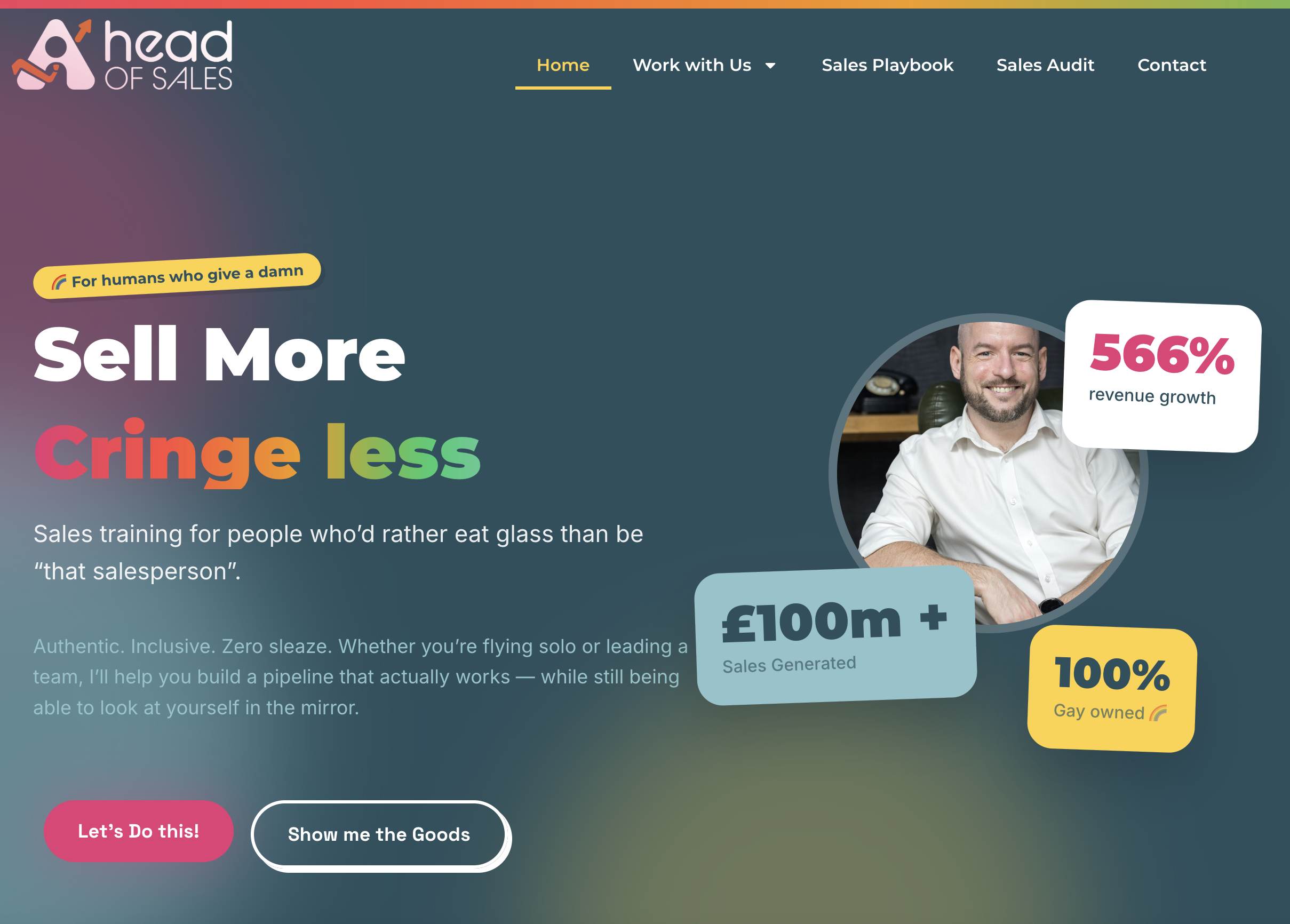
Packages start from £4,500, and every engagement is designed to help your team hit target every quarter and generate at least 50% sales growth year on year. Solo operators are also catered for, with sales acceleration packages starting from £2,995. If you are ready to see what structured, reinforced training looks like in practice, explore the full range of sales training services that Aheadofsales offers.
FAQ
What is sales training and why does it matter?
Sales training is the structured development of a sales team’s skills, knowledge, and behaviours to improve commercial performance. It matters because skill gaps, not motivation, are the primary cause of missed quotas.
How much ROI does sales training deliver?
Sales training delivers an average ROI of 353%, returning £4.53 for every £1 invested when delivered with continuous, personalised practice.
How quickly do sales training results show up?
Win rate and deal size improvements typically become measurable within 90 days of a well-reinforced programme. Ramp-up time reductions are visible as soon as new hires complete structured onboarding training.
Why do most sales training programmes fail to produce lasting results?
Most programmes fail because they are delivered as one-off events without manager reinforcement. Without ongoing coaching, 80% of training knowledge is lost within 90 days.
How do I measure whether sales training is working?
Track win rate delta and ramp time reduction before and after the programme. These two metrics provide CFOs and business leaders with credible, commercially relevant evidence of training impact.