
TL;DR:
- Lead generation involves attracting and capturing contact information from qualified prospects to create a reliable sales pipeline.
- It is essential for consistent sales growth, as it directly feeds the pipeline with leads that match buyer intent and profile.
Lead generation is the process of attracting potential customers and capturing their contact information so that sales and marketing teams can nurture them toward a purchase. Every business with a growth target depends on a steady, predictable flow of qualified prospects, and without a deliberate lead generation system, that flow becomes erratic at best. Platforms like Salesforce, LinkedIn, and Adobe have built entire product ecosystems around this single challenge, which tells you how central it is to commercial success. Whether you run a 50-person team or a solo consultancy, understanding how lead generation works is the foundation of any serious sales strategy.
What is lead generation and why does it matter?
Lead generation is the structured practice of identifying people who fit your target profile, attracting their attention, and capturing enough information to begin a sales conversation. A lead is typically a person at a company who has shown genuine interest, whether through a website form, a referral, an event registration, or a paid advertisement. The importance of lead generation lies in what it creates: a pipeline. Without pipeline, your sales team has nothing to work with, and revenue becomes unpredictable.
The distinction between a lead and a random contact matters enormously. Intent separates the two. A lead is defined by both fit and intent: fit means they match your ideal customer profile, and intent signals the right timing for a sales conversation. Chasing contacts who lack either quality wastes your team’s time and distorts your conversion data.
For businesses targeting 50% year-on-year sales growth, as Aheadofsales works toward with its clients, lead generation is not a marketing nice-to-have. It is the engine that makes consistent quarterly targets achievable.
What are the stages of the lead generation process?
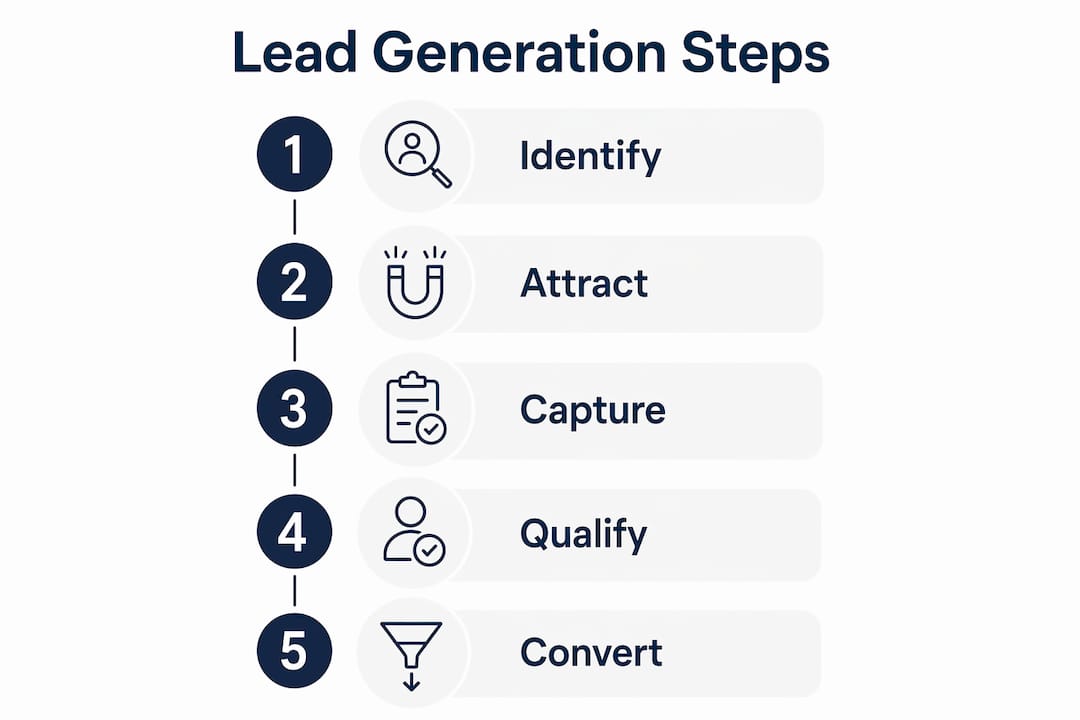
The lead generation funnel follows a clear sequence: attract, capture, nurture, qualify, and convert. Each stage has a distinct purpose, and collapsing them together is one of the most common mistakes growing businesses make.
-
Attract (TOFU). Top-of-funnel activity pulls in prospects who match your profile. This includes SEO-optimised content, paid social campaigns on LinkedIn, webinars, and organic search. The goal here is visibility to the right audience, not volume for its own sake.
-
Capture (TOFU/MOFU). Once a prospect engages, you collect their contact details through a form, a gated asset, a chatbot, or an event sign-up. This is the moment a visitor becomes a lead. The quality of your capture mechanism directly affects the quality of what enters your pipeline.
-
Nurture (MOFU). Middle-of-funnel nurturing keeps leads engaged until they are ready to buy. Email sequences, case studies, and targeted content all serve this purpose. Many leads are not ready to speak to sales on day one, and nurturing prevents them from going cold.
-
Qualify (MOFU/BOFU). This is where marketing qualified leads (MQLs) are assessed against sales qualified lead (SQL) criteria. An MQL has engaged with your content; an SQL has demonstrated buying intent and meets the commercial criteria for a sales conversation. Tightening MQL and SQL definitions improves pipeline quality far more than simply adding new channels.
-
Convert (BOFU). Sales takes ownership at this stage, running discovery calls, proposals, and negotiations to close the deal. Marketing’s job is largely complete; sales now converts the qualified opportunity into revenue.
Marketing owns stages one through four. Sales owns stage five. When those boundaries blur, leads fall through gaps, follow-up slows, and conversion rates drop.
Pro Tip: Map your current funnel against these five stages and identify where leads are dropping out. Most businesses lose the majority of their pipeline at the nurture-to-qualify transition, not at the top of the funnel.
How does lead generation differ from demand generation?
Lead generation is distinct from demand generation. Demand generation is the broader set of activities designed to create awareness and educate your market. Lead generation is the narrower practice of capturing measurable contact information from prospects who have shown intent.
Think of it this way:
- Demand generation includes brand advertising, thought leadership content, podcast appearances, and social media presence. None of these activities necessarily capture a lead. They build familiarity and trust over time.
- Lead generation includes gated content downloads, contact forms, demo requests, and event registrations. Each of these produces a named contact with verifiable interest.
- Demand generation happens earlier in the buyer journey. Lead generation happens mid to late funnel, when a prospect is actively researching solutions.
- Demand generation is harder to attribute directly to revenue. Lead generation produces trackable records that feed directly into your CRM.
The confusion between the two leads to misaligned budgets. Teams sometimes invest heavily in demand generation activities and then wonder why their pipeline is thin. The answer is usually that awareness was created but never converted into captured leads.
| Dimension | Demand generation | Lead generation |
|---|---|---|
| Primary goal | Build awareness and educate | Capture contact details and intent |
| Funnel position | Top of funnel | Mid to bottom of funnel |
| Typical tactics | Brand content, social media, PR | Forms, gated assets, demo requests |
| Measurement | Reach, engagement, share of voice | Leads captured, MQLs, SQLs |
| Sales handoff | Indirect | Direct, via CRM routing |
Both functions are necessary. The mistake is treating them as interchangeable or funding one at the expense of the other.
What are the common types and strategies of lead generation?
Inbound lead generation attracts prospects through content marketing, SEO, and social media. Outbound lead generation proactively reaches target prospects through cold email, cold calling, LinkedIn outreach, and events. Both have a role, and the best-performing businesses in 2026 run both in parallel.
Inbound lead generation strategies:
- SEO-optimised blog content that answers the questions your buyers are already searching
- LinkedIn thought leadership posts that position your team as credible experts
- Gated assets such as guides, calculators, or templates that exchange value for contact details
- Webinars and virtual events that attract prospects already interested in your category
Outbound lead generation strategies:
- Targeted cold email sequences to named decision-makers at companies matching your ideal customer profile
- LinkedIn Sales Navigator outreach to specific job titles and company sizes
- Trade events and industry conferences where face-to-face conversations accelerate trust
- Paid advertising on Google and LinkedIn targeting intent-based keywords and firmographic criteria
Beyond these two categories, visitor identification has become a significant lead generation technique. Most website visitors never fill out a form. Visitor identification tools track these anonymous visitors and match them to company records, allowing your team to follow up with prospects who showed interest but never raised their hand. This closes a substantial gap in most funnels.
Modern lead generation functions as a continuous cycle that connects marketing and sales through shared data and clear handoff processes. It is not a campaign you run once. It is a system you build, measure, and refine over time.
Pro Tip: Do not rely solely on form fills as your lead capture method. Combine gated content, visitor identification, and direct outreach to capture leads at different stages of buyer readiness.
How to implement an effective lead generation system
Building a lead generation system that produces consistent results requires more than choosing the right channels. It requires clear definitions, the right tools, and a disciplined handoff process between marketing and sales.

The table below outlines the core components of an effective system:
| Component | What it involves |
|---|---|
| Lead definition | Agreed criteria for MQL and SQL, including firmographic fit and behavioural signals |
| Lead scoring | Points-based system that ranks leads by engagement level and profile match |
| CRM integration | All leads captured into a single system such as Salesforce or HubSpot for visibility |
| Routing rules | Automatic assignment of leads to the right sales rep based on territory or segment |
| Follow-up SLA | Agreed response time for sales to contact a new SQL, typically within 24 hours |
The implementation process follows a logical sequence:
- Define your ideal customer profile precisely. Segment by company size, sector, job title, and buying trigger.
- Audit your current capture methods and identify which channels produce the highest-quality leads, not just the highest volume.
- Build or refine your CRM setup so that every lead is tracked from first touch to close. Without this, you cannot measure what is working.
- Set MQL and SQL criteria with your sales team. This conversation is often uncomfortable but it is the single most important alignment exercise in the entire process.
- Agree a lead generation workflow that specifies exactly when marketing hands a lead to sales and what information must accompany it.
Lead capture alone is insufficient. Without proper lead management, including consistent routing, scoring, and rapid follow-up, leads fall through gaps or unqualified contacts consume your sales team’s time. The funnel management strategies that separate high-growth businesses from stagnant ones are almost always found in this operational layer, not in the choice of marketing channel.
Key takeaways
Effective lead generation requires a structured funnel, clear qualification criteria, and disciplined marketing-to-sales handoff to produce consistent pipeline and revenue growth.
| Point | Details |
|---|---|
| Define leads precisely | Use agreed MQL and SQL criteria based on fit and intent, not just contact details. |
| Follow the five-stage funnel | Attract, capture, nurture, qualify, and convert are distinct stages with distinct owners. |
| Separate from demand generation | Demand gen builds awareness; lead gen captures measurable, qualified prospects. |
| Go beyond form fills | Combine inbound, outbound, and visitor identification to capture leads at every stage. |
| Align marketing and sales | Clear handoff rules and shared CRM data determine whether leads convert to revenue. |
Why most lead generation advice misses the point
I have worked with dozens of businesses that were generating plenty of leads on paper but struggling to hit their sales targets. When we dug into the data, the problem was almost never the volume of leads. It was the quality, and more specifically, the lack of any agreed definition of what a good lead actually looked like.
Marketing was sending over MQLs based on email opens and content downloads. Sales was ignoring half of them because they did not match the commercial profile. Neither team was wrong by their own logic. They simply had never sat in the same room and agreed on the criteria.
The second pattern I see repeatedly is an over-reliance on inbound. Inbound is excellent for building credibility and attracting warm prospects, but it is slow and unpredictable in the early stages of a business. Outbound, done well through targeted LinkedIn outreach and personalised cold email, gives you control over who you are speaking to and when. The businesses I see growing fastest in 2026 are running both in parallel, not choosing between them.
My honest advice: spend less time debating which channel to use and more time tightening your qualification criteria. A smaller number of genuinely qualified leads, followed up quickly and consistently, will always outperform a large volume of poorly defined contacts. Consultative selling techniques matter enormously at the point of conversion, but they only work when the lead quality is there to begin with.
— Jerry
Turn your leads into revenue with Aheadofsales
Understanding the lead generation process is one thing. Converting those leads into consistent revenue is where most businesses leave money on the table. Aheadofsales works with businesses of 50 to 1,000 staff to build the sales capability needed to qualify, follow up, and close the leads your marketing team is generating.
Our sales training programmes are built around bespoke 1:1 coaching combined with structured team training, designed to help your sales team hit target every quarter. For solo service businesses, our sales acceleration packages start from £2,995 and give you a clear system for converting leads into paying clients. If your pipeline is growing but your close rate is not, that is exactly the gap Aheadofsales is built to close.
FAQ
What is lead generation in simple terms?
Lead generation is the process of attracting potential buyers and capturing their contact details so that sales and marketing teams can follow up and convert them into customers. It covers everything from SEO content and paid ads to cold outreach and event registrations.
What is the difference between a lead and a prospect?
A lead is anyone who has provided contact information and shown some level of interest. A prospect is a lead that has been qualified against specific criteria, confirming they have both the fit and the intent to buy.
What are the main types of lead generation?
The two primary types of lead generation are inbound, which attracts prospects through content, SEO, and social media, and outbound, which proactively reaches prospects through cold email, calls, and events. Visitor identification is an increasingly important third method.
How do you qualify a lead?
Lead qualification uses MQL and SQL criteria to assess whether a lead matches your ideal customer profile and has demonstrated buying intent. Agreed qualification criteria between marketing and sales are the foundation of an effective qualification process.
How does lead generation connect to sales growth?
Lead generation creates the pipeline that sales teams convert into revenue. Without a consistent flow of qualified leads, sales targets become dependent on luck rather than system, which is why Aheadofsales treats lead generation as the starting point for any serious sales consultancy engagement.