
TL;DR:
- Effective B2B sales pipelines are defined by buyer milestones and verifiable exit criteria, not seller activities, to improve forecast accuracy. Adapting stage design to buyer behavior, such as identifying external signals, reduces forecasting errors and prevents deals from stagnating. Using frameworks like MEDDIC for complex sales and calibrating stages with historical data enhances pipeline reliability and deal conversion.
B2B sales pipeline stages are defined, observable buyer milestones that mark real progress toward a purchase decision, not a log of what your sales team has been doing. Most teams confuse the two, and that single error is responsible for forecasts that miss by 30 to 40% and pipelines stuffed with deals that will never close. Getting the stages right means understanding frameworks like MEDDIC and BANT, setting verifiable exit criteria in your CRM, and designing a stage model that reflects how your buyers actually behave. This guide covers all of it, in the order you need it.
What are the core b2b sales pipeline stages?

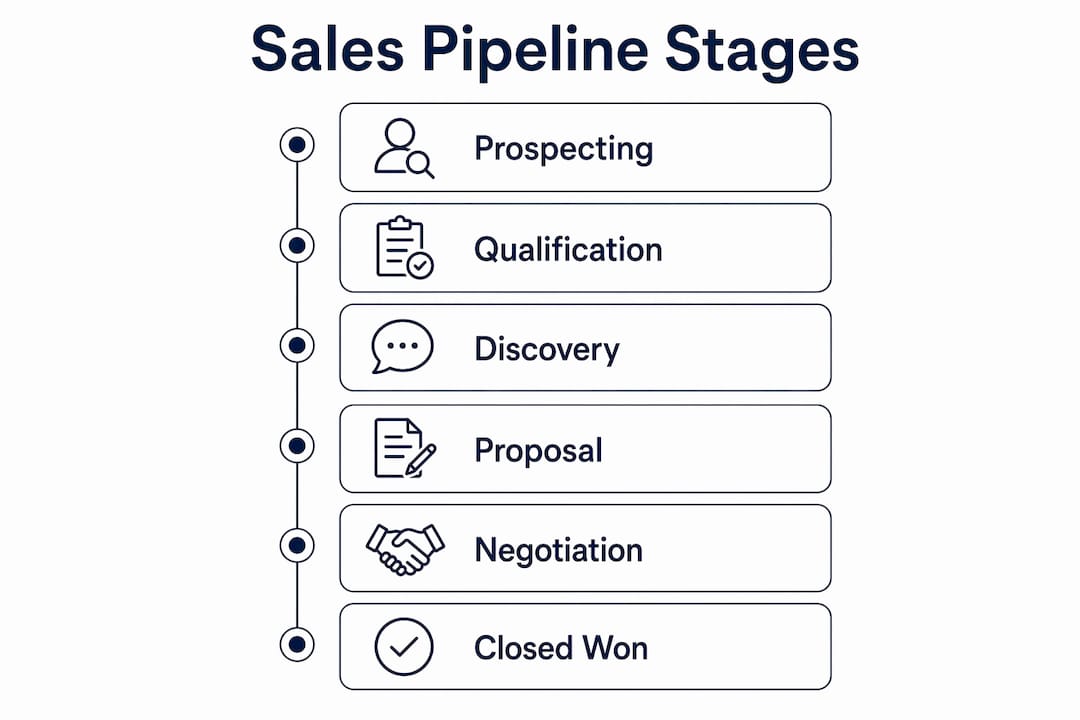
Most B2B sales pipelines use a six-stage baseline: Prospecting, Qualification, Discovery, Proposal, Negotiation, and Closed Won or Lost. Each stage represents a concrete buyer action or decision, not a task your rep has completed. “Proposal Sent” is a seller activity. “Proposal Reviewed by Economic Buyer” is a buyer milestone. The difference matters enormously when you are trying to forecast revenue with any accuracy.
Here is how the six stages map to buyer behaviour in practice.
Prospecting is where you identify accounts that match your ideal customer profile. The buyer milestone here is that the account has been confirmed as a genuine fit, not simply added to a list. Qualification is where you establish that the buyer has a real problem, a budget pathway, and the authority to progress. Discovery goes deeper: you are now mapping the full business case, understanding stakeholder dynamics, and confirming the economic impact of the problem you solve.
Proposal means the buyer has agreed to receive and review a formal recommendation. Negotiation begins when the buyer is actively working through commercial or contractual terms with you. Closed Won or Lost is self-explanatory, but recording the reason for a loss at this stage is one of the most underused sources of pipeline intelligence available to any sales team.
| Sales cycle length | Recommended stage count | Typical deal complexity |
|---|---|---|
| Under 30 days | 4 to 5 stages | Transactional, single buyer |
| 30 to 90 days | 5 to 7 stages | Mid-market, multiple stakeholders |
| Over 90 days | 7 to 10 stages | Enterprise, procurement and legal involved |
Pro Tip: If your deals involve procurement reviews or legal sign-off, add those as discrete stages. Treating them as background activity is how deals disappear from your forecast without warning.
How does buyer behaviour shape pipeline stage design?
B2B buyers spend only 17% of their purchase journey in direct contact with suppliers. The rest of the time they are conducting independent research, building internal consensus, and stress-testing options without you in the room. This means your pipeline stages must reflect long self-service periods where the buyer is progressing without any visible seller activity.
The practical implication is significant. If your CRM stages are built around what your reps do, such as “Demo Completed” or “Follow-Up Sent,” you are measuring your team’s effort, not the buyer’s intent. Activity-focused pipeline stages produce forecasts that are off by 30 to 40%, because a rep can complete every activity and still have a buyer who has mentally moved on.
The fix is to anchor each stage to an external, buyer-side signal. Consider these examples of genuine buyer milestones:
- The economic buyer has been identified and has agreed to a meeting
- The buyer has shared their internal decision criteria in writing
- A business case has been created or co-created with your team
- The buyer has confirmed a timeline tied to a real internal deadline
- Legal or procurement has been formally engaged on the buyer’s side
“Pipelines must focus on buyer-defined milestones to prevent inaccurate forecasting caused by activity-focused stages.” — Rework Sales Process Guide
When you redesign your pipeline stages around buyer behaviour, your forecast becomes a reflection of where buyers actually are, not where your reps hope they are.
What are exit criteria and why do they matter?
Exit criteria are verifiable conditions that must be met before a deal advances to the next pipeline stage. They replace gut feeling and rep optimism with observable evidence. Without them, deals drift forward based on effort and enthusiasm rather than buyer commitment.
Here is a practical set of exit criteria mapped to the six-stage model:
- Prospecting to Qualification: The account matches your ideal customer profile and a named contact has agreed to an exploratory conversation.
- Qualification to Discovery: Budget pathway confirmed, a business problem validated, and a decision-maker identified by name and role.
- Discovery to Proposal: Full stakeholder map completed, economic buyer engaged, and business impact quantified in the buyer’s own terms.
- Proposal to Negotiation: Proposal reviewed by the economic buyer, verbal indication of preference received, and no competing proposals still under active consideration.
- Negotiation to Closed: Commercial terms agreed in principle, legal review initiated, and a signed order or contract received.
The “two-rep test” is a useful calibration tool: if two different reps would reach different conclusions about whether a deal meets the exit criteria, the criteria are not specific enough. Pipeline stagnation is the direct result of vague criteria, and it creates what experienced sales leaders call “zombie pipeline.” These are deals that sit in the forecast, consuming management attention, while the buyer has long since moved on or chosen a competitor.
Pro Tip: Run a monthly pipeline review where every deal without a confirmed next step and a buyer-side commitment is either re-qualified or removed. A shorter, cleaner pipeline is always more accurate than a long, optimistic one.
MEDDIC vs BANT: which framework suits your pipeline?
BANT (Budget, Authority, Need, Timeline) is the traditional qualification framework and it works well for transactional or short-cycle B2B sales. It is fast to apply and easy to train. The limitation is that it treats qualification as a single event rather than an ongoing process, and it does not account for the complexity of multi-stakeholder enterprise deals where the economic buyer, the champion, and the end users all have different agendas.
MEDDIC (Metrics, Economic Buyer, Decision Criteria, Decision Process, Identify Pain, Champion) was designed specifically for complex B2B sales. It maps directly to the buyer milestones that matter most in enterprise deals. Switching from BANT to MEDDIC produces a 23% rise in late-stage conversion in complex B2B environments. That improvement comes from the fact that MEDDIC forces reps to confirm the economic buyer’s involvement and the decision process before a deal advances, not after.
Here is a practical comparison for pipeline stage management:
| Criterion | BANT | MEDDIC |
|---|---|---|
| Best suited for | Short cycles, single buyer | Enterprise, multi-stakeholder |
| Economic buyer focus | Partial (Authority) | Explicit and required |
| Decision process mapping | Not covered | Core component |
| Champion identification | Not covered | Core component |
| Ongoing qualification | Single event | Continuous throughout pipeline |
Embedding qualification scoring into your weekly pipeline reviews is where the real value appears. Rather than asking “is this deal qualified?”, ask “which MEDDIC elements are confirmed, and which are missing?” The gaps tell you exactly where the deal is at risk and what your rep needs to do next. For a deeper look at how qualification connects to the wider B2B sales process, the Aheadofsales practitioner guide covers this in detail.
How to design pipeline stages for your sales cycle length
The number of stages in your pipeline should reflect the complexity and length of your typical deal, not an industry template. Short sales cycles under 30 days need only four to five stages. Mid-market deals running 30 to 90 days work well with five to seven. Enterprise deals involving procurement, legal, and multiple approval layers can justify up to ten stages, provided each one represents a distinct buyer decision point.
The most common mistake is adding stages to feel thorough rather than because they reflect a real buyer milestone. Every stage you add creates a data entry obligation for your reps and a management overhead for your team. If two consecutive stages cannot be distinguished by a specific buyer action, merge them.
Historical deal data is the most reliable tool for calibrating your stage design. Review 20 closed-won and 20 closed-lost deals and map the actual sequence of buyer decisions that occurred. You will quickly see which stages your current model is missing and which ones exist only on paper. This exercise alone has transformed pipeline accuracy for many of the businesses Aheadofsales works with.
A few practical rules for managing stage design over time:
- Flag any deal that has not advanced in 21 days and require a documented next step with a buyer commitment
- Review stage conversion rates quarterly. If fewer than 40% of deals advance from one stage to the next, the exit criteria may be too loose or the stage definition unclear
- For deals involving procurement or legal review, create a dedicated stage rather than treating it as a sub-task within Negotiation
- Use your CRM (Salesforce, HubSpot, or Pipedrive are the most common in mid-market B2B) to enforce stage gates automatically where possible
Pro Tip: When you first redesign your pipeline stages, run the new model in parallel with the old one for one quarter. This gives you a comparison dataset and reduces resistance from reps who are used to the existing structure.
Key takeaways
A well-designed B2B sales pipeline uses buyer milestones, verifiable exit criteria, and a qualification framework matched to deal complexity to produce accurate forecasts and consistent conversion.
| Point | Details |
|---|---|
| Buyer milestones over seller activity | Stage advancement must be triggered by observable buyer actions, not rep tasks. |
| Six-stage baseline model | Prospecting through to Closed covers most B2B deals; adapt stage count to cycle length. |
| Exit criteria prevent zombie pipeline | Verifiable conditions per stage remove optimism and improve forecast reliability. |
| MEDDIC outperforms BANT in complex deals | MEDDIC’s 23% late-stage conversion uplift comes from mapping economic buyer and decision process. |
| Historical data calibrates stage design | Reviewing 20 closed-won and lost deals reveals gaps and validates your stage definitions. |
What I have learned from years of pipeline reviews
I have sat in hundreds of pipeline reviews with B2B sales teams, and the pattern is almost always the same. The pipeline looks healthy on paper, the forecast looks reasonable, and then the quarter closes 20 to 30% below target. When you dig into why, the answer is nearly always the same: deals were advanced based on what the rep did, not what the buyer decided.
The most damaging CRM habit I see is reps moving deals forward after sending a proposal or completing a demo, with no buyer-side confirmation at all. It feels like progress. It records as progress. But it is not progress. The buyer may not have even opened the proposal.
What actually works is building a culture where the question in every pipeline review is not “what have you done?” but “what has the buyer done?” That single shift in framing changes everything. Reps start qualifying more rigorously. Managers start coaching on real deal risk rather than activity volume. Forecasts start reflecting reality.
I am also direct about technology. Salesforce, HubSpot, and Pipedrive are excellent tools, but they do not fix a broken methodology. I have seen teams with world-class CRM configurations and catastrophic forecast accuracy, because the underlying stage definitions were built around seller convenience rather than buyer behaviour. The methodology governs the outcome. The technology records it.
If you are serious about sustainable pipeline growth, start with your stage definitions, not your CRM settings.
— Jerry
How Aheadofsales can help you build a pipeline that actually converts
If this article has surfaced gaps in how your pipeline is currently structured, you are not alone. Most B2B sales teams we work with at Aheadofsales have pipelines that look full but convert poorly, because the underlying stage design and qualification rigour are not where they need to be.
Aheadofsales offers bespoke sales training and consultancy specifically designed to fix this. Our programmes cover pipeline stage design, exit criteria implementation, MEDDIC and BANT qualification coaching, and CRM configuration aligned to buyer behaviour. Whether you are running a team of five or fifty, we tailor the work to your sales cycle and deal complexity. Explore our sales training services to see how we help B2B teams hit target every quarter, not just occasionally.
FAQ
What are the standard stages in a B2B sales pipeline?
Most B2B pipelines use six stages: Prospecting, Qualification, Discovery, Proposal, Negotiation, and Closed Won or Lost. The exact number should reflect your deal complexity and sales cycle length.
How is a sales pipeline different from a sales funnel?
A sales pipeline tracks individual deals through discrete buyer milestones from the seller’s perspective. A sales funnel measures the volume of leads moving through stages from a marketing perspective, typically showing drop-off rates at each level.
What are exit criteria in a sales pipeline?
Exit criteria are verifiable conditions a deal must meet before advancing to the next stage. They replace subjective rep judgement with observable buyer-side evidence, which improves forecast accuracy and reduces inflated pipelines.
Should I use MEDDIC or BANT for my B2B pipeline?
BANT suits short-cycle, single-buyer deals. MEDDIC is the stronger choice for complex, multi-stakeholder sales, where it has been shown to improve late-stage conversion by 23% compared to BANT.
How many pipeline stages does a B2B team need?
The right number depends on your cycle length. Four to five stages work for deals under 30 days. Five to seven suit mid-market deals. Enterprise deals with procurement and legal involvement can justify up to ten stages, provided each one reflects a distinct buyer decision.