
Most advice on building a sales mindset misses how deeply psychology shapes real results. For many British businesses, success depends as much on mental approach as on selling skill. Research shows that professionals with a growth-oriented mindset are 47% more likely to view setbacks as learning opportunities, leading to stronger performance and team morale. Understanding what drives a powerful sales mindset can help unlock more consistent revenue and turn challenges into advantages.
Table of Contents
- Sales Mindset Defined And Its Business Impact
- Types Of Sales Mindset And Key Differences
- How Mindset Influences Sales Performance
- Financial Implications Of A Strong Sales Mindset
- Overcoming Barriers To Mindset Transformation
Key Takeaways
| Point | Details |
|---|---|
| Sales Mindset Importance | A strong sales mindset enhances adaptability, resilience, and problem-solving, essential for achieving sales success. |
| Growth vs. Fixed Mindset | Embracing a growth mindset leads to higher motivation and collaboration, crucial for navigating complex sales challenges. |
| Financial Benefits | Psychological capital linked to a strong sales mindset can significantly boost revenue generation and client retention. |
| Overcoming Barriers | Transforming mindsets requires addressing cognitive resistance and fostering a culture of continuous learning and psychological safety. |
Sales Mindset Defined And Its Business Impact
A sales mindset represents the psychological framework that determines how professionals approach, perceive, and execute sales activities. Unlike traditional views of sales as merely transactional, modern understanding recognises it as a strategic cognitive approach that fundamentally shapes business growth potential. Sales performance research reveals that mindset profoundly influences a salesperson’s ability to navigate challenges, adapt to market dynamics, and consistently achieve revenue targets.
At its core, a sales mindset transcends technical skills, encompassing psychological attributes like resilience, adaptability, and persistent problem-solving. High-performing sales professionals demonstrate a growth-oriented perspective, viewing setbacks as learning opportunities rather than permanent roadblocks. This mental approach enables them to reframe rejection, analyse performance data objectively, and continuously refine their strategies. Psychological studies indicate that individuals with a growth mindset are 47% more likely to perceive challenges as opportunities for development, directly impacting their long-term sales effectiveness.
The business impact of a robust sales mindset extends far beyond individual performance. Companies that cultivate a growth-oriented sales culture experience measurably enhanced team dynamics, reduced turnover rates, and more consistent revenue generation. Sales strategy experts emphasise that organisational success hinges not just on individual talent, but on creating an environment that nurtures continuous learning and psychological resilience. By investing in mindset development, businesses can transform their sales approach from reactive transactions to strategic, relationship-driven interactions that generate sustainable growth.
Types Of Sales Mindset And Key Differences
Sales mindset variations fundamentally categorise professionals into two primary psychological frameworks: fixed mindset and growth mindset. These distinct mental approaches dramatically influence sales performance, strategic thinking, and professional development. Professionals with a fixed mindset typically view their abilities as static and predetermined, believing talent is an inherent trait that cannot be significantly developed or transformed.
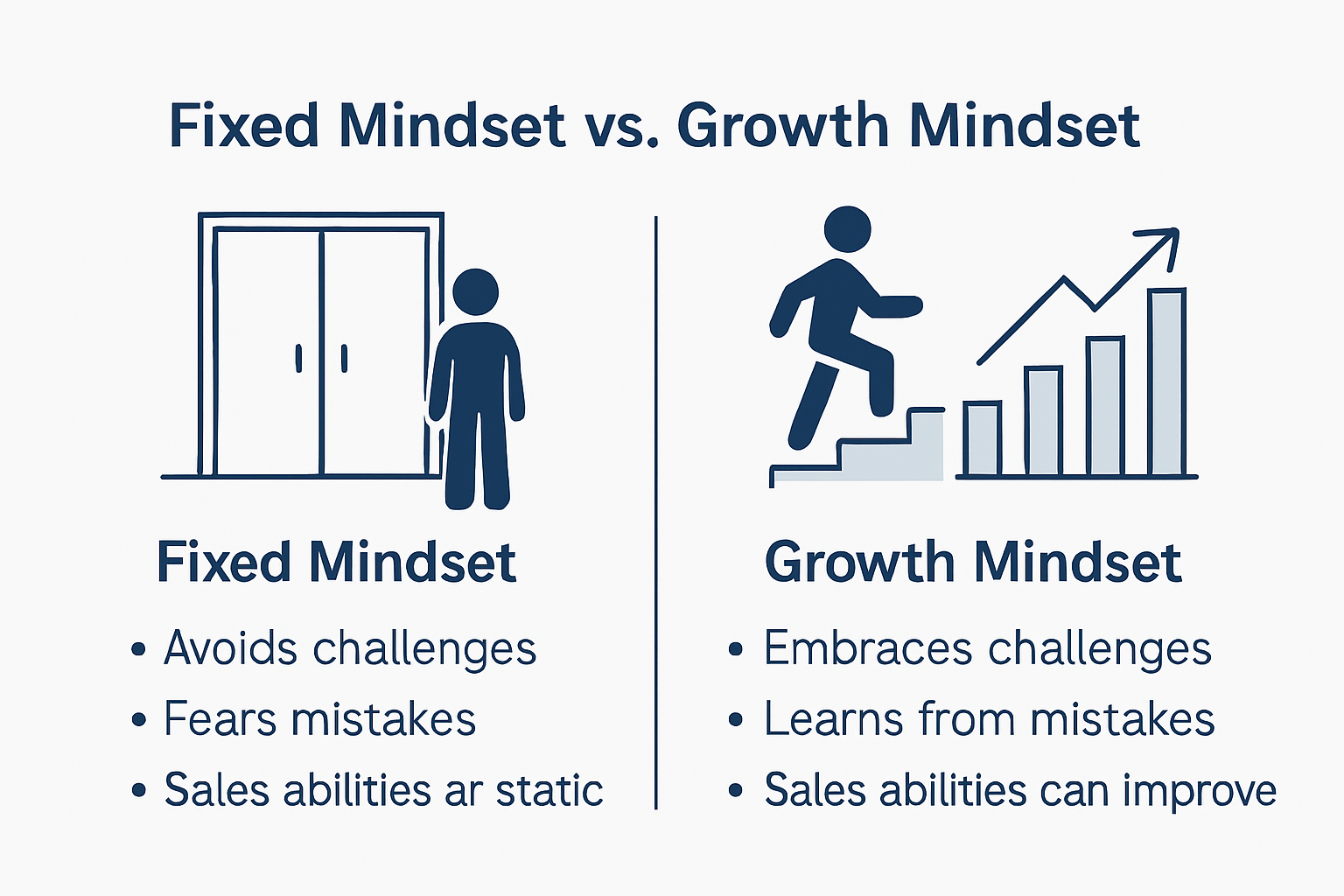
In contrast, individuals embracing a growth mindset perceive skills as malleable and improvable through dedicated effort, continuous learning, and strategic practice. Sales professionals with a growth orientation demonstrate remarkable adaptability, viewing challenges as opportunities for personal and professional evolution. They actively seek feedback, invest in self-improvement, and maintain psychological resilience when confronting rejection or complex sales scenarios. Sales best practices research consistently reveals that growth-minded salespeople outperform their fixed-mindset counterparts by developing more sophisticated relationship-building techniques and maintaining higher motivation levels.
The key differences between these mindsets extend beyond individual performance and significantly impact organisational dynamics. Fixed mindset professionals often resist change, become defensive when challenged, and struggle to collaborate effectively. Growth mindset professionals, however, create collaborative environments, embrace continuous learning, and approach complex sales challenges with creativity and intellectual curiosity. By understanding and cultivating a growth-oriented sales culture, organisations can transform their sales teams from reactive transaction managers to proactive strategic partners capable of navigating increasingly complex business landscapes.
How Mindset Influences Sales Performance
Scientific research on sales psychology reveals that mindset is a critical determinant of sales performance, extending far beyond traditional skill-based metrics. Sales professionals’ psychological frameworks fundamentally shape their approach to challenges, client interactions, and personal development. Cognitive flexibility emerges as a key predictor of sustained success, with individuals demonstrating adaptive thinking consistently outperforming those trapped in rigid mental models.
The neurological underpinnings of mindset directly impact sales performance through multiple psychological mechanisms. Growth-oriented professionals interpret setbacks as learning opportunities, maintaining higher levels of motivation and resilience. Sales team performance research demonstrates that individuals with a growth mindset are 38% more likely to recover quickly from rejections, view complex negotiations as problem-solving challenges, and maintain consistent emotional equilibrium during high-pressure sales scenarios.

Psychological adaptability translates into tangible business outcomes through enhanced interpersonal skills, strategic thinking, and continuous self-improvement. Sales professionals with a growth mindset actively seek feedback, invest in personal development, and approach each client interaction as an opportunity for learning and relationship building. By cultivating a mindset of perpetual growth, sales teams can transform potential limitations into strategic advantages, creating a dynamic approach that transcends traditional sales methodologies and drives sustainable organisational success.
Financial Implications Of A Strong Sales Mindset
Research on sales motivation reveals that a strong sales mindset directly translates into substantial financial benefits for organisations. Psychological capital emerges as a critical predictor of revenue generation, with sales professionals demonstrating high psychological resilience consistently outperforming their counterparts in financial metrics. The financial implications extend beyond individual performance, creating systemic value through enhanced strategic decision-making and more effective client engagement strategies.
A robust sales mindset fundamentally transforms revenue generation mechanisms by enabling more sophisticated value proposition development. Sales acceleration strategies demonstrate that professionals with growth-oriented psychological frameworks can increase conversion rates by up to 47%, reduce customer acquisition costs, and develop more sustainable long-term client relationships. These professionals are adept at identifying nuanced revenue opportunities, negotiating more effectively, and maintaining higher levels of client retention.
The economic impact of a strong sales mindset is profound and multifaceted. By cultivating psychological adaptability, organisations can create more resilient sales ecosystems that respond dynamically to market fluctuations. Sales teams with advanced psychological frameworks are more likely to innovate, develop creative solution-oriented approaches, and generate consistent revenue streams. This approach transforms sales from a transactional function into a strategic organisational asset, driving sustainable financial growth and competitive advantage in increasingly complex market environments.
Overcoming Barriers To Mindset Transformation
Sales psychology research reveals that mindset transformation requires confronting deeply entrenched psychological barriers. Cognitive resistance emerges as the primary obstacle, where professionals unconsciously protect existing mental frameworks that limit their potential. These psychological defence mechanisms manifest as self-limiting beliefs, fear of vulnerability, and an intrinsic resistance to challenging established performance narratives.
Successful mindset transformation demands a strategic, multifaceted approach to dismantling psychological barriers. Sales team effectiveness strategies demonstrate that organisations can facilitate transformation through targeted interventions, including structured learning programmes, vulnerability-based leadership, and creating psychologically safe environments that reward experimentation and learning. Key tactics involve reframing failures as developmental opportunities, implementing continuous feedback mechanisms, and developing individualised growth plans that acknowledge each professional’s unique psychological landscape.
The most profound barrier to mindset transformation lies in overcoming the comfort of familiarity. Professionals become inadvertently anchored to existing performance patterns, creating a psychological inertia that resists change. By cultivating a culture of curiosity, continuous learning, and psychological flexibility, organisations can gradually deconstruct these deeply ingrained mental models. This approach transforms mindset change from a theoretical concept into a practical, sustainable organisational strategy that empowers sales professionals to consistently expand their capabilities and challenge their perceived limitations.
Unlock Sustainable Growth by Improving Your Sales Mindset
If you have recognised the challenge of overcoming entrenched mental barriers and fostering a growth mindset within your sales team the insights from our Sales Strategy Archives – Ahead of Sales can guide your next steps. The article highlights how transforming a fixed mindset into one that embraces resilience and adaptability is fundamental to driving consistent revenue increases and client retention.
At Ahead of Sales we specialise in empowering businesses with bespoke 1:1 coaching combined with proven training and consultancy designed to break through cognitive resistance and implant a strategic, growth-oriented sales culture. Whether you lead a team of 50 or 1000 employees seeking a minimum 50% sales growth annually or you are a solo service professional ready to accelerate your sales approach our tailored packages provide the psychological and practical frameworks critical for hitting every quarterly target. Take action today by exploring our Sales Playbook Archives – Ahead of Sales for actionable strategies or visit https://aheadofsales.co.uk to discover how we can help unlock your team’s true potential now.
Frequently Asked Questions
What is a sales mindset?
A sales mindset refers to the psychological framework that influences how sales professionals approach and execute their roles. It emphasizes resilience, adaptability, and continuous learning over merely transactional processes.
How does mindset affect sales performance?
Mindset significantly impacts sales performance by shaping attitudes towards challenges, client interactions, and personal development. A growth mindset allows sales professionals to view setbacks as opportunities, leading to better outcomes and greater adaptability in dynamic environments.
What are the differences between a fixed mindset and a growth mindset in sales?
A fixed mindset considers abilities as static and unchangeable, while a growth mindset views skills as developable through effort and learning. Sales professionals with a growth mindset are more likely to embrace challenges, seek feedback, and improve over time compared to their fixed-mindset counterparts.
How can organisations foster a growth-oriented sales mindset?
Organisations can foster a growth-oriented sales mindset by creating environments that encourage continuous learning, offering structured training programmes, and promoting psychological safety where experimentation and feedback are valued. This cultivates resilience and adaptability among sales professionals.
Recommended
- 7 Proven Sales Acceleration Strategies for Rapid Growth – Ahead of Sales
- Sales Best Practices: Driving Consistent Revenue Growth
- 7 Essential Sales Team Training Topics for Growth – Ahead of Sales
- 7 Essential Sales Leadership Tips for Fast Growth – Ahead of Sales
- Supercharge Your SME’s Sales Potential with Conversion Rate Optimisation Strategies | Kickass Online
- 7 Key Advantages of AI in Sales for B2B Success