
Many British sales leaders realise that simply increasing headcount or updating technology rarely transforms revenue outcomes. The challenges facing sales teams involve deeper process inefficiencies, skill gaps, and strategic misalignment. Engaging a sales consultant provides targeted expertise to diagnose, optimise, and overhaul sales performance, helping organisations achieve results no ordinary training or quick fix can deliver. Discover how a consultant’s holistic approach creates real impact across strategy, process, and measurable results.
Table of Contents
- Defining The Role Of A Sales Consultant
- Types Of Sales Consultants In Business
- Core Skills And Competencies Required
- How Sales Consultants Drive Revenue Growth
- Common Pitfalls When Hiring Consultants
Key Takeaways
| Point | Details |
|---|---|
| Role of Sales Consultants | Sales consultants focus on enhancing the entire sales ecosystem rather than just selling products, employing strategic planning, training, and process optimisation. |
| Types of Sales Consultants | There are various types of sales consultants ranging from strategic to technical, each offering unique expertise for specific business challenges. |
| Core Skills Required | Successful sales consultants combine strategic thinking, analytical skills, and emotional intelligence to effectively transform sales performance. |
| Common Hiring Pitfalls | Businesses often face pitfalls such as undefined objectives and unrealistic expectations when selecting sales consultants; thorough due diligence is essential. |
Defining the Role of a Sales Consultant
A sales consultant is a strategic professional who helps businesses diagnose, optimise, and transform their sales performance through expert guidance and targeted interventions. Unlike traditional sales representatives, these specialists focus on comprehensive sales ecosystem improvement rather than direct product selling.
Sales consultants operate across multiple critical domains:
- Strategic planning: Developing robust sales methodologies
- Performance optimisation: Identifying and resolving systemic sales challenges
- Training and coaching: Upskilling sales teams for consistent results
- Process design: Streamlining sales workflows for maximum efficiency
Their role encompasses a holistic approach to sales performance enhancement, working closely with leadership to understand unique organisational dynamics. Typically, they conduct detailed diagnostics to uncover underlying sales inefficiencies and craft tailored strategies that drive sustainable growth.

Most sales consultants bring extensive experience across multiple industries, allowing them to introduce best practices and innovative approaches. They often employ data-driven techniques, leveraging analytics to measure progress and validate strategic recommendations. Their objective perspective enables them to challenge existing processes and introduce transformative solutions that internal teams might overlook.
Pro tip: When engaging a sales consultant, prioritise professionals with demonstrable experience in your specific industry and a track record of measurable performance improvements.
Types of Sales Consultants in Business
Sales consultants are not a monolithic group but represent a diverse range of specialisations tailored to address specific business challenges. Consulting industry experts recognise multiple distinct types of sales consultants who bring unique expertise to organisational growth strategies.
The primary categories of sales consultants include:
- Strategic Sales Consultants: Focus on high-level sales strategy development
- Operational Sales Consultants: Specialise in improving day-to-day sales processes
- Technical Sales Consultants: Provide expertise in complex product or industry-specific sales environments
- Training and Development Consultants: Concentrate on upskilling sales teams
- Digital Sales Transformation Consultants: Help businesses modernise sales approaches through technology
Each type of sales consultant brings a nuanced approach to organisational performance. Strategic consultants typically work with senior leadership to design comprehensive sales frameworks, while operational consultants drill down into specific workflow improvements. Technical sales consultants often serve niche markets like technology, pharmaceuticals, or engineering, where deep product knowledge is crucial.
The most effective sales consultants combine multiple specialisations, offering holistic insights that transcend traditional consulting boundaries. They leverage data analytics, behavioural science, and industry-specific knowledge to create tailored solutions that drive measurable revenue growth and operational efficiency.
Here’s a comparison of common sales consultant types and their ideal business use cases:
| Consultant Type | Typical Client Needs | Unique Advantage | Best Used For |
|---|---|---|---|
| Strategic Sales Consultant | Long-term market positioning | Framework design expertise | Growth planning |
| Operational Sales Consultant | Inefficient daily workflows | Process optimisation | Improving efficiency |
| Technical Sales Consultant | Complex product sales | Specialist technical knowledge | Industry-specific sales challenges |
| Training & Development Consultant | Underperforming teams | Skills development focus | Team upskilling |
| Digital Transformation Consultant | Outdated sales technology | Digital innovation leadership | Sales modernisation |
Pro tip: When selecting a sales consultant, prioritise those with demonstrable expertise in your specific industry and a proven track record of implementing transformative sales strategies.
Core Skills and Competencies Required
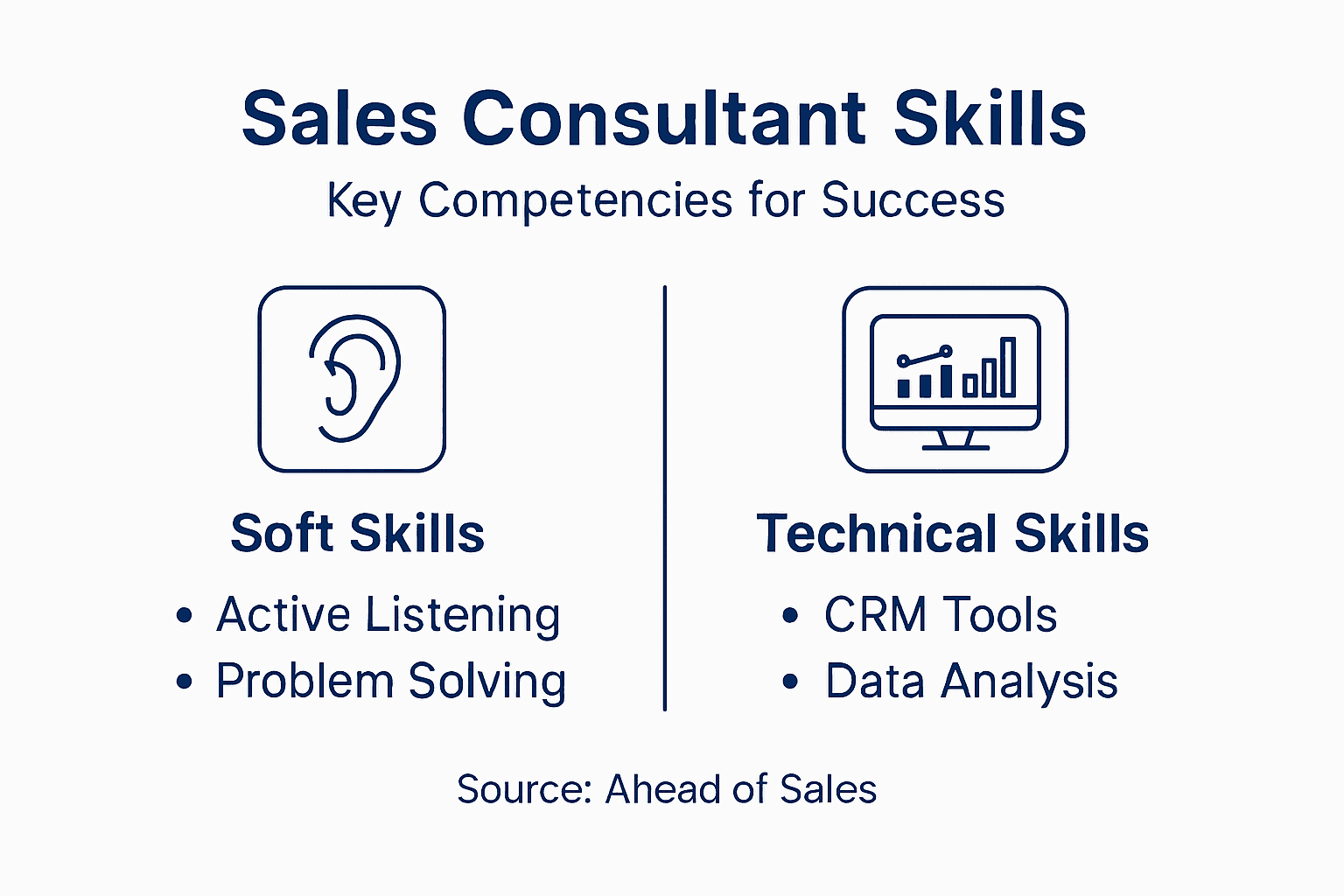
Successful sales consultants possess a sophisticated blend of strategic capabilities and interpersonal skills that enable them to transform organisational sales performance. Top boardroom advisors emphasise that exceptional consultants combine deep technical knowledge with remarkable relationship-building abilities.
The core competencies for high-performing sales consultants include:
- Strategic Thinking: Ability to develop comprehensive sales strategies
- Analytical Skills: Proficiency in data interpretation and performance measurement
- Communication Expertise: Clear, persuasive communication across multiple stakeholder levels
- Emotional Intelligence: Understanding and navigating complex interpersonal dynamics
- Adaptability: Quick learning and flexible approach to diverse business challenges
- Technical Proficiency: Understanding of modern sales technologies and digital platforms
Technical knowledge represents only one dimension of a sales consultant’s toolkit. Equally critical are nuanced interpersonal skills that enable deep client understanding and trust-building. Successful consultants demonstrate an exceptional capacity to diagnose organisational challenges, design targeted interventions, and facilitate meaningful behavioural change within sales teams.
Continuous learning distinguishes outstanding sales consultants from average performers. They maintain a growth mindset, constantly updating their skills, understanding emerging market trends, and developing innovative approaches to sales strategy and implementation. This commitment to professional development ensures they remain at the cutting edge of sales performance enhancement.
Pro tip: Invest in regular skills assessments and targeted professional development to maintain your competitive edge as a sales consultant.
How Sales Consultants Drive Revenue Growth
Sales consultants serve as strategic catalysts for revenue acceleration, employing sophisticated methodologies that transform organisational sales performance. Advanced revenue strategies enable these professionals to diagnose, redesign, and optimise entire sales ecosystems for sustainable growth.
Their revenue-driving approaches typically encompass:
- Market Analysis: Deep diagnostic evaluation of current sales infrastructure
- Process Optimisation: Identifying and eliminating performance bottlenecks
- Strategic Realignment: Restructuring sales workflows for maximum efficiency
- Technology Integration: Implementing digital tools to enhance sales capabilities
- Performance Measurement: Establishing robust KPI frameworks for continuous improvement
- Training and Development: Upskilling sales teams to execute advanced strategies
Successful sales consultants distinguish themselves by their ability to translate complex analytical insights into actionable strategies. They don’t merely provide recommendations but work collaboratively with organisations to implement transformative changes that directly impact bottom-line performance. Their interventions often result in significant productivity improvements, reduced sales cycles, and more predictable revenue generation.
The most impactful sales consultants approach revenue growth as a holistic challenge, combining data-driven insights with nuanced understanding of organisational culture and human dynamics. By bridging technological capabilities with strategic thinking, they create sustainable frameworks that enable businesses to achieve consistent, scalable growth.
The following table summarises how sales consultants contribute to sustainable revenue growth:
| Approach | Business Impact | Typical Tools/Methods |
|---|---|---|
| Market Analysis | Identifies market opportunities | Data analytics, competitive research |
| Process Optimisation | Reduces inefficiencies | Workflow auditing, mapping |
| Technology Integration | Enhances sales capabilities | CRM systems, automation platforms |
| Training & Development | Improves team performance | Workshops, coaching, performance reviews |
| Performance Measurement | Provides ongoing improvement | KPI dashboards, reporting tools |
Pro tip: Prioritise sales consultants who demonstrate a track record of measurable revenue improvement and can provide specific, quantifiable outcomes from previous engagements.
Common Pitfalls When Hiring Consultants
Engaging a sales consultant is a strategic decision that requires careful consideration and deliberate planning. Business consulting challenges reveal numerous potential missteps that can undermine the effectiveness of consulting engagements.
The most critical pitfalls businesses frequently encounter include:
- Undefined Objectives: Lacking clear, measurable expectations for the consulting intervention
- Reputation Over Expertise: Selecting consultants based on brand name rather than specific capabilities
- Cultural Misalignment: Ignoring the consultant’s compatibility with organisational culture
- Insufficient Stakeholder Engagement: Failing to secure internal support and commitment
- Unrealistic Expectations: Anticipating immediate transformational results
- Limited Performance Metrics: Not establishing precise evaluation criteria
Successful consultant selection requires a comprehensive approach that goes beyond surface-level assessments. Organisations must conduct thorough due diligence, examining a consultant’s track record, methodology, and demonstrated ability to deliver tangible results in similar business contexts. This means looking beyond glossy presentations and diving deep into concrete evidence of past performance.
The most sophisticated businesses treat consultant selection as a strategic partnership, not a transactional service procurement. They invest time in understanding potential consultants’ approach, validate their expertise through detailed case studies, and create collaborative frameworks that ensure mutual accountability and shared success objectives.
Pro tip: Request detailed case studies and references, and conduct structured interviews that explore the consultant’s specific problem-solving approach and past performance metrics.
Unlock Transformative Sales Growth with Expert Guidance
If you have identified the challenges of inefficient sales processes or underperforming teams as described in the article, it is time to take action that drives real change. Businesses seeking to overcome systemic sales inefficiencies and execute tailored growth strategies can benefit immensely from bespoke coaching combined with strategic consultancy. Our approach focuses on actionable insights and measurable improvements that align perfectly with the profound impact sales consultants bring to growth.
Explore our proven methods in the Sales Strategy Archives – Ahead of Sales and discover how our unique blend of 1:1 coaching and traditional training helps organisations consistently exceed targets. Whether you operate a mid-sized business aiming for over 50 percent sales growth or a solo service professional needing acceleration, we offer customised packages starting from £2995 available now. Do not leave your revenue growth to chance visit Ahead of Sales today to book a consultation and start transforming your sales performance.
Frequently Asked Questions
What are the primary functions of a sales consultant?
Sales consultants primarily focus on diagnosing sales performance issues, optimising processes, developing strategic sales plans, and providing training to sales teams to enhance their skills and effectiveness.
How do sales consultants drive revenue growth?
Sales consultants drive revenue growth by conducting market analysis, streamlining sales processes, integrating technology, and training teams to implement and sustain effective sales strategies, leading to improved organisational performance.
What types of sales consultants are there?
There are several types of sales consultants, including strategic sales consultants, operational sales consultants, technical sales consultants, training and development consultants, and digital sales transformation consultants, each specialising in different areas of sales improvement.
What skills should I look for in a sales consultant?
A strong sales consultant should possess strategic thinking, analytical skills, effective communication, emotional intelligence, adaptability, and technical proficiency, enabling them to navigate various business challenges effectively.