
Only a fraction of british SaaS firms fully understand just how rapidly sales models are evolving. With traditional licensing fading and modern SaaS sales driving up recurring revenue, sales leaders face new pressures to prove value and adapt. Staying ahead means mastering customer-centric strategies and integrating advanced technologies. This guide reveals the key approaches top-performing teams use to thrive amid shifting expectations and global competition.
Table of Contents
- Defining SaaS Sales: Evolving Models And Misconceptions
- Key SaaS Variations Driving Market Growth
- How AI And Automation Are Transforming Sales
- Talent Shortages, Skills, And Team Structures
- Navigating Pricing, Retention, And Compliance Challenges
Key Takeaways
| Point | Details |
|---|---|
| SaaS Sales Transformation | SaaS sales have evolved from one-time transactions to recurring revenue models, necessitating continuous customer engagement and value demonstration. |
| AI and Automation Integration | The integration of AI and automation in sales processes is essential for enhancing efficiency and personalisation in customer interactions. |
| Talent Development in SaaS | Successful SaaS organisations must focus on developing skilled teams with a combination of technical knowledge and emotional intelligence to navigate the complex sales landscape. |
| Evolving Pricing Strategies | SaaS pricing models are shifting towards consumption-based approaches, requiring flexibility and responsiveness to customer needs and market dynamics. |
Defining SaaS Sales: Evolving Models and Misconceptions
SaaS sales represents a fundamental transformation in software delivery, moving far beyond traditional transactional models towards dynamic, relationship-driven approaches. Unlike conventional product sales, SaaS requires continuous engagement and value demonstration. Sophisticated cloud-based delivery models now enable organisations to provide flexible, scalable services directly tailored to customer requirements.
Traditionally, software sales involved one-time licensing purchases with minimal post-sale interaction. Modern SaaS sales strategies challenge this paradigm by emphasising recurring revenue, continuous product evolution, and proactive customer success management. AI-driven monetisation strategies are reshaping how companies approach customer acquisition, retention, and expansion.
The emerging SaaS sales landscape demands a multifaceted approach. Sales professionals must now understand complex decision support systems, analyse user behaviour patterns, and develop strategies that go beyond initial contract signing. This requires deep technical knowledge, exceptional communication skills, and an adaptive mindset focused on long-term customer relationships rather than short-term transactions.
The evolution from traditional software sales to SaaS brings distinct changes in approach and business impact:
| Aspect | Traditional Software Sales | Modern SaaS Sales |
|---|---|---|
| Revenue Model | One-time licence purchase | Recurring subscription fees |
| Customer Engagement | Minimal after-sale contact | Continuous support and interaction |
| Product Updates | Infrequent, costly upgrades | Regular, automatic improvements |
| Value Demonstration | Upfront features focus | Ongoing value delivery |
| Sales Cycle | Linear and transactional | Cyclical and relationship-driven |
| Success Metrics | Deal closure rate | Customer lifetime value |
Pro tip: Invest in continuous training programmes that help your sales team understand both technological nuances and advanced customer engagement strategies.
Key SaaS Variations Driving Market Growth
The SaaS market is experiencing a profound transformation, characterised by diverse and sophisticated delivery models that challenge traditional software deployment approaches. Vertical SaaS solutions are emerging as critical drivers of market growth, offering specialised software tailored to specific industry verticals such as healthcare, finance, and manufacturing.

Regional market dynamics play a significant role in shaping SaaS variations. North America continues to lead in innovation, with Europe and Asia-Pacific rapidly developing unique market approaches. Multi-cloud environments and hybrid deployment strategies are becoming increasingly prevalent, enabling organisations to leverage diverse technological infrastructures and optimise their software ecosystems.
Pricing models are also undergoing substantial evolution, moving beyond traditional subscription frameworks. Consumption-based and hybrid pricing strategies are gaining traction, allowing businesses greater flexibility in software procurement. These innovative models reflect a broader trend towards more adaptable, customer-centric software solutions that can scale dynamically with organisational needs.
Pro tip: Conduct regular market research to understand emerging SaaS variations and align your technology strategy with the most promising industry trends.
How AI and Automation Are Transforming Sales
The sales landscape is undergoing a radical transformation driven by artificial intelligence and sophisticated automation technologies. Technical go-to-market engineers are increasingly replacing traditional sales roles, using AI-powered tools to streamline complex customer acquisition processes with unprecedented efficiency and precision.
Autonomous AI agents are revolutionising sales workflows by independently managing critical functions such as lead identification, customer interaction, and deal tracking. These intelligent systems can analyse vast datasets, predict customer behaviour, and generate personalised engagement strategies at speeds impossible for human teams. AI agents are reshaping sales interaction by dramatically reducing manual administrative tasks and enabling sales professionals to focus on high-value relationship-building activities.
Despite the technological advances, human relationships remain paramount in complex sales environments. Successful organisations are developing hybrid models that leverage AI’s computational power while maintaining the nuanced emotional intelligence and strategic thinking that only human sales professionals can provide. This balanced approach ensures technological efficiency without sacrificing the personal touch critical in high-value sales negotiations.
Pro tip: Invest in continuous AI skill training for your sales team to effectively integrate and collaborate with emerging autonomous technologies.
Talent Shortages, Skills, and Team Structures
The SaaS sales industry faces unprecedented challenges in talent acquisition and team development, driven by rapidly evolving technological landscapes and complex skill requirements. Global talent shortages demand innovative strategies that transcend traditional recruitment and training approaches, compelling organisations to reimagine their workforce development models.
Modern SaaS sales teams require a sophisticated blend of technical understanding, emotional intelligence, and adaptive skills. The emerging workforce needs proficiency in AI technologies, data analytics, and complex customer relationship management. This necessitates a radical shift from conventional sales training towards continuous learning programmes that emphasise technological fluency, strategic thinking, and cross-functional collaboration.
Successful organisations are responding by developing more flexible team structures that prioritise skill diversity and adaptability. This includes creating hybrid roles that combine sales expertise with technical knowledge, implementing micro-credentialing systems, and developing internal talent pipelines that can quickly respond to technological changes. By embracing inclusive hiring practices and investing in comprehensive upskilling initiatives, companies can build resilient sales teams capable of navigating the complex SaaS ecosystem.
Pro tip: Develop a structured continuous learning programme that provides your sales team with regular technology and skill updates, ensuring they remain competitive in an rapidly evolving market.
Navigating Pricing, Retention, and Compliance Challenges
The SaaS ecosystem is experiencing unprecedented complexity in pricing strategies, customer retention, and regulatory compliance, driven by economic uncertainties and technological disruptions. Operational risks are increasingly challenging organisations to develop more sophisticated and adaptive management approaches that balance financial sustainability with customer value.
Pricing models in SaaS are evolving from rigid subscription structures to more flexible, consumption-based frameworks that align directly with customer usage and perceived value. This shift requires sophisticated pricing intelligence that can dynamically adjust to changing market conditions, customer needs, and competitive landscapes. Organisations must develop granular pricing strategies that offer transparency, predictability, and scalability while maintaining competitive margins.
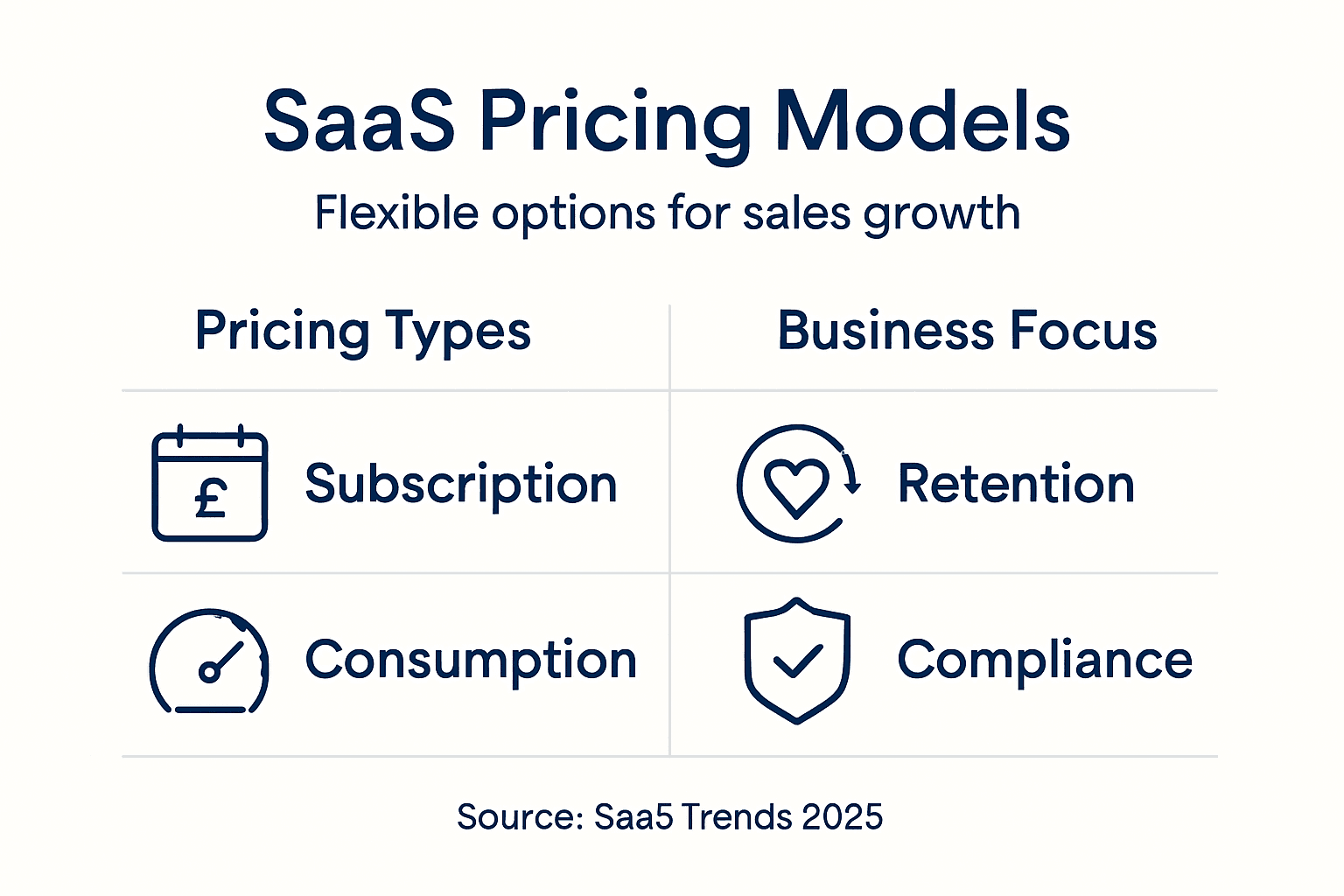
Below is a summary of the primary SaaS pricing models and their business implications:
| Pricing Model | Description | Business Impact |
|---|---|---|
| Subscription-based | Fixed recurring payment | Predictable income, simplifies budgeting |
| Consumption-based | Charges aligned with usage | Scales with customer needs, variable revenue |
| Hybrid | Combines subscription and usage fees | Flexible solutions, wider customer appeal |
Compliance and security have become central considerations in SaaS pricing and retention strategies. With increasing data protection regulations and cybersecurity threats, companies must integrate robust governance frameworks into their product offerings. This includes implementing automated onboarding and offboarding processes, developing unified management platforms, and creating comprehensive risk mitigation strategies that protect both organisational and customer interests.
Pro tip: Implement a quarterly pricing and compliance review process that systematically evaluates your SaaS offering’s market alignment, regulatory compliance, and customer value proposition.
Accelerate Your SaaS Sales Growth with Expert Coaching and Strategy
Navigating the complex challenges of SaaS sales in 2025 requires more than just understanding AI integration or talent shortages. You need tailored strategies that address evolving pricing models, continuous customer engagement, and a workforce skilled in cutting-edge technologies. At Ahead of Sales, we specialise in empowering sales teams to conquer these obstacles by combining bespoke 1:1 coaching with proven sales methodologies that ensure your team not only meets but exceeds targets consistently.
Unlock the full potential of your sales force today by exploring proven Sales Strategy Archives – Ahead of Sales that align with the latest SaaS trends. Whether you are part of a growing organisation with 50 to 1000 staff or a solo service business aiming for scalable growth, our flexible packages deliver at least 50% sales growth annually. Visit Ahead of Sales now to start your journey towards sustainable and accelerated SaaS sales success through expert guidance and actionable playbooks from our Sales Playbook Archives – Ahead of Sales. Take action now to future-proof your sales strategy and thrive in this rapidly evolving market.
Frequently Asked Questions
What are the key trends shaping SaaS sales in 2025?
The key trends include the integration of AI technologies to enhance sales processes, the need for skilled talent in navigating complex software solutions, and the evolution of pricing models to meet customer demands.
How is AI transforming the sales landscape in SaaS?
AI is transforming the sales landscape by automating lead identification, managing customer interactions, and enabling personalised engagement strategies through advanced data analysis.
What skills are essential for sales teams in the modern SaaS environment?
Sales teams need a blend of technical knowledge, emotional intelligence, and adaptability, along with proficiency in AI technologies and data analytics to thrive in a rapidly evolving market.
What are the challenges associated with SaaS pricing strategies?
Challenges include developing flexible pricing models that align with customer usage, maintaining compliance with regulatory requirements, and addressing operational risks in an uncertain economic landscape.