
Pressure to deliver stronger quarterly results pushes legal sales teams to look beyond traditional training. The competitive market in the United Kingdom demands more than deep legal knowledge alone, calling for lawyers with advanced business acumen and client management skills. This growing need to enhance commercial capabilities reflects the shift toward strategic upskilling as a tool for driving firm-wide growth and meeting evolving client expectations. Discover key strategies legal sales executives can use to close skill gaps and boost team performance.
Table of Contents
- Defining Sales Upskilling For Legal Firms
- Essential Categories Of Sales Upskilling
- How Bespoke Programmes Enhance Performance
- Practical Applications And Real-World Impact
- Common Barriers And Cost Implications
- Mistakes To Avoid In Sales Upskilling Initiatives
Key Takeaways
| Point | Details |
|---|---|
| Sales Upskilling Is Essential | Legal professionals must develop beyond technical expertise to drive organisational growth through advanced business skills. |
| Bespoke Programmes Enhance Learning | Customised training can address individual skill gaps, ensuring targeted and effective professional development. |
| Practical Applications Drive Outcomes | Implementing sales upskilling initiatives leads to improved client acquisition, relationship management, and overall firm revenue. |
| Avoid Generic Approaches | Tailoring training to individual needs is crucial to prevent ineffective learning experiences and ensure alignment with business goals. |
Defining Sales Upskilling for Legal Firms
Sales upskilling in legal firms represents a strategic transformation beyond traditional legal training. It involves developing comprehensive skills that enable lawyers to become more than technical legal experts by transforming them into strategic business professionals who can drive organisational growth. Continuous skills enhancement has become essential in today’s competitive legal marketplace.
At its core, sales upskilling for legal professionals encompasses several critical dimensions. These include developing advanced business acumen, enhancing communication and negotiation capabilities, understanding client relationship management, and acquiring technological competencies that enable more efficient service delivery. Lawyers must now combine deep legal knowledge with strong commercial insights to meet evolving client expectations and navigate increasingly complex business environments.
The fundamental goal of sales upskilling is to equip legal professionals with a holistic skill set that transcends pure legal expertise. This means training lawyers to think strategically about business development, understand financial metrics, create compelling value propositions, and build robust client engagement strategies. Legal sales skills development has transformed from a peripheral consideration to a central strategy for firm growth and sustainability.
Pro tip: Start tracking individual lawyer business development metrics and provide targeted training that addresses specific skill gaps in your legal team’s commercial capabilities.
Essential Categories of Sales Upskilling
Sales upskilling for legal professionals comprises multifaceted skill development across several critical categories. These encompass both technical competencies and interpersonal capabilities that are essential for modern legal practitioners to thrive in increasingly complex business environments. Skills for future legal practice emphasise a holistic approach to professional development.
The primary categories of sales upskilling include technological literacy, commercial awareness, client relationship management, and strategic communication. Technological literacy involves understanding and leveraging digital tools for efficient service delivery, while commercial awareness requires lawyers to develop deep insights into business dynamics, market trends, and client industries. Client relationship management focuses on building robust, long-term partnerships through proactive engagement and personalised service strategies.

Communication and negotiation skills represent another crucial category of sales upskilling. Legal professionals must now articulate complex legal concepts in accessible language, craft compelling value propositions, and negotiate effectively across diverse business contexts. This requires developing nuanced interpersonal skills, emotional intelligence, and the ability to align legal solutions with broader business objectives. The goal is to transform lawyers from pure legal technicians into strategic business advisors who can drive organisational growth and client satisfaction.
Pro tip: Create personalised skill development roadmaps for each lawyer, identifying specific competency gaps and designing targeted training interventions to enhance their commercial effectiveness.
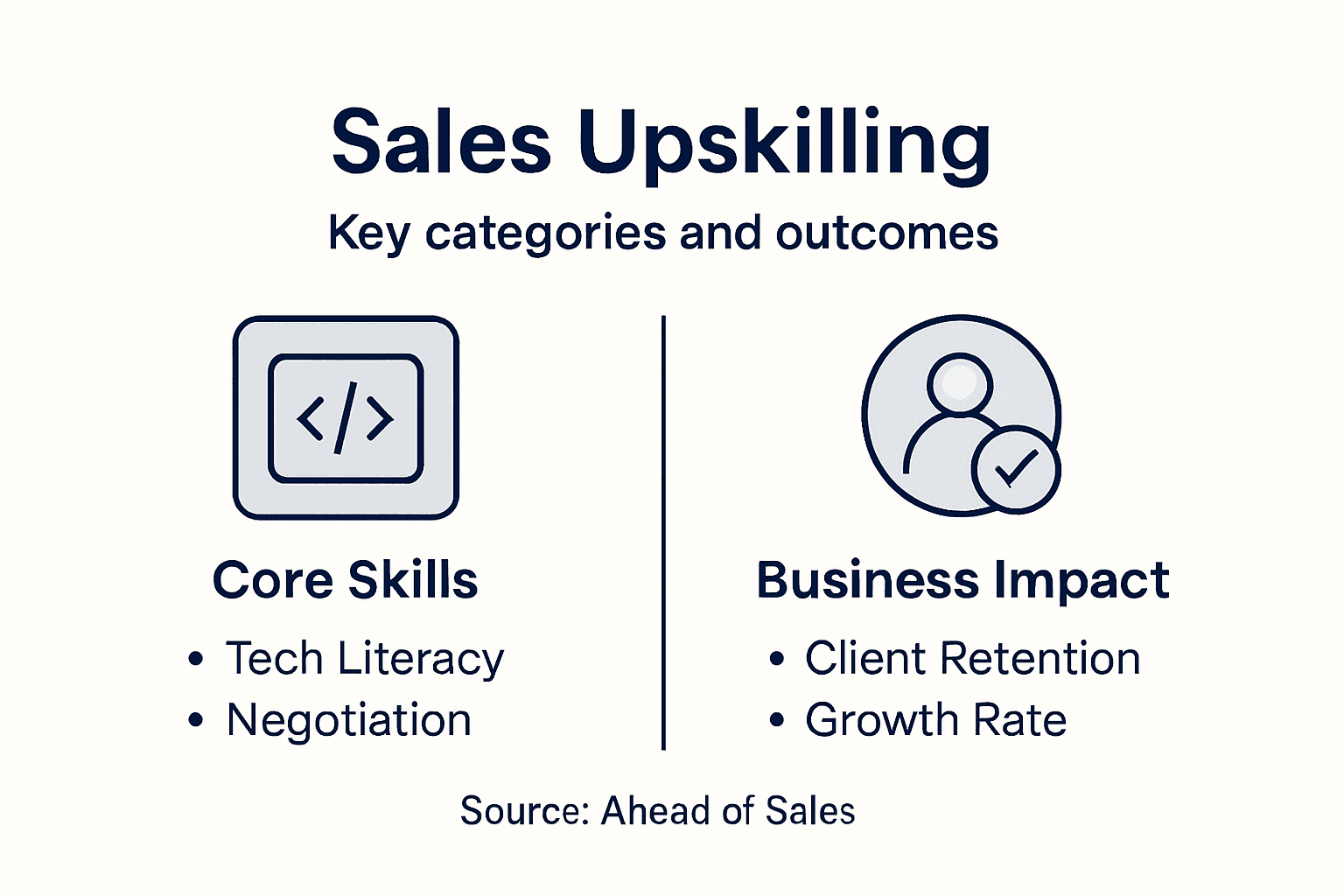
Below is a summary of key skill categories and their business impact relevant to legal sales upskilling:
| Skill Category | Description | Business Impact |
|---|---|---|
| Technological Literacy | Using digital tools for legal service | Increases efficiency and scalability |
| Commercial Awareness | Understanding business environment | Enables tailored client solutions |
| Relationship Management | Building long-term client partnerships | Fosters client loyalty and referrals |
| Strategic Communication | Translating legal to business language | Enhances proposal success rates |
| Negotiation Skills | Securing agreements beneficial to clients | Improves deal closures and retention |
How Bespoke Programmes Enhance Performance
Bespoke upskilling programmes represent a transformative approach to professional development in legal firms, offering targeted solutions that address specific performance challenges and individual learning needs. Customised learning interventions are designed to bridge critical skill gaps and accelerate professional growth by aligning training precisely with organisational objectives and individual capabilities.
The core strength of bespoke programmes lies in their ability to personalise learning experiences. Unlike generic training modules, these programmes conduct comprehensive skills assessments to identify unique competency requirements for each legal professional. This approach enables highly focused interventions that target specific areas such as technological proficiency, client communication strategies, business development skills, and advanced negotiation techniques. By tailoring content to individual learning styles and professional contexts, legal firms can ensure more meaningful and impactful skill development.
Moreover, bespoke programmes facilitate faster knowledge transfer and higher retention rates by integrating practical, real-world scenarios directly relevant to a lawyer’s specific practice area. These programmes typically combine multiple learning modalities, including interactive workshops, digital learning platforms, one-to-one coaching, and immersive simulation exercises. The goal is to create a holistic learning environment that not only imparts knowledge but also builds confidence and practical application skills essential for modern legal professionals navigating complex business landscapes.
Pro tip: Implement a quarterly skills audit and personalised development tracking system to continuously monitor and adapt individual learning pathways in your legal team.
Here is a comparison of generic versus bespoke upskilling programmes for legal firms:
| Upskilling Approach | Personalisation Level | Learning Effectiveness | Typical Outcomes |
|---|---|---|---|
| Generic Programme | Low | Moderate | Broad knowledge, minimal impact |
| Bespoke Programme | High | High | Targeted growth, better retention |
Practical Applications and Real-World Impact
Sales upskilling programmes translate theoretical knowledge into tangible business outcomes for legal firms through strategic, targeted interventions. 1:1 Sales Coaching demonstrates how individualised approaches can dramatically transform professional performance and organisational capabilities. By focusing on practical skill development, legal professionals can directly enhance their client acquisition, relationship management, and revenue generation strategies.
In real-world contexts, these programmes manifest through multiple practical applications. Lawyers learn to develop sophisticated business pitches, understand complex client procurement processes, and leverage technology for more efficient service delivery. This might involve mastering customer relationship management (CRM) tools, developing data-driven client engagement strategies, and creating compelling value propositions that differentiate their legal services in competitive markets. The key is translating technical legal expertise into strategic business communication that resonates with client needs and organisational objectives.
Moreover, practical applications extend beyond individual skill enhancement to broader organisational transformation. Sales upskilling programmes enable legal firms to create a culture of continuous learning, adaptability, and proactive business development. By equipping lawyers with commercial acumen, communication strategies, and technological proficiency, firms can develop more versatile professionals who understand the intricate connections between legal expertise and business strategy. This holistic approach ensures that legal professionals are not just service providers, but strategic partners who can drive meaningful business outcomes for their clients.
Pro tip: Establish a mentorship programme where senior lawyers with strong business development skills directly coach junior team members on practical sales and client engagement strategies.
Common Barriers and Cost Implications
Digital upskilling challenges in legal firms reveal complex obstacles that impede effective professional development initiatives. The primary barriers stem from structural challenges within traditional legal organisations, including resistance to change, limited training resources, and the inherent difficulty of quantifying return on investment for skill enhancement programmes.
Cost implications represent a significant deterrent for many legal firms considering comprehensive upskilling strategies. Training programmes require substantial financial investment, including expenses related to curriculum development, technology platforms, dedicated trainer time, and potential productivity losses during learning periods. Smaller legal practices often find these financial requirements particularly challenging, as they must balance immediate operational costs with long-term professional development investments. The opportunity cost of removing lawyers from billable work for training further complicates financial decision-making.
Moreover, organisational cultural resistance compounds these financial challenges. Many legal professionals view traditional skill sets as sufficient, creating internal friction against comprehensive upskilling initiatives. This resistance manifests through skepticism about the practical value of training programmes, concerns about time allocation, and a fundamental misalignment between existing professional expectations and emerging business development requirements. Successful implementation requires not just financial investment, but a strategic approach to change management that addresses both psychological and practical barriers to professional skill transformation.
Pro tip: Develop a phased implementation strategy with clear, measurable milestones and create a transparent cost-benefit analysis that demonstrates the direct financial impact of upskilling investments.
Mistakes to Avoid in Sales Upskilling Initiatives
Legal firms frequently encounter critical pitfalls when implementing sales upskilling programmes, with systematic learning challenges representing significant obstacles to effective professional development. The most prevalent mistake is adopting a generic, one-size-fits-all approach that fails to recognise the unique learning requirements and professional contexts of individual legal practitioners.
Another substantial error involves insufficient technological integration and inadequate customisation of training content. Many organisations mistakenly treat upskilling as a singular event rather than a continuous, adaptive learning process. This approach neglects the dynamic nature of professional skill development, resulting in training programmes that quickly become obsolete and fail to address emerging business challenges. Legal firms must develop flexible, technology-enabled learning ecosystems that can rapidly evolve to meet changing market demands and individual professional development needs.
Furthermore, organisations often disconnect upskilling initiatives from broader strategic objectives, creating a fundamental misalignment between training efforts and organisational growth goals. This disconnect manifests through fragmented learning experiences, inconsistent skill application, and limited mechanisms for measuring the tangible impact of professional development investments. Successful sales upskilling requires a holistic approach that integrates individual learning pathways with clear, measurable business outcomes and provides robust support infrastructures for sustained professional transformation.
Pro tip: Implement a comprehensive skills mapping and tracking system that allows real-time assessment of individual and collective learning progress, enabling targeted interventions and continuous programme refinement.
Unlock Strategic Sales Growth in Your Legal Firm Today
Navigating the complex landscape of legal sales upskilling requires more than basic training. This article highlights the challenges legal firms face when transforming lawyers into strategic business professionals equipped with commercial awareness, negotiation, and client engagement skills. If your firm struggles with resistance to change, limited resources, or aligning sales development with business objectives, bespoke and targeted coaching can provide the breakthrough.
At Ahead of Sales, we combine personalised 1:1 coaching with expert consultancy, tailored specifically for firms eager to drive consistent growth and ensure their sales teams hit targets every quarter. Our proven methodology addresses key pain points such as commercial skill gaps and strategic communication challenges. By focusing on practical applications and ongoing development, legal professionals can become trusted business advisors driving real growth.
Explore how our approaches align with insights from the Sales Strategy Archives – Ahead of Sales and discover success stories that demonstrate tangible results.

Don’t wait to empower your legal team with the skills required to thrive in today’s competitive market. Visit Ahead of Sales now for tailored sales acceleration programmes starting from £4,500. Learn more in our Sales Playbook Archives – Ahead of Sales and take the first step towards transforming your firm’s sales capabilities.
Frequently Asked Questions
What is sales upskilling for legal firms?
Sales upskilling for legal firms is the process of developing comprehensive skills that enable lawyers to move beyond traditional legal expertise, transforming them into strategic business professionals who can drive organisational growth.
Why is technological literacy important in legal sales upskilling?
Technological literacy is crucial as it enables legal professionals to leverage digital tools for efficient service delivery, improving overall efficiency and scalability of legal services offered to clients.
How can bespoke training programmes benefit legal professionals?
Bespoke training programmes personalise learning experiences by addressing individual skill gaps, resulting in targeted growth, better retention, and more effective application of new skills in practical scenarios relevant to a lawyer’s specific practice area.
What common barriers do legal firms face in implementing sales upskilling initiatives?
Common barriers include resistance to change, limited training resources, difficulty in quantifying ROI, and a cultural misalignment that undervalues comprehensive upskilling initiatives among legal professionals.