
Did you know that companies with well-defined sales strategies are up to 33 percent more likely to outperform their competitors in revenue growth? Knowing how to approach sales sets the stage for lasting business success. Whether you run a startup or lead a large team, understanding the principles behind great sales strategies helps you convert more leads, strengthen customer loyalty, and sustain profit in a changing market.
Table of Contents
- What Is Sales Strategy? Core Principles Defined
- Key Sales Strategy Types And Approaches
- How Sales Strategies Drive Sustainable Growth
- Critical Success Factors And Common Mistakes
- Integrating Coaching And Traditional Methods For Results
Key Takeaways
| Sales Strategy Insights | Details |
|---|---|
| Comprehensive Blueprint | A sales strategy serves as a systematic roadmap for organizations to drive revenue through well-defined processes and methodologies. |
| Dynamic and Adaptive | Successful sales strategies evolve with market conditions, requiring continuous analysis, performance tracking, and an agile approach. |
| Diverse Sales Approaches | Different circumstances necessitate tailored sales methodologies, such as consultative, relationship, and value-based selling, each suited for specific contexts. |
| Integration of Coaching | Modern sales success relies on blending traditional methods with personalized coaching to enhance performance and address individual skill gaps. |
What Is Sales Strategy? Core Principles Defined
A sales strategy is a comprehensive blueprint that defines how an organisation will systematically approach selling its products or services to generate sustainable revenue growth. Think of it like a detailed roadmap guiding your sales team’s actions, priorities, and approach to converting potential customers into loyal clients.
At its core, a sales strategy goes far beyond simple transaction mechanics. According to Wikipedia’s exploration of Porter’s generic strategies, effective sales strategies fundamentally revolve around achieving competitive advantage through three primary approaches: cost leadership, differentiation, and focused targeting. This means businesses must deliberately choose whether they will compete by being the lowest-cost provider, offering unique value propositions, or targeting specific market segments with precision.
Modern sales strategies have evolved to become increasingly sophisticated and data-driven. Wikipedia’s insights on account-based marketing highlight how advanced organisations now treat high-value accounts as distinct markets, aligning sales and marketing efforts with unprecedented granularity. This approach transforms traditional sales from a volume-based numbers game into a strategic, relationship-driven discipline.
The most powerful sales strategies typically incorporate several critical elements:
- Clear identification of ideal customer profiles
- Precise revenue and growth targets
- Defined sales processes and methodologies
- Comprehensive understanding of competitive landscape
- Robust performance measurement and tracking mechanisms
Ultimately, a world-class sales strategy isn’t just a document – it’s a living, breathing framework that adapts to market dynamics while maintaining laser-focused commitment to sustainable business growth.
Key Sales Strategy Types and Approaches
Every successful business understands that a one-size-fits-all approach to sales is fundamentally flawed. Different markets, customer segments, and business models demand nuanced and strategic sales methodologies that can adapt and resonate with specific audience needs.
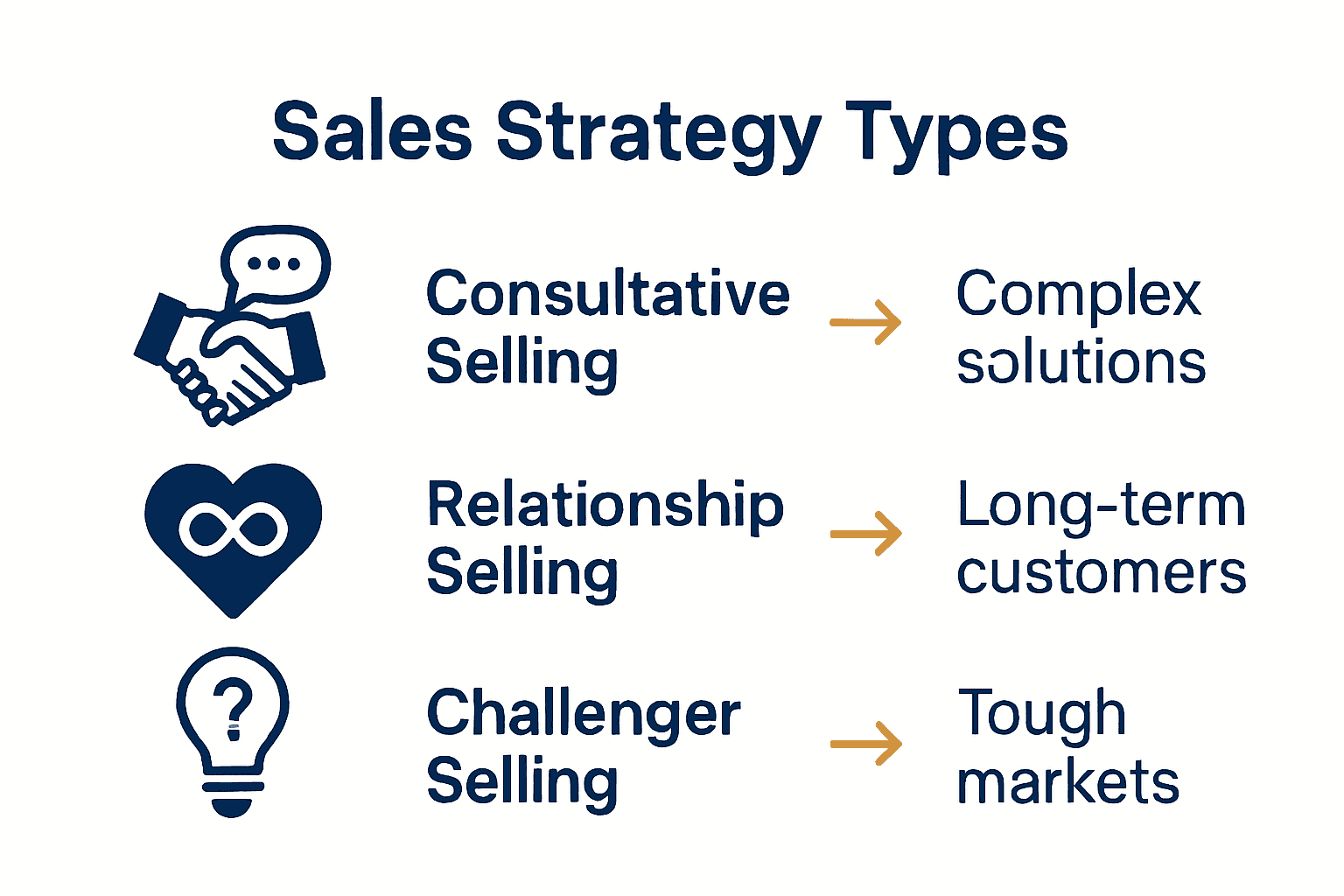
According to Kennect, organisations typically leverage several sophisticated sales approaches to drive revenue and customer engagement. These diverse strategies include consultative selling, where sales professionals act as trusted advisors providing tailored solutions; relationship selling, which prioritises long-term client connections over transactional interactions; challenger selling, which involves provocatively challenging customer perspectives; social selling, leveraging digital platforms and networks; direct sales, focusing on immediate, personal customer interactions; and value-based selling, centred on demonstrating tangible economic benefits.
Each sales approach carries distinct advantages and is most effective when precisely matched to specific business contexts.

Here’s a comparison of the most common sales strategy types and their ideal use cases:
| Sales Strategy Type | Description | Best Suited For |
|---|---|---|
| Consultative Selling | Advising with tailored solutions | Complex B2B sales Multi-stakeholder deals |
| Relationship Selling | Focusing on long-term client connections | Extended sales cycles High-trust industries |
| Challenger Selling | Challenging customer perspectives | Resistant or unaware customers Innovative markets |
| Social Selling | Leveraging digital platforms and networks | Online lead generation Tech-savvy audiences |
| Direct Sales | Personal, immediate customer interactions | Simple offerings Transactional environments |
| Value-Based Selling | Demonstrating tangible economic benefits | ROI-driven clients B2B technology solutions |
| Consultative selling works exceptionally well in complex B2B environments where purchasing decisions involve multiple stakeholders and require deep understanding. Relationship selling proves powerful in industries with extended sales cycles and high-trust requirements, such as professional services or enterprise technology. Challenger selling excels in markets where customers might be resistant to change or unaware of innovative solutions. |
Successful sales strategies are not static but dynamic frameworks that evolve with market conditions. Smart organisations continuously assess and adapt their approach by:
- Regularly analysing customer feedback
- Tracking conversion and retention metrics
- Investing in ongoing sales team training
- Embracing technological tools that enhance sales intelligence
- Maintaining flexibility in methodology
Ultimately, the most effective sales strategy is one that combines strategic insight, deep customer understanding, and a commitment to delivering genuine value beyond mere transactional exchanges.
How Sales Strategies Drive Sustainable Growth
Sustainable growth isn’t a magical outcome but a meticulously engineered result of strategic sales approaches that consistently align business capabilities with market opportunities. It represents an organisation’s ability to expand revenue, market share, and customer base without compromising long-term financial stability or operational integrity.
Wikipedia’s research on marketing mix modeling reveals that successful organisations leverage comprehensive data analysis to understand how various marketing activities directly impact sales performance. This approach transforms sales from a reactive function into a predictive, strategic discipline that can systematically optimize revenue generation by precisely understanding which tactics deliver the most significant returns.
Further insights from ArXiv’s research on situation awareness highlight that integrating advanced information fusion techniques can dramatically enhance sales decision-making. By creating a holistic view of customer interactions, market dynamics, and internal capabilities, businesses can develop adaptive sales strategies that respond intelligently to changing conditions while maintaining consistent growth momentum.
Key elements that drive sustainable sales growth include:
- Continuous skills development for sales teams
- Data-driven performance measurement
- Customer-centric approach to solution design
- Agile response to market shifts
- Strategic investment in technological capabilities
Ultimately, sustainable growth emerges from a sophisticated interplay between strategic insight, technological enablement, and a relentless commitment to understanding and serving customer needs with exceptional precision and value.
Critical Success Factors and Common Mistakes
Navigating the complex landscape of sales strategy requires a nuanced understanding of both critical success factors and potential pitfalls that can derail organisational growth. Successful businesses recognize that sustainable sales performance is not about luck, but about strategic design and continuous improvement.
ArXiv research on sales pipeline management reveals that effective sales pipeline management and accurate win propensity prediction are fundamental to achieving consistent revenue targets. The research highlights that many organisations fail by neglecting data-driven approaches and remaining static in dynamic market conditions. This means simply having a sales strategy is insufficient; it must be a living, adaptive framework that responds intelligently to changing market dynamics.
Additionally, ArXiv’s research on advanced analytical tools underscores the critical importance of leveraging sophisticated machine learning techniques like transfer learning and additive regression models to improve sales forecasting accuracy. This approach transforms traditional sales prediction from a reactive guesswork exercise into a precise, predictive science that can anticipate market trends and customer behaviors with remarkable precision.
Critical success factors for robust sales strategies include:
- Rigorous, continuous performance measurement
- Comprehensive skills development programmes
- Advanced data analytics capabilities
- Agile decision-making frameworks
- Customer-centric solution design
Common mistakes that can critically undermine sales performance typically involve:
- Ignoring data and relying on intuition
- Failing to invest in sales team training
- Maintaining rigid, unchanging sales approaches
- Neglecting customer feedback loops
- Undervaluing technological integration
Ultimately, exceptional sales strategies are not about perfection, but about creating resilient, adaptive systems that can learn, evolve, and consistently deliver value in an ever-changing business landscape.
Integrating Coaching and Traditional Methods for Results
The modern sales landscape demands a sophisticated approach that transcends traditional methodologies, blending time-tested strategies with innovative coaching techniques to unlock unprecedented team performance. Sales transformation is no longer about replacing old methods, but strategically integrating them with cutting-edge development approaches.
The Journal of Personal Selling & Sales Management emphasizes that successful sales organisations recognise coaching as a critical complementary approach to traditional sales training. This means moving beyond generic training programmes to create personalised, continuous learning experiences that address individual skill gaps, behavioural patterns, and performance potential.
Effective integration requires a multifaceted approach that combines structured traditional methods with personalised coaching interventions. This hybrid model typically involves:
- Systematic skill assessments
- Individualized performance coaching
- Regular knowledge transfer sessions
- Technology-enabled learning platforms
- Continuous feedback mechanisms
The most powerful coaching frameworks go beyond mere skill development, focusing on holistic performance enhancement. This means addressing not just technical sales capabilities, but also emotional intelligence, psychological resilience, and adaptive thinking skills that enable sales professionals to navigate complex customer interactions with confidence and strategic insight.
Key strategies for successful integration include:
- Developing customised learning pathways
- Implementing real-time performance tracking
- Creating mentorship and peer learning programmes
- Leveraging data analytics for targeted skill development
- Fostering a culture of continuous improvement
Ultimately, the most effective sales organisations view coaching not as an occasional intervention, but as a fundamental, ongoing process of professional transformation that continuously elevates individual and collective performance.
Unlock Sustainable Sales Growth with a Bespoke Strategy
The article highlights the critical need for adaptive and data-driven sales strategies that consistently deliver sustainable growth. If your business faces challenges like overcoming rigid sales approaches, lacking precise forecasting, or struggling to align your sales team with evolving market demands, you are not alone. Implementing concepts such as consultative selling and embracing continuous coaching can transform these pain points into powerful opportunities.
At Ahead of Sales, we specialise in blending personalised 1:1 coaching with proven traditional training and consultancy to help businesses like yours achieve at least 50% sales growth each year. Our programmes are designed for teams seeking to hit targets every quarter by integrating advanced sales methodologies discussed in the article, including customer-centric solution design and agile sales processes. Discover how tailored sales acceleration and growth strategies can elevate your performance by visiting our website.
Ready to move from strategy to results? Experience the difference of a customised sales transformation with our packages crafted for businesses with growth mindsets.
Take the first step towards consistent, measurable sales success today. Learn more about how our bespoke coaching and training can empower your team. Visit Ahead of Sales now and start building your comprehensive growth blueprint.
Frequently Asked Questions
What is a sales strategy?
A sales strategy is a comprehensive blueprint that defines how an organization will approach selling its products or services to generate sustainable revenue growth. It serves as a roadmap guiding the sales team in converting potential customers into loyal clients.
What are the core principles of a successful sales strategy?
Successful sales strategies revolve around achieving competitive advantage through cost leadership, differentiation, and focused targeting. They also include clearly identifying ideal customer profiles, setting revenue targets, understanding the competitive landscape, and implementing robust performance measurement mechanisms.
How do different sales strategies impact business growth?
Different sales strategies, such as consultative selling, relationship selling, and value-based selling, allow businesses to tailor their approaches to specific markets and customer segments. This adaptability helps in meeting diverse customer needs and drives sustainable growth by enhancing revenue and market share.
What are common mistakes to avoid when implementing a sales strategy?
Common mistakes include ignoring data analytics, failing to invest in team training, maintaining rigid sales methods, neglecting customer feedback, and undervaluing the integration of technology in sales processes.