
Bold growth targets are no longer reserved for giant corporations. Many British medium-sized companies are now aiming for at least 50 percent annual sales increases, yet only around 30 percent actually meet those ambitious goals. For sales leaders, mastering effective sales planning is the difference between falling short and driving real performance. This guide outlines the critical fundamentals behind sales planning frameworks, presenting practical strategies that help British teams turn expected potential into measurable results.
Table of Contents
- Understanding Sales Planning Fundamentals
- Sales Planning Types And Key Distinctions
- Critical Elements Of A Successful Sales Plan
- Common Pitfalls And Risks In Sales Planning
- Maximising Growth Through Data-Driven Planning
Key Takeaways
| Point | Details |
|---|---|
| Strategic Sales Planning | A successful sales plan integrates forecasting, market segmentation, and performance metrics to drive business growth. |
| Types of Sales Planning | Understanding the distinctions between B2C, B2B, and enterprise sales models is crucial for tailored approaches. |
| Risks in Sales Planning | Prioritising short-term gains can lead to misalignment with customer values and increased churn, necessitating a focus on strategic customer selection. |
| Data-Driven Decision Making | Embracing data analytics enhances forecasting accuracy and supports more effective resource allocation and customer targeting. |
Understanding Sales Planning Fundamentals
Sales planning represents a strategic roadmap that transforms potential revenue opportunities into actionable business growth. At its core, sales planning involves systematically designing frameworks to predict, analyse, and achieve consistent sales performance. Sales management techniques require comprehensive understanding of organisational objectives, market dynamics, and team capabilities.
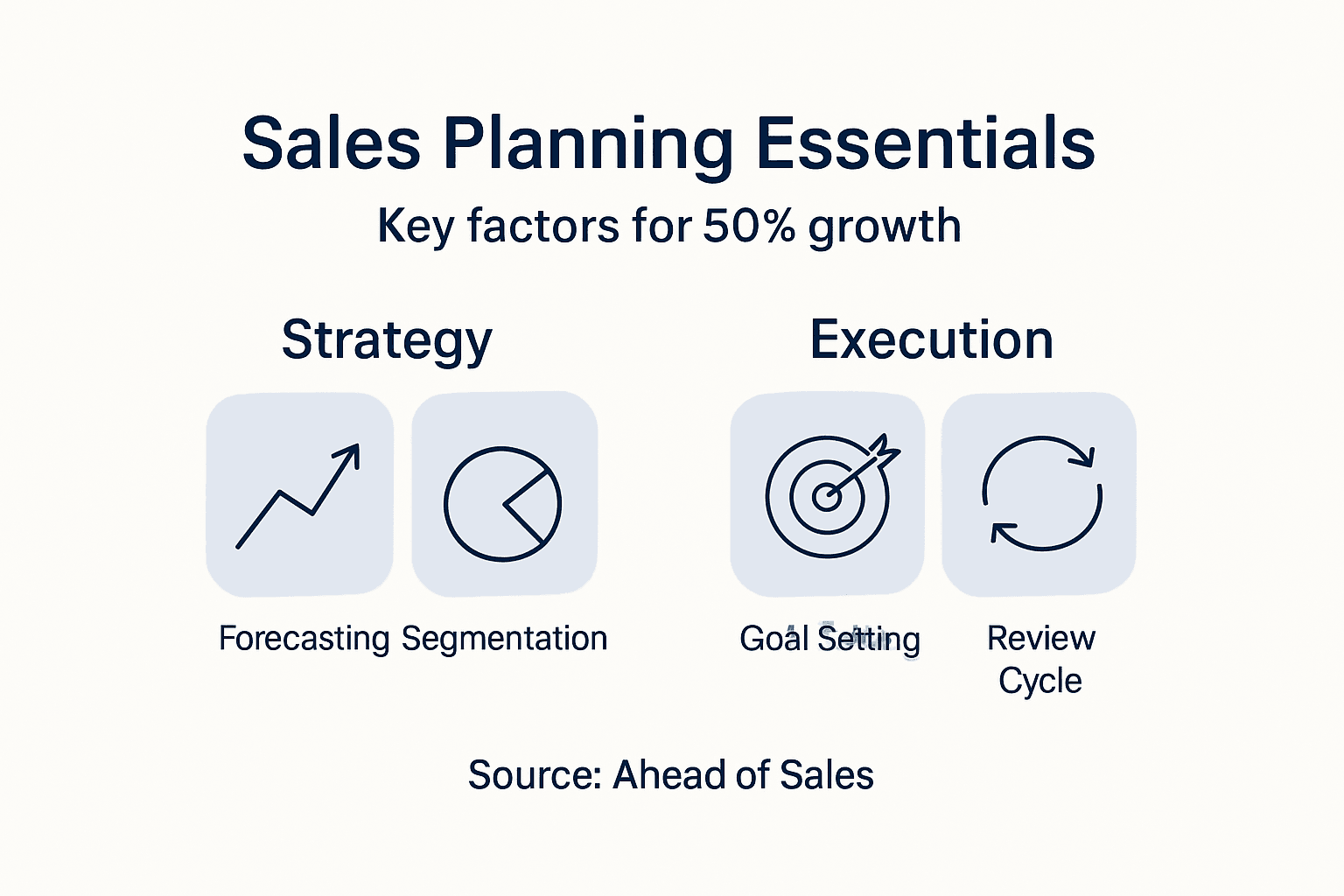
Successful sales planning encompasses multiple critical dimensions: forecasting potential revenue, establishing realistic targets, identifying potential market segments, and developing strategies to penetrate those segments effectively. Sales leaders must create detailed plans that align individual performance metrics with broader organisational goals, ensuring every team member understands their role in driving revenue growth.
Effective sales planning involves sophisticated techniques including quantitative analysis, competitive intelligence gathering, and strategic resource allocation. Sales professionals need to develop comprehensive strategies that account for market volatility, customer behaviour patterns, and emerging industry trends. This requires continuous monitoring of performance indicators, regular strategy refinement, and adaptable approaches that can pivot quickly in response to changing business environments.
Pro tip: Develop a quarterly sales planning review process that includes data-driven performance assessments and allows for agile strategy adjustments based on real-time market feedback.
Sales Planning Types And Key Distinctions
Sales planning is not a one-size-fits-all approach, but rather a nuanced discipline with distinct strategies tailored to different business contexts. Sales management approaches reveal critical variations across business models, each requiring unique planning methodologies and execution strategies.
The primary sales planning types include Business-to-Consumer (B2C), Business-to-Business (B2B), and enterprise sales planning. B2C sales planning typically focuses on shorter sales cycles, high-volume transactions, and more direct consumer engagement strategies. B2B sales planning, in contrast, involves longer decision-making processes, complex stakeholder negotiations, and more relationship-driven approaches. Enterprise sales planning represents the most sophisticated model, characterised by extended sales cycles, significant deal values, and intricate multi-stakeholder engagement strategies.
The following table highlights key distinctions between the three main types of sales planning models:
| Sales Model | Typical Sales Cycle | Customer Engagement Focus |
|---|---|---|
| B2C | Short and transactional | Direct consumer marketing |
| B2B | Medium to long-term | Relationship building and negotiation |
| Enterprise | Extended and complex | Multi-level stakeholder management |
Sales and Operations Planning (S&OP) provides another critical dimension to sales strategy. This integrated planning approach synchronises sales forecasts with production capabilities, inventory management, and budgetary constraints. By aligning multiple organisational functions, S&OP enables businesses to balance demand and supply effectively, creating a more holistic approach to revenue generation and resource allocation.
Pro tip: Create flexible sales planning frameworks that can be rapidly adapted across different sales models, ensuring your strategy remains responsive to changing market dynamics and organisational needs.
Critical Elements Of A Successful Sales Plan
Crafting a successful sales plan requires a strategic approach that goes beyond simple revenue targets. Optimising sales processes demands comprehensive understanding of key elements that drive sustainable business growth. These foundational components create a robust framework for predictable and scalable sales performance.
The critical elements of an effective sales plan include precise market segmentation, clear product positioning, and well-defined customer journey mapping. Businesses must articulate their unique competitive advantages, identifying exactly who their ideal customers are and how their offerings solve specific problems. This involves developing detailed customer personas, understanding purchase motivations, and creating targeted engagement strategies that resonate with each market segment.

Quantifiable goal-setting forms another crucial dimension of successful sales planning. This means establishing specific, measurable objectives that align with broader organisational strategies. Key performance indicators (KPIs) should cover multiple dimensions including lead generation rates, conversion percentages, average deal sizes, and customer acquisition costs. By creating a comprehensive measurement framework, sales teams can track progress, identify improvement opportunities, and maintain accountability throughout the sales cycle.
Here is a summary of essential sales performance metrics, along with their strategic value:
| Metric | What It Measures | Impact on Sales Strategy |
|---|---|---|
| Lead Generation Rate | New prospects acquired | Indicates effectiveness of outreach |
| Conversion Percentage | Leads turning to clients | Reveals process efficiency |
| Average Deal Size | Typical revenue per sale | Guides resource allocation |
| Customer Acquisition Cost | Cost per new customer | Assesses sales channel profitability |
Pro tip: Develop a dynamic sales plan that includes quarterly review mechanisms, allowing for real-time strategy adjustments based on market feedback and performance data.
Common Pitfalls And Risks In Sales Planning
Sales planning is fraught with potential risks that can dramatically undermine organisational growth objectives. Strategic planning pitfalls represent critical challenges that sales leaders must proactively identify and mitigate to ensure sustainable performance and predictable revenue generation.
One of the most significant risks in sales planning is the dangerous tendency to prioritise short-term revenue over long-term customer fit. This approach creates what strategic experts call ‘sales debt’ – a condition where organisations acquire customers who are fundamentally misaligned with their core value proposition. Such misalignment leads to increased customer churn, higher acquisition costs, and reduced overall profitability. Sales teams must develop sophisticated qualification processes that prioritise strategic customer selection over immediate financial gains.
Additional critical pitfalls include implementing too many initiatives simultaneously, neglecting stakeholder perspectives, and failing to establish robust review mechanisms. Successful sales planning requires disciplined focus, clear prioritisation, and continuous adaptation. This means creating flexible frameworks that can quickly respond to market changes, regularly reassessing performance metrics, and maintaining a holistic view of sales strategy that extends beyond immediate quarterly targets.
Pro tip: Implement a quarterly sales strategy review process that critically evaluates customer acquisition costs, retention rates, and alignment between sales activities and broader organisational objectives.
Maximising Growth Through Data-Driven Planning
Data represents the cornerstone of modern sales strategy, transforming traditional planning approaches into precision-driven growth mechanisms. Data-driven innovation enables organisations to develop sophisticated strategies that transcend intuition, leveraging empirical insights to make strategic decisions with unprecedented accuracy.
Successful data-driven planning requires sophisticated analytical capabilities that go beyond basic reporting. Sales teams must develop comprehensive data collection frameworks that capture nuanced performance metrics, customer behaviour patterns, and market dynamics. This involves integrating multiple data sources, including customer relationship management (CRM) systems, market research reports, competitive intelligence, and internal performance tracking mechanisms. By creating a holistic view of sales performance, organisations can identify subtle opportunities for optimisation and strategic intervention.
The implementation of data-driven planning demands a cultural shift towards analytical thinking and continuous learning. Sales professionals must develop advanced skills in data interpretation, statistical analysis, and predictive modelling. This requires investment in training, technological infrastructure, and creating robust feedback loops that enable rapid strategy refinement. Organisations that successfully embrace data-driven approaches can achieve remarkable competitive advantages, including more accurate forecasting, targeted customer acquisition, and more efficient resource allocation.
Pro tip: Invest in regular data literacy training for your sales team, ensuring they can effectively interpret and act on complex analytical insights.
Unlock 50% Sales Growth with Expert Sales Planning Support
If you found the insights on sales planning strategies and overcoming common pitfalls valuable, it is time to take control of your business growth by partnering with experts who can tailor a winning sales plan for your team. At Ahead of Sales, we understand the challenges of aligning market segmentation, goal setting, and data-driven decision making to deliver consistent quarterly targets and sustainable expansion.

Explore our Sales Strategy Archives – Ahead of Sales to discover proven frameworks that complement your sales planning knowledge. Whether you lead a company with 50 to 1000 staff seeking at least 50 percent sales growth every year or you are a solo service business aiming to accelerate your results, our bespoke 1:1 coaching and consultancy packages will help your sales team hit their targets regularly. Act now to build resilience against sales debt and market volatility by visiting Ahead of Sales and exploring tailored solutions within our Sales Playbook Archives – Ahead of Sales.
Take the next step towards transforming your sales outcomes today.
Frequently Asked Questions
What is sales planning?
Sales planning is a strategic roadmap that helps businesses anticipate and achieve revenue targets by systematically analysing market dynamics, forecasting potential revenue, and establishing performance metrics aligned with organisational goals.
Why is data important in sales planning?
Data is crucial in sales planning as it transforms traditional strategies into precision-driven approaches. It enables organisations to make informed decisions based on empirical insights regarding customer behaviour and market trends, leading to more accurate forecasting and targeted customer acquisition.
How does effective sales planning differ for B2B and B2C businesses?
Effective sales planning for B2B businesses typically involves longer sales cycles, complex negotiations, and a focus on relationship building, whereas B2C sales planning prioritises shorter transactions and direct consumer engagement strategies.
What are common pitfalls in sales planning?
Common pitfalls in sales planning include prioritising short-term revenue over long-term customer fit, implementing too many initiatives at once, and failing to establish robust performance review mechanisms, which can hinder sustainable growth and customer alignment.