
Most companies underestimate the power of clear sales performance metrics, yet more than 60 percent of british organisations report that tracking these numbers transforms their approach to revenue growth. When businesses know exactly which figures matter, they can focus their energy on what really drives results. This guide explains how understanding the right performance metrics can help you pinpoint strengths, tackle weaknesses, and build a sales strategy that delivers consistent, measurable success.
Table of Contents
- Defining Sales Performance Metrics
- Types of Metrics and Key Distinctions
- Essential KPIs for Modern Sales Teams
- Common Pitfalls in Measurement and Analysis
- Integrating Metrics Into Sales Strategy
- Best Tools and Technologies for Tracking
Key Takeaways
| Point | Details |
|---|---|
| Sales performance metrics are essential | These metrics provide insights into revenue generation and identify areas for improvement within a sales team. |
| Diverse types of sales metrics | Metrics can be categorised into financial, operational, customer-focused, and behavioural types for a comprehensive analysis. |
| KPIs drive strategic improvements | Identifying and tracking the right Key Performance Indicators is crucial for enhancing sales team performance and achieving growth. |
| Integrating metrics into strategy | Aligning performance measurements with business objectives allows organisations to make data-driven decisions that foster sustainable growth. |
Defining Sales Performance Metrics
Sales performance metrics are quantifiable measurements used to track, analyse, and evaluate the effectiveness of a sales team’s activities and outcomes. Sales metrics provide crucial insights into individual and collective sales performance, enabling businesses to understand their revenue generation capabilities and identify areas for improvement.
According to Wikipedia, metrics like the Category Development Index (CDI) help organisations measure sales performance within specific customer segments. This approach allows businesses to quantify relative performance and strategically target growth opportunities across different market groups.
Key sales performance metrics typically include financial indicators and operational benchmarks. As revealed by Wikipedia, operating margin represents a critical metric that calculates the proportion of revenue remaining after variable production costs, expressed as a percentage. This metric helps leadership understand profitability and operational efficiency before accounting for indirect expenses.
Effective sales performance metrics go beyond simple revenue tracking and provide multidimensional insights. These measurements help organisations:

- Identify top-performing sales representatives
- Understand customer acquisition costs
- Track conversion rates
- Predict future sales potential
- Align sales strategies with business objectives
By systematically measuring and analysing these metrics, businesses can make data-driven decisions that drive sustainable growth and competitive advantage. Sales Team Performance Explained offers deeper insights into leveraging performance metrics for maximum organisational success.
Types of Metrics and Key Distinctions
Sales performance metrics can be categorised into several distinct types, each offering unique insights into organisational effectiveness and strategic performance. Understanding these different categories helps businesses develop a comprehensive approach to measuring and improving sales outcomes.
According to Wikipedia, the Balanced Scorecard approach demonstrates that effective metric systems should encompass both financial and non-financial measures. This holistic perspective allows organisations to align their measurement strategies with broader strategic objectives, moving beyond traditional revenue-focused tracking.
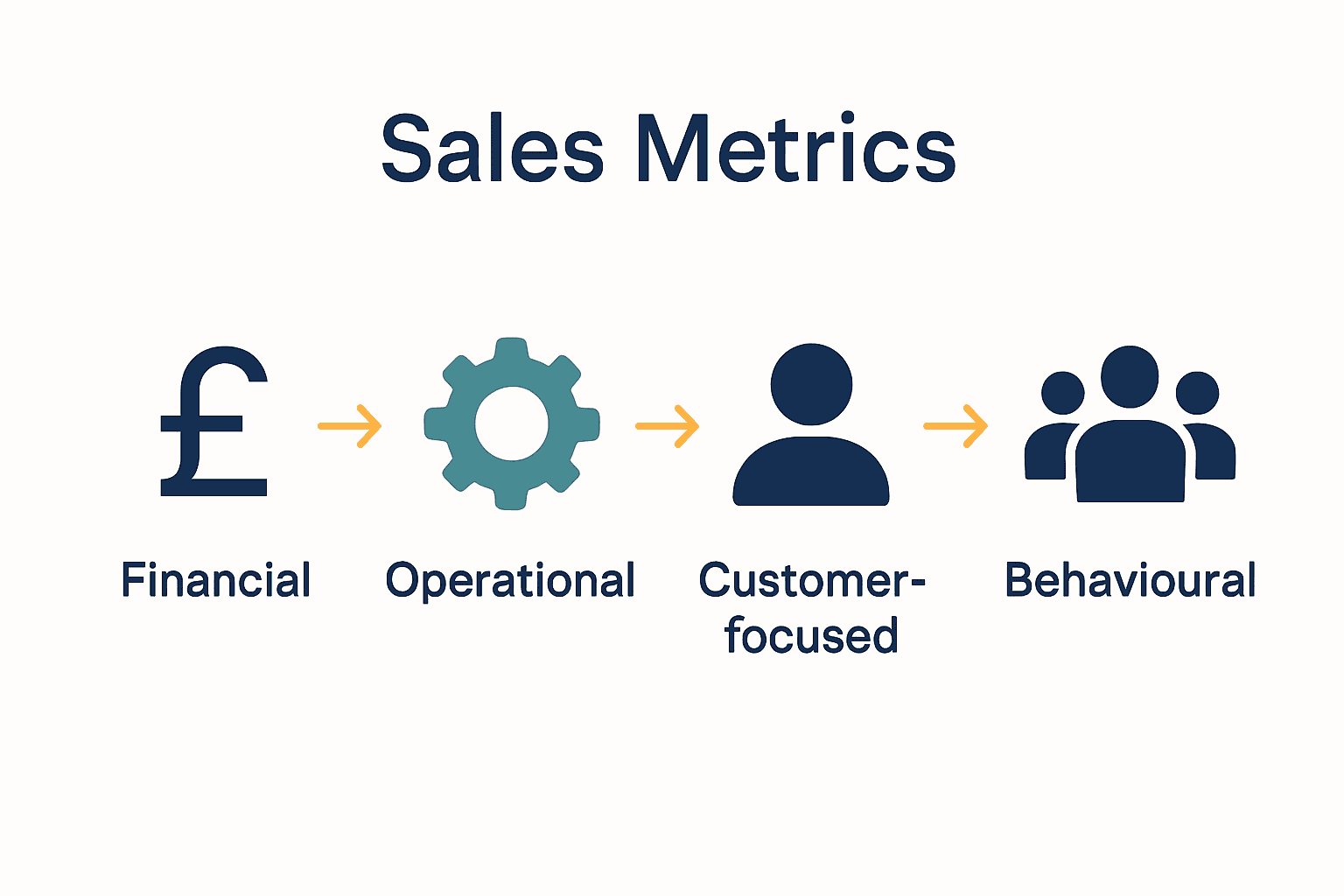
Types of sales performance metrics can be broadly classified into four primary categories:
- Financial Metrics: Directly measure monetary performance
- Operational Metrics: Track efficiency and productivity
- Customer-Focused Metrics: Evaluate relationship and satisfaction indicators
- Behavioural Metrics: Assess individual and team performance characteristics
As highlighted by Wikipedia, metrics like the Brand Development Index (BDI) showcase how sophisticated measurement tools can help organisations understand nuanced performance variations across different market segments. These advanced metrics provide granular insights that go beyond surface-level revenue calculations.
Understanding the distinctions between these metric types enables leadership to create more nuanced, strategic approaches to sales performance management.
Sales Team Effectiveness Explained provides additional context for implementing these sophisticated measurement strategies.
Essential KPIs for Modern Sales Teams
Key Performance Indicators (KPIs) are the critical metrics that enable sales teams to measure their performance, track progress, and drive strategic improvements. In today’s competitive business landscape, identifying and monitoring the right KPIs is essential for sustainable growth and operational excellence.
Modern sales teams typically focus on a comprehensive set of KPIs that provide holistic insights into performance. These indicators can be categorised into several crucial dimensions:
- Revenue-Focused KPIs
- Total sales revenue
- Average deal size
- Revenue growth rate
- Quarterly sales targets
- Performance Efficiency KPIs
- Conversion rates
- Sales cycle length
- Win/loss ratio
- Pipeline velocity
- Customer Acquisition KPIs
- Customer acquisition cost
- Number of new customers
- Lead generation rate
- Prospect-to-customer conversion
These multifaceted KPIs provide leadership with a nuanced understanding of sales team performance beyond simple revenue numbers. By tracking these metrics systematically, organisations can identify strengths, address weaknesses, and develop targeted strategies for improvement.
To implement these KPIs effectively, sales leaders must create a data-driven culture that emphasises continuous measurement and strategic adaptation. Sales Team Optimization Guide offers comprehensive strategies for transforming these insights into actionable growth plans.
Common Pitfalls in Measurement and Analysis
Sales performance measurement is a complex process fraught with potential errors that can significantly distort organisational understanding and strategic decision-making. Recognising and mitigating these common pitfalls is crucial for maintaining accurate and meaningful performance insights.
Research from Springer highlights that the associations between sales performance determinants can vary dramatically between traditional and relational sales outputs. This nuanced finding underscores the critical importance of sophisticated, context-aware measurement approaches that go beyond simplistic numerical tracking.
The most prevalent pitfalls in sales performance measurement include:
- Overreliance on Quantitative Metrics
Focusing exclusively on numerical data while ignoring qualitative factors - Inadequate Context Assessment
Measuring performance without considering market conditions or internal dynamics - Inconsistent Measurement Criteria
Using non-standardised approaches that prevent meaningful comparisons - Confirmation Bias
Selectively interpreting data to support pre-existing beliefs
To develop robust measurement strategies, organisations must adopt a holistic approach that balances quantitative precision with nuanced contextual understanding. By recognising these potential measurement traps, sales leaders can create more sophisticated, accurate performance evaluation systems.
Role of Sales Management Guide provides additional insights into developing comprehensive performance measurement frameworks that transcend these common analytical limitations.
Integrating Metrics Into Sales Strategy
Strategic metric integration transforms raw performance data into a powerful catalyst for organisational growth and continuous improvement. By systematically aligning performance measurements with overarching business objectives, sales teams can create a comprehensive framework that drives targeted, actionable insights.
According to research from Admas University, successful metric integration requires defining clear reporting periods and selecting key performance indicators that directly correspond with sales goals. Regular monitoring and evaluation of critical metrics like sales revenue, deal closure rates, and conversion percentages enable leadership to make timely, data-driven interventions.
The strategic integration process involves several critical steps:
- Alignment of Metrics with Strategic Objectives
- Identify primary business goals
- Select metrics that directly measure progress
- Establish clear baseline measurements
- Create benchmarks for success
- Comprehensive Performance Tracking
- Implement real-time monitoring systems
- Develop standardised reporting mechanisms
- Ensure cross-departmental visibility
- Enable rapid performance adjustments
- Continuous Improvement Framework
- Regularly review metric effectiveness
- Adjust measurement strategies
- Encourage data-driven decision making
- Promote a culture of transparency
By creating a holistic approach to metric integration, organisations can transform performance data from passive records into active strategic tools. The goal is not just measurement, but meaningful interpretation and strategic action.
Sales Strategy Explained Guide offers deeper insights into developing comprehensive performance measurement and strategic alignment approaches that can revolutionise organisational effectiveness.
Best Tools and Technologies for Tracking
Sales performance tracking technologies have evolved dramatically, transforming how organisations monitor, predict, and optimise their sales processes. Modern tools leverage advanced analytics, machine learning, and real-time data integration to provide unprecedented insights into sales performance and potential.
Research from arXiv highlights emerging machine learning frameworks that enable sophisticated sales pipeline win propensity prediction. These advanced technologies address complex challenges in predictive modeling, particularly in fast-changing market environments with limited transaction volumes. By employing intelligent algorithms, businesses can now forecast sales opportunities with remarkable precision.
Key technological capabilities for sales performance tracking include:
Predictive Analytics Tools
- Machine learning sales forecasting
- Probability-based opportunity scoring
- Real-time performance prediction
- Dynamic market trend analysis
Data Integration Platforms
- Comprehensive CRM systems
- Cross-platform performance dashboards
- Automated reporting mechanisms
- Seamless data synchronisation
Advanced Monitoring Technologies
- AI-powered performance insights
- Automated anomaly detection
- Predictive intervention recommendations
- Granular performance segmentation
Additionally, emerging research from arXiv demonstrates sophisticated Bayesian methodologies for consumer sales forecasting, introducing dynamic count mixture models that can predict individual customer transactions with unprecedented accuracy.
Sales Acceleration Strategies Guide provides comprehensive insights into implementing these cutting-edge tracking technologies for sustainable business growth.
Unlock Superior Sales Growth Through Tailored Metrics and Coaching
Understanding and effectively applying sales performance metrics can be challenging. You need clear insight into financial indicators, operational benchmarks and behavioural metrics to truly identify growth opportunities and boost your team’s effectiveness. If you find yourself struggling to convert data into strategic action or want to ensure your sales team consistently hits targets every quarter, you are not alone. Sales leaders often need personalised guidance to align metrics with business goals and foster a data-driven culture.
At Ahead of Sales, we specialise in bespoke 1:1 coaching combined with expert training and consultancy to guarantee at least 50 per cent sales growth annually. Our approach precisely targets the key KPIs and sales strategies necessary for your unique business challenges. Whether you manage a team of 50 or 1000 or operate a solo service business seeking accelerated growth, our proven packages help convert complex sales metrics into winning strategies.
Elevate your understanding of sales performance by exploring our Sales Strategy Archives – Ahead of Sales and empower your team with actionable insights today.

Ready to transform how your sales team measures success and drives results Learn how our tailored coaching solutions can integrate seamlessly with your existing metrics and supercharge your growth Visit Ahead of Sales now to take the next step towards consistent quarterly target achievement and sustainable business expansion.
Frequently Asked Questions
What are sales performance metrics?
Sales performance metrics are quantifiable measurements that track, analyse, and evaluate the effectiveness of a sales team’s activities and outcomes, providing insights into sales performance and areas for improvement.
Why are Key Performance Indicators (KPIs) important for sales teams?
KPIs are crucial as they enable sales teams to measure their performance, track progress, and identify strengths and weaknesses, ultimately driving strategic improvements for sustainable growth.
How can I effectively implement sales performance metrics in my organisation?
To implement sales performance metrics effectively, align them with strategic objectives, establish clear reporting periods, monitor them regularly, and foster a data-driven culture within your organisation.
What common pitfalls should I avoid when measuring sales performance?
Common pitfalls include overreliance on quantitative metrics, inadequate context assessment, inconsistent measurement criteria, and confirmation bias, which can distort understanding and decision-making.
One Response