
Bold ambitions often outpace yesterday’s strategies in the fast-moving world of British SaaS sales. From shifting buyer behaviours to the rapid evolution of technology, today’s sales leaders must rethink old playbooks and embrace a new level of agility. This article dissects the core elements of sales growth strategy for 2025, focusing on predictive analytics, channel selection, and modern team acceleration methods to help you build responsive frameworks that actually drive results.
Table of Contents
- Defining Sales Growth Strategies 2025
- Sales Models For High-Growth SaaS Firms
- Breakthrough Acceleration Techniques For Teams
- Quarterly Target Achievement Frameworks
- Common Pitfalls In Rapid Sales Expansion
Key Takeaways
| Point | Details |
|---|---|
| Agility in Sales Strategies | In 2025, organisations must adopt agile, data-driven sales strategies that can quickly adjust to market dynamics. |
| Effective SaaS Sales Models | High-growth SaaS firms should utilise a combination of direct, self-service, and hybrid sales models tailored to their customer segments. |
| Continuous Performance Review | Regular audits of sales metrics and strategies are crucial to ensure ongoing alignment with key performance indicators. |
| Mitigating Expansion Risks | Recognising and addressing potential pitfalls in rapid growth is essential for maintaining quality and sustaining customer relationships. |
Defining Sales Growth Strategies 2025
Sales growth strategies are sophisticated roadmaps designed to systematically accelerate revenue performance across complex business environments. In 2025, these strategies demand unprecedented agility, data-driven precision, and a holistic understanding of evolving market dynamics.
Successful sales growth strategies now require organisations to integrate multiple sophisticated approaches. Predictive analytics and adaptive sales methods have become fundamental, enabling businesses to anticipate market shifts and customer behaviours with remarkable accuracy. These strategies are no longer about simple incremental improvements, but creating comprehensive ecosystems of revenue generation.
Key components of effective sales growth strategies in 2025 include:
- Audience Targeting: Developing hyper-specific customer segmentation
- Value Proposition Refinement: Creating compelling, differentiated offerings
- Technology Integration: Leveraging AI and advanced analytics
- Sales Methodology Alignment: Balancing inbound and outbound approaches
- Continuous Learning: Implementing adaptive training and development programmes
The modern sales strategy recognises that growth is not linear. Instead, it requires a dynamic, responsive framework that can quickly pivot based on real-time market intelligence. Identifying precise target audiences and value propositions becomes critical in creating sustainable revenue streams.
Pro tip: Develop a quarterly review process that critically evaluates your sales strategy’s performance against key performance indicators, ensuring continuous refinement and adaptation.
Sales Models for High-Growth SaaS Firms
SaaS firms require sophisticated sales models that balance technological innovation with strategic customer engagement. Unlike traditional sales approaches, SaaS sales channels demand nuanced strategy that combines digital communication and personalised direct sales techniques.
Modern SaaS sales models typically encompass three primary approaches:
- Direct Sales Model: High-touch strategy targeting enterprise clients
- Self-Service Model: Low-touch digital acquisition for smaller businesses
- Hybrid Sales Model: Blending digital and personal interaction strategies
Successful sales approaches for high-growth SaaS organisations prioritise understanding critical performance metrics. Sales channel strategies require careful segmentation to optimise customer acquisition costs and maximise lifetime value. Key performance indicators like customer acquisition cost, monthly recurring revenue, and churn rate become fundamental measurements of sales model effectiveness.

The most dynamic SaaS sales models incorporate sophisticated technology integration, enabling real-time performance tracking and adaptive sales strategies. These models leverage AI-powered analytics, predictive forecasting, and automated customer relationship management tools to create responsive, data-driven sales ecosystems.
Here’s a comparison of common SaaS sales models and their business applications:
| Sales Model | Ideal Customer Segment | Primary Benefit | Key Limitation |
|---|---|---|---|
| Direct Sales | Large enterprises | Deep relationship-building | Slower sales cycle |
| Self-Service | SMEs and start-ups | Rapid scalability | Limited personalisation |
| Hybrid | Mixed market segments | Balanced approach | Increased operational complexity |
Pro tip: Regularly audit your sales model’s performance metrics, focusing on customer acquisition cost, lifetime value, and conversion rates to ensure continuous strategic refinement.
Breakthrough Acceleration Techniques for Teams
Sales teams in 2025 require sophisticated, technology-driven strategies to maintain competitive momentum. AI-powered sales enablement techniques are revolutionising how organisations approach performance acceleration, transforming traditional sales methodologies into data-driven, precision-focused ecosystems.
Key breakthrough acceleration techniques encompass multiple strategic dimensions:
- Technology Integration: Implementing advanced CRM and analytics platforms
- Personalised Coaching: Developing individual performance improvement strategies
- Predictive Analytics: Utilising data insights for targeted sales approaches
- Continuous Learning: Creating adaptive skill development programmes
- Emotional Intelligence: Enhancing relationship-building capabilities
Successful sales teams recognise that acceleration is not just about technology, but about creating a holistic performance environment. Structured sales processes with consultative selling approaches enable teams to transform raw potential into measurable, sustainable growth. This requires a nuanced understanding of individual team member strengths, market dynamics, and emerging technological capabilities.
The most progressive organisations are developing comprehensive acceleration frameworks that blend human expertise with technological sophistication, creating adaptive sales ecosystems capable of rapid response and continuous improvement.
Pro tip: Implement monthly skills audits and personalised development plans to ensure your sales team remains agile and continuously evolving.
Quarterly Target Achievement Frameworks
Quarterly target achievement is a strategic approach that transforms long-term business objectives into actionable, manageable milestones. Breaking annual goals into 90-day sprints enables organisations to maintain laser-focused momentum and adaptability in rapidly changing business landscapes.
Key components of effective quarterly target frameworks include:
- Clear Goal Definition: Establishing precise, measurable objectives
- Performance Tracking: Implementing robust monitoring systems
- Cross-Functional Alignment: Ensuring team-wide commitment
- Adaptive Strategy: Building flexibility into planning processes
- Regular Performance Reviews: Conducting systematic progress assessments
Quarterly planning best practices demonstrate that successful frameworks combine realistic Key Performance Indicators (KPIs) with data-driven insights. This approach allows businesses to create dynamic plans that can quickly respond to market shifts while maintaining strategic consistency.
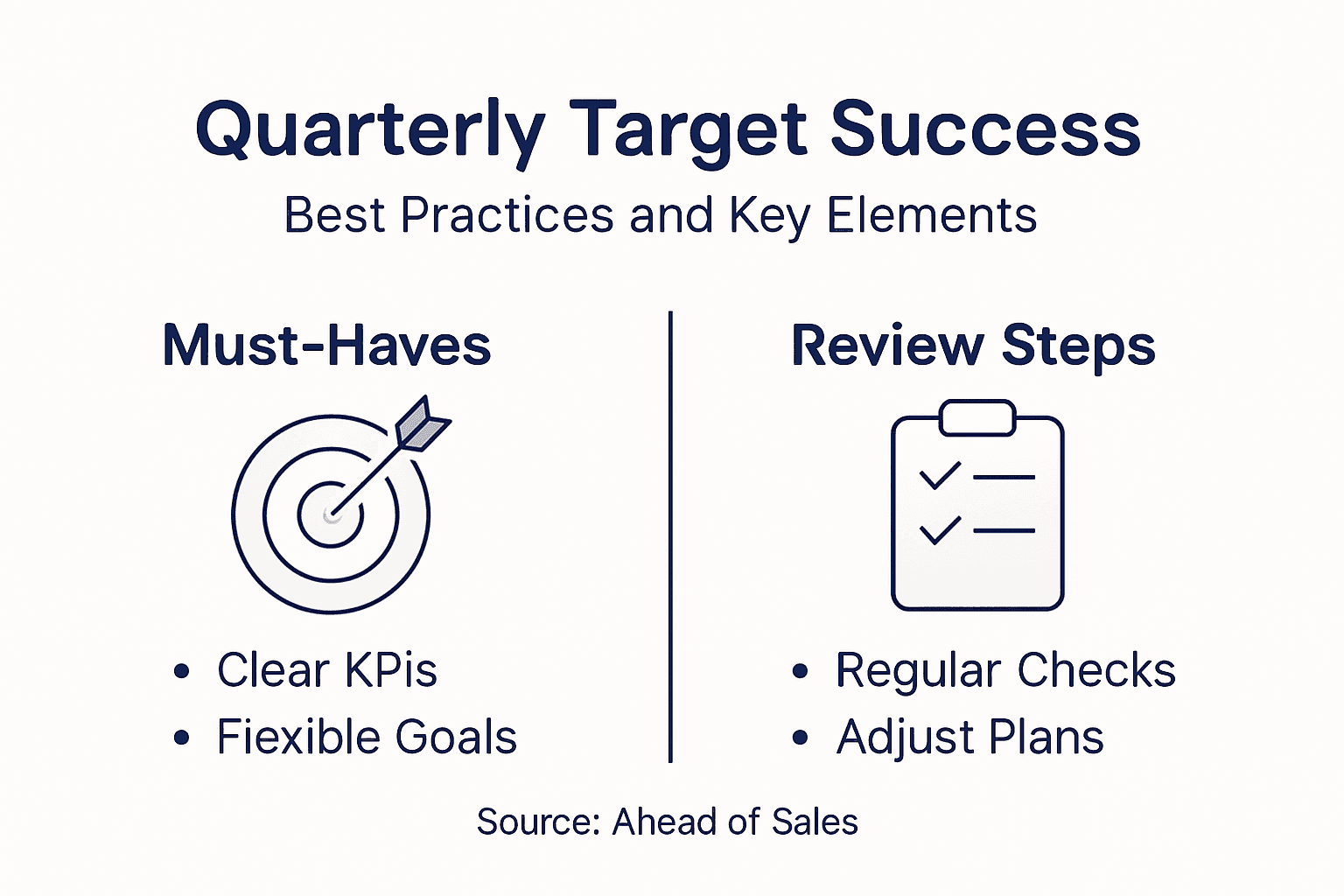
The most effective quarterly target achievement frameworks operate as living documents, continuously evolving through regular analysis, feedback loops, and strategic recalibration. They transform static annual plans into agile, responsive roadmaps that drive consistent organisational growth.
Pro tip: Conduct mid-quarter reviews to assess progress, identify potential obstacles, and make real-time strategic adjustments to maintain target momentum.
Common Pitfalls in Rapid Sales Expansion
Rapid sales expansion demands strategic precision and holistic understanding of potential organisational risks. Hidden traps in business growth can swiftly transform promising opportunities into catastrophic setbacks for ambitious sales teams.
Critical pitfalls in accelerated sales growth include:
- Stakeholder Misalignment: Failing to identify key decision-makers
- Customer Education Gaps: Inadequate product capability communication
- Metrics Mismanagement: Overemphasising features instead of ROI
- Relationship Complexity: Insufficient multi-threading within client organisations
- Operational Bandwidth: Neglecting infrastructure and resource constraints
Sustainable expansion risks highlight the importance of maintaining quality while scaling. Organisations must develop robust processes that balance aggressive growth objectives with strategic operational capabilities, preventing brand dilution and maintaining consistent performance standards.
Successful sales expansion requires a nuanced approach that recognises growth is not merely about increasing numbers, but creating sustainable, value-driven customer relationships. This demands continuous learning, adaptive strategies, and a deep understanding of market dynamics.
The following table summarises typical risks in rapid sales expansion and strategies for mitigation:
| Risk Type | Business Impact | Mitigation Strategy |
|---|---|---|
| Stakeholder misalignment | Lost deals and confusion | Enhance communication protocols |
| Metrics mismanagement | Misguided strategic decisions | Regular KPI reviews |
| Operational bandwidth gaps | Service disruptions | Incremental resource scaling |
Pro tip: Implement quarterly capability audits to assess your organisation’s readiness for expansion, identifying potential resource gaps before they become critical limitations.
Drive Your Sales Growth Strategy Forward with Proven Expertise
The journey to accelerating quarterly wins requires more than just ambition. This article highlights the critical need for dynamic, data-driven sales growth strategies that adapt quickly and keep your team hitting precise targets. If you are facing challenges such as maintaining consistent quarterly momentum, integrating advanced sales models, or avoiding common pitfalls in rapid expansion, our tailored solutions are designed specifically for businesses like yours.
At Ahead of Sales, we combine bespoke 1:1 coaching with expert training and consultancy to deliver at least 50% sales growth every year while ensuring your sales team achieves quarterly targets. Our approach leverages key concepts such as adaptive learning, predictive analytics, and robust quarterly planning frameworks discussed within the Sales Strategy Archives – Ahead of Sales to turn growth plans into measurable results.
Unlock the full potential of your sales team now. Visit Ahead of Sales to explore how our customised programmes help businesses with 50 to 1000 staff achieve sustainable, accelerated growth. Dive deeper into our proven methodologies in the Sales Playbook Archives – Ahead of Sales and start transforming your sales strategy today.
Frequently Asked Questions
What are the key components of effective sales growth strategies in 2025?
The key components include audience targeting, value proposition refinement, technology integration, sales methodology alignment, and continuous learning to adapt to market dynamics.
How can SaaS firms optimise their sales models for growth?
SaaS firms can optimise their sales models by choosing between direct, self-service, and hybrid approaches, ensuring they align their strategies with customer segments and performance metrics to maximise efficiency and effectiveness.
What are breakthrough acceleration techniques for sales teams in 2025?
Breakthrough acceleration techniques include advanced technology integration, personalised coaching, predictive analytics, continuous learning, and enhancing emotional intelligence to improve team performance and adaptability.
How can organisations effectively implement quarterly target achievement frameworks?
Organisations can implement effective quarterly target frameworks by defining clear goals, tracking performance regularly, aligning cross-functional teams, maintaining adaptability in strategy, and conducting performance reviews to ensure continuous progress.