
Many British sales directors grapple with forecasting that seems precise until market realities throw the numbers off course. The challenge goes beyond spreadsheets, demanding attention to shifting demand trends, seasonal patterns, and unpredictable market changes that often disrupt even the most robust calculations. For ambitious companies eyeing bold growth, mastering the fundamentals of sales forecasting and avoiding misconceptions becomes critical. This guide highlights practical strategies to build forecasts that drive more accurate decisions and sustainable business growth.
Table of Contents
- Sales Forecasting Fundamentals And Misconceptions
- Types Of Sales Forecasting Methods Explained
- How Sales Forecasting Works In Practice
- Benefits And Real-World Business Applications
- Common Mistakes And Risks In Sales Forecasting
- Best Practices For Accurate Forecasts And Growth
Key Takeaways
| Point | Details |
|---|---|
| Importance of Data Understanding | Sales forecasting requires recognising trends, seasonality, and noise in historical data to improve accuracy. It’s essential to treat historical data differently based on its relevance to the current forecast. |
| Addressing External Factors | Incorporating potential market shifts and external disruptions into forecasts is crucial; relying solely on past performance can lead to inaccuracies. Use scenario planning to assess various market conditions. |
| Combining Methods for Accuracy | A hybrid approach that integrates both qualitative and quantitative forecasting methods yields more reliable results. Engage your sales team to leverage their insights alongside historical data. |
| Regular Review and Adaptation | Establish a weekly review process to adjust forecasts based on real-time data and market changes. This keeps forecasts aligned with actual performance and enhances team accountability. |
Sales forecasting fundamentals and misconceptions
Sales forecasting is not about predicting the future with crystal clarity. Instead, it’s about understanding the patterns in your historical data and recognising what external factors might disrupt those patterns. Many sales leaders make a critical error here: they treat forecasting as a purely mathematical exercise, plugging numbers into a spreadsheet and expecting accuracy. The reality is messier. Your sales data contains three distinct elements that demand different attention. Trend shows the general direction your sales are moving, seasonality captures predictable fluctuations (think Boxing Day sales or new financial year buying), and noise represents random variation that has no meaningful pattern. Understanding these components separately is what separates accurate forecasts from educated guesses.
The most damaging misconception affecting mid-market British businesses is assuming that past performance guarantees future results without accounting for market shifts. You might have brilliant Q4 data from last year showing a 35% uplift, but if a major competitor entered your sector or your customer base shifted, that historical pattern becomes unreliable. Another common trap is overweighting recent data whilst ignoring longer-term trends, creating forecasts that whipsaw based on this month’s unusual activity. This is particularly problematic when your sales team has a strong month and leadership assumes you’ve discovered a new sustainable growth pattern, only to watch sales flatline the following quarter. Additionally, many organisations confuse correlation with causation. You might notice that sales increase when you spend more on marketing, but without understanding the actual causal relationship, your forecast becomes fragile when market conditions change. The external environment matters enormously. A supply chain disruption, regulatory change, or economic shift can render your forecast obsolete overnight, yet many forecasting approaches ignore these external signals entirely.
What separates effective forecasting from wishful thinking is a structured approach that acknowledges these complexities. Rather than treating all historical data as equally valuable, weight recent trends appropriately whilst maintaining awareness of seasonal patterns. Build your forecast with multiple scenarios in mind, not just a single “best guess” number. Consider what would happen if your top three customers reduced their orders by 20%, if a competitor matched your pricing, or if your sales cycle extended by two months. Understand that forecasting objectives need clarity from the outset because your method varies dramatically depending on whether you’re predicting next month’s revenue, planning quarterly staffing, or making a capital investment decision. For a mid-sized firm, this means involving your sales team in the forecasting conversation. They understand which opportunities are genuinely progressing versus which ones are wishful thinking. They know which sectors are facing headwinds and where unexpected demand is emerging. Combining their ground-level insight with analytical rigour creates forecasts that actually align with reality.
Pro tip: Start with a rolling 13-week forecast that you review and adjust weekly, rather than a static annual forecast. This keeps your predictions responsive to actual market movement whilst building your team’s forecasting confidence through regular, manageable adjustments.
Types of sales forecasting methods explained
Sales forecasting methods fall into two broad categories, and choosing between them depends entirely on your situation. Qualitative methods rely on expert judgement, intuition, and experience rather than raw data. Your sales director, account managers, and market specialists make educated assessments based on what they see happening in the field. Quantitative methods use historical sales data combined with statistical analysis to identify patterns and project future performance. The distinction matters because many British mid-market companies fail by picking the wrong approach for their circumstances. If you’ve just launched a new product line with no historical data, qualitative methods are your only option. If you’ve operated in your sector for five years with consistent customer patterns, quantitative methods give you numerical precision. In reality, the most effective approach combines both.
Quantitative forecasting breaks down further into three distinct types. Time series analysis examines your historical sales over fixed periods, looking for patterns, trends, and seasonal cycles. A simple moving average might smooth out monthly noise by averaging the last three months of sales. More sophisticated approaches like ARIMA (Autoregressive Integrated Moving Average) account for both recent momentum and longer-term trends, making them valuable when your sales show clear seasonal patterns. Causal models go deeper by identifying which external factors actually drive your sales. Perhaps your revenue correlates strongly with advertising spend, or client acquisition costs, or even broader economic indicators. By understanding these relationships through regression analysis or neural networks, you can forecast what happens if you change those inputs. Simulation models use these relationships to run thousands of scenarios, showing you a range of possible outcomes rather than a single prediction. This is particularly useful for financial planning because it reveals risk and opportunity simultaneously. Understanding which quantitative approach suits your business model prevents you from applying overly complex methods when simpler ones would suffice, or vice versa.

Qualitative methods deserve serious consideration even in data-rich environments. Sales team estimates work well when your team understands upcoming opportunities intimately. Your senior account manager knows which prospects are genuinely close to signing versus which ones are wishful thinking. A structured conversation where each team member forecasts their pipeline, with calibration for optimism bias, often produces remarkable accuracy. Market research and customer surveys reveal emerging demand that historical data cannot show. If your largest customers are signalling they intend to increase orders next year, or if market analysis suggests your sector is experiencing a shift, these insights must inform your forecast regardless of what the numbers say. Expert opinion from external consultants or industry specialists can validate your quantitative models or challenge assumptions you did not realise you were making. The key is treating qualitative input as data, not gut feel. Document what your team expects and why, then review their accuracy quarterly. Over time, you understand which voices are reliable forecasters and which ones consistently overestimate or underestimate.
For a mid-sized business targeting 50% annual growth, a pragmatic hybrid approach works best. Start with time series analysis of your existing customer base to forecast how current revenue will develop. Then layer on qualitative estimates from your sales team about new business opportunities, adjusted downward to account for typical pipeline conversion patterns. Stress-test these combined forecasts with scenario analysis: What if your top customer cuts orders? What if sales cycles extend by four weeks? What if three major opportunities slip into the following quarter? This creates a range rather than a single false number. Review your forecast weekly against actual results, updating your assumptions and methods as new information emerges. As your business scales and data accumulates, you will naturally shift towards more quantitative approaches. Until then, respecting both the patterns in your historical data and the insights from people close to your customers produces forecasts aligned with commercial reality.
Pro tip: Build a simple scorecard that tracks forecast accuracy by method each quarter. This reveals which approaches work best for different product lines or customer segments, allowing you to refine your methodology continuously rather than assuming one method works everywhere.
Here is a concise comparison of qualitative and quantitative sales forecasting methods:
| Criteria | Qualitative Methods | Quantitative Methods |
|---|---|---|
| Data Requirement | Requires little or no historical data | Needs robust historical data |
| Flexibility | Adapts quickly to market changes | Best for stable, data-rich environments |
| Accuracy Potential | Highly dependent on expert judgement | Output improves as data quality increases |
| Typical Use Cases | New products, changing markets | Mature offerings, stable sales cycles |
How sales forecasting works in practice
The process begins with a clear definition of your market and the specific opportunities you are pursuing. You cannot forecast accurately if you have not articulated what you are actually selling, to whom, and through which channels. A manufacturing company selling components through distributors needs a fundamentally different forecasting approach than a B2B service firm with direct enterprise clients. Once your market scope is defined, establish a repeatable data collection process that captures pipeline activity, closed deals, sales cycle length, and conversion rates. Many mid-market British companies fumble here because their sales team uses spreadsheets that are updated sporadically, or worse, they lack any systematic record of what was promised versus what actually materialised. Your forecasting system requires clean, consistent data fed in regularly. This is not about perfection but about patterns you can track. Record which stage each opportunity occupies in your sales process, how long it has been there, the deal value, and any relevant context. Historical data then becomes your foundation for mathematical modelling.
Once data flows reliably, you blend analytical methods with human judgement. Start by reviewing your historical conversion rates. If you typically close 35% of opportunities in your first qualification stage and 60% of those that reach proposal, you have empirical baseline rates. Apply these to your current pipeline. Your sales director forecasts 18 new qualified opportunities this quarter, and your team currently has 12 proposals outstanding. Using historical conversion rates, you would forecast 18 multiplied by 0.35, then add 12 multiplied by 0.60, giving you a mathematical prediction. Now layer on qualitative input. Does your team believe the 12 outstanding proposals are stronger or weaker than typical? Are there external factors affecting this quarter that differ from historical patterns? If a major competitor has entered your sector, historical conversion rates may no longer apply. If your largest customer signals they intend to triple their orders, your forecast must reflect that opportunity even if it is unprecedented. The skilled forecaster combines these numbers with commercial reality. Adjust downward if you detect excessive optimism in the team’s pipeline estimates. Adjust upward if there are genuine external drivers of demand that historical data cannot capture.
Implementing this practically means establishing a weekly or bi-weekly forecasting rhythm rather than a quarterly one. Meet with your sales team, review what has closed since last week, update pipeline positions, and recalibrate your forecast. This serves two purposes. First, it keeps your forecast responsive to market movement, revealing slippage early rather than discovering in week 12 of a quarter that revenue will miss target. Second, it builds accountability. Your team understands that their pipeline estimates are tracked against actual outcomes, creating natural pressure towards accuracy. Document your assumptions each week so you understand what changed between forecasts. Did a customer delay their decision? Did your sales cycle extend by two weeks? Did three opportunities move to the next stage? These patterns become your learning loop. After three or four quarters, you will have enough data to identify which sales stages are reliable predictors of future revenue and which ones consistently disappoint. You will understand how long deals typically take at each stage and where bottlenecks slow progress. This granular understanding transforms forecasting from guesswork into management discipline. Your forecast becomes a tool that drives operational decisions: resource allocation, marketing investment, hiring plans, and financial commitment all flow from an accurate view of your likely revenue.
Aligning your forecast with your financial planning and operational capacity is crucial. A forecast that predicts 50% revenue growth means nothing if your delivery team cannot service that demand or your cash position cannot fund the working capital required to support it. Present your forecast in multiple scenarios: conservative case, most likely case, and optimistic case. Show leadership what investment is required at each stage of your sales process to achieve different outcomes. Perhaps reaching your 50% growth target requires doubling your business development team six months ahead, or increasing marketing spend by 40% to fill your pipeline. By connecting forecasting to resource decisions, you convert a prediction into a strategy. Integrating forecasting with your broader sales planning ensures your revenue targets remain achievable rather than aspirational, and your team stays aligned on priorities throughout the year.
Pro tip: Create a simple one-page forecast dashboard showing current pipeline value by stage, historical conversion rates for each stage, your mathematical forecast for the quarter, and the qualitative adjustments your team has made. Review this together weekly and update it as deals progress, making forecast accountability visual and real-time.
Benefits and real-world business applications
Accurate sales forecasting transforms from a spreadsheet exercise into a competitive advantage when you understand the tangible business outcomes it delivers. The most immediate benefit is cash flow certainty. When you know with reasonable confidence what revenue will arrive each month, you can plan working capital requirements, manage debt repayment schedules, and invest in growth without the panic of unexpected shortfalls. A mid-market company forecasting £500,000 in Q2 revenue can commit to hiring a sales engineer in March, knowing the cash will be available to pay their salary by May. Without that forecast, that hiring decision becomes a gamble. Resource allocation becomes rational rather than reactive. Your marketing team stops scattering budget across every possible channel and instead concentrates investment where pipeline analysis shows the greatest conversion opportunity. Your delivery team can schedule capacity knowing when demand will arrive, preventing the destructive cycle of alternating between idle staff and overwhelming backlog. Operations managers can negotiate supplier contracts with confidence, knowing what volumes they need to purchase and when. Every function in your business performs better when they operate from a shared, reliable view of future revenue.
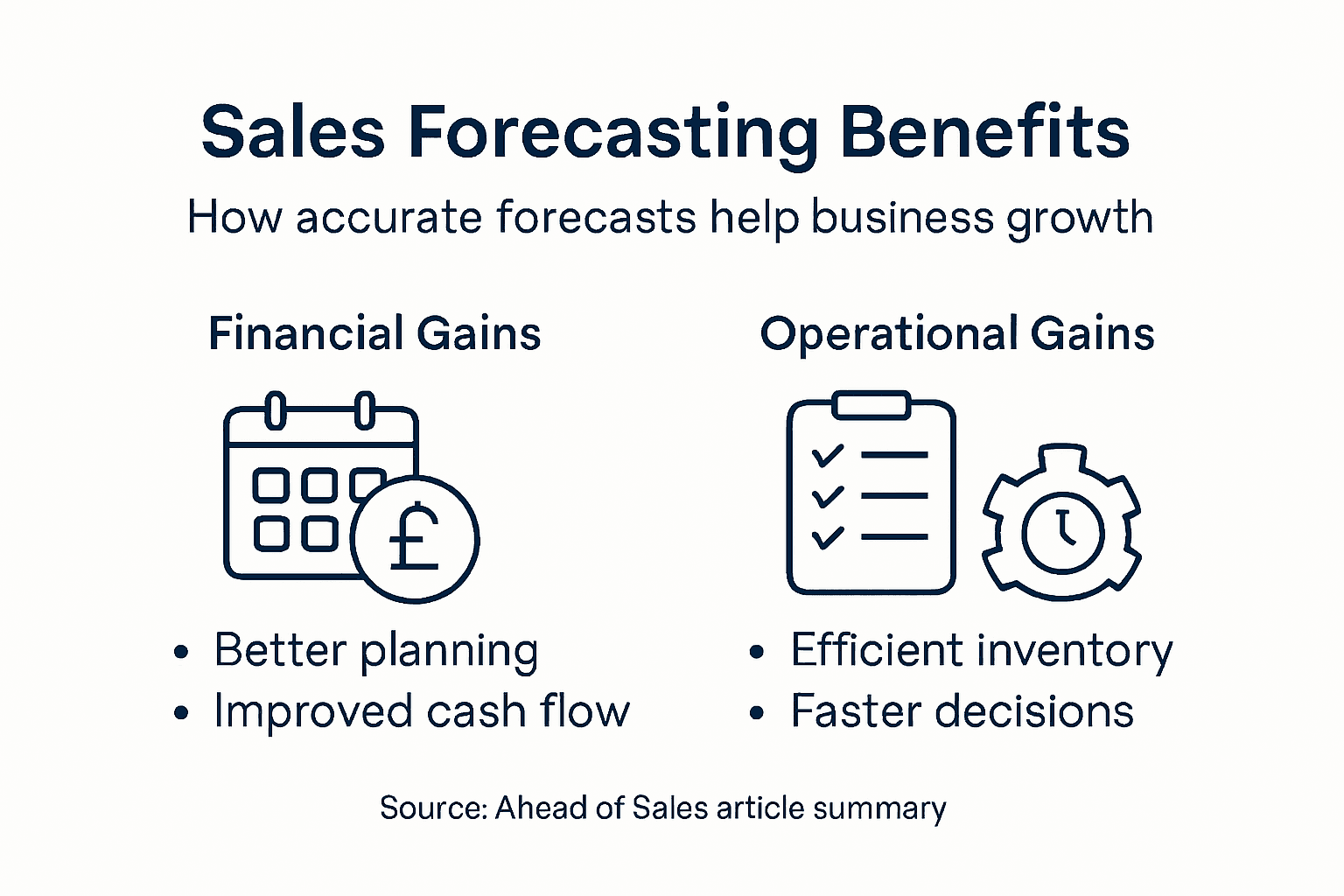
The financial planning benefits extend beyond internal operations. Banks and investors scrutinise your forecasting capability as a proxy for management competence. A company that consistently hits its quarterly revenue targets within a small margin of error demonstrates discipline and market understanding. A company that misses its forecast by 30% suggests chaotic sales processes or leadership that cannot accurately read their own market. Systematic forecasting approaches drive improved financial performance and operational resilience by revealing where your business is truly heading, enabling you to course-correct before problems become crises. This matters intensely when you are seeking growth capital. Venture capital investors or private equity firms evaluating your business for investment or acquisition place enormous weight on your sales forecast credibility. A founder who can walk into a conversation with a forecast built on actual pipeline data, validated against historical conversion rates, and stress-tested against market scenarios commands immediate credibility. That founder can potentially access capital at better terms because the investment thesis is grounded in reality rather than aspiration.
In retail and consumer-facing businesses, accurate sales forecasts enable efficient inventory control and timely production planning that directly impact profitability. Overstock your warehouse based on inflated forecasts and you tie up cash in slow-moving inventory, eventually forced to discount and destroy margin. Understock based on pessimistic forecasts and you lose sales to competitors who have product available. A clothing retailer using proper forecasting knows how many winter coats to buy in July, preventing both stockouts in November and January fire sales. For service businesses, forecasting drives capacity planning. A consulting firm needs to know if Q3 will bring enough project demand to justify hiring two new consultants or if demand is slowing and they should pause hiring. A recruitment agency can forecast which sectors will have the strongest talent demand, allowing them to build candidate networks in advance rather than scrambling when client demand emerges. These are not abstract benefits. They directly affect profit margins and business survival.
Beyond financial metrics, accurate forecasting builds trust between sales leadership and the rest of the business. When your sales director consistently delivers forecasts that materialise, operations trusts their pipeline assessments. Finance can plan headcount and investment with confidence. The board receives updates it can rely on, reducing the need for constant replanning and emergency cost cuts. Conversely, when forecasts are routinely wrong, organisational trust erodes. Finance starts building contingency buffers into every plan. Operations hires excess capacity to hedge against demand uncertainty. Leadership becomes reactive, making decisions week to week rather than strategically. The forecast accuracy you build today through disciplined process creates organisational credibility that makes everything easier tomorrow. For your specific goal of achieving 50% annual growth, forecasting becomes your primary management tool. It reveals whether your current sales engine can generate that growth or whether you need to fundamentally change your approach. It identifies which customer segments are growing fastest and which are stalling. It shows whether your sales cycles are extending or compressing. It tells you whether you are gaining market share or losing it to competitors. Without this clarity, 50% growth remains wishful thinking. With it, growth becomes a managed objective.
Pro tip: Start tracking the accuracy of your sales team’s forecast estimates against actual closures month by month, then share these results transparently with the team and adjust compensation or recognition accordingly. Teams who see their forecast accuracy measured and rewarded tighten their estimates dramatically within two quarters, transforming your forecast from a rough guess into a genuinely useful management tool.
This summary shows the core business benefits of accurate sales forecasting:
| Benefit | Description | Impact on Business |
|---|---|---|
| Cash flow certainty | Predictable revenue streams | Confident investment planning |
| Resource allocation | Targeted spend and capacity management | Efficient operations |
| Investor confidence | Demonstrated forecasting discipline | Favourable funding conditions |
| Inventory control | Proper stock and production planning | Reduced waste, maximised margin |
| Organisational trust | Alignment across teams and leadership | Improved decision-making |
Common mistakes and risks in sales forecasting
The most pervasive mistake in sales forecasting is over-optimism bias, where teams systematically overestimate what will close in the current period. This happens because your sales staff have genuine confidence in their deals, and they want to deliver good news to leadership. A sales representative with five proposals outstanding genuinely believes all five will close this quarter, even though historical data shows only two typically progress to signature. Leadership wants to believe the optimistic forecast because it supports the revenue target they promised to the board. Finance accepts it because questioning the forecast feels politically risky. Before you know it, the forecast contains 40% more revenue than your conversion rates justify, and when the quarter closes, you miss target by a significant margin. The damage compounds. Leadership loses confidence in forecasts altogether and starts treating them as optional. Finance builds larger contingency buffers into every plan, tying up working capital. Operations over-hires capacity to hedge against the uncertainty created by unreliable forecasts. The single biggest cause of forecasting failure in mid-market companies is this unchecked optimism that no one questions because challenging it feels uncomfortable.
A related trap is over-precision. Your sales director presents a forecast showing exactly £487,250 in revenue for Q3, calculated to the pound. This false precision creates an illusion of certainty that does not exist. Your forecast will be wrong. The question is by how much. Presenting a range, say £420,000 to £550,000, with a most likely case of £485,000, is more honest and actually more useful. The range tells leadership what uncertainty exists. It reveals how dependent your forecast is on a few large deals closing on time. Yet many forecasters cling to point estimates because they feel more professional, or because leadership demands a single number for financial planning. Over-precision and failure to incorporate external variables create systemic forecasting errors that can derail operational planning and financial commitments. The solution is disciplined use of scenario planning. Build your forecast showing base case, upside case, and downside case, then explain the specific assumptions that drive movement between them.
Another critical mistake is ignoring external factors and incentive misalignment. Your sales team is incentivised on quota achievement. If the forecast is used to set quotas, your team has every incentive to lowball it so they can hit target and earn commission. Conversely, if the forecast is used purely for financial planning and does not affect quotas, your team has every incentive to overstate it to look good. Neither scenario produces accurate forecasts. The solution requires separating forecasting from quota-setting and ensuring your team is rewarded for forecast accuracy, not for beating an inflated number. Additionally, your forecast reflects your sales team’s view of the market, but it ignores the external environment that could reshape demand overnight. A regulatory change, competitor entry, customer consolidation, or economic shock can render historical patterns irrelevant. Many forecasters treat these as impossible to predict and therefore ignore them. Instead, you should explicitly identify the top three external risks that could impact your forecast, then decide whether those risks justify adjusting your numbers downward or building contingency into your plan.
A final dangerous mistake is treating the forecast as a prediction rather than as an input to decision-making. Business forecasts are not crystal balls. They are wrong. The more valuable question is whether your forecast is wrong in a way that still supports good decisions. If your forecast shows £500,000 in Q2 revenue, plus or minus £60,000, and you are planning to hire a salesperson costing £40,000, you can proceed with confidence. If your forecast is £500,000 plus or minus £150,000, you cannot make that decision with the same confidence. The mistake is treating the £500,000 as fact rather than as a starting point for exploring risk. Leadership should ask what happens to the business if revenue comes in at the downside case. Can you still pay the bills? Can you still fund marketing? Can you still cover payroll? By using the forecast as a tool for stress-testing decisions rather than as a prediction to trust blindly, you reduce the impact of forecasting error. This approach, focused on scenario planning and decision-framing rather than point prediction accuracy, actually improves business outcomes even when the forecast itself proves inaccurate.
Pro tip: Create a simple forecast error tracking spreadsheet that records your forecast each month alongside actual results, then calculates the percentage error. Share this publicly with leadership quarterly. This transparency makes over-optimism uncomfortable and creates natural accountability that tightens forecast accuracy faster than any policy could.
Best practices for accurate forecasts and growth
Accurate forecasting requires a disciplined blend of rigorous data collection, cross-functional collaboration, and honest assumption-testing. Start by establishing a single source of truth for your pipeline data. Multiple spreadsheets, disconnected CRM systems, and informal verbal updates create confusion and inconsistency. Invest in a forecasting system, whether that is a modern CRM platform like Salesforce or Pipedrive, or even a well-structured Excel workbook with clear data entry rules, that every team member updates consistently. The investment pays dividends because clean data is foundational. You cannot build accurate forecasts on data you do not trust. Then define your sales stages clearly. What exactly does “prospect” mean versus “qualified opportunity” versus “proposal stage”? Your stages should reflect the actual decision-making journey your customers take, not arbitrary labels that mean different things to different salespeople. Once your stages are defined, track how long deals typically spend in each stage and what percentage progress to the next stage. This historical baseline becomes your mathematical foundation. A new deal entering your pipeline moves through your forecast based on proven progression rates, not on optimistic assumptions.
Engage your cross-functional team in forecasting conversations, not just your sales staff. Your marketing team understands campaign performance and can forecast pipeline inflow. Your delivery team understands capacity constraints that affect when revenue can actually be recognised. Your finance team understands cash flow timing and can identify where forecasts create working capital challenges. By bringing these perspectives into your forecasting process, you identify blind spots and build forecasts that are actually executable. Integrating qualitative and quantitative data with cross-functional engagement improves forecast precision and creates alignment across the business. When operations understands the forecast because they helped build it, they trust it enough to commit resources. When finance understands the assumptions, they can model scenarios confidently. This collaborative approach transforms forecasting from a sales activity into a business discipline that everyone contributes to and owns. Additionally, establish a regular forecast review cadence. Weekly reviews are ideal for mid-market companies targeting growth. Sit with your sales team, review what closed since last week, update opportunities that have progressed, and recalibrate your forecast. This rhythm keeps your forecast accurate and responsive rather than stale.
Implement a system that separates your forecast from your targets. Your forecast is your best prediction of what will actually happen. Your target is what you want to achieve. These are different numbers. Your forecast might show £480,000 in Q2 revenue based on your pipeline and historical conversion rates. Your target might be £550,000 because you need to grow 50% annually. The target should not automatically become the forecast. Instead, if your forecast shows you will miss your target, that is diagnostic information. It tells you that you need to change something: hire more salespeople, increase marketing spend to fill the pipeline, improve your sales process to increase conversion rates, or extend your sales cycle to capture more opportunities. By keeping forecast and target separate, you prevent the dangerous situation where missing your forecast becomes normal because no one really believed it in the first place. Additionally, select forecasting methods appropriate to your business stage and continuously evaluate accuracy rather than assuming one method works forever. Early-stage companies with sparse data should lean on qualitative sales team estimates and market research. Mature companies with five years of data should use quantitative time series analysis and regression models. As your business scales and your data accumulates, your forecasting methods should evolve accordingly.
Finally, build your forecast with scenario planning from the start. Instead of a single point estimate, present three scenarios: downside case where your top three deals slip by one quarter, base case reflecting your most likely outcome, and upside case where you win two unexpected large opportunities. Show leadership what each scenario means for cash flow, hiring plans, and investment capacity. This approach acknowledges that your forecast will be wrong while making the forecast genuinely useful for decision-making. By presenting ranges rather than false precision, you signal confidence in your process whilst admitting uncertainty about specific outcomes. You also prepare leadership mentally for multiple possibilities, so if the downside scenario materialises, it is not a shock but simply one of the outcomes you identified in advance. This is how forecasting drives 50% annual growth. Not by predicting the future perfectly, but by building a shared understanding of your sales engine, identifying what needs to change to accelerate growth, and making resource decisions with eyes wide open about the risks involved.
Pro tip: Assign one person ownership of your forecast process, give them 30 minutes weekly to update data and run the numbers, and make them accountable for forecast accuracy. Without a single owner, forecasting becomes everyone’s responsibility, which quickly becomes nobody’s responsibility, and accuracy decays rapidly.
Unlock Reliable Sales Growth Through Expert Forecasting Support
Struggling to turn your sales forecasts into dependable growth can feel overwhelming. This article highlights critical challenges like over-optimism bias and ignoring external market factors that cause forecasts to miss the mark. If you want to move beyond wishful thinking and build a structured, accountable forecasting process to consistently hit or exceed targets, exploring tailored sales strategies is key. Our Sales Strategy Archives – Ahead of Sales reveal proven methods that align forecasts with real market opportunities and team insights.
At Ahead of Sales, we combine bespoke 1:1 coaching with hands-on training and consultancy to help businesses generate at least 50% sales growth annually while ensuring sales teams meet their quarterly targets. Whether you are part of a mid-sized company aiming to sharpen your forecasting accuracy or a solo service provider seeking sales acceleration, our solutions adapt to your needs. Start transforming your forecasting approach today by visiting Ahead of Sales and discover how disciplined forecasting drives confident decision-making and sustainable growth. For further insights on business growth fundamentals, explore our Uncategorized Archives – Ahead of Sales. Take the next step toward consistent sales success now.
Frequently Asked Questions
What is sales forecasting and why is it important?
Sales forecasting is the process of estimating future sales based on historical data and market analysis. It is important because accurate forecasts help businesses make informed decisions about resource allocation, budget planning, and strategy development, ultimately driving consistent growth.
What are the main components of a sales forecast?
The main components of a sales forecast include trends, which indicate the general direction of sales; seasonality, which captures predictable fluctuations in demand; and noise, which reflects random variations that have no significant pattern.
How can I improve the accuracy of my sales forecasts?
To improve the accuracy of sales forecasts, adopt a structured approach that combines both qualitative and quantitative methods. Engage your sales team for insights, leverage historical data, and consider external factors affecting demand. Regularly review and adjust forecasts based on actual results to enhance precision.
What mistakes should I avoid in sales forecasting?
Common mistakes to avoid include over-optimism bias, where sales staff overestimate potential closures, and over-precision in forecasts, which can create a false sense of certainty. Additionally, ignoring external factors and treating forecasts as predictions rather than decision-making tools can lead to inaccuracies and poor business outcomes.