
Most advice about British sales techniques gets it wrong. While nearly 60 percent of managers still believe only extroverts are built for sales, research shows that effective strategies rely on empathy, adaptability, and thoughtful problem-solving. This matters because deeply rooted misconceptions can hold back both individuals and businesses from real success. Discover how evolving your approach brings measurable results and helps British sales teams master the art of relationship-driven selling.
Table of Contents
- Defining Sales Best Practices And Misconceptions
- Essential Pillars Of Effective Sales Processes
- Tailoring Approaches For Different Business Models
- Keys To Implementing High-Impact Sales Strategies
- Avoiding Common Errors And Maximising ROI
Key Takeaways
| Point | Details |
|---|---|
| Sales Success Relies on Skills, Not Personality | Effective sales performance is driven by active listening, empathy, and strategic problem-solving rather than solely personality traits. |
| Continuous Learning is Essential | Sales strategies must evolve with market conditions, emphasising ongoing training and adaptability for sustained growth. |
| Tailored Approaches for Different Models | Sales strategies should be customised for varying business models, recognising the distinct needs of B2B and B2C environments. |
| Holistic Evaluation Maximises ROI | Regular performance audits and data-driven approaches are vital to align sales strategies with market dynamics and customer relationships. |
Defining Sales Best Practices and Misconceptions
Sales best practices are strategic approaches that consistently drive revenue growth, moving far beyond traditional stereotypes and misconceptions. While many professionals believe sales success depends solely on personality or aggressive tactics, the reality is significantly more nuanced. Common sales myths require careful deconstruction to understand what truly drives exceptional performance.
One persistent misconception is that only extroverted individuals can excel in sales roles. Research demonstrates that successful sales professionals represent a diverse range of personality types, with the most critical attributes being active listening, empathy, and strategic problem-solving. Effective salespeople understand customer needs deeply, focusing on providing genuine value rather than pushing unnecessary products. This approach requires emotional intelligence and consultative skills that transcend traditional personality stereotypes.
Another critical aspect of modern sales best practices involves continuous learning and adaptability. Sales strategies are not static frameworks but dynamic systems that must evolve with market conditions. Strategic sales management requires regular operational audits to identify potential improvements and maintain competitive advantage. High-performing sales teams invest in ongoing training, leverage data-driven insights, and maintain a growth mindset that prioritises skill development over short-term transactional thinking.
Ultimately, successful sales practices centre on building genuine relationships, understanding customer pain points, and delivering tailored solutions. This means moving beyond outdated notions of ‘hard selling’ towards a more sophisticated, consultative approach that positions the salesperson as a trusted advisor. By dismantling traditional misconceptions and embracing a more nuanced, strategic methodology, businesses can transform their sales performance and create sustainable revenue growth.
Essential Pillars of Effective Sales Processes
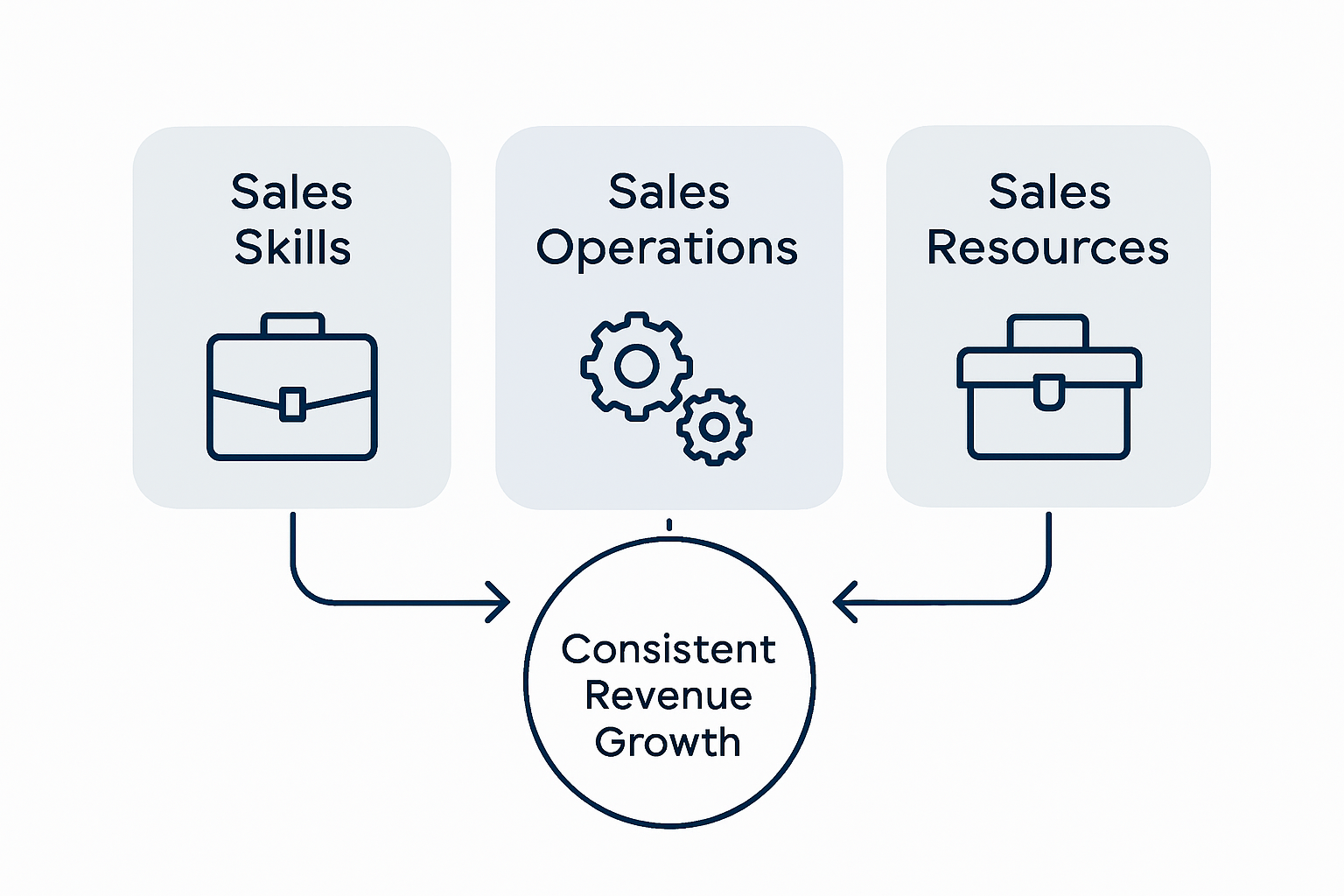
Successful sales organisations recognise that effective sales processes are built on comprehensive foundational elements that work synergistically to drive consistent revenue growth. Sales enablement relies on three critical pillars: Sales Skills, Sales Operations, and Sales Resources. These interconnected components form the backbone of a robust sales strategy that can adapt and thrive in dynamic business environments.
The first pillar, Sales Skills, encompasses the individual capabilities of sales professionals. This includes not only technical knowledge and product understanding but also advanced interpersonal skills such as active listening, emotional intelligence, and strategic communication. Sales teams must continuously invest in skill development, creating a culture of learning that enables representatives to navigate complex customer interactions with confidence and expertise. Strategic sales management demands a holistic approach to team development that goes beyond traditional training methods.
Sales Operations represents the second crucial pillar, focusing on the systematic processes, technologies, and infrastructures that support sales performance. This includes implementing effective customer relationship management (CRM) systems, developing clear sales workflows, establishing performance metrics, and creating streamlined communication channels. High-performing sales organisations design their operational frameworks to reduce administrative friction, allowing sales professionals to spend more time engaging with potential customers and less time managing bureaucratic processes.
The final pillar, Sales Resources, encompasses the strategic assets and support mechanisms that enable sales teams to perform effectively. These resources include comprehensive product knowledge databases, competitive intelligence reports, marketing collateral, negotiation tools, and ongoing training programmes. By providing sales professionals with robust, accessible resources, organisations can empower their teams to make informed decisions, personalise customer interactions, and consistently deliver value. Ultimately, these three pillars work in concert to create a dynamic, responsive sales ecosystem capable of driving sustainable business growth.
Tailoring Approaches for Different Business Models
Successful sales strategies demand nuanced approaches that recognise the fundamental differences across various business models. Sales methodologies cannot be applied uniformly, as each business type requires a unique configuration of tactics, communication styles, and relationship-building techniques. Sales team management workflows must be flexible enough to accommodate the distinct characteristics of different organisational structures and market segments.
B2B (Business-to-Business) sales environments typically require more complex, relationship-driven approaches characterised by longer sales cycles and multiple stakeholder interactions. These models demand deep industry knowledge, consultative selling techniques, and the ability to navigate intricate decision-making hierarchies. Sales representatives must develop sophisticated communication skills, presenting comprehensive solutions that address specific organisational challenges rather than generic product pitches. Sophisticated technical understanding, patience, and strategic networking become critical success factors in these intricate sales landscapes.

In contrast, B2C (Business-to-Consumer) sales models prioritise speed, emotional connection, and immediate value proposition. These environments require rapid engagement strategies, compelling storytelling, and the ability to create instant rapport. Sales professionals must master quick decision-making triggers, understand consumer psychology, and craft messages that resonate emotionally while demonstrating clear, tangible benefits. The sales approach here is more dynamic, often leveraging digital communication channels and personalised marketing techniques to create immediate impact.
Service-based businesses and technology start-ups represent another unique sales model, where the product’s potential and the team’s expertise become primary selling points. These organisations must balance technical credibility with compelling narrative, demonstrating not just what their solution does, but how it transforms the customer’s operational capabilities. Sales team effectiveness in these contexts relies heavily on continuous learning, adaptability, and the capacity to articulate complex value propositions in accessible, engaging language. Successful sales strategies in these models blend technical proficiency with strategic storytelling, creating a comprehensive approach that bridges innovation and practical customer needs.
Keys to Implementing High-Impact Sales Strategies
Mastering the art of sales management requires a strategic, multifaceted approach that goes beyond traditional selling techniques. Sales strategies must be dynamic, data-driven frameworks designed to transform potential opportunities into consistent revenue streams. Successful implementation demands a holistic perspective that integrates leadership, technology, and continuous skill development into a cohesive, adaptable system.
The foundation of high-impact sales strategies lies in comprehensive performance evaluation and targeted skill enhancement. Sales teams must embrace a culture of continuous learning, where individual and collective performance are regularly assessed and refined. This involves developing robust sales process frameworks that provide clear guidance while maintaining flexibility for individual adaptation. Key performance indicators should be carefully selected to measure not just quantitative outcomes, but also qualitative aspects such as customer satisfaction, relationship building, and long-term account potential.
Technology plays a critical role in modern sales strategy implementation. Advanced customer relationship management (CRM) systems, predictive analytics, and artificial intelligence tools enable sales teams to gather deeper insights, personalise customer interactions, and make more informed strategic decisions. These technological capabilities allow for more precise targeting, more efficient pipeline management, and more accurate forecasting. By leveraging data-driven insights, sales organisations can move beyond reactive approaches to proactively identify and capitalise on emerging market opportunities.
Ultimately, successful sales strategy implementation requires a delicate balance between structured methodology and creative problem-solving. Leadership must create an environment that encourages innovation, supports continuous learning, and provides the necessary resources for sales professionals to excel. This means investing in comprehensive training programmes, creating transparent communication channels, and developing compensation structures that incentivise both individual achievement and collaborative team success. By treating sales strategy as a dynamic, evolving discipline rather than a static set of rules, organisations can build resilient, adaptable sales ecosystems capable of thriving in increasingly complex business landscapes.
Avoiding Common Errors and Maximising ROI
Identifying and busting prevalent sales myths represents the first critical step in maximising sales return on investment. Sales performance is frequently undermined by deeply ingrained misconceptions that limit potential and create inefficient practices. Understanding these systematic errors allows organisations to develop more strategic, data-driven approaches that consistently deliver measurable results.
One fundamental error organisations repeatedly make involves misaligning sales strategies with actual market dynamics. Strategic sales management requires regular comprehensive audits that examine not just individual performance, but the entire operational ecosystem. This means moving beyond simplistic metrics like total revenue to analyse nuanced indicators such as customer acquisition cost, lifetime value, conversion rates, and qualitative relationship indicators. Successful teams recognise that ROI is not just about closing deals, but about building sustainable, long-term customer relationships that generate consistent value.
Technological integration and skill development play pivotal roles in minimising common sales errors. Many organisations underestimate the importance of continuous training and technological adaptation. Sales professionals must be equipped with advanced tools that provide real-time insights, predictive analytics, and personalised customer interaction capabilities. This involves investing in sophisticated customer relationship management systems, ongoing professional development programmes, and creating a culture that values learning and adaptive strategy over rigid, outdated sales approaches.
Ultimately, maximising ROI requires a holistic approach that balances human expertise with technological innovation. Sales leaders must create environments that encourage experimentation, support data-driven decision-making, and provide clear, achievable performance frameworks. This means developing compensation structures that incentivise not just short-term sales, but long-term customer satisfaction and strategic account growth. By treating sales as a sophisticated, evolving discipline rather than a transactional process, organisations can transform potential errors into opportunities for continuous improvement and sustained competitive advantage.
Transform Your Sales Performance with Proven Strategies
Struggling to implement effective sales best practices that truly drive consistent revenue growth? This article highlights the critical need for strategic, consultative sales approaches, continuous skill development, and dynamic sales management frameworks that many businesses overlook. If your sales team wrestles with outdated methods or lacks tailored solutions for growing revenue quarter after quarter, you are not alone. Key challenges such as aligning sales strategies with market realities and fostering genuine customer relationships can hold back sustained success.
Discover how Sales Strategy Archives – Ahead of Sales offers actionable insights and frameworks designed to overcome these obstacles.

Ready to move beyond common sales misconceptions and accelerate your team’s growth? Our revolutionary training combines bespoke 1:1 coaching with expert consultancy to help businesses like yours generate at least 50% sales growth every year. Whether you represent a mid-sized business with a growth mindset or a solo service business seeking rapid sales acceleration, our tailored packages, starting from £2,995 up to £8,500, equip your team to hit their targets consistently. Take the first step today by visiting Ahead of Sales and explore practical tools and personalised guidance that turn strategic sales visions into everyday results.
Frequently Asked Questions
What are some common misconceptions about sales best practices?
Many professionals believe that sales success relies solely on personality traits or aggressive tactics. However, effective sales require active listening, empathy, and strategic problem-solving, showcasing that a diverse range of personality types can excel in sales roles.
How do sales strategies need to evolve to drive consistent revenue growth?
Sales strategies must be dynamic and adaptable, requiring ongoing learning and regular operational audits to identify areas for improvement, ensuring they align with changing market conditions.
What are the essential pillars of effective sales processes?
The three fundamental pillars of effective sales processes are Sales Skills, Sales Operations, and Sales Resources, which work together to create a robust and adaptive sales strategy that drives revenue growth.
How can businesses tailor their sales approaches for different business models?
Businesses must recognise the distinct characteristics of each business model, such as B2B or B2C, and adapt their sales methodologies accordingly, using relationship-driven approaches for B2B and quick engagement strategies for B2C.