
Over half of British mid-sized companies miss out on achieving their full sales growth potential despite ambitious annual targets. For sales directors leading dynamic teams, the challenge isn’t just scaling numbers but selecting the right strategies that can propel organisations to a 50 percent or greater increase. This clear guide breaks down proven methods, focusing on what actually drives revenue and market expansion for successful British businesses.
Table of Contents
- Sales Growth Strategies Explained Clearly
- Types Of Sales Growth Approaches
- Key Elements For Sustainable Revenue Increase
- Implementing Data-Driven Sales Decisions
- Common Pitfalls In Sales Growth Initiatives
Key Takeaways
| Point | Details |
|---|---|
| Sales Strategies Are Diverse | Tailor sales growth strategies to your specific business context for optimal outcomes. Understand the difference between organic and inorganic growth approaches. |
| Leverage Technology Smartly | Incorporate advanced technologies like AI and CRM to enhance sales processes and drive personalised customer engagement. |
| Integrate Data-Driven Decisions | Establish data-driven frameworks to inform sales strategies and adapt to market changes swiftly. Regularly review your performance metrics. |
| Address Common Pitfalls | Avoid neglecting the human element in sales initiatives; invest in team development and focus on value-driven activities for better alignment and progress. |
Sales Growth Strategies Explained Clearly
Sales growth strategies represent systematic approaches organisations use to increase revenue, expand market presence, and drive sustainable business development. Understanding these strategies requires recognising they are not one-size-fits-all solutions but nuanced frameworks tailored to specific business contexts. Sales strategy development involves continuous adaptation and strategic planning across different company growth phases.
Successful sales strategies typically encompass several core components. These include market segmentation, targeted customer acquisition, product positioning, pricing optimisation, and leveraging technological capabilities. High-performing sales teams recognise that growth isn’t just about generating more leads but about creating more sophisticated, personalised engagement models that deliver genuine value to potential customers. Advanced organisations integrate data analytics, customer insights, and predictive modelling to refine their approach continually.
Technology plays a critical role in modern sales growth strategies. Gartner research insights highlight how artificial intelligence, customer relationship management platforms, and sophisticated analytics tools can transform sales performance. These technologies enable more precise targeting, better lead qualification, and more efficient conversion processes. Sales teams can now access real-time performance data, predict customer behaviours, and create more personalised engagement strategies that significantly improve conversion rates.
Pro tip: Develop a comprehensive sales growth strategy by conducting regular market research, tracking key performance indicators, and remaining flexible enough to pivot your approach based on emerging data and customer feedback.
Types Of Sales Growth Approaches
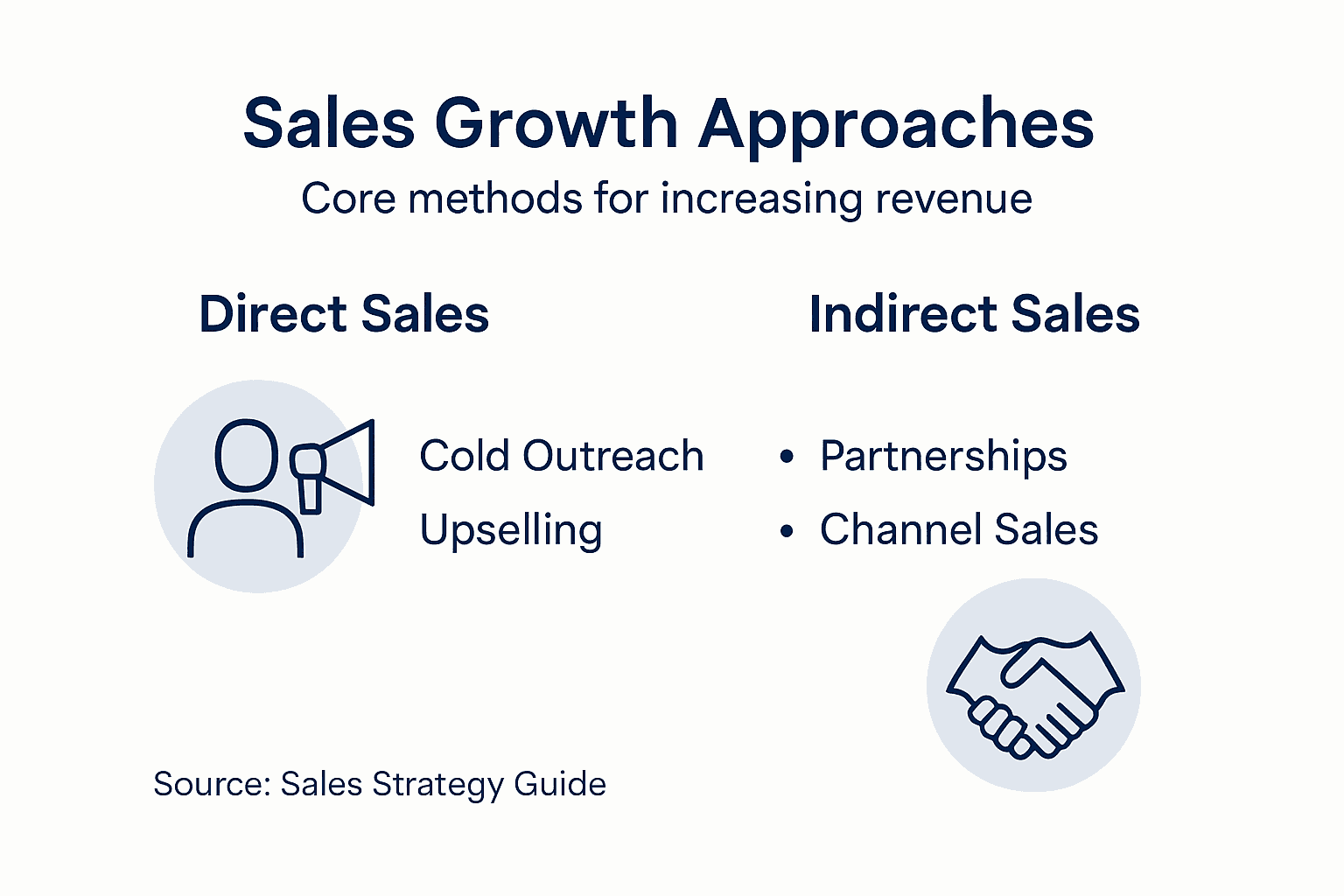
Sales organisations can pursue multiple strategic approaches to drive revenue expansion, each with distinct methodologies and potential outcomes. Sales growth strategies fundamentally divide into two primary categories: organic and inorganic growth approaches. Organic growth focuses on expanding existing business activities through enhanced sales techniques, while inorganic growth involves more complex interventions like mergers, acquisitions, and strategic partnerships.
The main types of sales growth approaches can be contrasted as follows:
| Approach Type | Key Focus | Typical Methods | Main Outcome |
|---|---|---|---|
| Organic Growth | Internal business expansion | Improved selling, new products | Gradual, sustainable growth |
| Inorganic Growth | External interventions | Mergers, acquisitions, partnerships | Rapid, large-scale expansion |
Within sales methodologies, professionals can leverage different engagement models tailored to specific market contexts. Sales approaches include consultative selling, which emphasises relationship-building and deep customer understanding, transactional selling for rapid deal closures, and solution selling that prioritises solving specific customer challenges. Each approach requires distinct skills, communication strategies, and performance metrics to effectively drive revenue growth.
Comprehensive sales growth strategies typically integrate multiple approaches. This might involve combining targeted customer acquisition, market segmentation, technological innovation, and advanced data analytics. Successful implementation requires continuous adaptation, robust performance tracking, and a willingness to experiment with different methodological combinations. Modern sales teams increasingly rely on sophisticated customer relationship management tools, predictive analytics, and personalised engagement strategies to differentiate themselves in competitive markets.
Pro tip: Regularly assess and blend different sales approaches, tracking key performance indicators to identify which strategies deliver the most consistent and scalable revenue growth for your specific business context.
Key Elements For Sustainable Revenue Increase
Sustainable revenue growth demands a multifaceted approach that goes beyond traditional sales tactics. Revenue diversification strategies are fundamental, requiring businesses to spread income streams across different products, services, customer segments, and geographical markets. This approach reduces organisational vulnerability by minimising dependence on single revenue sources and enhancing economic resilience.

Modern organisations must also integrate strategic considerations that extend beyond pure financial metrics. Growth and sustainability research indicates that companies achieving long-term success align their growth strategies with environmental, social, and governance (ESG) priorities. This holistic approach involves making bold strategic decisions, understanding evolving market dynamics, and creating value propositions that resonate with increasingly conscientious customers and stakeholders.
Successful revenue increase requires a dynamic, adaptive framework. Key elements include robust market research, continuous performance tracking, agile pricing strategies, and leveraging advanced analytics to predict and respond to market shifts. Companies must develop sophisticated forecasting models, invest in technological capabilities that enhance customer insights, and maintain flexibility to pivot strategies rapidly in response to emerging opportunities and potential disruptions.
Pro tip: Conduct quarterly comprehensive reviews of your revenue streams, systematically identifying potential diversification opportunities and assessing the performance of existing income channels to maintain sustainable growth momentum.
Implementing Data-Driven Sales Decisions
Data-driven decision making represents a transformative approach for sales organisations seeking to optimise performance and reduce uncertainty. This methodology moves beyond traditional intuition-based strategies, leveraging comprehensive data analysis to generate precise insights, personalise customer experiences, and drive sustainable revenue growth. By systematically collecting and interpreting data from multiple sources such as customer feedback, market trends, and financial reports, businesses can make more informed and strategic sales decisions.
Successful implementation requires establishing robust data collection and analysis frameworks. Sales teams must invest in advanced analytics technologies that enable real-time performance tracking, predictive modelling, and comprehensive customer segmentation. This involves integrating sophisticated customer relationship management systems, implementing advanced statistical analysis tools, and developing cross-functional data literacy across sales, marketing, and strategic planning teams to ensure a holistic understanding of performance metrics.
The most effective data-driven sales strategies go beyond mere number crunching. They require creating a culture of continuous learning and adaptation, where data insights are regularly translated into actionable strategies. This means developing agile decision-making processes that can quickly respond to emerging market trends, customer preferences, and competitive dynamics. Sales leaders must foster an environment that encourages experimentation, values evidence-based insights, and maintains the flexibility to pivot strategies based on empirical evidence.
Pro tip: Establish a quarterly data review process that systematically evaluates key performance indicators, customer engagement metrics, and market trends to continuously refine and optimise your sales approach.
Common Pitfalls In Sales Growth Initiatives
Business development strategies often fail due to fundamental misconceptions about growth mechanisms. Many organisations inadvertently undermine their sales potential by treating sales compensation as a mere expense, resisting necessary organisational changes, and confusing operational activity with meaningful progress. These systemic errors can create substantial barriers to sustainable revenue expansion, preventing teams from realising their true growth potential.
Technology implementation presents another critical area of potential failure. Simply investing in sophisticated sales tools does not guarantee improved performance. Successful sales transformations require a holistic approach that integrates technology with comprehensive change management, practical training, and a deep understanding of actual buyer engagement needs. Without carefully aligning technological solutions with real-world sales workflows and team capabilities, organisations risk creating complex systems that ultimately reduce rather than enhance productivity.
Perhaps the most significant pitfall is neglecting the human element in sales growth initiatives. Many organisations focus excessively on quantitative metrics and technological solutions while overlooking the importance of continuous learning, skill development, and creating a culture that supports innovative sales approaches. This narrow perspective can lead to demotivated sales teams, high turnover rates, and a fundamental misalignment between strategic objectives and front-line execution.
Below is a summary of frequent pitfalls and corrective actions for sales growth initiatives:
| Pitfall Area | Common Mistake | Corrective Action |
|---|---|---|
| Misaligned Priorities | Overemphasising activity over meaningful progress | Focus on value-adding activities |
| Technology Integration | Implementing tools without proper alignment | Match technology to sales workflows |
| Team Engagement | Ignoring people development and motivation | Invest in skills and supportive culture |
Pro tip: Conduct regular diagnostic assessments of your sales strategy, identifying potential blind spots and creating adaptive mechanisms that allow for rapid recalibration of growth approaches.
Drive Meaningful Sales Growth with Expert Guidance
The journey to accelerating revenue and implementing robust sales growth strategies can be complex without personalised support. This article highlights key challenges such as aligning sales approaches, integrating technology effectively, and sustaining revenue growth through data-driven decisions. If you find yourself struggling to translate these insights into consistent sales targets and scalable growth, a tailored coaching programme could be the missing link. At Ahead of Sales, we understand how vital it is to blend bespoke 1:1 coaching with proven strategic frameworks that address your unique business context.
Explore how our comprehensive packages are designed for businesses with growth mindsets aiming for at least 50% annual sales growth. Whether you lead a sizeable sales team or run a solo service venture, our Sales Strategy Archives – Ahead of Sales provide valuable insights while our practical training ensures your team hits their targets every quarter. Ready to transform your sales outcomes? Visit Ahead of Sales now to start accelerating your revenue with a proven partner and discover more in our Sales Playbook Archives – Ahead of Sales. Your next growth breakthrough is just a step away.
Frequently Asked Questions
What are sales growth strategies?
Sales growth strategies are systematic approaches that businesses use to increase revenue, expand market presence, and drive sustainable development. They encompass various components such as market segmentation, targeted customer acquisition, and product positioning.
How can technology enhance sales growth strategies?
Technology enhances sales growth strategies by enabling more precise targeting, efficient lead qualification, and improved conversion processes. Tools like artificial intelligence and customer relationship management systems provide real-time data and insights that help personalise customer engagement.
What are the key elements of a sustainable revenue increase?
Key elements for sustainable revenue increase include revenue diversification, robust market research, continuous performance tracking, and agile pricing strategies. Companies must adapt to market shifts and align their strategies with environmental, social, and governance priorities.
What are common pitfalls in sales growth initiatives?
Common pitfalls in sales growth initiatives include misaligned priorities, neglecting the human element in sales strategies, and technology integration issues. To avoid these, organisations should focus on value-adding activities, invest in skills development, and ensure that technology aligns with real-world sales processes.
Recommended
- How to Accelerate Revenue Growth: Step-by-Step Guide
- Sales Acceleration Packages: Driving Exponential Growth
- Sales Strategy Explained: Comprehensive Growth Blueprint – Ahead of Sales
- 7 Proven Sales Acceleration Strategies for Rapid Growth – Ahead of Sales
- How to Increase Employee Productivity for Business Growth – Tariq Juneja