
The consultative selling process starts the moment a genuine customer need, problem, or ambition is identified, whether that’s a brand-new prospect telling you something’s broken or an existing account letting slip that their current setup isn’t cutting it any more. That’s the trigger. Everything before it is prospecting. Everything after it is discovery.
I’ve coached hundreds of sales teams on this exact question, and the confusion almost always comes from the same place: people think consultative selling is a style, so they assume it starts whenever they choose to “be consultative.” It doesn’t work that way. The process itself has a starting gun, and it fires the instant a real need surfaces, not when you decide to sound helpful.
Frameworks like SPIN Selling and the Challenger Sale both build on this same premise: value gets created by understanding a problem before proposing anything to solve it. At Aheadofsales, we teach the same principle to every team we work with, because reps who wait for the real trigger close more deals than reps who pitch on instinct.
The common triggers you’ll actually see in the field:
- A prospect states a specific problem, frustration, or ambition, unprompted or in answer to a light question.
- An existing customer raises a gap between what they have and what they now need.
- You observe an external change signal: new hire, new funding round, a system migration, a regulatory shift.
- The buyer explicitly says they want to change something, even vaguely (“we’re rethinking how we do X”).
- A formal RFP or procurement request lands, though this is usually a late signal, not the true starting point.
Miss that first four and wait for the fifth, and you’ve already lost the advisor position to whoever spotted the earlier signal.
Table of Contents
- The consultative selling process explained: what it is and why the start matters
- What triggers mark the true start of consultative selling?
- The consultative selling process: stage by stage once it’s begun
- Your first-interaction starter kit: what to actually do
- Mistakes that stop consultative selling from ever starting
- Why recognising the start changes everything that follows
- Key takeaways: when consultative selling starts and what to do next
- Sources
The consultative selling process explained: what it is and why the start matters
Consultative selling is a customer-centred posture built around one sequence: understand first, recommend second. Salesforce’s own guiding principles describe it as prioritising the customer’s needs and building trust and value before a solution ever gets mentioned. That ordering is the entire discipline. Get it backwards and you’re not doing consultative selling, you’re doing transactional selling with better manners.
The distinction matters because transactional and consultative approaches optimise for completely different things.
| Element | Transactional selling | Consultative selling |
|---|---|---|
| Primary goal | Close the immediate sale | Solve the underlying problem |
| Tempo | Fast, script-driven | Slower, diagnostic |
| Evidence of success | Deal closed | Correct fit confirmed before proposal |
| Buyer experience | Sold to | Advised by someone who understands them |
Lucidchart’s breakdown of the consultative model makes the same point from a different angle: the model works because it favours relational engagement over transactional acceleration. You’re not trying to get to “yes” quickly. You’re trying to get to the right yes, which sometimes takes longer and sometimes, surprisingly, takes far less time than a scripted pitch because the buyer never has to fight through irrelevant features.
Why does pinning down the exact start matter practically? Three reasons:
- Prioritisation. If you can’t name the trigger, you can’t tell a warm consultative opportunity from a cold prospecting lead, and your pipeline fills with the wrong kind of activity.
- Coaching. Managers can’t coach discovery quality if reps disagree on when discovery is even supposed to begin.
- Qualification. A deal without an identified need isn’t a qualified opportunity yet, no matter how many meetings are booked.
What triggers mark the true start of consultative selling?
Some triggers demand you drop everything and shift into discovery mode. Others are worth noting but don’t justify an immediate consultative push. Knowing which is which saves you from either wasting effort on noise or, worse, letting a real signal pass you by because it arrived quietly.
High-priority triggers, the ones that should switch you into consultative mode immediately:
- The prospect names a specific pain point on a call, in an email, or in a public post (“our onboarding takes six weeks and it’s costing us renewals”).
- An existing customer flags a gap during a check-in, even a throwaway comment like “we’re starting to outgrow this.”
- A visible change event hits your radar: new leadership hire, a funding announcement, a tech stack swap, a compliance deadline.
Lower-priority triggers, worth logging but not worth a full consultative sprint yet:
- General enthusiasm with no stated problem (“this looks interesting, tell me more”).
- Early-stage browsing behaviour with no direct contact.
- A formal RFP with no prior relationship. By the time procurement paperwork lands, the buyer has often already done their own diagnosis, and your room to shape the conversation has shrunk.
Here’s what this looks like in practice. A new prospect emails your team after downloading a resource, saying: “We’ve been managing this manually and it’s starting to break at our size.” That single sentence is your trigger. Nothing before it, not the download, not the email address, counted as the start of the consultative process.
Now the existing account version: a client you’ve worked with for eighteen months mentions on a routine call that their team lead just left and they’re worried about continuity. That’s also a trigger, arguably a stronger one, because you already have context and trust. ToolsHero’s explainer on consultative selling puts it plainly: the process begins when a customer’s needs are identified, and identification should be diagnostic rather than a long interrogation. You don’t need twenty questions to confirm a trigger is real. You usually need two or three well-aimed ones.

The consultative selling process: stage by stage once it’s begun
Once the trigger fires, the consultative selling framework runs through a fairly consistent sequence. HubSpot’s model for consultative sales maps closely to the buyer’s own journey, and it’s the structure we use as a baseline when training teams at Aheadofsales, adapted to each business’s actual sales cycle.
-
Target and qualify. Confirm the account or contact fits your ideal profile before investing further time. Outcome: a shortlist of accounts worth researching properly. Cue to progress: you’ve confirmed budget authority or influence exists somewhere in the account.
-
Research and prepare. Gather account context, recent news, and likely pain points before any live conversation happens. Outcome: a working hypothesis about their probable problem. Cue to progress: you have at least one specific, testable guess, not a generic assumption.
-
Discovery: ask and listen. This is where consultative selling earns its name. Rather than opening with basic situation questions, you test your hypothesis with sharper, more personalised ones. Outcome: a confirmed or corrected understanding of the real problem. Cue to progress: the buyer has volunteered specifics, numbers, timelines, or named consequences.
-
Diagnose and frame. Synthesise what you’ve heard into a clear problem statement the buyer recognises as accurate. Outcome: buyer agreement that you’ve understood their situation correctly. Cue to progress: they nod along or add detail rather than correct you.
-
Solution alignment. Map the diagnosed problem to specific capabilities, not a generic feature list. Outcome: a solution shape that visibly answers the stated problem. Cue to progress: the buyer asks how it would work for their specific case.
-
Present and follow up. Show the tailored solution, then check understanding rather than pushing straight to close. Outcome: clarity on any remaining objections or gaps. Cue to progress: objections are practical (timing, budget) rather than fundamental (wrong fit).
-
Negotiate and close. With the diagnosis and fit already agreed, this stage becomes largely logistical. Outcome: signed agreement. Cue to progress: terms are settled.
-
Implement and expand. Delivery, onboarding, and watching for the next trigger inside the same account. Outcome: a satisfied customer and the seeds of the next consultative cycle.
Discovery is the stage that separates this model from a transactional one. HubSpot’s guide to consultative discovery is explicit that thorough research beforehand lets you arrive with a hypothesis, which changes the entire tone of the conversation. You’re not filling in a form. You’re testing an idea, out loud, with someone who can tell you if you’re right.
Your first-interaction starter kit: what to actually do
Recognising a trigger is only useful if you know what to do in the next ten minutes. Here’s a practical sequence for your first consultative interaction, whether that’s a discovery call, an email reply, or an in-person conversation.
Pre-call research checklist, in priority order:
- Check for the specific signal that triggered this opportunity (what did they actually say or do?).
- Review any prior contact history if this is an existing account.
- Scan for one recent public signal (funding, hiring, a leadership change, an industry shift affecting them).
- Form one testable hypothesis about their likely problem, written down in a single sentence.
- Draft two or three open questions that would confirm or disprove that hypothesis.
Revenue backs this up directly: the process genuinely starts before the first live conversation, when reps gather buying signals so that discovery questions test something rather than fish for basic facts.
Sample discovery questions, grouped by what you’re trying to surface:
- To surface the pain: “What’s prompting you to look at this now, rather than six months ago?”
- To surface the pain: “Walk me through what happens when this problem shows up in a normal week.”
- To probe impact: “What does that cost you, in time, money, or people, when it goes wrong?”
- To probe impact: “Who else in the business feels this, beyond you?”
- To test urgency: “If nothing changes in the next quarter, what happens?”
- To test urgency: “Is there a deadline or event forcing a decision here?”
A short discovery script snippet might open like this: “Before we get into anything, I did a bit of digging and it looks like [specific signal]. I wanted to check, is that actually connected to what’s driving this conversation, or is something else going on?” That single line does more work than an hour of generic rapport-building, because it proves you did the research and invites correction rather than assuming you already know.
A simple diagnostic mapping template helps you keep discovery honest:
| Stated pain | Consequence if unresolved | Solution fit |
|---|---|---|
| Manual process breaking at scale | Missed renewals, staff burnout | Automated workflow component |
| New leader, no continuity plan | Knowledge loss, stalled projects | Structured handover support |
Pro Tip: Walk into every first call with a written hypothesis, not just a list of situation questions. Asking “what’s your current process?” from a blank slate reads as generic; asking “I noticed you’ve just brought on a new ops hire, is that connected to rethinking your current process?” reads as informed. The second version is the one that gets a real answer.
For teams that want this built into daily habits rather than treated as one-off advice, our piece on consultative selling techniques for real revenue growth goes deeper into the specific behaviours worth coaching for.
Mistakes that stop consultative selling from ever starting
Most reps who struggle with consultative selling aren’t lacking talent, they’re making one of a small handful of avoidable mistakes that quietly kill the process before it begins.
- Poor preparation. Turning up without a hypothesis means every question sounds generic, and generic questions signal “vendor,” not “advisor.” Quick fix: spend ten minutes forming one specific guess before any call.
- Asking closed questions. “Are you happy with your current provider?” invites a one-word answer and kills momentum. Quick fix: rephrase as “what would need to change for you to feel differently about your current provider?”
- Pitching before diagnosing. This is the single most common failure. A rep hears one keyword and jumps straight to features. Quick fix: physically hold back your solution for at least three exchanges after the trigger surfaces.
- Overloading with features. Once you do present, listing capabilities the buyer didn’t ask about buries the one that actually matters. Quick fix: map every feature you mention back to a pain they specifically named.
- Ignoring buying signals. Urgency cues (a deadline, a budget window, a competitor mentioned) get missed because the rep is following a script instead of listening. Quick fix: keep a visible note pad during calls specifically for “things they said that suggest urgency.”
MindTools’ breakdown of consultative selling flags these same failure points, and notes each one has a genuinely coachable correction, none of them require a personality change, just a different habit.
If you catch yourself mid-pitch and realise you jumped too early, the recovery is simpler than it feels: stop, acknowledge it directly (“actually, let me back up, I want to make sure I understand the problem properly first”), and ask one sharp diagnostic question. Buyers respect the correction far more than they’d respect a rep who barrels on regardless.
Why recognising the start changes everything that follows
The gap between reps who close consistently and reps who don’t usually isn’t skill in the room. It’s what they did in the ten minutes before the room existed.
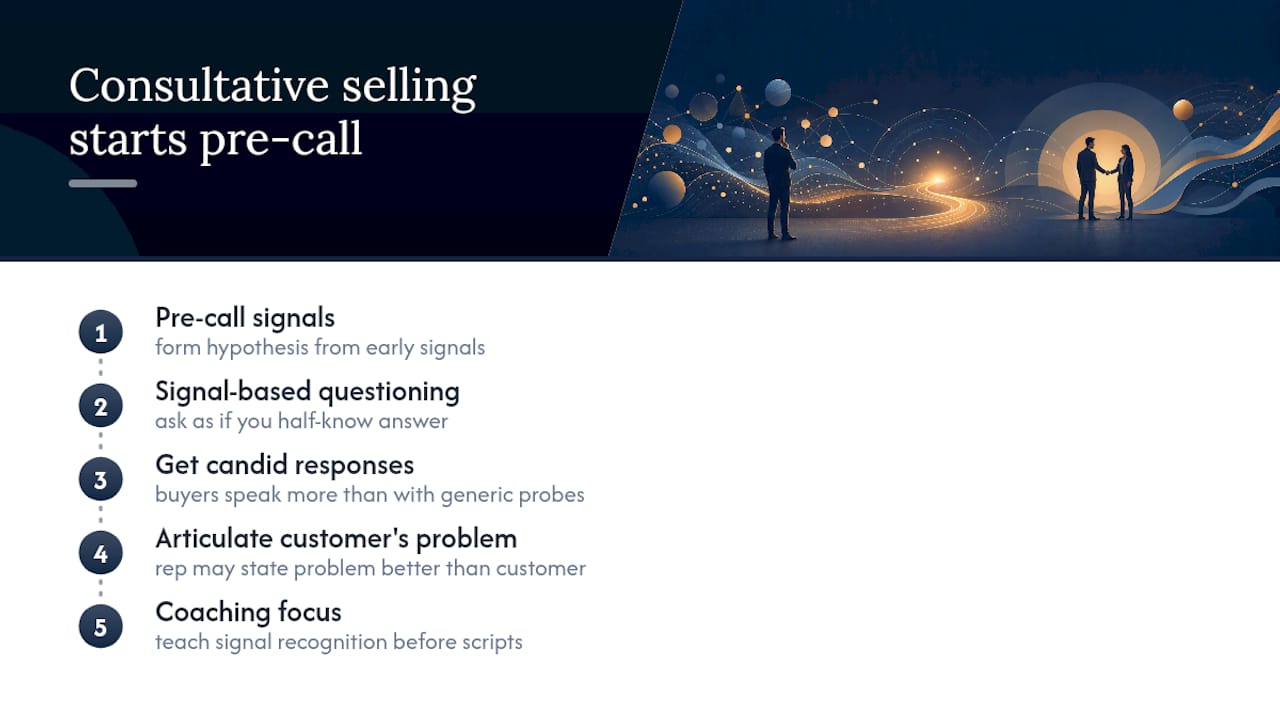
I’ve watched enough discovery calls to notice a pattern: reps who walk in with a specific, signal-based hypothesis ask questions that sound like they already half-know the answer, and buyers respond to that with far more candour than they give a generic interrogation. It changes the entire texture of the conversation. One analysis of consultative frameworks puts it well: high-performing reps often end up able to articulate a customer’s problem better than the customer can themselves. That’s not a party trick. It’s what happens when preparation and real listening compound.
The uncomfortable truth is that most “consultative selling training” fails because it teaches question lists without teaching reps to recognise the trigger in the first place. You can hand someone the perfect script and it won’t matter if they can’t tell a genuine signal from small talk. That recognition skill is exactly what we build into coaching at Aheadofsales, because it’s the difference between a rep who talks about being consultative and one who actually practises it, deal after deal. If your team’s discovery calls feel more like interviews than conversations, that’s usually the first thing worth fixing, and it’s the starting point for most of our sales training services.
Key takeaways: when consultative selling starts and what to do next
The consultative selling process starts when a genuine need or problem is identified, not when a rep decides to sound helpful, and everything that follows depends on recognising that moment accurately.
| Point | Details |
|---|---|
| The start trigger | A stated problem, an observed change signal, or an explicit desire to change, for new or existing accounts. |
| First action | Research the signal and form a written hypothesis before the first live conversation. |
| Discovery style | Ask hypothesis-testing questions, not generic situation questions, to surface pain, impact, and urgency. |
| Progress cue | Move from discovery to proposing once the buyer confirms your problem framing without correcting it. |
| Biggest failure mode | Pitching before diagnosis; recoverable by pausing and asking one sharp diagnostic question. |
This week’s practice step: pick three active opportunities in your pipeline and map each one against the trigger checklist above. If you can’t name the specific signal that started the deal, you’ve found your next coaching conversation. For a structured walkthrough of the full sequence, our guide to consultative selling step by step for revenue growth covers the stages in more depth, and if you’d rather have someone build this into your team’s habits directly, explore our sales training for teams and solo operators.
Sources
- What Is Consultative Sales? 5 guiding principles | Salesforce
- The 6 elements of a truly consultative sales process | HubSpot
- The consultative selling process | Lucidchart
- Revenue