
TL;DR:
- A business growth strategy is a detailed plan that guides a company’s expansion over 12 to 36 months. It combines frameworks, prioritization tools, and disciplined execution to achieve measurable, sustainable growth. Successful strategies focus on sequencing growth levers, improving retention, and maintaining continuous, focused iteration.
A business growth strategy is a structured plan that defines how a company expands its revenue, market position, and operational capability to achieve repeatable, measurable growth. Unlike a traditional business plan focused on static financials, a growth plan is a 12–36 month operational roadmap that translates ambition into concrete, sequenced actions. The most effective business growth strategy combines three elements: a clear framework for prioritising opportunities, disciplined execution, and a feedback loop that improves performance over time. This guide covers the frameworks, prioritisation tools, practical tactics, and common pitfalls that every business owner needs to build a plan that actually works.
What are the foundational frameworks for business growth strategy?
The right growth strategy framework determines which opportunities you pursue and in what order. Three frameworks dominate serious strategic planning for growth in 2026: the McKinsey Growth Pyramid, the BDA BoCK model, and the Three-Horizon Model.
The McKinsey Growth Pyramid
The McKinsey Growth Pyramid organises seven growth options across three tiers, requiring sequential progression from operational excellence through to new products and markets. Tier one covers operational skills: the efficiency and quality of what you already do. Tier two covers privileged assets: your brand, customer relationships, and proprietary data. Tier three covers new markets and products: the highest risk, highest reward moves. The pyramid’s core logic is that you cannot sustain tier-three growth without first securing tiers one and two.
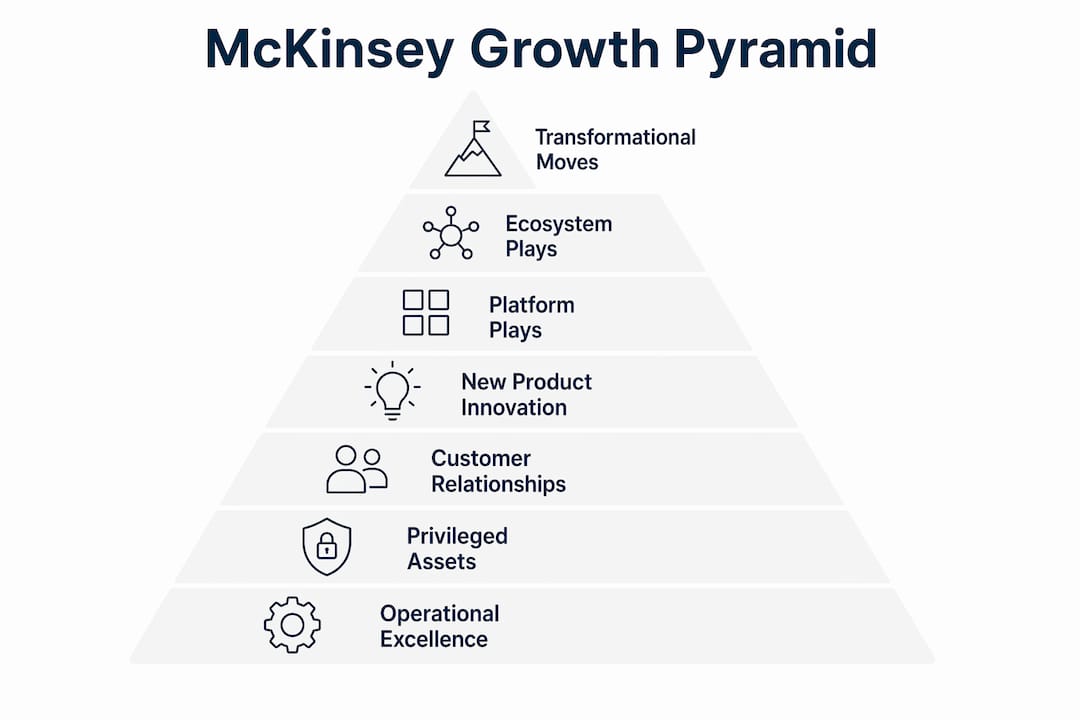
The BDA BoCK model and Three-Horizon thinking
The BDA BoCK framework draws a sharp distinction between growth targets and growth strategy. A target is a number. A strategy is a structured execution plan built on genuine business development capability. Without that capability, targets consistently underperform. The Three-Horizon Model complements this by allocating resources across three time horizons: defending and extending the core business, building emerging opportunities, and seeding future options. Used together, these frameworks prevent the common trap of chasing new markets before the core business is solid.
Four primary growth levers for B2B businesses
Most B2B growth comes from four levers, each with a distinct risk and resource profile.
- Market penetration: Selling more to existing customers in existing markets. Lowest risk, fastest return.
- Market development: Taking existing products into new segments or geographies. Moderate risk, requires sales and marketing investment.
- Product development: Creating new offerings for existing customers. Moderate risk, requires R&D or service design capability.
- Diversification: New products for new markets. Highest risk, requires significant capital and operational readiness.
| Growth lever | Risk level | Resource demand | Time to return |
|---|---|---|---|
| Market penetration | Low | Low to medium | Short (0–12 months) |
| Market development | Medium | Medium | Medium (6–18 months) |
| Product development | Medium | Medium to high | Medium (12–24 months) |
| Diversification | High | High | Long (18+ months) |
Pro Tip: Start every strategic planning session by auditing your current operational capability before selecting a growth lever. Choosing the wrong tier for your current maturity is the single most common cause of wasted growth spend.
How to prioritise and sequence business growth initiatives?
Prioritisation separates businesses that grow from those that stay busy. The goal is to identify the highest leverage moves and sequence them so each one builds on the last.
Running a capability and asset audit
Before selecting any growth initiative, map what you already have. List your top ten customers and identify what they value most. Catalogue your sales process, conversion rates at each funnel stage, and your team’s core skills. This audit reveals where you are genuinely strong and where gaps exist. Growth initiatives that build on existing strengths deliver faster returns than those that require building capability from scratch.
Using ICE scoring to rank initiatives
ICE scoring prioritises growth experiments by rating each one on Impact, Confidence, and Ease, then averaging the three scores. A campaign that scores 8 on impact, 7 on confidence, and 9 on ease (average: 8.0) beats one scoring 9, 4, and 3 (average: 5.3), even though the second has higher theoretical impact. ICE scoring forces you to favour quick wins that generate learning, rather than betting everything on a single high-risk initiative.
Here is a practical sequencing approach for most owner-managed businesses:
- Audit current operations and identify the weakest funnel stage.
- Score all candidate initiatives using ICE.
- Select the top two or three initiatives and assign clear owners and deadlines.
- Run each initiative for four to six weeks, measure results, and iterate.
- Only add a new growth lever once the current one is producing consistent results.
| Prioritisation method | Best used for | Key advantage |
|---|---|---|
| ICE scoring | Experiment selection | Fast, objective ranking |
| Capability audit | Lever selection | Matches moves to real strengths |
| Three-Horizon allocation | Budget planning | Balances short and long-term |
| Funnel stage analysis | Tactical optimisation | Identifies highest leverage fix |
Pro Tip: Run your ICE scoring as a team exercise, not a solo task. Different perspectives on “ease” and “confidence” surface assumptions you would otherwise miss, and the discussion itself often reveals better options.
What practical tactics accelerate sustainable growth?
Effective growth techniques follow the AARRR framework: Acquisition, Activation, Retention, Revenue, and Referral. Each stage requires different tactics and different metrics.
Acquisition and activation
Concentrating budget on your highest performing acquisition channel delivers 40–60% pipeline growth compared to spreading resources across multiple channels. That finding is counterintuitive for most business owners, who instinctively want to diversify. Pick the channel where your cost per qualified lead is lowest and your close rate is highest, then go deep before going wide.

Activation is the stage most businesses ignore. The activation stage is a new customer’s first meaningful success with your product or service. If that experience fails, acquisition spend is wasted. Map the first 30 days of a new client’s experience and identify the moment they first get clear value. Then engineer every step to reach that moment faster.
AI-driven discovery channels are also worth serious attention. Conversion rates from AI platform traffic are approximately five times higher than from traditional organic search. Understanding AI-driven search visibility is now a genuine acquisition lever, not a future consideration.
Retention, revenue, and referral
Improving Net Revenue Retention from 90% to 110% has greater impact on total revenue than doubling new lead volume. That is the single most important retention insight in B2B growth. NRR above 100% means your existing customers are spending more over time, which compounds without additional acquisition cost. Read more about what NRR means in practice and how to track it.
Growth loops outperform linear funnels because outputs feed inputs, creating compounding expansion. A referral programme where satisfied clients introduce new prospects is a growth loop. A content strategy where published articles generate inbound leads, which become case studies, which generate more articles, is a growth loop. Build at least one loop into your growth plan and measure its compounding effect quarterly.
Pro Tip: Track your sales funnel performance weekly, not monthly. Weekly visibility means you catch activation and retention problems within days, not after a quarter of wasted spend.
What are the most common pitfalls in business growth strategy?
Most growth failures follow a predictable pattern. Recognising these mistakes before you make them saves significant time and money.
-
Skipping operational excellence. Companies frequently fail by pursuing tier-three growth options before securing operational excellence. Acquiring new customers into a broken delivery process accelerates churn, not growth.
-
Confusing targets with strategy. Setting targets without structured business development capability is a consistent cause of underperformance. “Grow revenue by 30%” is a target. The plan for how your team will generate, convert, and retain that revenue is the strategy.
-
Spreading resources too thin. Chasing three or four growth levers simultaneously dilutes focus and produces mediocre results across all of them. Pick one lever, execute it well, and expand only when it is working.
-
Ignoring activation and retention metrics. Iterating on the weakest funnel stage weekly beats unfocused resource spread across many stages. Most businesses over-invest in acquisition and under-invest in the stages that determine whether acquired customers stay and grow.
-
Treating growth as a one-time plan. A growth strategy is a living document. Markets shift, customer needs change, and what worked in Q1 may not work in Q3. Build a monthly review cadence into your plan from day one.
“Growth strategy is not about doing more things. It is about doing the right things in the right order, with the discipline to stop doing what is not working.”
Pro Tip: Before adding a new growth initiative, ask whether your current weakest funnel stage has been fixed. If it has not, the new initiative will leak value through the same hole.
Key takeaways
A business growth strategy succeeds when it sequences the right growth levers in the right order, prioritises retention over acquisition volume, and iterates weekly on the weakest funnel stage.
| Point | Details |
|---|---|
| Framework first | Use the McKinsey Growth Pyramid to sequence growth moves from operational excellence outward. |
| Prioritise with ICE | Score initiatives by Impact, Confidence, and Ease to focus resources on quick, high-confidence wins. |
| Retention beats acquisition | Improving NRR from 90% to 110% outperforms doubling new lead volume in B2B growth. |
| One channel, deep focus | Concentrating budget on your best acquisition channel delivers 40–60% more pipeline than spreading spend. |
| Fix activation first | Optimise the first meaningful customer experience before scaling any acquisition spend. |
What I have learned about building growth strategies that actually work
After working with dozens of businesses across sectors, the pattern I see most often is this: owners set ambitious revenue targets and then immediately ask “how do we get more leads?” That is almost always the wrong question. The right question is “where is our biggest leak?”
I have seen businesses triple their revenue without a single new marketing channel, simply by fixing their onboarding process and following up with lapsed clients. The McKinsey pyramid is right: operational excellence is not a prerequisite you complete once. It is a discipline you maintain continuously, and it is where the highest leverage improvements almost always live.
On AI: I am genuinely excited about what AI-driven discovery channels can do for acquisition efficiency, but I caution against treating it as a shortcut. The businesses getting the best results from AI search visibility are the ones who already have strong content and clear positioning. AI amplifies what is already working. It does not fix what is broken.
The growth plans I have seen succeed share one trait: they are boring in the best possible way. Weekly funnel reviews, monthly strategy check-ins, quarterly lever assessments. No dramatic pivots, no shiny new tactics every month. Just disciplined iteration on a clear plan. That is what 50% year-on-year growth actually looks like from the inside.
— Jerry
How Aheadofsales supports your growth strategy execution
Building a growth strategy is one thing. Executing it through your sales team is another challenge entirely.

Aheadofsales combines bespoke 1:1 coaching with structured sales training and consultancy to help businesses generate at least 50% sales growth every year, with sales teams hitting target every quarter. Whether you need to diagnose a conversion problem, build a repeatable pipeline process, or accelerate revenue through a structured sales acceleration package, Aheadofsales works directly with your team to close the gap between your growth plan and your actual results. Packages start from £4,500 for teams of 50 to 1,000 staff, with solo operator packages from £2,995.
FAQ
What is a business growth strategy?
A business growth strategy is a structured plan that defines how a company will expand its revenue, market position, and operational capability over a defined period, typically 12–36 months. It differs from a growth target by specifying the execution steps, not just the numerical goal.
What is the McKinsey Growth Pyramid?
The McKinsey Growth Pyramid organises seven growth options across three tiers: operational excellence, privileged assets, and new markets or products. It requires businesses to progress sequentially, securing each tier before moving to the next.
How does ICE scoring work in growth planning?
ICE scoring rates each growth initiative on Impact, Confidence, and Ease, then averages the three scores to produce a priority ranking. Higher scores indicate initiatives that are likely to deliver results quickly and with available resources.
Why does retention matter more than acquisition in B2B growth?
Improving Net Revenue Retention from 90% to 110% delivers greater total revenue impact than doubling new lead volume. Existing customers who spend more over time compound revenue without additional acquisition cost.
What is the biggest mistake businesses make with growth strategy?
The most common mistake is confusing growth targets with growth strategy. Setting a revenue number without a structured plan for how the sales team will generate, convert, and retain that revenue consistently produces underperformance.