
TL;DR:
- A sales operations manager optimizes sales performance by managing systems, processes, and analytics for consistent revenue. Their role improves team efficiency, forecast accuracy, and pipeline management, which significantly impacts revenue growth. Sales Ops focuses solely on the sales team, while RevOps covers marketing, sales, and customer success functions.
A sales operations manager is the professional who turns a sales team’s daily activity into a measurable, optimised revenue engine by owning the systems, processes, and analytics that drive consistent selling performance. Without this role, reps lose hours each week to admin, forecasts become guesswork, and leadership loses visibility into what is actually working. Mature sales operations functions generate 19% faster revenue growth, 15% higher win rates, and 23% better forecast accuracy than their peers. Those numbers tell you exactly what is at stake when the role is done well, and what you are leaving on the table when it is not.
What does a sales operations manager actually do?
A sales operations manager owns the infrastructure that makes selling possible at scale. The role sits at the intersection of data, process, and technology, and its scope is broader than most people realise.
The core responsibilities fall into five categories:
- CRM governance: Maintaining data hygiene, enforcing field completion standards, and managing integrations across the sales technology stack. CRM hygiene and pipeline rules are foundational tasks that transform selling from individual effort into an inspectable revenue system.
- Territory and quota design: Building territory models that distribute opportunity fairly, setting quotas that are stretching but achievable, and running capacity planning to ensure headcount matches growth targets.
- Sales process standards: Defining pipeline stage definitions, deal entry criteria, and handoff rules between teams so every rep works from the same playbook.
- Analytics and forecasting: Running pipeline reviews, building forecast models, and producing the reports that give leadership confidence in their revenue projections.
- AI and automation governance: Overseeing how sales AI tools and workflow automation are deployed, monitored, and adjusted within the sales process.
The role of a sales operations manager is not about doing the selling. It is about removing every obstacle that stops reps from selling at their best.
Pro Tip: When you first step into a sales operations role, map every tool in the tech stack and every manual process before you change anything. Changing systems before understanding workflows is the fastest route to losing credibility with the sales team.

How does a sales operations manager improve team performance?
The single biggest efficiency problem in most sales teams is time. Sales representatives spend only 28–40% of their working week on actual selling, with the rest lost to admin, CRM updates, and internal meetings. Top-performing teams push that figure above 45%. That gap is where a skilled sales operations specialist earns their salary.
Recovering selling time is only part of the picture. The other part is forecasting. When pipeline data is clean and stage definitions are consistent, leadership can predict revenue with confidence. When they cannot, the business either over-hires or under-invests, and both outcomes are expensive.
The metrics that measure operational success are specific:
- Sales cycle time: How long it takes a deal to move from first contact to close. Shorter cycles mean reps are spending time on the right deals.
- Win rate by stage: Where deals are being lost in the pipeline. This tells you whether the problem is qualification, proposal quality, or closing.
- CRM adoption rate: The percentage of reps logging activity consistently. Low adoption means your data is unreliable and your forecasts are fiction.
- Pipeline velocity: The speed at which revenue moves through the funnel. This single metric combines deal volume, average deal size, win rate, and cycle time into one number leadership can act on.
Shifting from volume-based reporting to outcome metrics like pipeline velocity and forecast accuracy is what separates a tactical sales ops function from a strategic one. The former produces reports. The latter drives decisions.
You can also look at the sales performance metrics checklist that Aheadofsales has published for a practical framework on tracking these numbers across your team.
Pro Tip: Do not wait for leadership to ask for better reporting. Build a single weekly pipeline health dashboard and share it proactively. That one habit builds more trust than any formal presentation.
What distinguishes a sales operations manager from a revenue operations manager?
This distinction matters more than most organisations realise. Sales Ops focuses exclusively on the sales team and typically reports to a VP of Sales or Chief Revenue Officer. Revenue Operations (RevOps) spans marketing, sales, and customer success, and reports higher in the organisation, often directly to the CRO or CEO.
The table below clarifies the key differences:
| Dimension | Sales operations manager | Revenue operations manager |
|---|---|---|
| Scope | Sales team only | Marketing, sales, and customer success |
| Reporting line | VP Sales or CRO | CRO or CEO |
| Data ownership | Sales pipeline and CRM | Full revenue data across all functions |
| Primary goal | Sales team efficiency | Cross-functional revenue alignment |
| Typical team size | 1–3 specialists | 4–12 across analytics, systems, and strategy |
Many companies mislabel Sales Ops as RevOps without granting the necessary authority or data access that RevOps requires. The result is operational confusion and underperformance. If your business has a single person managing CRM and quota design but calling it RevOps, you have a Sales Ops function, not a RevOps function. That is not a criticism. It is just accurate, and accuracy matters when you are designing your team.
As companies scale, a well-run Sales Ops function often becomes the foundation on which a full RevOps structure is built. The skills needed for sales operations, including data analysis, process design, and systems management, transfer directly into a broader RevOps remit.
What best practices help sales operations managers succeed in 2026?
The best sales operations managers are disciplined about how they start, how they measure, and how they scale. Here are the practices that separate high-impact operators from those who stay stuck in tactical reporting.
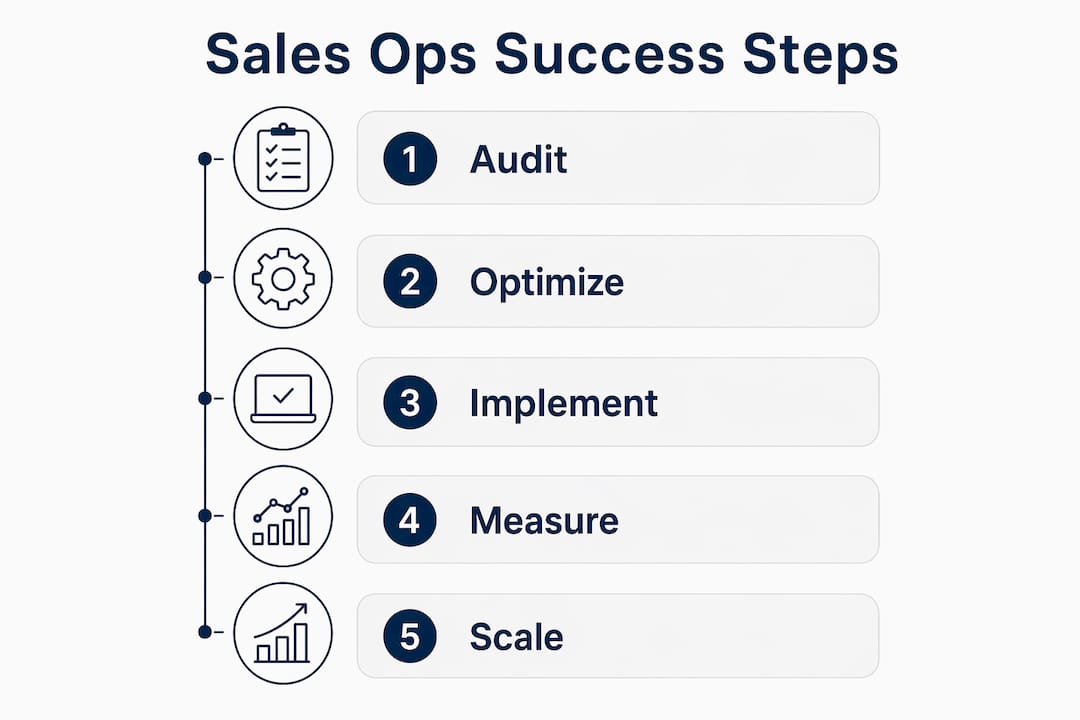
Start with a 30/60/90 day plan. Effective new Sales Ops managers spend the first 30 days auditing workflows and understanding how the team actually sells, not how the process document says they sell. By day 60, they deliver three quick wins, typically a cleaner dashboard, a fixed CRM field, or a simplified forecast template. By day 90, they establish a formal operating cadence: weekly pipeline reviews, monthly forecast calls, and quarterly process reviews. Rushing system changes before completing the audit is the most common reason new ops hires fail.
Right-size the function. A business with £30M+ in annual recurring revenue should have more than one person in operations. A $50M ARR SaaS company needs 8–12 operations professionals across analytics, enablement, systems, and strategy to run the revenue engine properly. Under-resourcing ops is a false economy. You save on headcount and lose it in forecast errors and rep inefficiency.
Treat data hygiene as a non-negotiable. B2B data decays at roughly 30% annually, meaning nearly a third of your CRM contacts become inaccurate within twelve months. High-performing teams prioritise data hygiene significantly more than underperformers. Automated enrichment tools that update contact records, flag duplicates, and enforce field completion are not optional extras in 2026. They are table stakes.
Measure outcomes, not activity. Revenue leaders expect Sales Ops managers to diagnose why metrics change, not just report that they have. If win rate drops, the ops manager should identify whether the cause is a new competitor, a change in rep behaviour, or a shift in deal mix. That diagnostic mindset is what creates strategic value. You can read more about outcome-driven performance measurement and how the same shift from activity to outcome metrics plays out across business functions.
- Automate CRM data enrichment to counter annual data decay
- Build a single source of truth for pipeline data that every stakeholder trusts
- Define pipeline stage exit criteria in writing, not just in conversation
- Review quota attainment distribution monthly, not just at quarter end
- Govern AI tools within the sales workflow with clear rules on what reps can and cannot automate
Pro Tip: The ‘Execution Gap’ is the difference between having a sales process and having reps actually follow it. Structured deal reviews are used by only 3% of sales teams, yet they are one of the most effective tools for closing that gap. Add a weekly structured deal review to your operating cadence and you will see quota attainment improve within a quarter.
Key takeaways
A sales operations manager delivers measurable revenue impact by owning the processes, data, and systems that allow sales teams to sell more and forecast accurately.
| Point | Details |
|---|---|
| Core responsibility | Manage CRM hygiene, territory design, quota setting, and pipeline analytics as a connected system. |
| Performance impact | Mature ops functions produce 19% faster revenue growth and 23% better forecast accuracy than peers. |
| Ops vs RevOps | Sales Ops serves the sales team only; RevOps spans marketing, sales, and customer success with broader authority. |
| Best practice entry | Use a 30/60/90 day plan to audit, deliver quick wins, and establish operating cadence before changing systems. |
| Data hygiene | B2B data decays at 30% annually; automated enrichment tools are required to maintain reliable pipeline data. |
Why most sales ops functions never reach their potential
I have worked with a lot of sales leaders who hired a sales operations manager and then wondered why nothing changed. The honest answer, almost every time, is that the role was set up to produce reports rather than to drive decisions. The manager was given a CRM login and a spreadsheet and told to “sort out the data.” That is not sales operations. That is data entry with a better job title.
The ops managers who genuinely move the needle are the ones who earn a seat in the forecast call, not because they were invited, but because leadership cannot run the meeting without their numbers. That trust is built through one thing: reliability. When your forecast is accurate three quarters in a row, people stop questioning your methodology and start acting on your recommendations.
The other pitfall I see regularly is premature scaling. A business with twelve reps does not need a full RevOps function. It needs one sharp sales operations specialist who can own the CRM, build a clean pipeline report, and set sensible quotas. Trying to build a cross-functional revenue operations team before you have a stable sales process is like fitting a turbocharger to an engine that has not had its oil changed.
The growing role of AI in sales workflows adds a new layer of complexity. Sales ops managers now need to govern which AI tools reps use, how those tools interact with CRM data, and what guardrails prevent automation from creating compliance or quality problems. That is a genuinely new skill set, and the managers who get ahead of it now will be the ones with the most influence in 2027.
If you are building or rebuilding a sales ops function, start with the foundation. Clean data, clear process, and a forecast you can defend. Everything else follows from that.
— Jerry
How Aheadofsales supports sales operations managers
Building a high-performing sales ops function is only half the equation. The other half is making sure your sales team has the skills to perform within the systems you build.

Aheadofsales combines bespoke 1:1 coaching with structured training and consultancy to help businesses achieve at least 50% sales growth each year and hit target every quarter. Whether you are a sales leader looking to sharpen your team’s execution or a sales operations specialist who needs the commercial side of the business to match the operational infrastructure you have built, the sales training services at Aheadofsales are designed to deliver measurable results. Packages start from £4,500 for teams of 50 to 1,000 staff. You can also explore the sales consultancy services for hands-on support with process design and team performance.
FAQ
What is a sales operations manager?
A sales operations manager is the professional responsible for managing the systems, processes, data, and analytics that enable a sales team to sell efficiently and forecast accurately. The role typically covers CRM governance, territory and quota design, pipeline management, and sales technology oversight.
How much does a sales operations manager earn in the UK?
Total compensation for sales operations managers ranges broadly depending on experience, company size, and technical skills. Stack proficiency in tools such as Salesforce or HubSpot can increase earning potential by 15–25% above base salary, with bonuses typically ranging from 8–25% of base pay.
What skills are needed for sales operations?
The core skills for sales operations include CRM administration, data analysis, sales process design, quota and territory modelling, and the ability to translate data into decisions that leadership can act on. Increasingly, AI governance and workflow automation are becoming required competencies.
When should a business hire a sales operations manager?
A business should hire a dedicated sales operations manager when forecast accuracy is consistently poor, reps are spending more time on admin than selling, or the sales process varies significantly between individuals. These are signs that the revenue engine needs structure, not just more headcount.
What is the difference between sales ops and RevOps?
Sales operations focuses exclusively on the sales team and reports to the VP of Sales or CRO. Revenue operations spans marketing, sales, and customer success with broader data authority and typically reports to the CRO or CEO. Sales Ops is often the foundation on which a full RevOps function is later built.